加密货币市场市值上涨,为什么大多数币还是表现不佳?

coinvoicePublished on 2024-09-19Last updated on 2024-09-19

撰文:@ysiu

翻译:白话区块链

加密市场总体上同比增长超过 2 万亿美元,而另类币集体上涨了 70%。那么,为什么许多近期推出的项目表现不佳呢?主要原因是注意力稀释,因为 2024 年推出了数百万种新 Token。

@pumpdotfun 单独负责了超过 200 万种 Memecoin 的推出,这极大地稀释了整体注意力。对于网络来说,机构参与变得比以往任何时候都更加关键,这一点在比特币 ETF 推出时得到了最好的体现。

Token 上市的增加是否表明现在注重数量而不是质量?

用户可能会对选择感到不知所措,从而导致 Coinbase 等平台上的活动减少。由于市场波动、监管问题或缺乏引人注目的用例,他们可能会感到疲劳或对新 Token 不感兴趣。
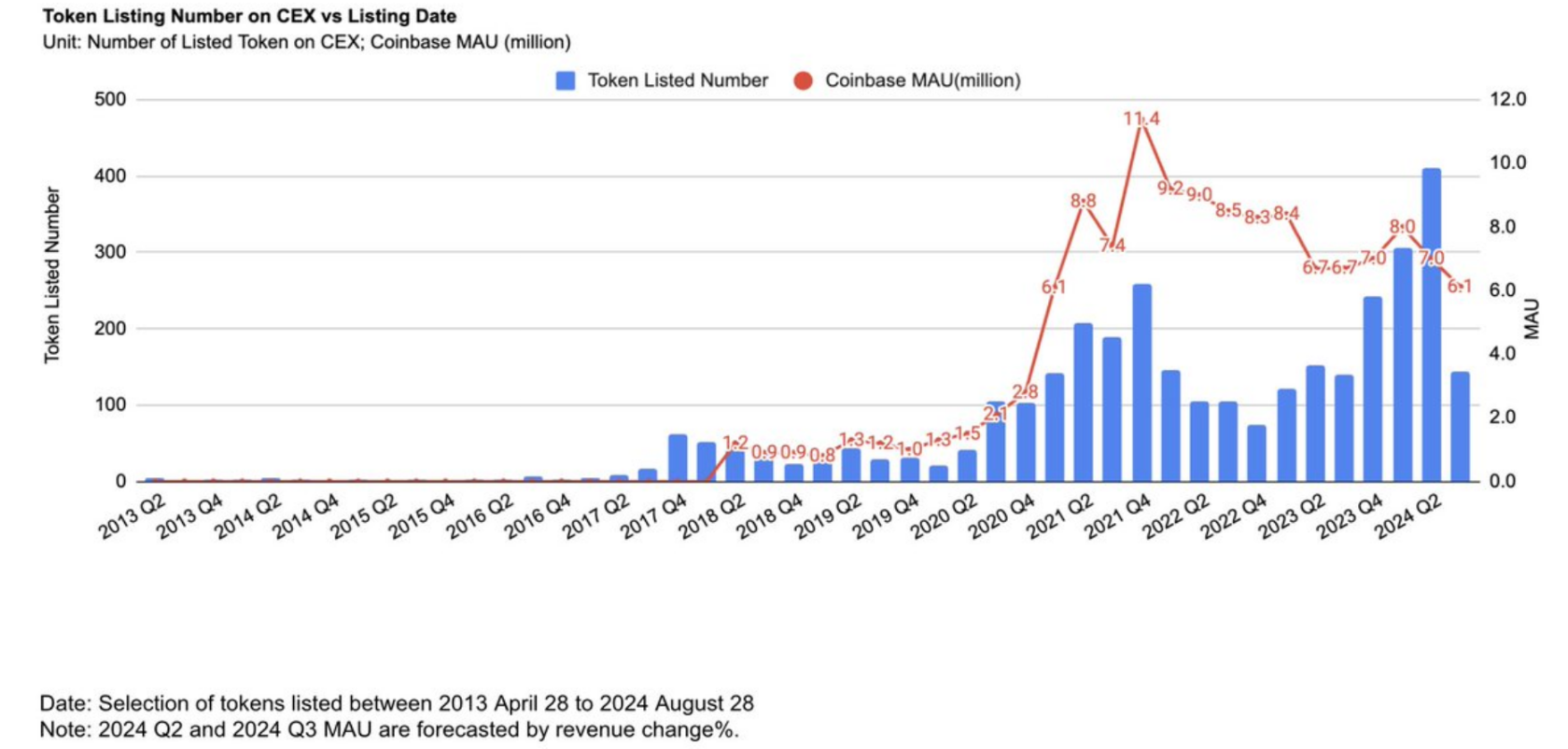
 

机构支持是 $MOCA、$SOL、$BNB 和 $TON 等 Token 表现较好的原因之一。正如 @blockchaingmg 所说,「来自 @animocabrands 的 MOCA Token 是唯一的亮点,自发行价格上涨了 51%。」

@animocabrands 现在将投资扩展到包括上市 Token,重点关注他们的投资组合。在这个竞争激烈的市场中,能吸引机构关注的 Web3 项目将更容易脱颖而出,从而部分缓解注意力稀释的问题。

各种观点已经被 @hosseeb 和其他专家详细分析,其中最受关注的原因之一是高 FDV。虽然有很多因素影响,但结论是这些问题并非根本性问题。

目前,另类币的推出速度远远超过了 Web3 网络参与者的增长,这与互联网泡沫时期的网站、留言板和聊天室的推出,或 2010-12 年间智能手机应用的推出类似。

与美国股市中约 80% 的机构参与不同,数字资产目前仅吸引了 5% 的机构资金,并且主要集中在比特币上,这意味着还有很大的增长空间。

虽然建立社区和扩展网络仍然非常重要,它们是项目产品和服务的核心,但在我看来,能吸引机构参与的项目在当前市场环境下会更具优势。


声明:本内容为作者独立观点,不代表 CoinVoice 立场,且不构成投资建议,请谨慎对待,如需报道或加入交流群,请联系微信:VOICE-V。

来源:白话区块链

Related Reads

Where Did China's Q1 AI Funding Exceeding 100 Billion RMB Go?

In Q1 2026, China's AI sector raised over 110 billion yuan (approximately $152 billion) across nearly 600 financing deals, a 185.4% year-on-year increase. Major recipients included large model companies and embodied AI firms. Approximately 30-50% of funding was allocated to computing power (GPU procurement and cloud services), highlighting its critical role as a barrier to entry. Significant portions also went to R&D and global talent acquisition. In the large model sector, three key players emerged with distinct strategies: Moonshot AI (valued at $20 billion) pursued an open-source route, achieving rapid commercialization with its Kimi K2.5 model. StepFun (raising billions) focused on a trillion-parameter foundation model and terminal device integration, backed by smartphone supply chain capital. DeepSeek, launching its first funding round at a $45 billion valuation, maintained its open-source, cost-effective approach, now attracting state fund interest. The embodied AI sector saw over 50 deals totaling around 20 billion yuan, creating over 10 unicorns with valuations exceeding 10 billion yuan each. Leading companies like Galaxy General, Qianxun AI, Independent Variable Robotics, and Zhi Jian Power secured major funding, with some beginning initial product deliveries. However, a gap between high valuations and actual revenue poses bubble risks. Key trends identified include: a shift from VC-dominated funding to mixed industrial and state capital; rapidly rising valuations intensifying the "Matthew Effect"; accelerating IPO pipelines; the competitive advantage of open-source strategies; and embodied AI transitioning from proof-of-concept to small-batch delivery. Ultimately, the massive capital influx is pushing China's AI competition into a high-stakes phase where sustaining cash flow and operational endurance may be as decisive as technological breakthroughs.

marsbit6m ago

Where Did China's Q1 AI Funding Exceeding 100 Billion RMB Go?

marsbit6m ago

The First Encyclical of the New Pope in Rome, to Save the Common People in the AI Era

New Pope's First Encyclical Aims to Safeguard Humanity in the AI Era On May 25th, Pope Leo XIV issued his first encyclical, "Magnifica humanitas," a 40,000-word document addressing the profound challenges posed by Artificial Intelligence. Released on the 135th anniversary of Pope Leo XIII's "Rerum novarum," it positions itself as a guide for the Church's social doctrine in the AI age. The encyclical's central concern is preserving deep humanity amid rapid technological advancement. It argues technology is never neutral, carrying the values of its creators and users, and warns against building a "Tower of Babel" of technological tyranny versus a human-centric community. Pope Leo XIV criticizes the concentrated, opaque power of tech giants and the "new forms of slavery" emerging in the digital economy, where humans risk being reduced to mere instruments. A significant focus is the military use of AI. The Pope declares traditional "just war" theory obsolete, arguing that delegating lethal decisions to opaque algorithms severs moral accountability. He calls for "disarming AI" from military and economic arms races. The document also warns that deepfakes and information manipulation erode societal trust and rational discourse. Anthropic co-founder Chris Olah, present at the Vatican, responded by acknowledging the AI industry's limitations due to commercial and competitive pressures, necessitating external ethical oversight. He emphasized that AI's nature and its interaction with the world are ultimately philosophical and religious questions, not solvable by computer science alone. Olah revealed unsettling findings from his team's research into AI internals, including structures mirroring human neuroscience and evidence of internal states resembling emotions and introspection. The dialogue highlights a pivotal shift: AI is not a passive tool but an entity with emerging "quasi-agency." As creators themselves express unease, science is turning to realms like religion to grapple with fundamental questions about human identity and dignity. The core imperative becomes safeguarding irreducible human qualities—compassion, conscience, free will, and the pursuit of truth—in the face of a potentially more efficient intelligence.

Odaily星球日报22m ago

The First Encyclical of the New Pope in Rome, to Save the Common People in the AI Era

Odaily星球日报22m ago

On-chain Analyst: Why Are Most Zcash Transactions Still Traceable?

Title: Why Most Zcash Transactions Remain Traceable Zcash, a privacy-focused cryptocurrency launched in 2016, was designed to offer anonymity by hiding transaction details like sender, receiver, and amount using zero-knowledge proof technology (zk-SNARKs). However, in practice, a significant portion of ZEC transactions are still traceable on-chain. The key reason is Zcash's dual-address system. It features transparent addresses (t-addresses), which work like standard Bitcoin addresses with all data public, and shielded addresses (z-addresses) that encrypt transaction details. There are four transaction types with varying privacy levels: fully transparent (t→t), partially shielded (t→z and z→t), and fully private (z→z). Despite its privacy capabilities, most real-world Zcash activity involves transparent addresses, primarily because major exchanges and institutions use them for regulatory compliance. As a result, blockchain analytics platforms like Arkham can track and attribute a substantial volume of Zcash transactions. Arkham reports it has identified entities behind over $420 billion in ZEC transaction volume. Case studies highlight this traceability: the U.S. government holds seized Zcash from a dark web case, visible via its transparent wallet, and individual traders' profitable moves are trackable from purchase to exchange deposit. In conclusion, Zcash's privacy is not inherent but user-dependent. While purely shielded (z→z) transactions remain cryptographically private, the prevalence of transparent address usage makes much of the network's activity traceable. The actual privacy protection offered depends entirely on how users choose to transact.

marsbit1h ago

On-chain Analyst: Why Are Most Zcash Transactions Still Traceable?

marsbit1h ago

Trading

Spot
Futures
活动图片