Создатели токенов-мемов заработали на Pump.fun свыше $100 млн

investing.ruPublished on 2024-09-01Last updated on 2024-09-01

Happycoin.club - Создатели токенов-мемов заработали свыше $100 млн на запущенной в марте 2024 года платформе Pump.fun, позволяющей выпускать монеты на блокчейне Solana (SOL).

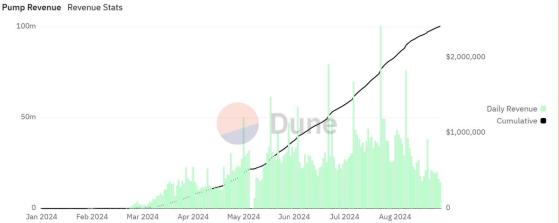
По данным исследовательской компании Dune Analytics, пользователи Pump.fun разработали более 1 млн цифровых активов. Монеты принесли своим создателям $100,4 млн, и только за последние сутки обогатили их на $344 600.

Тем не менее доход авторов токенов-мемов снизился в августе по сравнению с июльскими рекордными показателями. В частности, 29 июля они заработали максимальную сумму – $2,4 млн.

Доход создателей токенов-мемов на площадке Pump.fun

Чтобы подстегнуть развитие платформы, в начале прошлого месяца руководство Pump.fun упразднило плату в размере около $2 за выпуск криптовалюты, поэтому сейчас монеты можно создавать бесплатно.

Кроме того, авторов токенов-мемов стали награждать 0,5 Solana (SOL) стоимостью $67,7 по текущей цене, если курс их детищ превысит определённый показатель, вычисляемый с учётом циркулирующего предложения монет.

Платформа SunPump для выпуска токенов-мемов в сети Tron (TRX), которая начала работать 9 августа, пока не может конкурировать с Pump.fun по величине дохода пользователей. 31 августа создатели криптовалют заработали на этой площадке $132 340, и их выручка за сутки в прошлом месяце не превысила $588 415.

Читайте оригинальную статью на сайте Happycoin.club
Trending Cryptos

Related Reads

Crypto 美股观察:CRCL、HOOD、COIN 与 MSTR,最近在交易什么?

Recent weeks have seen significant developments for four key US-listed crypto-related stocks—Circle (CRCL), Robinhood (HOOD), Coinbase (COIN), and MicroStrategy (MSTR)—with their core investment theses diverging. For **Circle (CRCL)**, its stock price is increasingly realigning with the fundamental driver of **USDC circulation**. After IPO exuberance faded, CRCL's performance now correlates closely with changes in USDC supply, which is heavily influenced by DeFi activity and risk appetite. The recent contraction in USDC, linked to events like the KelpDAO incident, has pressured the stock. A sustainable recovery signal for CRCL would require a confluence of recovering DeFi TVL, stablecoin demand, and consecutive weeks of USDC net issuance. **Robinhood (HOOD)** gained market attention with the launch of its **Robinhood Chain**, an Ethereum L2. While not an immediate threat to Coinbase's dominant Base network in terms of scale or developer ecosystem, it represents a strategic encroachment. Robinhood's path—leveraging its traditional retail brokerage user base and assets to build a chain-based financial system—challenges Coinbase's narrative as the sole listed company integrating crypto-native infrastructure with traditional finance. This could dilute COIN's long-term scarcity premium. **MicroStrategy (MSTR)** made a notable shift by **selling Bitcoin** for the first time in a meaningful way (3,588 BTC), breaking its long-standing "buy-only" posture. The sales, used to fund dividends and replenish USD reserves, signal a move towards active capital management. While not indicative of a bearish turn on Bitcoin, it introduces new complexity for MSTR investors. The stock must now be evaluated not just as a leveraged Bitcoin proxy, but also considering fixed cash obligations from preferred dividends and debt, alongside its capital allocation strategy between holding BTC and maintaining liquidity. In summary, the investment narratives for these stocks are evolving beyond simple crypto market beta. Key variables now include stablecoin fundamentals, competition in chain-based financial ecosystems, and the balance between asset accumulation and corporate capital structure management.

marsbit1m ago

Crypto 美股观察:CRCL、HOOD、COIN 与 MSTR,最近在交易什么?

marsbit1m ago

Behind Robinhood's Launch of Its Own Chain, the Beautifully Packaged "Tokenized Stocks" Still Have No Equity Rights

Robinhood has launched "Robinhood Chain," an Ethereum-based Layer 2 built with Arbitrum technology, and introduced "Stock Tokens." This article clarifies that these tokens are not actual on-chain equity. They are tokenized debt securities issued by Robinhood Assets Jersey Limited, offering economic exposure to reference stocks or ETFs but lacking direct ownership, voting rights, or other shareholder privileges. The legal structure is conservative, relying on traditional financial intermediaries, custody, KYC/AML controls, and specific jurisdiction rules, even though the tokens are transferable on-chain. The move is part of Robinhood's broader strategy to evolve from a retail brokerage into a global financial ecosystem, integrating services like banking, retirement, crypto, and DeFi. Robinhood Chain aims to provide a programmable settlement layer, making financial products more portable and accessible while masking underlying complexity. However, the "brokerage chain paradox" lies in balancing a simple user interface with the intricate, regulated reality of the wrapped assets. The success of this model depends on users and regulators accepting this structured approach without misunderstanding the tokens as direct stock ownership. Key components supporting this strategy include the Bitstamp acquisition (expanding institutional crypto capabilities), the Robinhood Wallet (bridging brokerage and self-custody), the Robinhood Earn program (integrating DeFi lending), and the Lighter perpetual contracts platform. While ambitious, the initiative is still early, facing challenges in achieving liquidity, developer adoption, and regulatory clarity across jurisdictions.

marsbit1h ago

Behind Robinhood's Launch of Its Own Chain, the Beautifully Packaged "Tokenized Stocks" Still Have No Equity Rights

marsbit1h ago

Strategy's Accounting Gimmick: The Cap on BTC Sales Far Exceeds $1.25 Billion

The article, originally from Bankless, discusses how MicroStrategy's (MSTR) recent Bitcoin (BTC) sales reveal a much larger potential selling capacity than the widely reported $1.25 billion "reserve-building" cap. On July 7, MicroStrategy disclosed a sale of 3,588 BTC (~$216M) to pay dividends for its STRAT (STRC) preferred shares and replenish its USD Reserve. Crucially, the company stated this sale did not count against its stated $1.25 billion "reserve-building capacity." The analysis explains that MicroStrategy's "BTC Monetization Plan," part of its broader "Digital Credit Capital Framework," actually outlines three main purposes for selling BTC, only one of which has the $1.25B cap: 1. **Building the USD Reserve** (capped at $1.25B). 2. **Covering preferred share/ debt costs** (replenishing the reserve after payments). 3. **Funding buybacks** (up to $10B for preferred shares and $10B for MSTR common stock). The key nuance is the accounting distinction between "building" the reserve (selling BTC before making payments) and "replenishing" it (selling BTC after using reserve funds for payments). While functionally the same—converting BTC to cash for obligations—only "building" counts against the publicized $1.25B limit. This means sales for "replenishing" and the $20B+ buyback pool allow for total potential sales exceeding $30B. The article frames this as part of MicroStrategy's shift from a simple "buy and hold" Bitcoin narrative to an "active capital management" model, where BTC becomes a balance-sheet tool to manage pressures between its common stock, preferred shares, dollar reserve, and Bitcoin holdings. This creates complex trade-offs and potential conflicts of interest. The conclusion warns investors that the $1.25B figure is not a total sales ceiling. Understanding terms like "build," "replenish," and "repurchase" in MicroStrategy's disclosures is now critical, as the company navigates a new, more complex role as an actively managed entity rather than a passive Bitcoin accumulator.

Odaily星球日报1h ago

Strategy's Accounting Gimmick: The Cap on BTC Sales Far Exceeds $1.25 Billion

Odaily星球日报1h ago

Trading

Spot

Hot Articles

How to Buy PUMP

Welcome to HTX.com! We've made purchasing Pump.fun (PUMP) simple and convenient. Follow our step-by-step guide to embark on your crypto journey.Step 1: Create Your HTX AccountUse your email or phone number to sign up for a free account on HTX. Experience a hassle-free registration journey and unlock all features.Get My AccountStep 2: Go to Buy Crypto and Choose Your Payment MethodCredit/Debit Card: Use your Visa or Mastercard to buy Pump.fun (PUMP) instantly.Balance: Use funds from your HTX account balance to trade seamlessly.Third Parties: We've added popular payment methods such as Google Pay and Apple Pay to enhance convenience.P2P: Trade directly with other users on HTX.Over-the-Counter (OTC): We offer tailor-made services and competitive exchange rates for traders.Step 3: Store Your Pump.fun (PUMP)After purchasing your Pump.fun (PUMP), store it in your HTX account. Alternatively, you can send it elsewhere via blockchain transfer or use it to trade other cryptocurrencies.Step 4: Trade Pump.fun (PUMP)Easily trade Pump.fun (PUMP) on HTX's spot market. Simply access your account, select your trading pair, execute your trades, and monitor in real-time. We offer a user-friendly experience for both beginners and seasoned traders.

4.4k Total ViewsPublished 2024.03.29Updated 2026.07.09

How to Buy PUMP

Discussions

Welcome to the HTX Community. Here, you can stay informed about the latest platform developments and gain access to professional market insights. Users' opinions on the price of PUMP (PUMP) are presented below.

活动图片