1天涨千倍!有人日赚600万美元,干爆Steam的悟空让相关MEME币疯狂

链捕手Published on 2024-08-21Last updated on 2024-08-21

作者: Arain, ChainCatcher

编辑: Marco , ChainCatcher


中国国产的3A 游戏《黑神话:悟空》(Black Myth :Wukong于北京时间8月20日10点正式发售,上线1小时同时在线人数突破100 万,令Steam服务器一度崩溃。


该游戏发售1小时后的数据已突破《赛博朋克2077》《艾尔登法环》《博德之门》等热门大作,截至发稿,同时在线人数峰值超200万,占据Steam在线人数榜首,成为Steam所有游戏在线人数历史峰值中排名第三的游戏,而历史排名第一的是《CS 2》和《Dota 2》。


游戏圈火热,资本市场也闻风而动,开始炒作相关概念。A股相关概念轮番表演,Wind数据显示,截至8月20日收盘,旗天科技(300061.SZ)股价涨停,股价涨幅达到20%;中信出版(300788.SZ)股价涨停,收于29.86元/股,涨幅为20%;华谊兄弟(300027.SZ)股价大涨19%,收于2.94元/股。


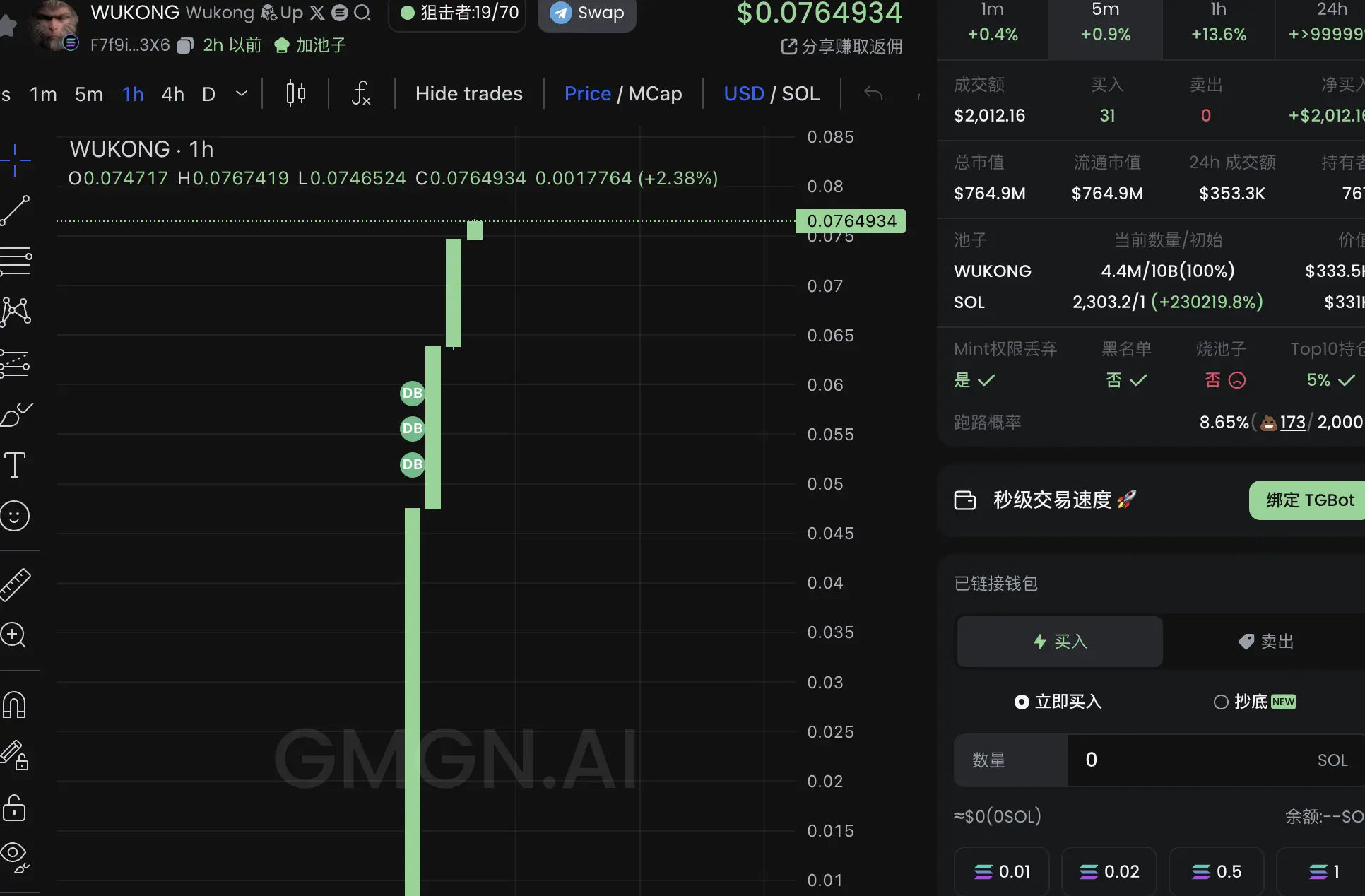
蹭该游戏热度的加密货币有更惊人的涨幅。根据gmgn.ai数据,发行于Solana上Meme币$WuKong在当日24小时涨幅超过99999%,有用户5小时就赚走35万美元。与此同时,Solana上出现了多个$WuKong同名Meme币的交易池,涨跌不一。此外,ETH和BNB上也出现了$WuKong同名MEME币,均呈现不同涨幅。


当晚最靓的仔冲刷 X 加密圈


8月20日晚上的 X 加密华语圈是属于《黑神话:悟空》的。无他,只因为各大华语加密KOL、交易所和媒体都蹭 《黑神话:悟空》:只要你转发,你关注,你评论,你就有可能抽中《黑神话:悟空》的游戏资格。


而这正好也是不少加密数字货币华语圈用户需要的,许多参与抽奖的用户表示很早就想玩了,《黑神话:悟空》成功成为当晚流量密码C位。


据不完全统计,当晚被用于引流的《黑神话:悟空》主要是328元的豪华版——该游戏共4个版本,分别是售价268元的数字标准版、328元的数字豪华版、820元的实体豪华版和1998元的实体收藏版,其中实体收藏版在一些二手转让平台已经被炒到6000元以上的高价。



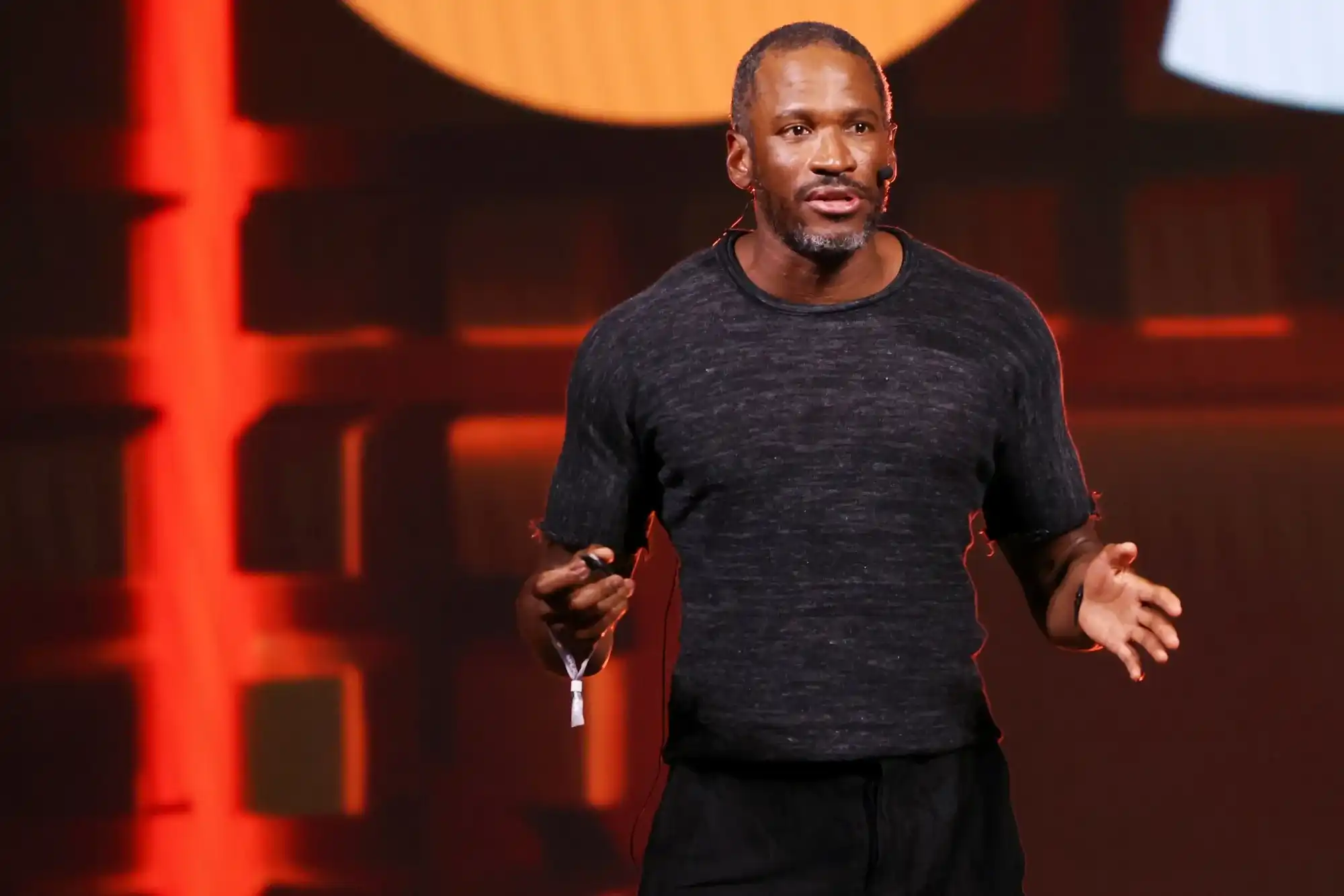
不过在这波营销中最狠的“狠人”还是当属波场的创始人孙宇晨,直接贴出自己的海报附带上一连串的激活码,简单而粗暴,让用户自行领取,不设任何条件,慷慨而大方,这也让加密货币圈的游戏用户气氛直接嗨爆。



行情拉爆  各大链忙发悟空相关MEME币


“股票都给干涨停了。”

“沾边的概念股,都是涨。”

“有没有黑悟空Meme?感觉有一波行情。”

“已经拉菲了(同“飞”,行业黑话,意思是涨的很高)。”


在一个链游社群里,社群员们兴奋地讨论着《黑神话:悟空》及其周边。


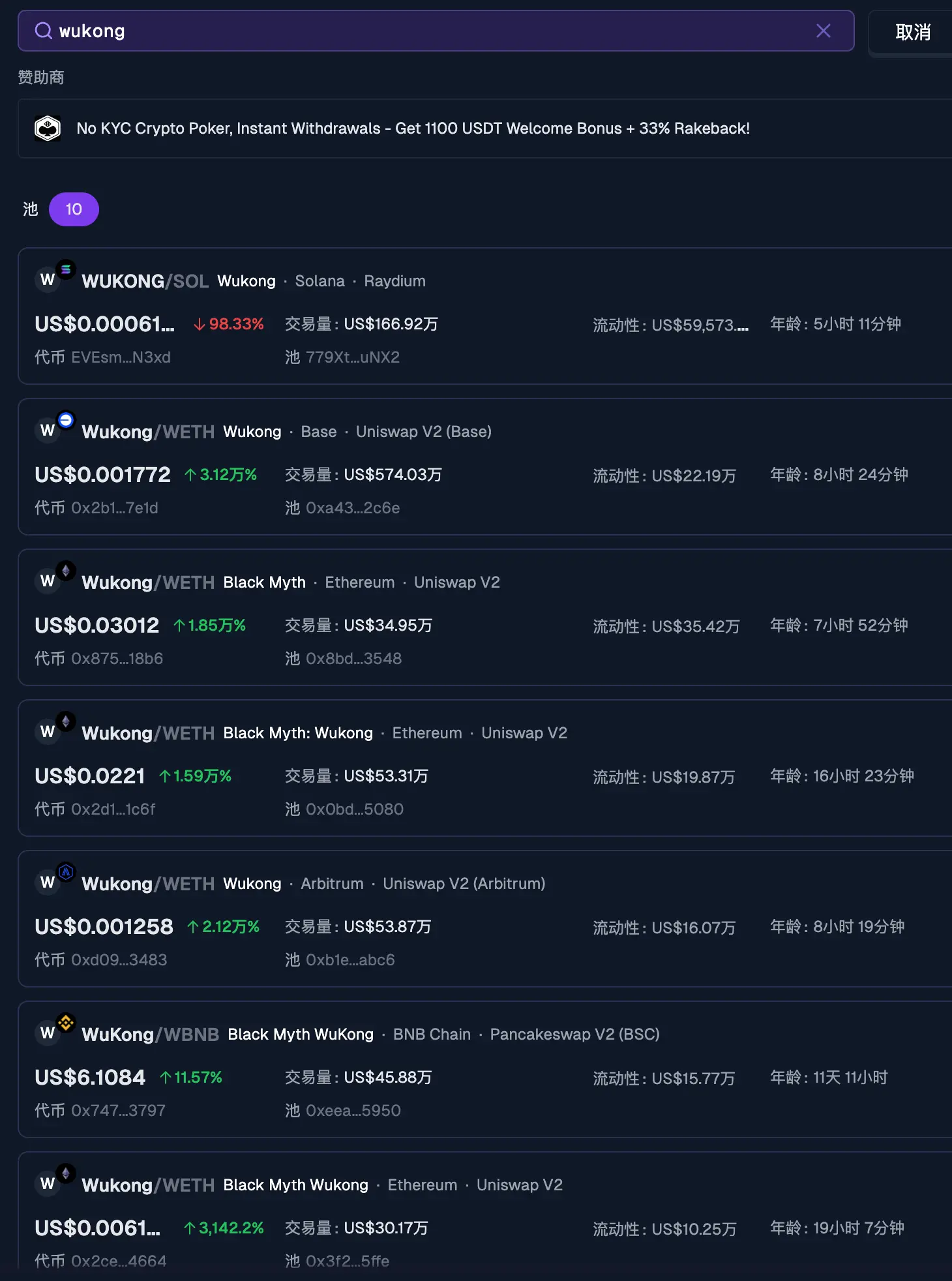
目前已经有多个$WuKong同名Meme币出现ETH、BSC、Solona和Base这四条公链上,根据Geckotermina数据,目前$WuKong最主要的战场还是在Solana的Raydium上,其24小时交易量最大。而表现最佳的是Base链上的Uniswap V2,截至发稿,$WuKong的24小时涨幅达到31077%。这可能是由于Uniswap V2的$WuKong要新于Solana的Raydium上的$WuKong,流动性也更弱一些——目前已有1100多人参与这场“游戏”。


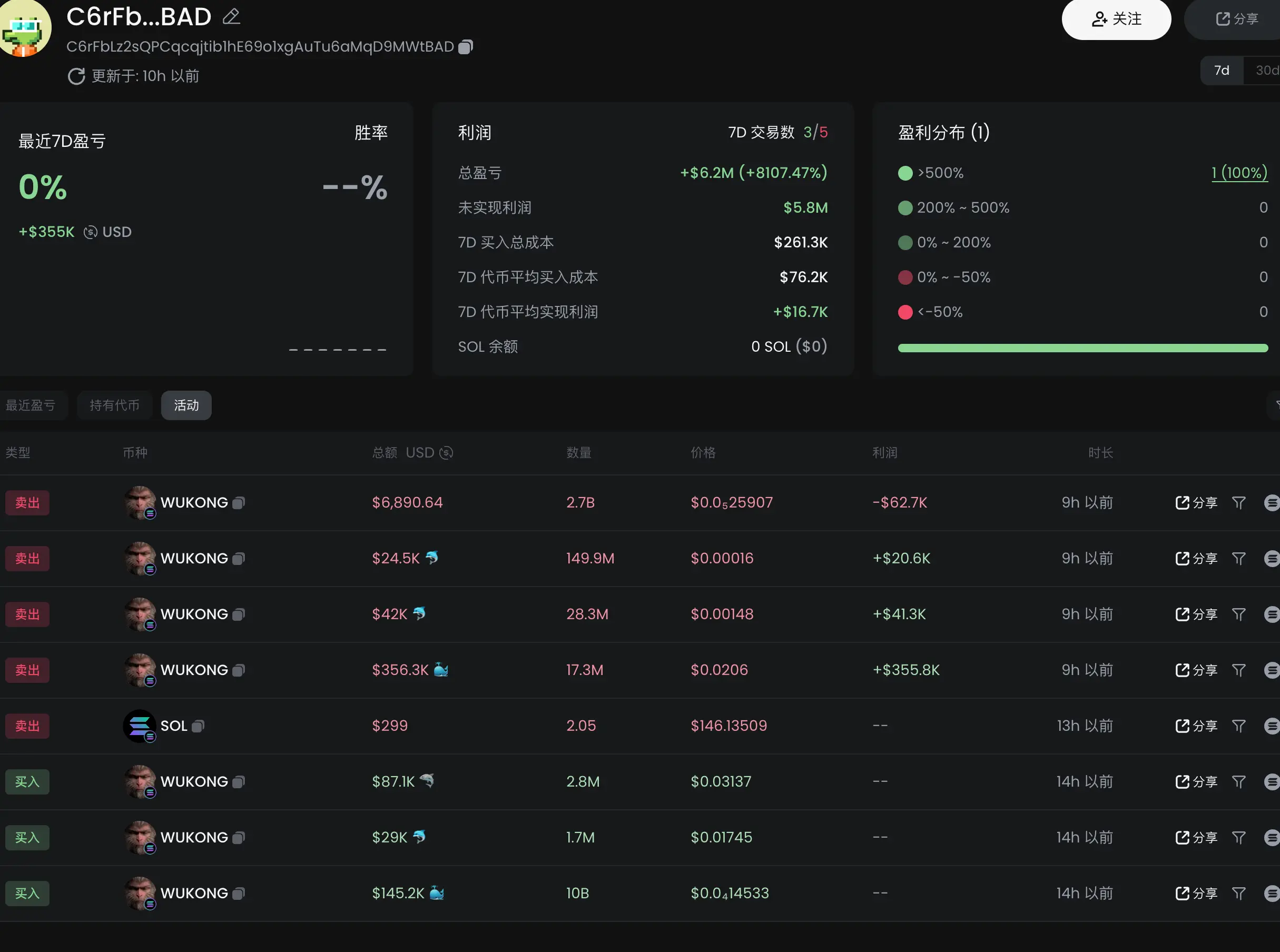
Solana的Raydium上最大的一个$Wukong池子合约地址是F7f9iebj97bVARvbRuPwUxG7gz75A5VfZLTj7kEfZ3X6,根据gmgn.ai数据,有900多人参与了这个池子,该$Wukong由C6rFbLz2sQPCqcqjtib1hE69o1xgAuTu6aMqD9MWtBAD创立,该用户买入总成本约为26万美元,截至发稿,该账户目前已获利,实现盈利约35万美元,还有580万浮盈。


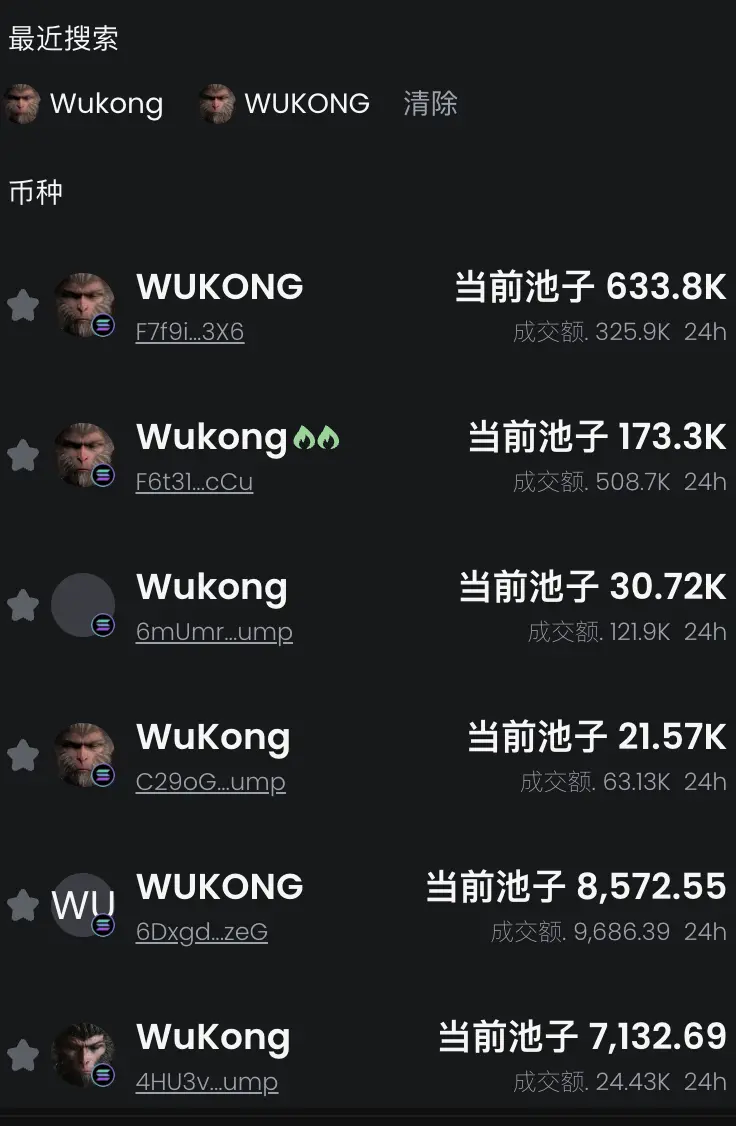
当然,Solana上不止一个$Wukong,但只有这个池子量最大,且涨幅最高。其他的池子涨跌不一,且池中流动性较差。


NFT市场措手不及


《黑神话:悟空》的大热,也有NFT想要来蹭一波热度。但相较于Meme的迅速、便捷,一键发币,NFT似乎有些措手不及。


在现有的一些NFT概念中,可能与“猴子”、“猿”相关的NFT并未出现异动,而新的NFT项目还在准备铸造中。


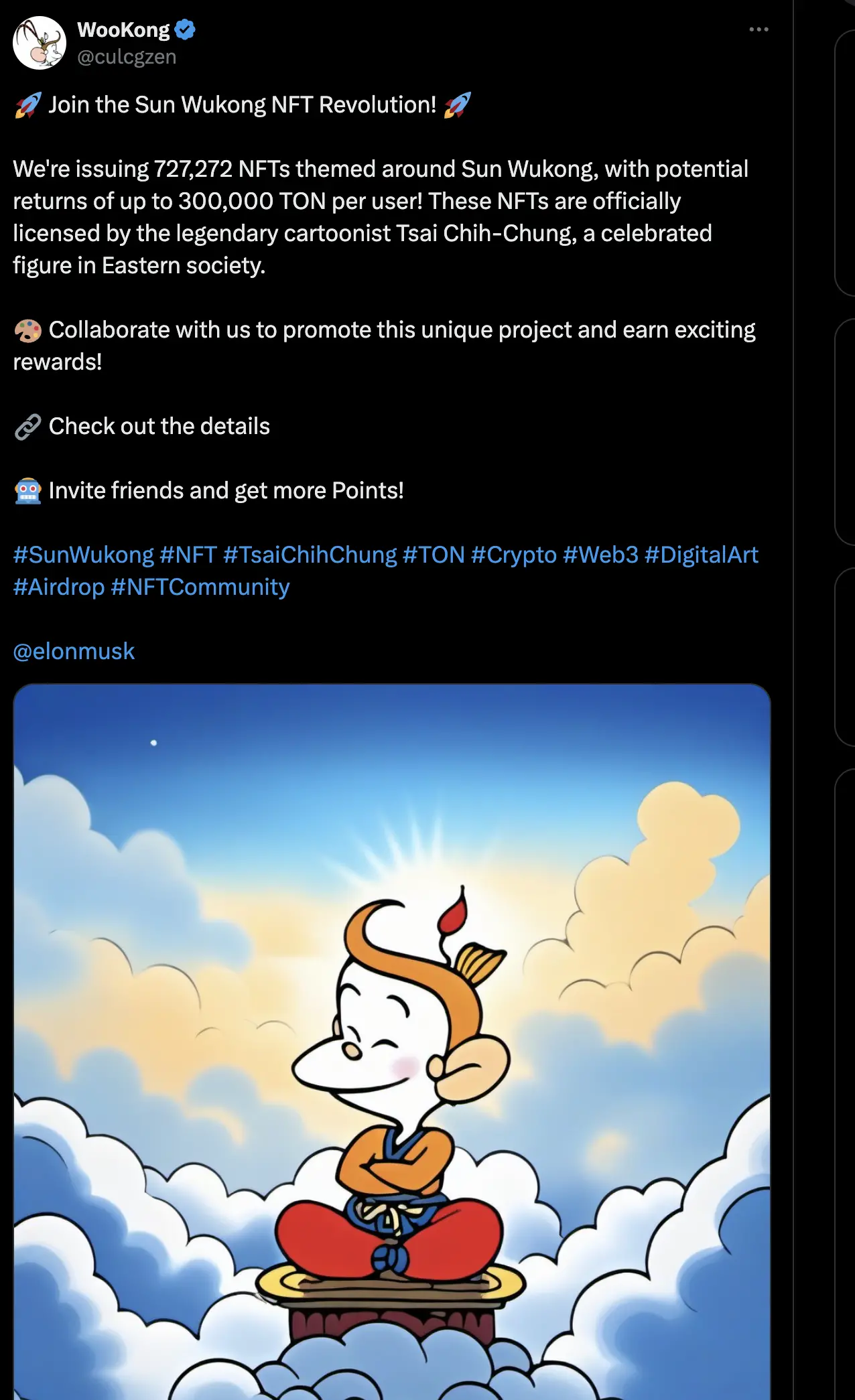
有一个名为“SUn WuKong”的NFT宣称是蔡志忠与 Caturapramana Universe 合作推出《西游记》NFT,发 X 蹭上了《黑神话:悟空》的热度,但他们还没有开放Mint——只是不知道等他们开启Mint的时候,《黑神话:悟空》这碗饭还热不热?


此外,就是以将价值328元豪华版《黑神话:悟空》发行成NFT供推特用户免费Mint,但本质上还是一个 X 引流活动,需要用户点赞、转发才能抽中免费Mint资格。虽然发行方称会提供1000份,但10小时过去了,参与转发、点赞的用户还不到100个,对免费MINT的热情寥寥而已。


圈内用《黑神话:悟空》再一次验证了,要蹭热度,Meme是最好的途径,NFT已经成为明日黄花。


Trending Cryptos

Related Reads

AI Sweeps the Globe, So Why Is Crypto + AI Facing Gloom?

The article "AI Sweeps the Globe, But Why Is Crypto + AI So Bleak?" analyzes the disconnect between the booming AI industry and the struggling crypto+AI sector. It argues the issue is not flawed logic but severe demand-supply mismatch across four key sub-sectors. Decentralized compute and storage projects offer theoretical benefits like cost savings and data sovereignty but lack a decisive technical edge over entrenched cloud providers (AWS, GCP). Enterprises are unwilling to risk migration for unproven infrastructure that can't guarantee the performance and reliability needed for critical AI workloads. ZKML and privacy solutions address important issues like model verification but solve non-urgent, long-term concerns for most businesses currently focused on core performance and ROI. Demand here is likely to be regulation-driven (e.g., EU AI Act) rather than organic. AI agent infrastructure is developing foundational tech for a future multi-agent economy. However, the current market phase is dominated by internal process automation within single companies, making this technology premature. AI agent payments is highlighted as the only sub-sector where blockchain competes on a level playing field with traditional finance, as neither has adequately solved the challenges of machine-to-machine micropayments and real-time settlement. Overall, crypto+AI projects are building for future needs (data ownership, decentralization, transparency) that don't align with the industry's immediate priorities (performance, cost, stability). The absence of a flagship, large-scale use case further hinders mainstream adoption and capital inflow. The path forward requires either adapting to current market demands or patiently building the foundational infrastructure for the next phase of AI.

marsbit7m ago

AI Sweeps the Globe, So Why Is Crypto + AI Facing Gloom?

marsbit7m ago

"King of Pump Calls" Arthur Hayes Strikes Again, This Time Targeting Deribit

On June 29, BitMEX co-founder Arthur Hayes purchased approximately 6.16 million SYN tokens via OTC platform Flowdesk for around $2.2 million. Hayes subsequently declared on X that SYN represents one of the most asymmetric investments he has seen since HYPE, stating it's time for an options DEX to challenge the dominant platform Deribit, and identifying Hypercall as that challenger. SYN's price surged over 40% following his comments, with a tenfold increase in June 2026 alone, bringing its FDV to roughly $110 million. The article details Synapse Protocol's evolution from a cross-chain messaging and liquidity network into the chain-based options trading protocol Hypercall. Hypercall, built on the Hyperliquid ecosystem's HyperEVM, aims to be a universal options exchange supporting any asset size with capped loss (limited to premium paid) and no forced liquidations. Deribit, established in 2016, remains the centralized leader in crypto options with an estimated 85% market share in BTC and ETH options and $3.588 billion in assets. Its strengths include deep liquidity and professional tools, but it faces criticisms over custody risk, KYC requirements, and regulatory uncertainty. The analysis positions Hypercall not as an immediate replacement for Deribit's entrenched network effects, but as a potential complementary and differentiated competitor, particularly for DeFi-native assets and new asset classes like RWA. The article concludes by noting Hayes's recent mixed "call" record, including fully exiting and later re-buying HYPE, and the controversial price target for CARDS from his family office Maelstrom, which was followed by a significant price drop.

marsbit28m ago

"King of Pump Calls" Arthur Hayes Strikes Again, This Time Targeting Deribit

marsbit28m ago

AI is Sweeping the Globe, So Why is Crypto + AI in a Slump?

AI Booms, But Crypto + AI Remains Sluggish: A Demand-Side Analysis Despite the AI industry's explosive growth and massive investment, the convergence of blockchain and AI (Crypto + AI) has seen limited traction. The core issue is a severe supply-demand mismatch, not a flawed premise. Analyzing four key sub-sectors reveals specific gaps: 1. **Decentralized Compute/Storage:** Offer logical benefits like data sovereignty and cost savings but lack a decisive technical advantage over entrenched cloud giants (AWS, GCP). Enterprises prioritize performance and stability and are unwilling to bear the switching risk and uncertainty of decentralized networks. 2. **Model Verification/Privacy (e.g., ZKML):** Address important long-term issues like auditability and data privacy, but these are not urgent operational pain points for most businesses today. Widespread demand will likely follow regulatory mandates (like the EU AI Act), not precede them. 3. **AI Agent Infrastructure:** Projects are building infrastructure for a future of autonomous, interacting agents. However, the current market focus is on internal process automation within corporate firewalls. The technology is ahead of market readiness. 4. **AI Agent Payments:** This is the only sub-sector where blockchain is on a level playing field with traditional finance. Both are trying to solve the unsolved problem of real-time, micro-transactions for machines, making it the most immediately competitive area. The overarching problem is that the AI industry invests heavily in solutions that solve immediate bottlenecks (e.g., faster memory, more power). Most Crypto + AI solutions target secondary, longer-term concerns (decentralization, transparency) and often come with performance trade-offs. The lack of a flagship, large-scale commercial success case further hinders mainstream capital inflow. The path forward requires either aligning more closely with the current industry's performance demands or patiently building the foundational infrastructure for the next phase of AI.

Foresight News38m ago

AI is Sweeping the Globe, So Why is Crypto + AI in a Slump?

Foresight News38m ago

Continuous Net Outflows from ETFs, Are Institutions Exiting?

US spot Bitcoin ETFs have experienced approximately $6 billion in net outflows over the past six weeks, marking the longest consecutive weekly withdrawal streak since their launch in 2024. The iShares Bitcoin Trust (IBIT) from BlackRock has been particularly affected, accounting for over 70% of recent outflows. On-chain analysis indicates that long-term Bitcoin holders (holding for over 155 days), who control about 83% of the circulating supply, remain steadfast. The selling pressure is primarily coming from allocators who entered through ETF brokerage accounts. This represents the first major collective capitulation since Bitcoin gained mainstream Wall Street recognition, driven more by risk-off portfolio adjustments than a fundamental rejection of the asset. Factors such as rising inflation, a hawkish shift in Federal Reserve policy, massive capital inflows into AI infrastructure, and attractive IPO opportunities have redirected speculative funds. Bitcoin, treated as a high-beta risk asset, was among the first to be sold. While the pace of outflows has slowed significantly—from $1.72 billion in early June to $226.8 million mid-month—the structural issue remains. IBIT's large size means its outflows alone exert substantial market pressure. With spot market volume thin, new capital inflows absent, and ETF buying muted, the market lacks sufficient buying support to absorb this selling. The coming sessions are critical. If IBIT outflows decelerate and Bitcoin reclaims $60,000, this phase could be seen as a healthy reset. However, if heavy IBIT redemptions resume and the price falls below $58,000, it would signal a more sustained institutional exit, requiring non-ETF buyers to shoulder the entire selling pressure alone. The ETF, while lowering entry barriers, has not removed Bitcoin's inherent volatility.

marsbit1h ago

Continuous Net Outflows from ETFs, Are Institutions Exiting?

marsbit1h ago

Introduction to the Concept of World Models: A Story from Psychology to the Main Battlefield of AI

**World Models: From Psychology to AI's Core Concept** "World model" is a trending but often confusing term in AI, describing a system that allows machines to internally simulate, predict, and rehearse potential outcomes before taking real-world action—like a mental "sandbox." While definitions vary—Yann LeCun emphasizes physical understanding, OpenAI's Sora is a video-based "world simulator," Google DeepMind's Genie 3 creates interactive 3D environments, and companies like Alibaba and Tesla focus on practical applications—the core goal is consistent: reduce reliance on vast real-world data by creating an internal, predictive model for safer and more efficient AI. The concept has deep roots, tracing back to psychologist Kenneth Craik (1943). In AI, it was revitalized by researchers like David Ha and Jürgen Schmidhuber (2018). Major technical approaches include: 1) generative video models (e.g., Sora) for visual realism; 2) abstract predictive models (e.g., LeCun's JEPA) for efficiency and physical reasoning; and 3) explicit 3D simulators (e.g., NVIDIA Omniverse) for precision. Fei-Fei Li proposes a classification based on the AI action loop: renderers (output observations), simulators (output world states), and planners (output actions). The emerging "World Action Model" (WAM) paradigm aims to unify future prediction and action generation. An industry framework is forming: upstream (data, compute, sensors), midstream (general and vertical platforms), and downstream applications (autonomous driving, robotics, gaming, etc.). Autonomous driving is currently the most mature use case. The current lack of a unified definition reflects the field's early, dynamic stage, similar to past tech revolutions. Different approaches—focusing on pixels, physics, or behavior—represent parallel explorations of how best to compress and understand the world. This diversity, while seemingly chaotic, signals that world models have moved from an academic idea to a critical industrial battleground, ultimately aiming to give machines the ability to understand, imagine, and reason about the world.

marsbit1h ago

Introduction to the Concept of World Models: A Story from Psychology to the Main Battlefield of AI

marsbit1h ago

Trading

Spot

Hot Articles

Discussions

Welcome to the HTX Community. Here, you can stay informed about the latest platform developments and gain access to professional market insights. Users' opinions on the price of MEME (MEME) are presented below.

活动图片