
比特币反弹至 64,000 美元 牛市的反转来了吗?

币界网Published on 2024-07-18Last updated on 2024-07-18

币界网报道:

v2-a4cf21f514e483b833acf20547b494e6_720w.webp

比特币价格下跌的原因

加密货币市场最近的低迷尤为明显,过去 24 小时内整体市值经历了 1.77% 或约 500 亿美元的大幅回调,总估值降至 2.36 万亿美元。比特币是市场领导者和更广泛的加密生态系统的领头羊,也未能免受这种下行压力的影响。机构投资者寻求对冲全球经济不确定性,推动了对数字资产的需求增长。此外,可以肯定地说,数字资产比传统投资产品提供更好的长期保险。
v2-52021d94ab14c9193e5359c3391d4001_720w.webp

现货比特币ETF流入

近期现货比特币 ETF资金流入动态对塑造市场情绪和价格走势起到了至关重要的作用。此前,加密货币市场受到机构投资者的强烈兴趣的推动,11 只基金的出色表现就是明证,这些基金累计净流入金额达 4.225 亿美元。这一数字是自 6 月 5 日以来单日最高纪录,并延续了连续七天的上涨势头。然而,最近几天形势发生了巨大变化。最新数据显示,这些资金流入大幅下降,现货比特币 ETF 累计流入量降至仅 5300 万美元。

多头与空头清算之争

比特币期货市场多头和空头清算的持续动态为交易者情绪和市场方向提供了宝贵的见解。截至最新报告期,数据显示多头和空头清算之间存在显着的不平衡,多头头寸清算速度明显超过空头头寸清算速度。

过去 24 小时内,比特币多头清算额为 2775 万美元,而空头清算额为 1582 万美元。近 1200 万美元的差距清楚地表明,当前的市场环境下,市场情绪偏向看跌。

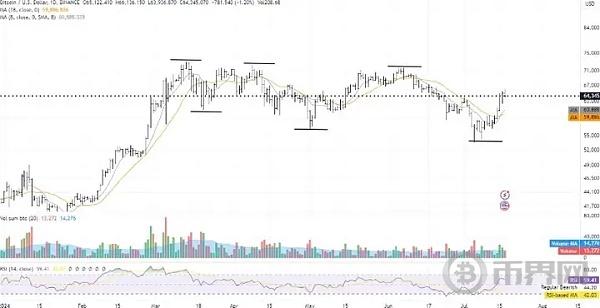
多头清算的盛行表明,许多原本看好价格进一步上涨的交易者由于达到止损水平或追加保证金而被迫亏损平仓。过去四个月,比特币价格一直处于盘整状态。尽管通过美国现货 BTC ETF 获得了大量现金流入,但自 3 月份以来,这一旗舰代币一直在 60,000 美元至 71,000 美元之间波动。

比特币价格一直形成较低的高点和较低的低点,这是下跌趋势的既定特征。
v2-c637f8443705ea0fc7bca0acdcab40e8_720w.webp

过去一个月非零比特币地址减少了超过67.2万个。不过,机构投资者的需求上升抵消了短期比特币地址的减少。仅在过去九天里,美国现货比特币 ETF 的现金流入就超过 20 亿美元。德国已完成出售其持有的比特币,这减轻了一些抛售压力。此外,Mt. Gox 已将其 66% 的未偿还 BTC 分发给客户,市场已成功吸收了这笔资金,帮助比特币维持在 64,000 美元左右的盘整水平。

Altseason 正在加载

随着对加密货币进一步投降的担忧逐渐消退,比特币地址数量有所下降,因为投资者正在购买更多山寨币。此外,比特币近期的主导地位预示着不可避免的逆转,而每周相对强弱指数 (RSI) 的看跌背离则支持了这一逆转。美国证券交易委员会已经批准两只现货以太币 ETF——Grayscale 以太坊迷你信托和 ProShares 以太坊 ETF——将于下周在纽约证券交易所 Arca 上开始交易。

美国推出现货以太币 ETF 交易将引发整个山寨币行业的重大胜利。此外,以太坊是整个山寨币行业的主要流动性提供者。自 5 月中旬以太坊 ETF获得批准以来,以太坊的表现已超过比特币 20%。 这一趋势表明人们对以太坊及其生态系统的信心不断增强,可能为山寨币投资者带来更高的回报。从历史上看,山寨币往往在下半年表现更好。这种趋势将持续下去,尤其是考虑到当前的市场状况和围绕以太坊的积极情绪。


Trending Cryptos

Related Reads

When Real Estate Ownership Goes Digital: What Happens to Your Rights, Risks, and Liquidity?

"Tokenizing Real Estate: Rights, Risks, and the Path to Liquidity" While tokenizing real-world assets (RWA) gains traction, real estate presents unique complexities. Beyond technical token issuance, critical challenges remain: enforcing legal rights, managing the underlying physical asset, and creating genuine secondary market liquidity. This article explores these issues through OneAsset, a Dubai-based commercial real estate (CRE) tokenization platform. OneAsset moves away from simply offering asset fragmentation. Instead, it focuses on institutional-grade infrastructure, prioritizing asset quality, legal enforceability, and operational fundamentals. Each property is held in an independent, single-asset vault, backed by a legally separate Special Purpose Vehicle (SPV) for bankruptcy remoteness. Investors acquire tokens representing the economic rights to a specific property, with precise legal claims defined by the underlying SPV structure. OneAsset emphasizes that tokenization cannot transform a poor-quality asset. Its initial focus is on institutional investors and quality Dubai-based CRE, selected for stable tenant cash flows and a clear regulatory environment. The platform integrates compliance by design, aiming to embed investor qualification and transfer rules directly into the token architecture. A core insight is that asset fragmentation does not automatically create liquidity. True liquidity depends on the asset's inherent quality—its location, cash flow, and valuation—as well as sufficient buyer demand. The goal is not just tradability, but making real estate rights more easily priced, verified, and reallocated. Looking ahead, the article discusses the potential for "AiFi" (AI-powered finance). For AI agents to autonomously allocate capital, investment assets like real estate tokens must become truly "machine-readable." This requires a high degree of standardization in legal rights, valuations, cash flows, and compliance data—a direction OneAsset is pursuing through its structured data reporting. In conclusion, real estate tokenization is shifting from a technology narrative to a focus on asset fundamentals. Blockchain can enhance efficiency and programmability, but it cannot replace sound underwriting, property management, or legal execution. The real work begins after the asset is on-chain.

marsbit13m ago

When Real Estate Ownership Goes Digital: What Happens to Your Rights, Risks, and Liquidity?

marsbit13m ago

After Affecting Two Generations, Meta Ordered to Pay $18 Billion in Damages

After more than two decades, a legal parallel has emerged. In 1998, major U.S. tobacco companies settled for $206 billion, leading to strict advertising bans and warning labels that significantly reduced smoking rates. On August 26, 2026, Meta reached a landmark settlement with U.S. attorneys general, agreeing to pay up to approximately $18 billion and implement mandatory changes to Facebook and Instagram. This historic settlement, one of the largest against a tech company, stems from allegations that Meta deliberately designed addictive features like infinite scroll and push notifications, harming youth mental health and violating child privacy laws. Facing a potential $1.4 trillion lawsuit and a series of unfavorable jury verdicts, Meta chose to settle on the eighth day of trial to avoid a catastrophic ruling. The core of the agreement is not just the financial penalty, which Meta will pay over 10 years, but a series of strict, 10-year product mandates for young users. These include a hard two-hour daily time limit (combined across apps), a default "nighttime block" from midnight to 6 AM, restricted notifications during school hours, hidden "like" counts, an optional non-algorithmic feed, and stronger age verification. An independent auditor will monitor compliance. Crucially, roughly 30% ($5.3 billion) of Meta's payment is contingent on YouTube and TikTok adopting similar measures and paying around $5 billion each. This move aims to create an industry-wide standard and prevent Meta from being competitively disadvantaged. The settlement is being likened to Big Tobacco's "tobacco moment." By legally framing addictive algorithm design as a "public nuisance," it sets a powerful precedent. Nearly 3,000 similar cases are pending against other social media giants, signaling a fundamental shift in regulatory pressure. The era where platforms could deny the addictive impact of their designs on children is effectively over.

marsbit19m ago

After Affecting Two Generations, Meta Ordered to Pay $18 Billion in Damages

marsbit19m ago

Trading

Spot

Hot Articles

What is $BITCOIN

DIGITAL GOLD ($BITCOIN): A Comprehensive Analysis Introduction to DIGITAL GOLD ($BITCOIN) DIGITAL GOLD ($BITCOIN) is a blockchain-based project operating on the Solana network, which aims to combine the characteristics of traditional precious metals with the innovation of decentralized technologies. While it shares a name with Bitcoin, often referred to as “digital gold” due to its perception as a store of value, DIGITAL GOLD is a separate token designed to create a unique ecosystem within the Web3 landscape. Its goal is to position itself as a viable alternative digital asset, although specifics regarding its applications and functionalities are still developing. What is DIGITAL GOLD ($BITCOIN)? DIGITAL GOLD ($BITCOIN) is a cryptocurrency token explicitly designed for use on the Solana blockchain. In contrast to Bitcoin, which provides a widely recognized value storage role, this token appears to focus on broader applications and characteristics. Notable aspects include: Blockchain Infrastructure: The token is built on the Solana blockchain, known for its capacity to handle high-speed and low-cost transactions. Supply Dynamics: DIGITAL GOLD has a maximum supply capped at 100 quadrillion tokens (100P $BITCOIN), although details regarding its circulating supply are currently undisclosed. Utility: While precise functionalities are not explicitly outlined, there are indications that the token could be utilized for various applications, potentially involving decentralized applications (dApps) or asset tokenization strategies. Who is the Creator of DIGITAL GOLD ($BITCOIN)? At present, the identity of the creators and development team behind DIGITAL GOLD ($BITCOIN) remains unknown. This situation is typical among many innovative projects within the blockchain space, particularly those aligning with decentralized finance and meme coin phenomena. While such anonymity may foster a community-driven culture, it intensifies concerns about governance and accountability. Who are the Investors of DIGITAL GOLD ($BITCOIN)? The available information indicates that DIGITAL GOLD ($BITCOIN) does not have any known institutional backers or prominent venture capital investments. The project seems to operate on a peer-to-peer model focused on community support and adoption rather than traditional funding routes. Its activity and liquidity are primarily situated on decentralized exchanges (DEXs), such as PumpSwap, rather than established centralized trading platforms, further highlighting its grassroots approach. How DIGITAL GOLD ($BITCOIN) Works The operational mechanics of DIGITAL GOLD ($BITCOIN) can be elaborated on based on its blockchain design and network attributes: Consensus Mechanism: By leveraging Solana’s unique proof-of-history (PoH) combined with a proof-of-stake (PoS) model, the project ensures efficient transaction validation contributing to the network's high performance. Tokenomics: While specific deflationary mechanisms have not been extensively detailed, the vast maximum token supply implies that it may cater to microtransactions or niche use cases that are still to be defined. Interoperability: There exists the potential for integration with Solana’s broader ecosystem, including various decentralized finance (DeFi) platforms. However, the details regarding specific integrations remain unspecified. Timeline of Key Events Here is a timeline that highlights significant milestones concerning DIGITAL GOLD ($BITCOIN): 2023: The initial deployment of the token occurs on the Solana blockchain, marked by its contract address. 2024: DIGITAL GOLD gains visibility as it becomes available for trading on decentralized exchanges like PumpSwap, allowing users to trade it against SOL. 2025: The project witnesses sporadic trading activity and potential interest in community-led engagements, although no noteworthy partnerships or technical advancements have been documented as of yet. Critical Analysis Strengths Scalability: The underlying Solana infrastructure supports high transaction volumes, which could enhance the utility of $BITCOIN in various transaction scenarios. Accessibility: The potential low trading price per token could attract retail investors, facilitating wider participation due to fractional ownership opportunities. Risks Lack of Transparency: The absence of publicly known backers, developers, or an audit process may yield skepticism regarding the project's sustainability and trustworthiness. Market Volatility: The trading activity is heavily reliant on speculative behavior, which can result in significant price volatility and uncertainty for investors. Conclusion DIGITAL GOLD ($BITCOIN) emerges as an intriguing yet ambiguous project within the rapidly evolving Solana ecosystem. While it attempts to leverage the “digital gold” narrative, its departure from Bitcoin's established role as a store of value underscores the need for a clearer differentiation of its intended utility and governance structure. Future acceptance and adoption will likely depend on addressing the current opacity and defining its operational and economic strategies more explicitly. Note: This report encompasses synthesised information available as of October 2023, and developments may have transpired beyond the research period.

2.3k Total ViewsPublished 2025.05.13Updated 2025.05.13

What is $BITCOIN

Discussions

Welcome to the HTX Community. Here, you can stay informed about the latest platform developments and gain access to professional market insights. Users' opinions on the price of BTC (BTC) are presented below.

活动图片