$2.1B in Bitcoin Options Expire Today as Traders Watch Volatility And $BMIC’s Presale Narrative Builds

bitcoinistPublished on 2026-02-06Last updated on 2026-02-06

Abstract

A significant $2.15 billion in Bitcoin options and $408 million in Ethereum options are expiring on February 6, 2026, creating potential market volatility. The high put-to-call ratio of 1.42 indicates traders are hedging against downside risk. Bitcoin and Ethereum are experiencing volatility, trading around $66K and $1,920 respectively. Post-expiry, implied volatility may reset, influencing market direction. Amid this uncertainty, BMIC ($BMIC) is gaining attention as a quantum-secure wallet project on Ethereum. It aims to address security risks like "harvest now, decrypt later" attacks through zero public-key exposure, AI-enhanced threat detection, and post-quantum cryptography. The presale has raised over $437K, with tokens priced at $0.049474. The narrative aligns with increased risk-off sentiment, offering a hedge against security threats rather than price fluctuations.

Trusted Editorial content, reviewed by leading industry experts and seasoned editors. Ad Disclosure

Quick Facts:

  • ➡️ Bitcoin options notional around $2.15B expires Feb 6, 2026, with positioning skewed defensive via put-heavy ratios.
  • ➡️ $BTC and $ETH remain highly volatile; post-expiry dealer hedging shifts could change market behavior fast.
  • ➡️ ETF flow whiplash suggests institutions are tactically reallocating rather than steadily accumulating.
  • ➡️ BMIC’s quantum-secure wallet narrative targets ‘harvest now, decrypt later’ risk, a theme that resonates during risk-off regimes.

A massive derivatives pin hits the market this Friday, February 6, 2026.

Roughly $2.15B in Bitcoin options notional is expiring, with another ~$408M in Ethereum options riding shotgun, according to Deribit’s settlement calendar.

Why care? Weekly expiries tend to suck liquidity out of the room exactly when you need it most. If spot prices are already jumpy, dealers hedging large strike clusters can amplify intraday moves, especially when their positioning leans defensive.

Right now, the $BTC put-to-call ratio sits at a gloomy 1.42, implying traders are paying up for downside protection rather than betting on a moonshot.

The tape is already looking nervous. Bitcoin is hovering near $66K while Ether trades around $1,920 after some nasty risk-off swings.

Mainstream outlets are already calling this another ‘crypto winter, prices are halved from October 2025 highs, and sentiment is shaky (to put it mildly) as leveraged positions get rinsed.

But here’s the thing most headlines miss: settlement doesn’t just ’cause volatility, it re-prices it. Once the expiry clears, implied vol resets, gamma exposure shifts, and the market can finally pick a direction instead of chopping sideways. That’s why veteran traders obsess over these Fridays.

In this mess, capital starts hunting for asymmetric bets away from the crowded majors, specifically plays tied to infrastructure rather than just price action.

That’s the wedge BMIC ($BMIC) is driving into the conversation.

Options Expiry Meets ETF Whiplash: What Traders Watch Next

We’re entering this expiry on thin ice.

Bitcoin’s 24-hour range on CoinGecko has stretched from $64K to $66K, a brutal reminder that liquidity vanishes fast when everyone reaches for the exit at the same time.

Then there’s the ETF situation. U.S. spot Bitcoin ETFs have been erratic, swinging between sharp redemptions and the occasional bounce. MarketWatch flagged heavy damage in the ETF complex during the selloff, noting outflows often hit right as $BTC lost key technical levels.

The takeaway? Dip-buying exists, but it’s tactical. Not unconditional.

So, what happens after the bell?

If $BTC holds the mid-$60Ks, short-dated hedges can come off quickly, allowing spot prices to drift higher as dealer pressure eases.
If $BTC loses the recent lows, that defensive positioning turns into momentum selling as hedges pay out and risk desks cut exposure.

Either way, the risk is obvious: expiry is often the catalyst for a bigger move, not the move itself. Watch if volatility drops after settlement, or stubbornly stays high (usually a bad sign).

And then we have BMIC’s ($BMIC) quantum-security thesis.

Learn more about BMIC here.

BMIC Pushes ‘Quantum-Secure Finance Stack’ as a New Risk Hedge

BMIC ($BMIC) positions itself as a quantum-secure wallet project on Ethereum (ERC-20).

The pitch? ‘The only platform offering wallet + staking + payments protected by post-quantum cryptography.’

It’s a message tailored for a specific nightmare: ‘harvest now, decrypt later,’ where attackers hoard encrypted data today to crack it later with stronger compute.

That narrative is gaining traction precisely because macro structure is getting messy. When volatility spikes, operational security usually degrades, panic leads to sloppy key management, SIM swaps, and rushed transfers.

BMIC’s angle is to remove the weakest link: public-key exposure.

Its stack relies on a few distinct pillars:

  • Zero Public-Key Exposure (structural mitigation, not just a bolt-on feature)
  • AI-Enhanced Threat Detection (security that adapts rather than just authenticates)
  • Quantum Meta-Cloud (branding-heavy, sure, but signals an enterprise-grade layer)
  • ERC-4337 Smart Accounts, paired with Post-Quantum Cryptography

There’s a clear link to the options drama: when markets feel like a knife fight, smart money doesn’t just hedge price—they hedge custody risk.

Explore BMIC today.

BMIC Presale Numbers: Price, Raise, and the Setup

BMIC has raised over $437K so far, with tokens priced at $0.049474 on the official presale page.

Those figures matter because they define the starting line for liquidity and reveal how much hype is baked into the valuation.
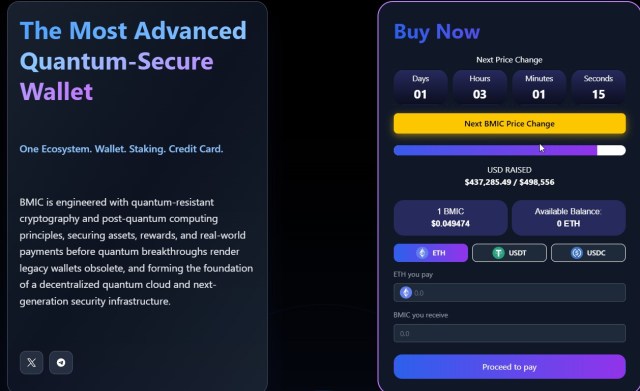
Unlike meme coins selling pure attention, BMIC is selling a security thesis and that tends to perform best when investors are actively worried about risk. Options expiry weeks do that. Sharp drawdowns do that.

The caveat? Big claims need big proof. Markets will eventually demand working product milestones and clarity on how ‘quantum-secure staking’ actually functions under the hood. But right now, the timing feels intentional.

In a week where $BTC’s derivatives calendar is the headline and spot is whipping around, BMIC offers a different kind of hedge: not against price, but against the future security model of crypto itself.

Buy your $BMIC here.

This article is not financial advice; crypto is volatile. Options expiry can distort prices, and early-stage tokens carry execution risk.

Editorial Process for bitcoinist is centered on delivering thoroughly researched, accurate, and unbiased content. We uphold strict sourcing standards, and each page undergoes diligent review by our team of top technology experts and seasoned editors. This process ensures the integrity, relevance, and value of our content for our readers.

patrubogdan

Follow

Full Profile

Related Posts

RWA Perpetuals Record $15B in Volume, Putting LiquidChain’s $LIQUID Presale in Focus

Solana ($SOL) Price Prediction 2026 Turns Bearish: Can It Recover, Or Should We Look at SUBBD Token?

Metaplanet Will Keep Buying Bitcoin, Says Gerovich, as $HYPER Hits $31M Presale Milestone

Bitcoin ETFs See $434M in Outflows as $BTC Tests $60K Support – Can Bitcoin Hyper Take Over?

Peter Brandt Says Bitcoin is Heading to $42K – Has $SUBBD’s Time Arrived?

Bitcoin’s Crash Triggered IBIT’s Biggest Trading Day, as $HYPER Keeps Pumping

Related Questions

QWhat is the total notional value of Bitcoin options expiring on February 6, 2026, and what does the put-to-call ratio indicate about trader sentiment?

AApproximately $2.15 billion in Bitcoin options are expiring. The put-to-call ratio of 1.42 indicates a defensive, bearish sentiment, as traders are purchasing more puts (downside protection) than calls (upside bets).

QHow can the expiration of these large options positions impact Bitcoin's price and market behavior in the short term?

AOptions expiration can suck liquidity from the market and amplify intraday price moves due to dealer hedging activity. After expiry, implied volatility resets and gamma exposure shifts, which can allow the market to pick a clearer directional move instead of chopping sideways.

QAccording to the article, what is the core security narrative being promoted by the BMIC ($BMIC) project?

ABMIC promotes a 'quantum-secure finance stack.' Its core narrative is mitigating the 'harvest now, decrypt later' risk by offering a wallet, staking, and payments platform protected by post-quantum cryptography, aiming to eliminate public-key exposure.

QWhat key technical levels for Bitcoin price are mentioned as critical to watch following the options expiry?

AThe mid-$60,000 level is cited as critical. Holding above it could lead to a drift higher as hedges are removed, while losing recent lows could trigger momentum selling as protective puts pay out and risk desks cut exposure.

QWhat does the erratic flow in U.S. spot Bitcoin ETFs suggest about institutional behavior, as described in the article?

AThe erratic flows, swinging between sharp redemptions and occasional bounces, suggest that institutional buying is tactical and conditional rather than representing steady, unconditional accumulation. They are reallocating based on market conditions and key technical levels.

Related Reads

Uncovering the Truth About Agent Commerce, Payments, and Infrastructure

Decoding Agent Commerce, Payments, and Infrastructure: The Reality Over the past year, I've been building infrastructure for the Agent economy, engaging with major players like Stripe, Visa, Coinbase, Google, and dozens of startups. A clear conclusion emerges: true, large-scale demand does not yet exist. Startups face structural challenges. Data points illustrate this gap. Stripe's Agent commerce platform has over 1,000 merchants but only single-digit transacting agents. Visa's Agent payment token requires 9-month KYC and a $250M revenue threshold, accessible only to giants like Amazon. On-chain analysis reveals actual daily Agent transaction volume is around $17k, half of which are test transactions. The article analyzes four potential markets: **1. Agent-to-Merchant (A2M):** Current AI shopping UX is often inferior to traditional e-commerce for visual, comparison-heavy purchases (clothing, electronics). Chat interfaces are a step back. Real merchant interest is defensive "Agent Engine Optimization," fearing future obsolescence, not current demand. Potential exists in high-frequency, low-decision purchases (e.g., food delivery) or simplifying terrible UX (complex checkouts, non-native shoppers), but these require massive consumer distribution channels dominated by giants like DoorDash and Amazon. **2. Agent-to-API (A2A):** Developers already have subscriptions and billing for core APIs (compute, data). The argument for micro-payments via crypto for sub-dollar API calls is addressed by pre-paid balances today. The deeper issue is supplier resistance; major SaaS firms rely on enterprise contracts, not fractional cent pricing. Opportunity lies in the long tail of niche services, but this is a smaller market catering to developers, a historically low-paying group. **3. Agent-to-Agent (A2A):** This remains a theoretical long-term vision with near-zero current transaction volume. It involves unique challenges: discovery, trust, negotiation, dispute resolution. When it materializes, it will require a fundamentally new settlement infrastructure for high-speed, variable-value, multi-party transactions. It's a real long-term bet, but not the current market. **4. Agent-to-Finance (A2F):** This is the only category with existing, paying demand. Integrating AI into financial workflows (trading, portfolio management) is a natural evolution and enables new capabilities like autonomous rebalancing. However, competition favors incumbents with regulatory licenses, compliance infrastructure, and existing client relationships. **The Real Issue:** Why is infrastructure still being built? Incumbents can afford long-term bets, and payment companies see every problem as a nail for their payment hammer. However, payment is just one piece. The core challenge is *coordination*—orchestrating work between Agents and humans, verifying outcomes, and settling results. Payment is part of settlement, which is part of coordination. Companies that solve the coordination problem will subsume payments, not the other way around. Startups lack the infinite runway of giants and must find today's real market, which, after a year of exploration, lies outside these four categories—in an area with real, growing, and underserved activity.

marsbit26m ago

Uncovering the Truth About Agent Commerce, Payments, and Infrastructure

marsbit26m ago

Kalshi, MTS, and a16z's Ambition

The article "Kalshi, MTS, and a16z's Ambition" explores prediction markets as a focal point of excitement in 2025 for investors, crypto enthusiasts, and media. It traces their intellectual lineage from Friedrich Hayek's ideas on dispersed knowledge and market coordination to Robin Hanson's Logarithmic Market Scoring Rule (LMSR), which incentivizes truthful information sharing. The piece argues that a16z's significant investment in prediction market platform Kalshi (valued at $220B) transcends mere financial speculation. a16z frames prediction markets as a new form of "media" that provides "presence"—a way for individuals to actively engage with and influence world events through financial stakes, countering postmodern detachment. By wagering on outcomes, users become "super observers," and the market's aggregated probabilities gain authoritative power to define event truth and importance. The article uses media company MTS ("Monitoring The Situation") as a case study of a16z's "new media" strategy: rapidly producing high-intensity, multi-format content to "take over the timeline." However, prediction markets like Kalshi are presented as the ultimate piece in this media empire. Their real-money, crowd-sourced probabilities possess a unique "reality distortion field" and perceived objectivity, potentially swaying public opinion and granting a private company unprecedented interpretive power over reality. Ultimately, Kalshi's immense valuation is attributed not just to its exchange model, but to its role as a foundational component in a16z's envisioned new media landscape, where prediction markets define narrative and truth.

链捕手27m ago

Kalshi, MTS, and a16z's Ambition

链捕手27m ago

Trading

Spot
Futures

Hot Articles

Discussions

Welcome to the HTX Community. Here, you can stay informed about the latest platform developments and gain access to professional market insights. Users' opinions on the price of S (S) are presented below.

活动图片