Author:0xJeff
Compiled by: Deep Tide TechFlow
Reviewing the history of Crypto and AI, the narratives that survived and thrived, and the future of this field in 2026.
2024 was the year Crypto x AI truly started trending on Crypto Twitter—the market saw an influx of interesting, useful, and entertaining crypto agents, each with its own token.
In 2025, speculation around crypto agents gradually shifted towards real AI applications, decentralized AI moved from research and conceptual stages to early productization, and "Darwinian AI" became the preferred way to attract new talent and accelerate the development of decentralized AI. Meanwhile, DeFi x AI emerged as the most valuable sub-sector, further enhancing crypto's core value proposition.
2026 will be the year of Crypto AI.
Thanks to the efforts and experiments accumulated between 2024 and 2025, we are beginning to see early signs of product-market fit and a clearer direction on how cryptocurrencies, blockchain, and distributed systems can enhance AI.
Narratives that lacked inherent utility or market demand, or couldn't compete with Web2 AI startups, either died out or stagnated (e.g., AI x Gaming, AI Entertainment, Generative AI, Video/Voice Agents, AI Workflows for Productivity).
Those that survived transformed into innovative models that could change how we work.
DeFAI is the New Generation of DeFi
DeFAI (Decentralized Finance AI) emerged in the crypto space in early 2025, sparking a massive wave of using AI to enhance existing DeFi systems.
The first iteration of DeFi x AI was called "Abstraction layers"—through ChatGPT-like interfaces, users could directly prompt the desired outcome.
This was an "aha moment" for many, as DeFi itself is highly complex—users need to find the right bridges to transfer assets or gas fees, understand how top decentralized exchanges (DEXs) and lending protocols on new chains work, and grasp the nature, risks, and underlying assets of protocols.
Tools that could help users quickly achieve their desired results seemed like the perfect first step to make DeFi more accessible.
While it sounded great in theory, integration in reality faced many challenges. Most DeFAI solutions were either full of vulnerabilities or very difficult to use. UI/UX issues were maddening—users didn't know how to input prompts or even what they could or couldn't input.
As a result, most projects failed, with only a few players pivoting or continuing to deepen their efforts.
-
@HeyAnonai was once a top DeFAI project but has now pivoted to a trading assistant and prediction market tool.
-
@griffaindotcom hasn't updated on X since April and appears to have vanished.
Those who persisted and doubled down:
-
@AIWayfinder continues with its terminal/ChatGPT-style interface and has expanded functionality to include perpetual trading, DeFi strategies, predictions, and more.
-
@bankrbot remains focused on being a terminal-based co-pilot, helping users with trade execution, research, and analysis.
-
@Infinit_Labs focuses on DeFi strategy execution while introducing crowdsourced/creator-driven DeFi strategies (becoming a hub where users can curate and/or invest in top DeFi strategies).
The first iteration of DeFAI failed to achieve product-market fit (PMF) in 2025, but some of these projects might succeed in helping newcomers navigate the on-chain environment more easily.
The failure of the first generation to find PMF spurred the rise of the second generation of DeFAI projects: "autonomous yield agents." The core idea is that users no longer need to think about how to input prompts, which strategy to execute, when to rebalance, or what strategy to choose next—instead, autonomous agents handle all the heavy lifting for users.
This model offers a simple "set and forget" experience, where users delegate all complex operations to personalized smart agents. @gizatechxyz was the first project to popularize this model, with its agent system equipped with numerous security measures (e.g., smart wallets with preset permissions defining what they can and cannot do and which protocols they can interact with; session keys allowing agents limited-time access to necessary permissions to complete tasks).
This time, preliminary product-market fit was validated—Giza achieved approximately $30 million in Assets under Agent (AuA) and generated over $3 billion in trading volume on top lending protocols. The second-tier project @ZyfAI_ also saw significant growth, reaching about $8 million in AuA and around $1.1 billion in trading volume.
However, challenges remain. Large capital, institutional funds, and significant sums remain cautious about entrusting hundreds of millions to autonomous agents, primarily due to concerns about "black-box" operations, potential erroneous decisions (e.g., AI "hallucinations"), and other issues.
It is in this context that the third generation of DeFAI emerged: "AI Vaults." This model leverages a group of specialized smart agents to quickly generate and optimize DeFi smart contracts. @almanak was the first project to realize that this architecture could combine the advantages of both models.
In this model, the core of the strategy remains the DeFi smart contract. These contracts are generated by smart agents in minutes via "vibe-code," drastically reducing the time required for quants and capital allocators to create complex strategies. These contracts are auditable, with everything open and transparent, similar to traditional DeFi contracts that have been battle-tested for years and are more secure.
DeFAI Outlook
DeFAI is gradually evolving towards optimizing AI systems to support DeFi, with its main iterations including:
-
Abstraction layers—Lowering the barrier to entry, helping new users interested in trading and DeFi yield farming get started quickly.
-
Autonomous agents—Assisting users in managing "set and forget" DeFi strategies, simplifying the operational process.
-
AI vaults—Providing more efficient strategy-building tools for on-chain capital allocators, significantly improving efficiency.
In the future, these three directions will likely continue to optimize for their respective target user groups, while we can also expect major DeFi protocols, wallet services, and centralized/decentralized exchanges (CEXs/DEXs) to gradually adopt these products to improve the user DeFi experience.
Trends Worth Watching but Still Early
-
Trading agents: Currently, most dApps either offer market analysis or are "black-box" AIs that trade for users, while products providing a full-featured, end-to-end solution from scratch are not yet mature. @Cod3xOrg offers the most comprehensive solution, but its UI/UX still needs optimization to suit everyday users.
-
Dynamic DeFi: Using machine learning systems to make DeFi strategies more dynamic, thereby achieving better risk-adjusted returns. @AlloraNetwork is currently the only project exploring this space but is still in a very early stage.
The Rise, Fall, and Rebirth of AI Agents
The AI agent narrative was first led by @virtuals_io in late 2024, entering the public eye by combining AI applications/products with fair-launched tokens.
This narrative emerged at an opportune time when the market was tired of low-circulation, high-fully diluted valuation (FDV) venture-backed tokens, and high-circulation, low-FDV fair-launched tokens paired with the right narrative were the perfect antidote.
The first generation of AI agents were primarily entertainment and "alpha" agents. For example, @truth_terminal spurred a wave of AI agents on X (commonly called "slops") that spent all day chatting and replying to users. Initially, they were purely for entertainment but gradually evolved into more useful tools (e.g., sharing market analysis, token analysis, etc.). Among them, @aixbt_agent became a standout in this field due to its popular "degen" persona that was both funny and professional.
With the rapid proliferation of "slops," demand for development frameworks surged—these middleware tools helped developers easily build AI agent workflows on X. ElizaOS (initially named AI16Z) quickly became a household name, launching the largest open-source AI wave in crypto history. This further spurred the emergence of more AI agents but also led to growing fatigue among Crypto Twitter (CT) users.
By 2025, the AI agent narrative gradually cooled down, primarily due to a lack of actual utility and overhyped valuations.
It's worth noting that the actual definition of an AI agent is an application that can:
-
Extract information from a changing and unstructured environment;
-
Reason about the information based on goals;
-
Discover patterns in data and learn how to leverage them;
-
Perform operations its owner hadn't even considered.
(Credit to @almanak for the precise definition)
The initial AI agent products weren't truly "AI agents" in this sense; they were more like AI workflows or applications designed to attract attention, impressive at first sight.
However, as people realized this, attention began shifting to other narratives, such as DeFAI, DeAI, robotics, or even moving away from Crypto x AI entirely.
Things changed in October-November 2025. The payment standard x402, developed by Coinbase, began gaining traction among enterprises, including giants like Google and Cloudflare. More Web3 developers started experimenting with x402, leading to many refreshing applications, such as token launches via x402 links or on-demand payment microservices based on x402.
Simultaneously, the Ethereum Foundation increased its investment in AI, and the ERC-8004 standard began gaining popularity. This standard creates a decentralized "trust layer" for autonomous AI agents, giving them verifiable identity, reputation, and proof of work, enabling them to reliably discover, collaborate, and transact without centralized institutions. The Ethereum Foundation also formed the Ethereum dAI team specifically to support AI agent teams using ERC-8004.
The emergence of x402 and ERC-8004 once again fueled market excitement for the AI agent narrative, but due to macroeconomic volatility, this hype and market uptick didn't last long.
Nevertheless, @virtuals_io remains the premier AI agent hub, but so far, we haven't seen any application or agent from this narrative break out with significant user numbers or revenue.
Perhaps 2026 will see such a breakthrough agent, or perhaps not. My prediction is that breakthrough agents will likely emerge first in other narrative areas, particularly DeFAI and DeAI.
Regardless, frameworks and standards like x402, ERC-8004, and ACP (provided by Virtuals) will shape the future of the on-chain AI agent economy in 2026.
Decentralized AI: The True Crypto x AI Product-Market Fit (PMF)
Since 2023 (or even earlier), decentralized AI (DeAI) has been a potential direction in the Crypto x AI narrative. The prospect of using blockchain and tokens to build distributed systems where humans and machines collectively contribute work and resources is undoubtedly huge.
In reality, we find many underutilized resources:
-
GPUs, gaming chips, edge devices (e.g., work laptops, phones) may be idle more than half the time;
-
Engineers and data scientists from India, Pakistan, and the Philippines are skilled but lack access to top tech companies and cutting-edge AI labs;
-
Investors worldwide want to support early-stage startups driving the next generation of AI innovation to change the world but may not have access to Y Combinator (YC) and Silicon Valley companies.
This is where decentralized AI comes in. Through coordination layers and "Darwinian AI" ecosystems, various resources are integrated, allowing stakeholders to contribute to the development of open-source and decentralized AI in their own way.
-
A developer from Pakistan can train the most accurate ETH price prediction model and be handsomely rewarded;
-
An investor from Iceland can invest in a $20 million market cap startup focused on reinforcement learning innovation;
-
A gamer from Mongolia can contribute their idle GPU resources to support AI model training.
The examples are endless.
2025 was a year of significant progress for decentralized AI (DeAI). Countless research papers and experiments emerged in decentralized training, reinforcement learning, federated learning, privacy preservation, verification techniques, security, and more. @MessariCrypto covered these developments in its "2025 State of AI Report"—check it out if you haven't.
Highlights of the Year
-
Bittensor (@opentensor) solidified its leadership in the decentralized AI ecosystem
Bittensor successfully solidified its position as the leader of the decentralized AI ecosystem, becoming a hub for many unique AI startups (subnets). There are now 128 subnets, each innovating and developing in different areas. Bittensor subsidizes the operational and capital expenditures of AI development through coordinated incentive mechanisms, driving innovation. Its "Darwinian AI" concept (driving development through incentivized competition and innovation competition) has also inspired many other projects.
-
Decentralized Reinforcement Learning (RL) achieved scale
Decentralized reinforcement learning technology has been proven to work at scale. Reinforcement learning is often used to optimize models, making them smarter through self-learning and self-play. Multiple decentralized AI labs, such as @gensynai, @NousResearch, @PrimeIntellect, @Gradient_HQ, and @Pluralis, have made progress in reinforcement learning. Once commercialized, this technology has the potential to provide highly intelligent domain-specific solutions for enterprises, such as sales/customer service agents, logistics/supply chain agents, legal, finance, etc.
-
Enhanced AI transparency and compliance
To make AI trusted by enterprises, governments, and traditional financial institutions, AI must no longer be a "black box" but a more deterministic and compliant tool. The following technologies are being gradually adopted:
-
TEE (Trusted Execution Environment) for hardware security (@PhalaNetwork);
-
AI output verification technologies like zkML, opML, EigenAI (@eigencloud);
-
Private data and computation (@vana);
-
Federated learning (@flock_io), training AI while keeping data local and private.
-
-
The rise of multi-agent systems (Swarm)
The rise of multi-agent systems increased the need for coordination and orchestration. Standards like MCP (Multi-Agent Communication Protocol) facilitated integration, while orchestration layers enabled multiple agents to collaborate, providing users with more complex AI workflows. Projects like @questflow and @openservai are driving this direction.
All these developments point to a future where both domain-specific application scenarios and crypto-native use cases (e.g., DeFi, trading, prediction, on-chain operations) can be executed and scaled in a safer, more efficient manner. The risks of AI vulnerabilities, runaway AI, and "hallucinations" will be significantly reduced.
Decentralized AI (DeAI) Outlook
More and more startups from Y Combinator (YC) and Silicon Valley are choosing to develop open-source models and adopt decentralized computing, a trend that is accelerating. Inference service providers like @chutes_ai already support billions of tokens processed daily, a trend expected to continue into 2026.
Decentralized AI will drive the birth of commercially viable AI agents suitable for traditional enterprises.
Furthermore, its infrastructure will also support the growth of yield farming, trading, and prediction agents, becoming a core pillar for DeFi protocols, prediction market platforms, centralized exchanges (CEX), and mainstream wallet services.
If you want to dive deeper into decentralized AI, you can read the following articles:
-
From Closed AI to Open-Source AI to Decentralized AI ➔ Trends Driving DeAI
-
How Decentralized AI Competes with Centralized AI ➔ Decentralized Training and Reinforcement Learning (RL)
-
The Economies of Scale of Decentralized AI ➔ The Network Effects of DeAI
The Rise of Prediction Markets and AI
With the rise of prediction markets, machine learning systems found an excellent application—not only predicting event outcomes but also making directional bets and providing liquidity in prediction markets.
The latter, in particular, is growing in popularity. Multiple subnets on Bittensor, such as @sportstensor, @SynthdataCo, @webuildscore, and @sire_agent, are developing machine learning systems that can: Predict the prices of cryptocurrencies like BTC, ETH, SOL; Develop prediction market yield vault products that place bets and generate yield for users.
-
Sportsensor: Became the official liquidity provider/market maker for @Polymarket earlier this year, focusing on sports and esports markets.
-
Synth: Publicly predicted on Polymarket, achieving a return of over 20x in just two months, growing capital from $3,000 to $60,000 with its accurate prediction signals.
-
Sire: Achieved 5%-10% weekly returns on investment through its prediction market yield vault product.
We also see more Darwinian AI projects entering this space, exploring the deep integration of prediction markets and AI.
-
@AlloraNetwork: Making DeFi More Dynamic
AlloraNetwork uses machine learning systems provided by a network of contributors to predict asset prices and volatility. These price and volatility models can be integrated into smart contracts as AI Oracles, enabling dynamic strategy adjustments based on predictions. For example:
-
Automatic leverage and deleverage loop strategies;
-
AI-managed CLAMM strategies (Concentrated Liquidity Market Making);
-
Delta-neutral strategies (risk hedging). These functions significantly enhance the flexibility and efficiency of DeFi.
-
@crunchDAO: The Supply Side of Darwinian AI
crunchDAO focuses on the supply side of Darwinian AI, attracting high-quality engineers, data scientists, and talent to participate and contribute to machine learning subnets (like Synth). By mining and optimizing these subnets, it drives the improvement of AI prediction capabilities.
-
@FractionAI_xyz: Enhancing AI Agent Capabilities Through Competition
FractionAI uses real competition environments to drive the fine-tuning and expansion of domain-specific AI agent capabilities. They launched agent-centric "Spaces," which are games that allow AI agents to continuously improve. The most notable projects include:
-
ALFA: Humans can bet on agent vs. agent trading duels;
-
StableUp: AI agents for stablecoin yield farming.
Beyond the booming prediction markets, Bittensor's competitions and trading contests by @the_nof1 have also injected strong momentum into this field, further promoting the rapid growth of prediction markets x AI.
Prediction Markets x AI Outlook
With the development of large language models (LLMs) and AI workflows, AI terminals, copy-trading in prediction markets, data analysis, and signal tools will become more prevalent. These tools will greatly simplify information research and acquisition, providing prediction market traders with more edge. Among them, @Polysights remains the leader in mining internal signals.
Prediction market APIs and yield vault products that users can "set and automatically profit" will also become more widely available, offering more opportunities for users to try.
Despite the bright prospects, prediction markets still face two major challenges:
-
Insufficient liquidity: Prediction markets are relatively small, with scarce liquidity;
-
Edge decay: When bet sizes increase, the trading edge quickly diminishes.
Therefore, machine learning systems focused on arbitrage and providing liquidity (e.g., liquidity mining via limit orders in Yes/No markets) might become the most successful products in prediction markets in 2026. As prediction markets attract significant capital, point rewards and airdrop value will be worth mining, similar to Hyperliquid's early days in perpetuals.
The Future of Decentralized AI and Finance
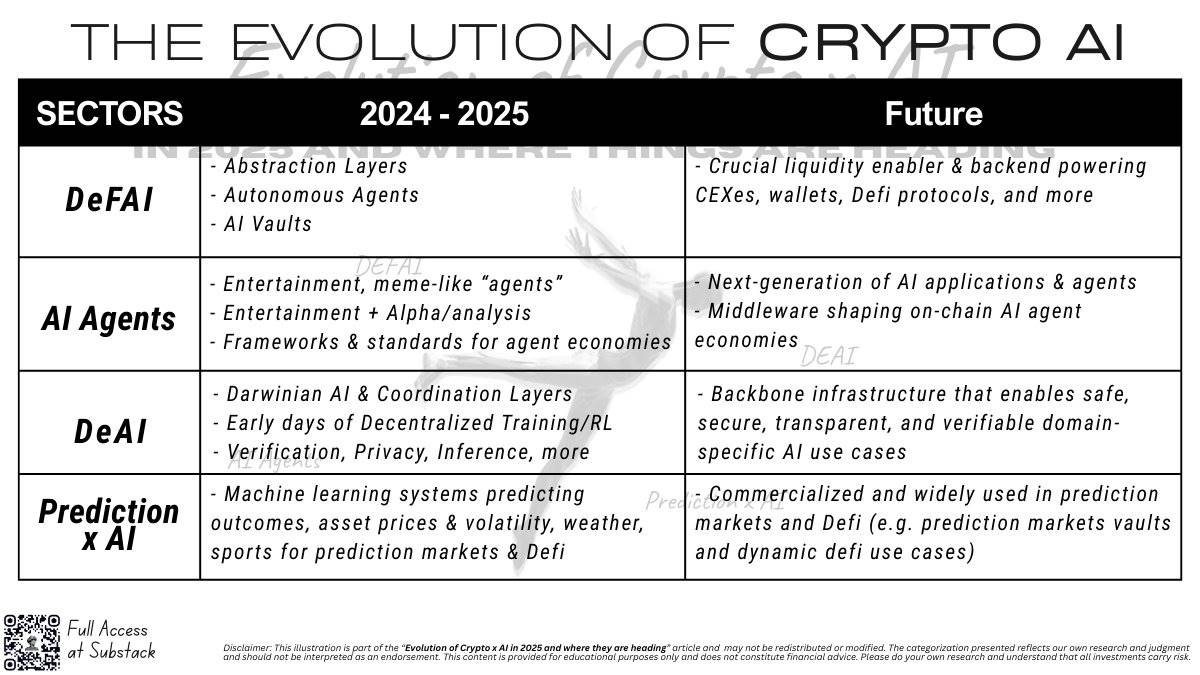
Across all areas, the same trend is evident—the narratives that survived are those with real users, actual utility, and economic alignment.
Decentralized Finance AI (DeFAI) will gradually mature into a three-layer architecture:
-
Abstraction layer
-
Automation layer
-
Strategy creation layer powered by AI agents
It will quietly become the entry and execution layer for millions of users accessing on-chain finance, most of whom may not even realize they are using crypto technology.
Once overhyped AI agents will re-emerge as verifiable economic actors.
This transformation is thanks to standards that赋予AI agents identity, reputation, and deterministic behavior, currently being actively developed and supported by the Ethereum Foundation, Coinbase, Google, Cloudflare, and others.
Decentralized AI (DeAI) remains the most important structural pillar. The networks that excel in the following areas will become long-term winners:
-
Efficiently coordinating computational resources
-
Attracting and retaining global developer talent
-
Verifying results and provenance
-
Providing enterprise-grade reliability
As markets deepen, tools optimize, and machine learning-driven liquidity becomes a sustainable source of yield, prediction markets x AI will continue to expand. However, liquidity constraints and edge decay will remain fundamental challenges for any participant trying to scale capital.
Overall, these development trends indicate that the entire industry is moving from narrative to infrastructure, from speculation to systematic solutions, from hype to actual products. 2026 will be the year crypto-native AI products start becoming indispensable.
If you are new to Crypto x AI, it is recommended to read this "Beginner's Guide" to quickly get up to speed with the latest developments in this field.