What would it take to do DAS with inner product arguments (IPAs)?

Vitalik ButerinPublished on 2022-02-22Last updated on 2022-02-22

Abstract

Data availability sampling (DA-sampling or DAS) today is planned to be done with KZG commitments.

Data availability sampling (DA-sampling or DAS) today is planned to be done with KZG commitments. KZG commitments have the advantage that they are very easy to work with, and have some really nice algebraic properties:
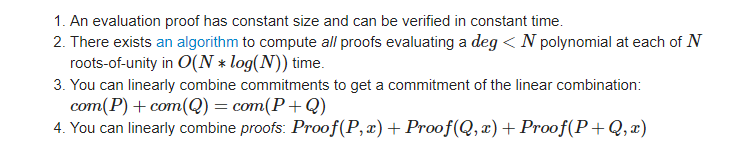
The first is a nice efficiency guarantee. The second ensures that producing a blob that can be DA-sampled is easy: if it takes O(N2) time to generate all proofs, then it would require either highly centralized actors or a complicated distributed algorithm to make it DAS-ready.

The third and the fourth are very valuable for 2D sampling, and enabling distributed block producers and efficient self-healing:

A block producer only needs to know the original M commitments to “extend the columns” with an FFT-over-the-curve and generate 2M commitments that are on the same deg<M polynomial.

You can do not only per-row reconstruction but also per-column reconstruction: if some values and proofs on a column are missing (but more than half are still available), you can do an FFT to recover the missing values and proofs.

However, KZG has a weakness: it relies on complicated pairing cryptography, and on a trusted setup. Pairings have been understood for over 20 years, and the trusted setup is a 1-of-N trust assumption with N being hundreds of participants, so the risk in practice is high and this author believes that proceeding with KZG is perfectly acceptable. However, it is worth asking the question: if we don’t want to pay the costs of KZG, can we use inner product arguments (IPAs) instead?

IPAs have the following properties:

  1. An evaluation proof has logarithmic size and can be verified in linear time (roughly 40ms for a size-4096 polynomial)
  2. There is no known efficient multi-proof generation algorithm.
  3. Commitments are elliptic curve points and you can linearly combine them just like KZG commitments
  4. There is no known way to linearly combine proofs.

Hence, we keep some properties and we lose some. In fact, we lose enough that our “current approach” to generating, distributing and self-healing proofs is no longer possible. This post describes an alternative approach that, while somewhat more clunky, still achieves the goals.

An alternative approach

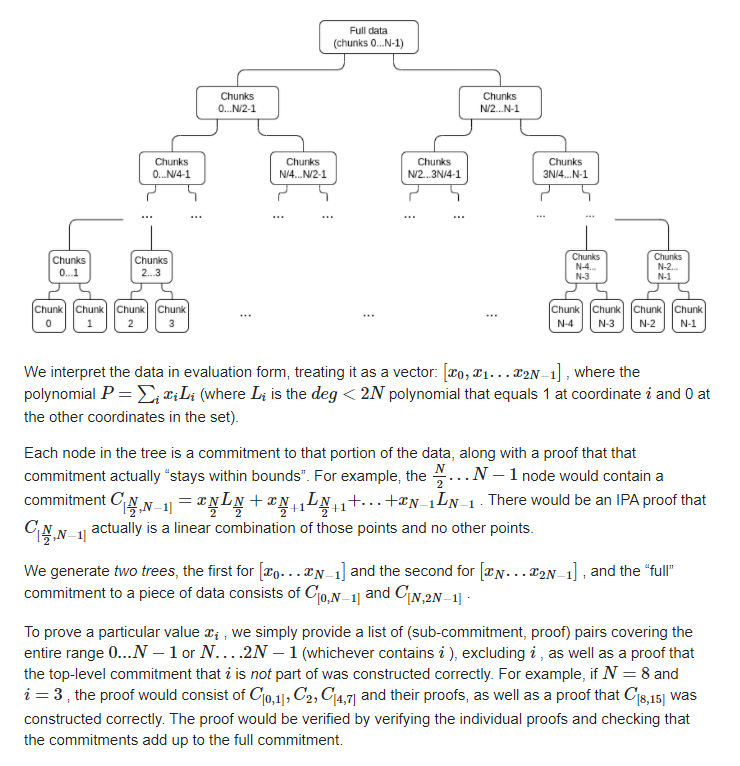
First, instead of generating 2N independent proofs for a deg<N polynoial, we generate a proof tree. This looks as follows:
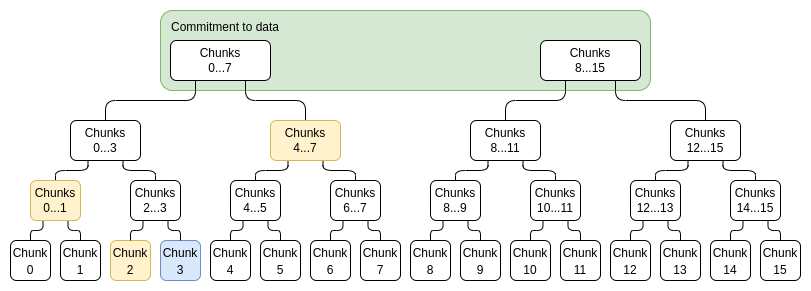
Blue: chunk 3, yellow: proof for chunk 3.

Note that to improve efficiency, each chunk does not need to be a single evaluation; instead, we can crop the tree so that eg. a chunk is a set of 16 evaluations. Given the combined size of the proofs will be larger than this regardless, we lose little from making chunks larger like this.

Generating these proofs takes O(N∗log(N)) time. Verifying a proof takes O(N) time, but note that verification of many proofs can be batched: the O(N) step of verifying an IPA is an elliptic curve linear combination, and we can check many of these with a random linear combination. O(N) field operations per proof would still be required, but this takes <1 ms.

Extension: fanout greater than 2

Instead of having a fanout of 2 at each step, we can have a higher fanout, eg. 8. Instead of one proof per commitment, we would have 7 proofs per commitment. At the bottom level, for example, we would have a proof of {1,2,3,4,5,6,7} , {0,2,3,4,5,6,7} , {0,1,3,4,5,6,7} , etc. This increases total proof generation effort by ≈(7∗7/4)/3 x (7 proofs per node, each proof 1.75x the size of the original, but 3x fewer layers, so ~4.08x more effort total), but it reduces proof size by 3x.

Proof size numbers

Suppose that we are dealing with N=128 chunks of size 32 (so we have deg<4096 polynomials), and a fanout of (4x, 4x, 8x). A single branch proof would consist of 3 IPAs, of total size 2∗(7+9+12)=56 curve points (~1792 bytes) plus 512 bytes for the chunk. This compares to 48 byte proofs for a 256 byte or 512 byte chunk today.

Generating the proofs would require a total of 2∗8192∗(3∗2+7) curve multiplications (3 * 2 for the two fanout-4 layers and 7 for the fanout-8 layer), or a total of ~212992 multiplications. Hence, this would require either a powerful computer to do quickly (a regular computer can do one multiplication in ~50 us, so this would take 10 seconds which is a little too long) or a distributed process where different nodes focus on generating proofs for different chunks.

Verifying the proofs is easy, as proof verification can be batched and only a single elliptic curve multiplication done. Hence, it should not be much slower than with KZG proofs.

Self-healing

Self-healing could not effectively be done column-by-column. But can we avoid requiring a single healer to have all of the data (all 2N chunks from each of all 2M polynomials)?

Suppose that a single row is entirely missing. It’s easy to use any column to reconstruct the value in the missing row in that column. But how to prove it?

The simplest technique is cryptoeconomic: anyone can simply post a bond claiming a value, and someone can later take that claim together with a branch proof proving a different value to slash that validator. As long as enough legitimate claims are available, someone on that row subnet can combine together the claims and reconstruct the commitment and the proofs. Validators could even be required to publish such claims for sample indices that they are assigned to.

A cryptoeconomics-free but more technically complicated and slow alternative is to pass along M branch proofs for values along that column, along with a Halo-style proof that the proofs verify correctly.


Trending Cryptos

Related Reads

The Verdict in Choi Tae-won's Divorce Case: Revealing the Inheritance Undercurrent Behind SK Hynix's Trillion-Won Empire

SK Group Chairman Chey Tae-won's high-profile divorce case, involving a record 1.38 trillion won settlement, has drawn attention to the succession plans for Korea's second-largest conglomerate, especially its crown jewel, SK hynix. Unlike traditional chaebol scripts centered on the eldest son, Chey's three children from his marriage to former President Roh Tae-woo's daughter, Roh Soh-yeong, are carving distinct, non-traditional paths. Eldest daughter Chey Yun-jung (b. 1989) is seen as the most evident successor. With a scientific and consulting background, she holds executive roles at SK bioscience and SK Inc.'s growth support department, focusing on future strategy and biopharma. Her marriage is to an AI infrastructure entrepreneur, not a traditional business alliance. Second daughter Chey Min-jung (b. 1991) took a unique route, voluntarily serving as a South Korean naval officer, including an anti-piracy deployment. She later worked on policy and strategy for SK hynix in Washington D.C. before co-founding an AI-driven healthcare startup. She married a former U.S. Marine Corps officer, connecting her to U.S. defense and policy circles—networks crucial for a global semiconductor giant. The only son, Chey In-geun (b. 1995), who studied physics like his father, worked briefly at SK E&S before joining McKinsey. Despite fitting the traditional "heir" profile as the eldest son, he remains silent and holds no public position or shares in SK, suggesting the old succession playbook is obsolete. As SK hynix's valuation soars, becoming a geopolitical asset in the AI era, the heirs' legitimacy is no longer automatic. They must prove themselves in fields like AI biotech, global policy, and strategic consulting. Their marriages also reflect new elite networks in tech and defense, not old political alliances. Their inheritance is the complex challenge of navigating a globalized, tech-driven world, not just a corporate throne.

marsbit4h ago

The Verdict in Choi Tae-won's Divorce Case: Revealing the Inheritance Undercurrent Behind SK Hynix's Trillion-Won Empire

marsbit4h ago

From OpenSea to OpenRouter: Is Alex Atallah Repeating His 'Exit at the Peak' Playbook?

From OpenSea to OpenRouter: Is Alex Atallah Repeating His "Exit at the Peak" Playbook? According to the Wall Street Journal, payments giant Stripe is in talks to acquire the AI model aggregation platform OpenRouter in a potential deal valuing the company near $100 billion. This would mark founder Alex Atallah's second creation of a company reaching a $100 billion valuation, following his co-founding of NFT marketplace OpenSea. OpenRouter, founded just over three years ago, has grown rapidly by acting as a unified gateway for developers to access over 400 AI models. It currently has about 10 million users and processes over 200 trillion tokens monthly. While the platform's annualized revenue is around $50 million, its valuation has skyrocketed from $1.3 billion in March 2026. The potential acquisition by Stripe, a company OpenRouter's founder once likened it to, represents a major expansion into AI infrastructure for the payments leader. This move echoes Atallah's previous timing with OpenSea, where he departed before the NFT market's significant downturn. For OpenRouter, selling now may be strategic. Despite its scale, its business model—charging a 5-5.5% fee on AI inference calls—faces pressure from competition, open-source models, and potential price wars among model providers, limiting its profitability narrative for an IPO. A key asset for potential acquirers like Stripe is OpenRouter's vast repository of real-world AI usage data, which offers unique insights into model performance and developer preferences that are difficult to replicate. Whether this potential deal signifies a new valuation benchmark for AI infrastructure or another market peak signal remains to be seen.

链捕手5h ago

From OpenSea to OpenRouter: Is Alex Atallah Repeating His 'Exit at the Peak' Playbook?

链捕手5h ago

Trading

Spot

Hot Articles

How to Buy ETC

Welcome to HTX.com! We've made purchasing Ethereum Classic (ETC) simple and convenient. Follow our step-by-step guide to embark on your crypto journey.Step 1: Create Your HTX AccountUse your email or phone number to sign up for a free account on HTX. Experience a hassle-free registration journey and unlock all features.Get My AccountStep 2: Go to Buy Crypto and Choose Your Payment MethodCredit/Debit Card: Use your Visa or Mastercard to buy Ethereum Classic (ETC) instantly.Balance: Use funds from your HTX account balance to trade seamlessly.Third Parties: We've added popular payment methods such as Google Pay and Apple Pay to enhance convenience.P2P: Trade directly with other users on HTX.Over-the-Counter (OTC): We offer tailor-made services and competitive exchange rates for traders.Step 3: Store Your Ethereum Classic (ETC)After purchasing your Ethereum Classic (ETC), store it in your HTX account. Alternatively, you can send it elsewhere via blockchain transfer or use it to trade other cryptocurrencies.Step 4: Trade Ethereum Classic (ETC)Easily trade Ethereum Classic (ETC) on HTX's spot market. Simply access your account, select your trading pair, execute your trades, and monitor in real-time. We offer a user-friendly experience for both beginners and seasoned traders.

4.6k Total ViewsPublished 2024.03.29Updated 2026.06.02

How to Buy ETC

Discussions

Welcome to the HTX Community. Here, you can stay informed about the latest platform developments and gain access to professional market insights. Users' opinions on the price of ETC (ETC) are presented below.

活动图片