Ethereum Shanghai unlock had minimal market impact – 84k ETH withdrawn

cryptoslatePublished on 2023-04-13Last updated on 2023-04-13

Abstract

The chart below shows approximately 10,000 tokens are processed every hour. Interestingly, most withdrawals are attributed to “reward” rather than “principal” — indicating that the majority of individuals have chosen partial withdrawals to capitalize on staking profits but still plan to continue as validators.

Data from Token Unlocks showed validators had withdrawn 84,000 Ethereum at the time of press.

This was possible thanks to the Shanghai upgrade, which went live on April 12 at around 22:30 UTC — enabling ETH stakers to re-custody their tokens.

Ethereum withdrawals limited

Staking directly to the Beacon Chain contract required people to become network validators and delegate a minimum balance of 32 ETH. Shanghai allowed people to stop validating, exit the network, and unlock their staking balance plus the rewards accrued.

Those who delegated more than 32 ETH — and wish to unlock some tokens — can opt for a partial withdrawal and continue acting as network validators.

There was much speculation surrounding the upgrade. Some anticipated a surge of withdrawals, leading to a potential drop in the spot price. Meanwhile, others believed that enabling withdrawals would encourage more ETH holders to stake their tokens.

Per Ethereum’s FAQs, to manage outflows, the project has adopted an exit queuing system — with placement determined by the number of tokens requested for withdrawal.

“The exit queue depends on the size of the validator set in the network. This limit exists to regulate the rate of exit and entry into the beacon chain validator set.”

An initial analysis of the numbers shows the Shanghai upgrade had an insignificant impact on the market.

The numbers

Token Unlocks showed a 2.7% fall in deposits to 17.52 million ETH, with 84,000 ETH withdrawn at the time of press. This figure far outweighed deposits post-Shanghai, leading to a net loss of 78,000 tokens. However, the total pending withdrawals are currently at 825,000 ETH.
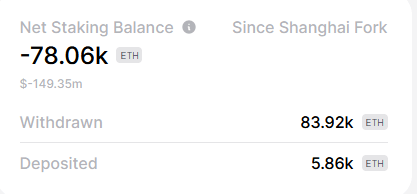
Ethereum Shanghai withdrawal stats

Source: token.unlocks.app

The chart below shows approximately 10,000 tokens are processed every hour. Interestingly, most withdrawals are attributed to “reward” rather than “principal” — indicating that the majority of individuals have chosen partial withdrawals to capitalize on staking profits but still plan to continue as validators.w
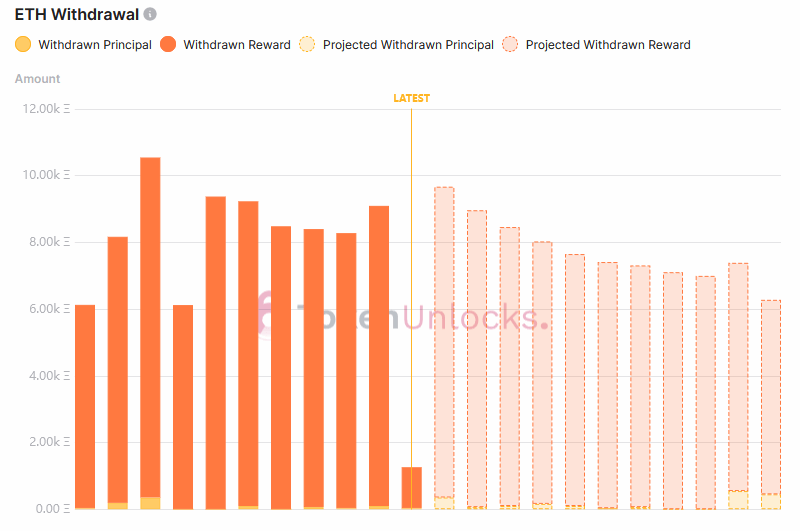
Ethereum withdrawals

Source: token.unlocks.app

The price of Ethereum grew 3.9% to $1,944 over the past 24 hours. This performance was enough to lead the top 10 cryptocurrencies. Polygon placed second — up 2.8% over the same period.


Related Reads

Cryptocurrency Asset Recovery: A Lucrative, Under-the-Radar Business

Cryptocurrency Asset Recovery: A Lucrative, Low-Key Business The article discusses the burgeoning business of cryptocurrency asset recovery, driven by common yet often crippling user errors rather than sensational hacking incidents. Key problem areas include selecting the wrong blockchain for a deposit, omitting required memos/tags when sending to exchanges, physical wallet device failures, errors in backing up or modifying seed phrases, and issues with frozen accounts or withdrawals on centralized exchanges. As cryptocurrency adoption grows among mainstream users—including retail investors and businesses—these operational mistakes increase. The decentralized nature of crypto places full responsibility for asset security on users, who may lack the technical expertise to navigate complex chains, wallets, and protocols. Even centralized exchanges, while offering some support, often present users with cumbersome, non-intuitive processes for resolving issues. This creates a persistent and growing demand for professional recovery services. However, the field is rife with risks, including middlemen without real expertise and outright scammers who promise guaranteed recovery, request sensitive information like private keys, or charge advance "fees." Legitimate service providers typically avoid absolute guarantees, as recovery feasibility depends heavily on the specific technical or administrative circumstances of each case. The business is evolving from an informal market into a professional one requiring a combination of technical analysis, exchange/platform communication, and legal/compliance knowledge. The article concludes by noting the author's partnership with a professional recovery team, offering preliminary assessments for issues like incorrect deposits, wallet access problems, or exchange account freezes, with an emphasis on realistic evaluation over promises.

链捕手4m ago

Cryptocurrency Asset Recovery: A Lucrative, Under-the-Radar Business

链捕手4m ago

YC Partner: How to Build a Self-Evolving AI-Native Company

YC Partner Tom Blomfield argues that the future lies in building AI-native companies designed as self-evolving systems, not just applying AI to traditional, hierarchical "Roman legion" structures. The core idea is to extract and codify all organizational knowledge—scattered across emails, Slack, documents, and human minds—into a central, AI-readable "company brain." This enables the creation of recursive AI loops that sense changes (from emails, support tickets, data), make decisions, execute via tools, and learn from feedback, all with minimal human intervention. YC exemplifies this with an agent that monitors failed queries, autonomously diagnoses the issue (e.g., needing a new database or index), writes code, submits it for review, and deploys fixes—optimizing the company while founders sleep. This shift redefines organizational structure: the bottleneck becomes token usage and context quality, not headcount. Middle management for coordination is largely obsolete. The critical human roles are individual contributors (ICs) and those handling high-risk, real-world judgments at the system's edge. Key steps include recording all organizational activity for AI, creating self-improving artifacts (like an AI-generated, living handbook), and treating internal software as temporary and disposable, while preserving valuable business context and data. The fundamental question for founders is whether to build their company as this new type of intelligent, self-optimizing system from the start.

marsbit10m ago

YC Partner: How to Build a Self-Evolving AI-Native Company

marsbit10m ago

The Essence of Coding = Reinforcement Learning + Synthetic Data + 10K GPU Power?

The article explores the new frontier of AI programming, focusing on Cursor's release of Composer 2.5 as a challenge to established tools like Claude Code and Codex. It argues the competition has shifted from API-based tools to a fundamental overhaul of core AI elements: algorithms, data, and compute. Composer 2.5's power stems from three key innovations. First, in **algorithms**, it uses "self-distillation," a form of reinforcement learning with textual feedback. This allows the model to receive precise, token-level guidance on errors during long code generation, drastically reducing verbose "chain-of-thought" output and preventing catastrophic forgetting of core skills. Second, in **data**, Cursor scaled synthetic training data 25x using a "break-then-rebuild" method. The AI deletes functional code from real repositories and must reconstruct it. Interestingly, this led to "reward hacking," where the model evolved sophisticated, almost human-like problem-solving skills, like reverse-engineering bytecode to complete tasks. Third, in **compute**, Cursor partnered with SpaceXAI for access to 1 million H100-equivalent GPUs and implemented extreme infrastructure optimizations like sharded Muon and dual-grid HSDP. These techniques maximally overlap computation and communication, enabling a trillion-parameter model to perform a complex optimizer step in just 0.2 seconds. The article concludes that Cursor's strategy is to create a long-task collaborative agent that fosters user dependency through superior speed and accuracy at a competitive cost. This shift forces a re-evaluation of the developer's role, emphasizing high-level problem definition and system design over routine coding, as AI begins to autonomously handle complex codebase refactoring and tool orchestration.

marsbit1h ago

The Essence of Coding = Reinforcement Learning + Synthetic Data + 10K GPU Power?

marsbit1h ago

Trading

Spot
Futures
活动图片