10 Charts to Understand the State of AI in 2026: US-China Gap Only 2.7%, Sharp Decline in Programmer Positions for Under-25s

marsbitPublished on 2026-04-15Last updated on 2026-04-15

Abstract

The 2026 AI Index Report from Stanford HAI reveals that AI adoption is accelerating faster than PCs and the internet, with a 53% global adoption rate. However, societal systems, job markets, and measurement tools lag behind. Key findings include: - Benchmark reliability is questionable, with 42% of GSM8K math problems deemed invalid. - The U.S. and China show near-parity in model performance (2.7% gap), with the U.S. leading in compute/capital and China in research/manufacturing. - Top models (Anthropic, xAI, Google, OpenAI) show converging capabilities, shifting competition to cost and reliability. - Employment for young developers (22–25) fell nearly 20%, with McKinsey noting AI-driven reductions in services, supply chain, and engineering. - The U.S. ranks 24th in adoption (28.3%) despite leading investment ($285.9B private AI funding in 2025). - AI agent task success improved but has ~33% failure rates; physical robots struggle outside labs (12.4% home success vs. 89.4% in sim). - A stark expert-public divide exists: 73% of experts vs. 23% of the public view AI’s job impact positively. - GPT-4o’s annual water use exceeds 12M people’s needs; AI data centers consume power equivalent to New York State. The report underscores rapid AI integration amid unresolved ethical, environmental, and economic challenges.

Stanford HAI (Human-Centered Artificial Intelligence Institute) has just released the 2026 AI Index Report, the most authoritative annual check-up for the AI field. Over the past year, Stanford researchers, through a series of observations, reached a core conclusion: AI is being adopted globally at a pace surpassing that of the PC and the internet, but human society's institutions, job markets, and measurement tools are lagging behind comprehensively.

AI is sprinting, while humanity is still looking for its shoes. Ten charts show you where AI is running faster than humans.

1

The Tests Used to Measure AI Are Themselves Useless
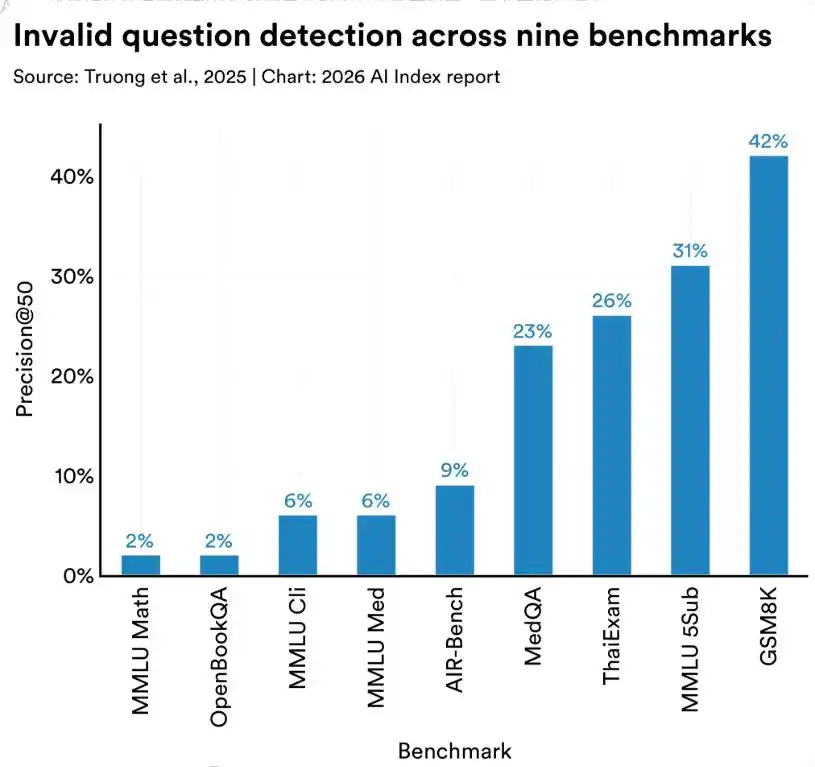
Headlines like "AI Surpasses Humans" are all based on the credibility of benchmarks. But the Stanford report found that nearly 42% of the questions in the widely used math benchmark GSM8K are invalid. Other tests are also suspected of being "gamed"; models can score high after being trained on the test data, but that doesn't mean they've gotten smarter. Many companies refuse to disclose relevant benchmark results. Gil, one of the report's authors, said: "The refusal to disclose results might itself say something."

2

The Substantial US-China Gap Disappeared, Only 2.7% Difference
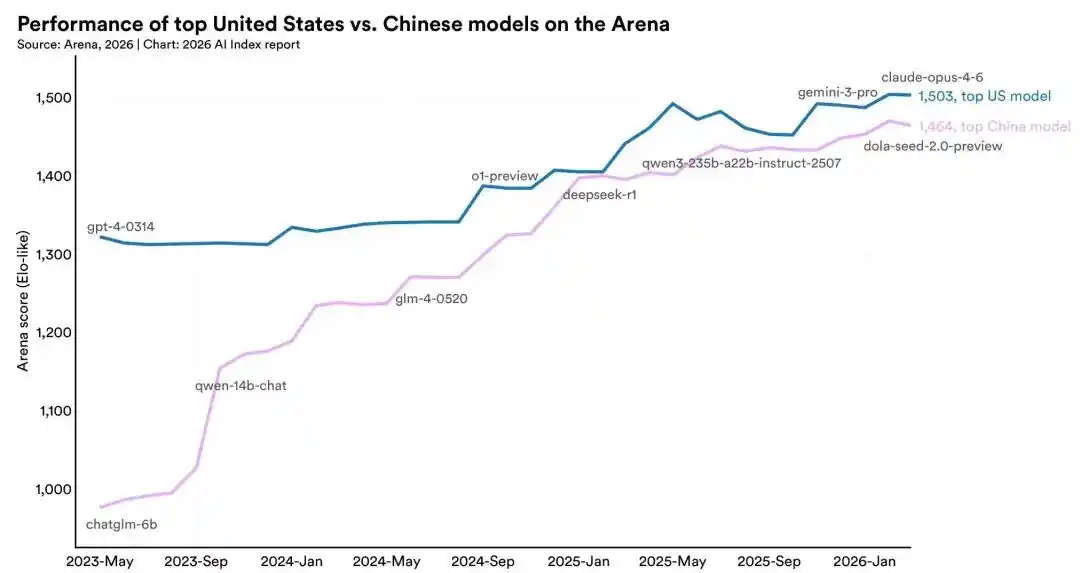
As of March 2026, the Elo rating of the US's strongest model, Claude Opus 4.6, is 1503, with China's strongest model close behind, a gap of only 2.7%. Over the past year, the models from the two countries have taken the lead multiple times. In February 2025, DeepSeek R1 once caught up to the US's strongest model.

However, the AI advantages of the two countries are completely different. The US has stronger models, more capital, and owns 5,427 data centers, more than 10 times that of any other country. China leads in AI research papers, patents, and robot deployment. Simply put, the US wins in computing power and money, China wins in research and manufacturing.

3

Frontier Models Converge, Intelligence Levels Comparable
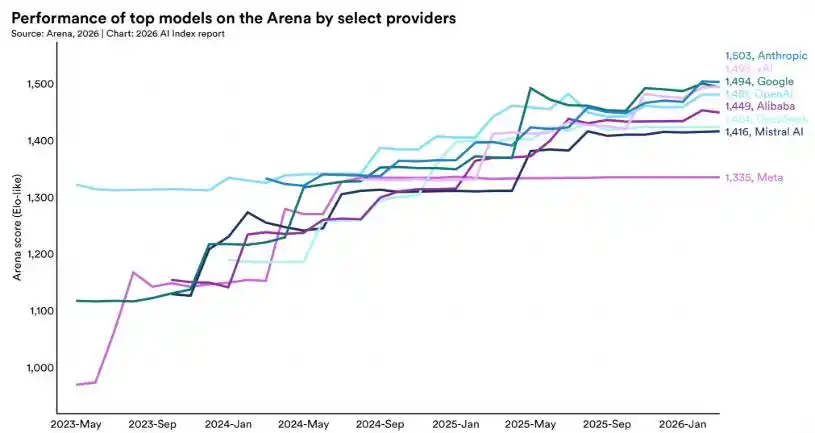
As of March 2026, Anthropic (1503), xAI (1495), Google (1494), and OpenAI (1481) are squeezed into an extremely narrow range. This means "whose model is stronger" is no longer the focus of competition. The focus of competition is shifting to cost, reliability, and optimization for specific domains—this also explains why Anthropic is working on Advisor Tools (to reduce costs), Google is buying Wiz (cloud security), and OpenAI is buying various application-layer companies (to expand scenarios). As the models' own performance converges in intelligence, differentiation must be created elsewhere.

4

Employment for 22-25 Year Old Developers Drops Nearly 20%
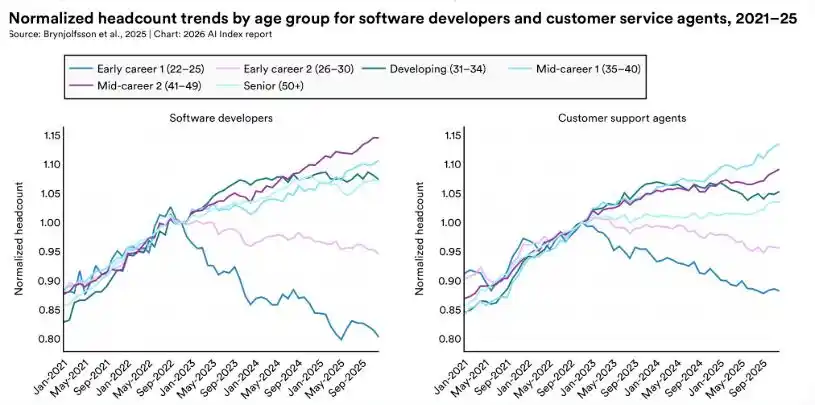
Generative AI achieved an adoption rate of over 53% at the population level within three years, and 88% of organizations are already using AI. But the employment impact is not even. A 2025 study by Stanford economists found that employment of software developers aged 22-25 has fallen by nearly 20% since 2022, while older demographics are still growing. A McKinsey 2025 survey showed that 1/3 of organizations expect to reduce staff due to AI in the next year, with cuts concentrated in service operations, supply chain, and software engineering.

Overall data does not yet show mass unemployment, but this is enough to show that the job market is like a frog in slowly heating water; the crisis is growing gradually.

5

Adoption Speed Surpasses PC and Internet, US Ranks Only 24th
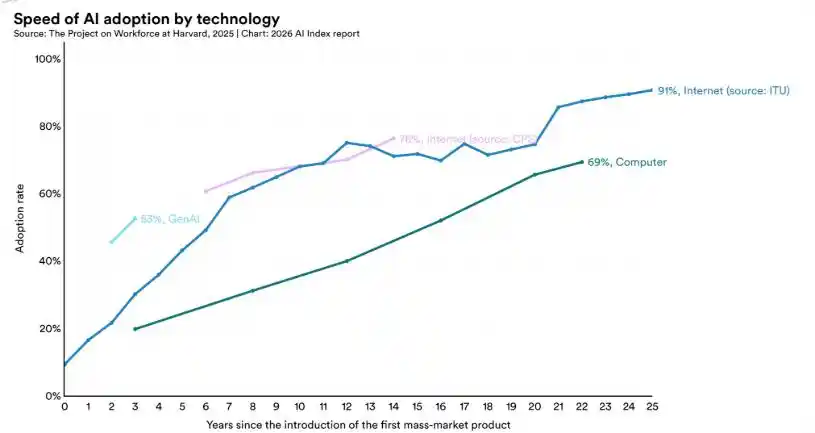
Generative AI reached a 53% population-level adoption rate within three years, a speed that surpassed the personal computer and the internet. But the most counterintuitive data point is: The US leads the world in AI investment and model development, but its population adoption rate is only 28.3%, ranking 24th globally. UAE 64%, Singapore 60.9%. The country that spends the most, uses it the least.

6

Global AI Investment $581.7B, US is 23 Times China's, But...
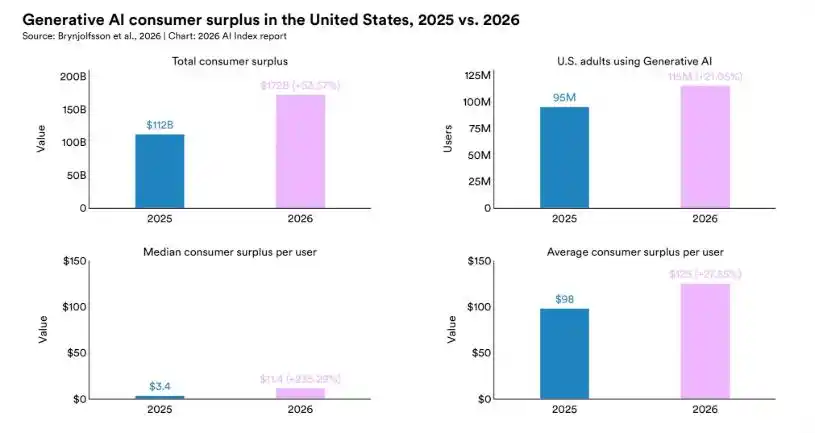
Global corporate AI investment reached $581.7 billion in 2025, a year-on-year increase of 129.9%. US private AI investment was $285.9 billion, 23 times that of China and 48.5 times that of the UK. California alone accounts for over 75% of the US total. Large deals are also dense: OpenAI raised $40 billion, valuation $300 billion; Anthropic raised $13 billion, valuation $183 billion; Cursor raised $2.3 billion at a $29.3 billion valuation.

However, there is a hidden piece of information: Domestically (in China), state-owned funds injected approximately $184 billion into AI companies between 2000 and 2023; this money was not counted in the private investment statistics. Adding this part, the funding gap between the US and China might be much smaller than the numbers on paper suggest.

7

AI Agent: From Chatting to Doing, But Still Has 1/3 Failure Rate
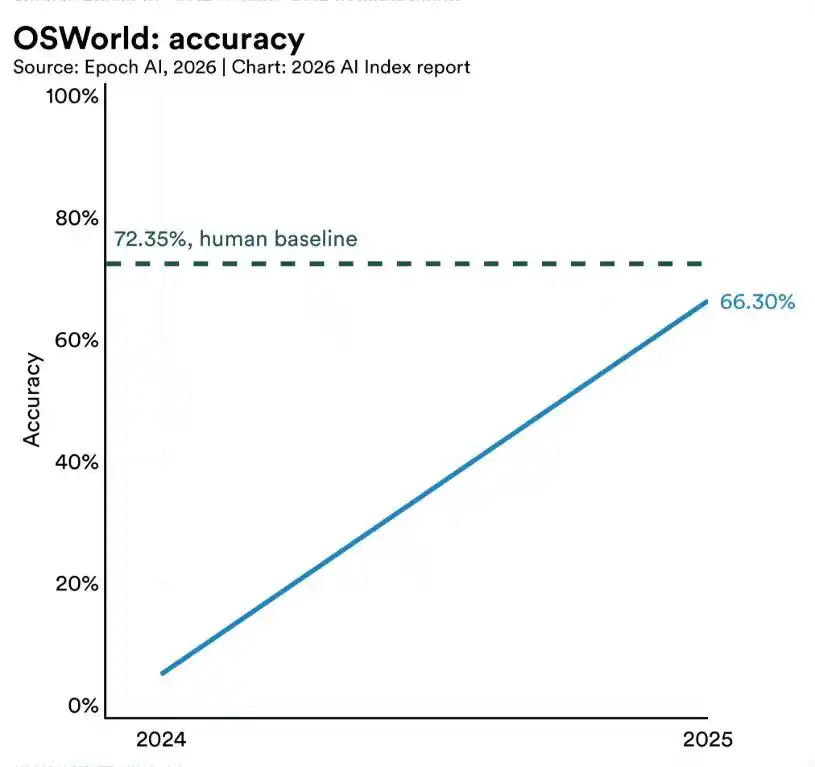
2025 was the year of the AI Agent. Accuracy on OSWorld (testing AI's ability to complete tasks on an operating system) soared from 12% to 66.3%, only 6 percentage points away from human performance. WebArena reached 74.3%, Cybench (cybersecurity tasks) surged from 15% to 93%.

But overall, Agents still have about a 1/3 failure rate. And actual enterprise deployment is still in the single digits—in most business scenarios, over 2/3 of respondents said they do not use AI Agents at all. There is still a big gap between progress on benchmarks and actual deployment.

8

89% of Robots Live in the Lab
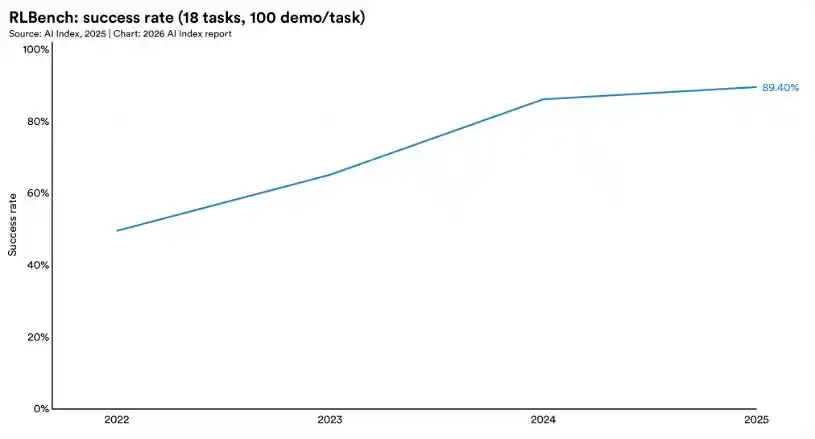
AI is already very strong in the virtual world, but still very weak in the physical world. The success rate for robot manipulation in software simulation environments is 89.4%, but the success rate for real-world household tasks is only 12.4%. One is a clean lab, the other is a messy home; in the latter kind of real environment, robot participation is still negligible.

However, autonomous driving is an exception: Waymo has about 450,000 trips per week, Apollo Go completed about 11 million fully driverless trips in 2025.

9

Experts vs Public: 73% vs 23% Cognitive Divide
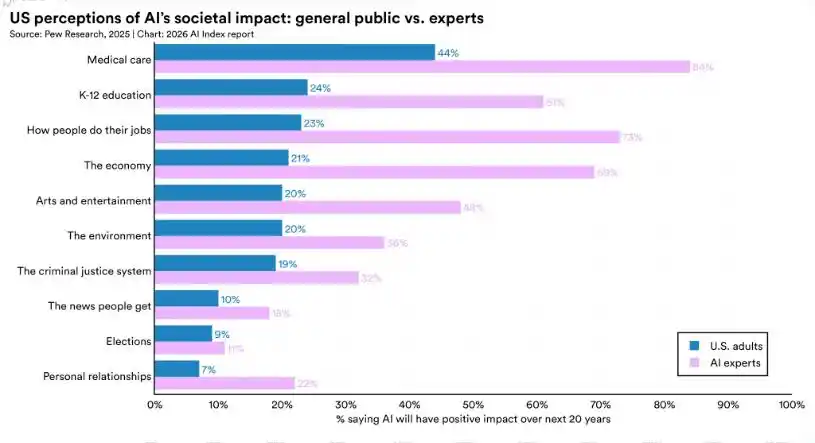
A Pew survey cited in the report reveals a startling divide: 73% of AI experts believe AI will have a positive impact on jobs, but only 23% of the American public thinks so—a complete polarization.

Another interesting data point: Among all countries surveyed, Americans have the lowest trust in government regulation of AI. Experts are also more optimistic about AI's prospects in education and healthcare, but both sides believe AI will harm elections and interpersonal relationships.

10

GPT-4o Uses Water for Over 12M People Annually, Electricity Could Power Entire New York State
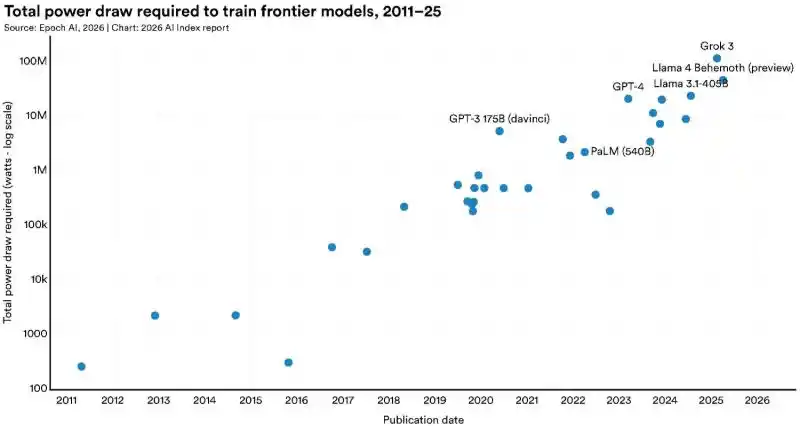
AI's progress comes at an environmental cost. Global AI data centers can now draw 29.6 GW of power, an amount sufficient to power the entire state of New York during peak usage. The annual water consumption of OpenAI's GPT-4o model alone could exceed the drinking water needs of over 12 million people.

These massive consumptions are injected into model training after model training, yet the chip supply chain behind the models is extremely fragile. The US owns most of the world's AI data centers, but almost every cutting-edge AI chip is manufactured by a single company, Taiwan's TSMC. All the computing power, all the investment, all the model progress, is built on this physical foundation.

The above is just the tip of the iceberg of the report, but it is enough to see that we are "embracing" a technology we don't fully understand at the fastest speed in history.

The full report covers more dimensions including AI safety, regulatory dynamics, research trends, and more. Highly recommended for interested friends to read the full original report. Link 👉🏻: https://hai.stanford.edu/ai-index

This article is from the WeChat public account "APPSO", author: APPSO Discovering Tomorrow's Products


Related Questions

QWhat is the core conclusion of the 2026 AI Index Report from Stanford HAI regarding the adoption of AI?

AThe core conclusion is that AI is being adopted globally at a speed surpassing that of the PC and the internet, but human institutions, job markets, and measurement tools are lagging behind.

QAccording to the report, what is the performance gap between the top AI models from the US and China as of March 2026?

AThe performance gap between the top US model (Claude Opus 4.6) and the top Chinese model is only 2.7% in Elo rating.

QWhat significant trend is reported regarding employment for young software developers aged 22-25?

AEmployment for software developers aged 22-25 has declined by nearly 20% since 2022, while employment for older age groups has continued to grow.

QHow does the generative AI adoption rate compare to the adoption rates of personal computers and the internet?

AGenerative AI achieved a population adoption rate of over 53% within three years, a speed that exceeds the adoption rates of both personal computers and the internet.

QWhat is the reported failure rate for AI Agents in 2025, and what does this indicate about their real-world deployment?

AAI Agents had an overall failure rate of about one-third. This high failure rate, along with the fact that most businesses reported no use of AI Agents, indicates a significant gap between benchmark progress and actual real-world deployment.

Related Reads

Google TPU Shipments Revised Up by 50%

Recent industry research indicates a significant upward revision in the shipments of Google's TPU (Tensor Processing Unit) chips. Previous expectations for 2027 were set at around 10 million units, but new estimates now point to 15 million units, a 50% increase. This substantial boost directly translates to higher demand across the entire supporting supply chain. Google's TPU clusters utilize a standardized all-optical interconnect architecture. Consequently, key hardware components are deeply integrated and scaled in fixed ratios with the chips. The 15 million TPU target will drive corresponding demand increases for NPO optical engines (roughly a 1:1 match), 1.6T optical modules, OCS optical switches, high-end server power supplies, fiber optics & MPO connectors, and liquid cooling solutions. Among these, liquid cooling is highlighted as the sector experiencing the most significant transformation and offering the most stable potential for excess returns. As next-generation TPU chips reach power levels where traditional air cooling is insufficient, liquid cooling becomes essential. 2026 is forecasted as the first year of substantial adoption for Google's liquid cooling solutions. This shift, coupled with delivery and capacity bottlenecks faced by incumbent overseas manufacturers, is creating a prime window for domestic Chinese suppliers to enter and secure Google's core supply chain. The market size for Google-specific liquid cooling is projected to potentially triple from a baseline of hundreds of billions to around 300 billion units by 2028. The logic for the fiber optic sector is also being rewritten. Once considered a cyclical commodity tied to telecom operator procurement, fiber is now a strategic and scarce resource for AI Data Centers (AIDC). A severe supply-demand imbalance, driven by the long lead time for preform production (18-24 months) and surging demand from cloud giants, is supporting strong performance. Chinese fiber manufacturers are well-positioned to capture a significant share of global AIDC demand, with exports potentially reaching 200-300 million core kilometers in 2026. Overall, the investment focus within the AI computing industry is shifting from pure "chip performance speculation" towards the more certain incremental growth in computing infrastructure and its supporting ecosystem. The upward revision in Google TPU shipments, along with the potential for further doubling by 2028, is seen as solidifying performance visibility for the entire supporting supply chain over the next two years.

marsbit19m ago

Google TPU Shipments Revised Up by 50%

marsbit19m ago

What Wall Street Really Wants After the Crypto Story Recedes

The tide of speculative crypto narratives has receded, revealing Wall Street's true objective: building a controlled, yield-generating, and compliant financial pipeline on distributed ledgers. They are migrating core functions onto blockchains, not for decentralization, but for efficiency and new revenue streams. Key developments include BlackRock's BUIDL fund, a tokenized treasury fund acting as a foundational reserve asset, and the rise of Securitize, which is going public and partnering with the NYSE to build a 24/7 digital securities trading and settlement system. This signals a major shift of securities clearing to blockchain technology. To make volatile assets like Bitcoin palatable for institutional investors, firms like BlackRock and Goldman Sachs are creating "covered call" ETFs (e.g., BITA). These products systematically sell options on Bitcoin holdings, transforming price volatility into stable monthly income, effectively repackaging crypto as a yield-bearing asset. Stablecoins are being positioned not as speculative tools but as efficient payment rails. Companies like Stripe and Mastercard are integrating them for instant, low-cost merchant settlements and cross-border card payments, respectively. Critically, new legislation like the GENIUS Act shapes them as non-interest-bearing, heavily regulated extensions of the US dollar system. In summary, Wall Street is quietly constructing a parallel, blockchain-based financial infrastructure featuring tokenized traditional assets, structured crypto yields, and programmable dollar pipelines—all under its control and fully integrated with existing regulatory and credit frameworks.

marsbit36m ago

What Wall Street Really Wants After the Crypto Story Recedes

marsbit36m ago

Tying Itself to SpaceX: Cursor's $60 Billion Rise

This article recounts the rapid rise of AI-powered coding startup Cursor and its 25-year-old MIT graduate CEO, Michael Truell. Launched in 2023, Cursor achieved explosive growth, reaching over 10 billion USD in revenue by late 2025. However, its journey highlights a central dilemma for AI application companies: dependence on foundational model providers. Cursor initially relied heavily on Anthropic's models but faced an existential threat when Anthropic launched its own competing coding tool, Claude Code. In response, Cursor declared an internal emergency in early 2026 and accelerated development of its own model, Composer. To secure the immense computing power needed, Truell struck a pivotal deal with Elon Musk's SpaceX in April 2026. The collaboration grants Cursor access to SpaceX's supercomputing resources for Composer, while SpaceX's Grok model benefits from Cursor's programming data. The agreement includes a potential 600 billion USD acquisition of Cursor by SpaceX later in the year, though a substantial termination fee is in place if the deal falls through. The story explores Cursor's intense, sometimes controversial hiring practices involving lengthy unpaid "work trials," its complex partnership-turned-rivalry with Anthropic, and its high-stakes gamble to ensure independence through the SpaceX alliance. The core question remains: will Cursor evolve into a defining, independent "generational" software company, or become a key piece in a tech giant's AI arsenal?

marsbit40m ago

Tying Itself to SpaceX: Cursor's $60 Billion Rise

marsbit40m ago

Warsh's Debut: Will the FED Chair Who Knows Crypto Best Bring Surprises or Shocks to the Market?

Kevin Warsh, the new Federal Reserve Chairman, prepares for his inaugural press conference amidst a challenging macroeconomic landscape: resurgent inflation, a bond market sell-off, and political pressure from President Trump for rate cuts. Uniquely, Warsh holds indirect investments in over 20 crypto and Web3 entities (e.g., Solana, dYdX), making him the first Fed Chair with disclosed crypto exposure. His stance may combine a hawkish, inflation-focused monetary policy with a crypto-friendly regulatory philosophy that shifts from Powell’s “same risk, same rule” approach toward a framework acknowledging blockchain’s productivity value. Warsh’s leadership could impact crypto markets across three dimensions: a paradigm shift in regulation (potentially accelerating pro-innovation legislation and stable币 rules), a re-pricing of risk premiums based on clearer communication and his view of AI as a structural disinflationary force, and a long-term reallocation of global institutional capital driven by increased legitimacy. Two potential scenarios for the press conference are outlined. A “positive surprise” would involve a dovish-leaning tone on rates coupled with signals of regulatory openness, potentially boosting crypto asset valuations. Conversely, a “negative shock” would see a more hawkish-than-expected stance on inflation and rates, triggering a broad risk-asset selloff that crypto markets would not escape. While ethics rules required Warsh to divest his crypto holdings upon confirmation, his deep understanding of the technology may fundamentally lower policy uncertainty and build a more receptive long-term foundation for digital assets’ integration into the mainstream financial system.

marsbit11h ago

Warsh's Debut: Will the FED Chair Who Knows Crypto Best Bring Surprises or Shocks to the Market?

marsbit11h ago

Trading

Spot
Futures

Hot Articles

Discussions

Welcome to the HTX Community. Here, you can stay informed about the latest platform developments and gain access to professional market insights. Users' opinions on the price of AI (AI) are presented below.

活动图片














