Cardano Price Forecast: 800% Upside or Another Step Down – Which Analyst Is Right About ADA?

cryptonews.ruPublished on 2026-07-29Last updated on 2026-07-29

Abstract

Cardano (ADA) is trading at $0.1643 on July 29th, rebounding from a fair value gap (FVG) around $0.1450-$0.1515 after a 6.27% drop. Key resistance levels are the 20-day EMA at $0.1654 and the 50-day EMA at $0.1737. Support levels include $0.1563 and $0.1513. Analyst Cheeky Crypto argues current prices are a generational buying opportunity, citing whale accumulation during June's market drop and Cardano's fundamentals like zero fees for failed transactions. He sees an 800% upside potential to previous highs. Conversely, analyst LuckSide Crypto attributes recent price weakness to geopolitical tensions (Iran rejecting a ceasefire) and a US Senate delay of the CLARITY Act, which is stalling crypto ETF approvals, including Grayscale's spot ADA ETF. On-chain data shows Cardano's stablecoin supply has tripled to over $55 million in a year. A new partnership with Reef Data for payment streams was also announced. The price forecast outlines two scenarios: 1) Bullish: ADA holds the FVG, reclaims key EMAs, and benefits from positive regulatory momentum. 2) Bearish: The FVG rebound fails due to heightened geopolitical risk and prolonged regulatory delays, pushing ADA towards lower support levels around $0.1563-$0.1513.

Cardano is trading at $0.1643 on July 29, having filled a fair value gap after Iran refused ceasefire talks and the Senate postponed the CLARITY Act for another week, with one analyst calling current prices a generational entry and another pointing directly to the legislative clock running out.

$ADA Bounces from FVG, but Triangle Already Broke Down
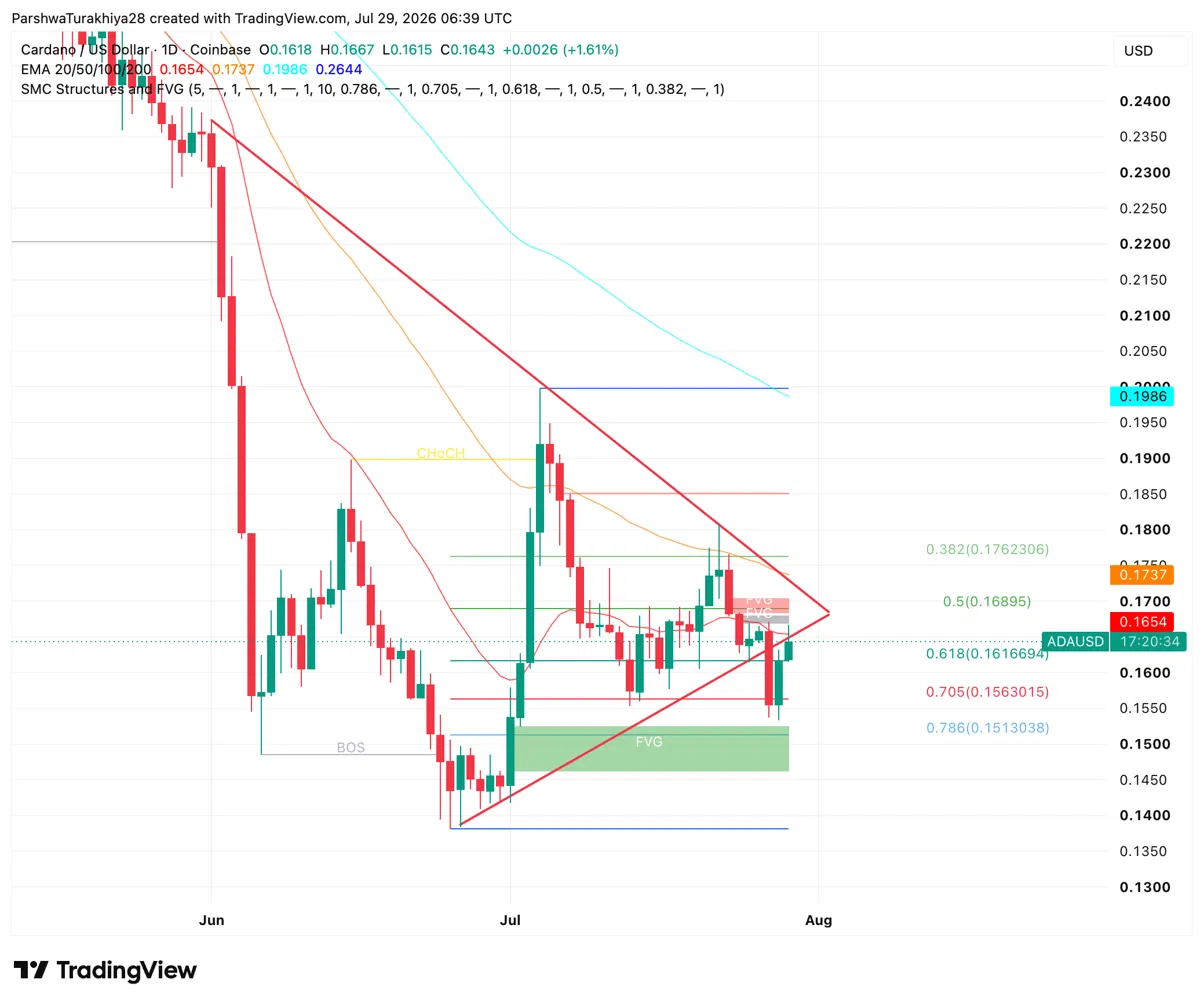
$ADA 1D Price Action (Source: TradingView)

The daily chart shows $ADA bouncing from the fair value gap roughly between $0.1450 and $0.1515 following yesterday's 6.27% drop, which broke through a triangular structure that had been compressing since mid-July. The FVG providing today's bounce sits just above the June lows around $0.1386.

The 20-day EMA at $0.1654 is the immediate ceiling above the current price, followed by the 50-day level at $0.1737. Below price, the SMC 0.705 level at $0.1563 and 0.786 at $0.1513 define the next support levels should the FVG bounce fail to hold.

What Are the Key Support and Resistance Levels for $ADA Today?

Resistance

  1. $0.1654 — 20-day EMA, immediate ceiling
  2. $0.1737 — 50-day EMA
  3. $0.1762 — 0.382 SMC Fibonacci Level
  4. $0.1986 — 100-day EMA level and CHoCH from the July recovery

Support

  1. $0.1617 — 0.618 SMC Fibonacci, current bounce zone
  2. $0.1563 — 0.705 level, next support below
  3. $0.1513 — 0.786 level and upper bound of FVG
  4. $0.1450 — Lower bound of FVG and last floor before June lows

Cheeky Crypto: Selling $ADA Here Could Cost You 800%

Analyst Cheeky Crypto argued in a YouTube video that $ADA at current prices represents an opportunity most investors will miss because they focus on price action rather than blockchain fundamentals. He cited a Claude AI analysis noting that whale wallets accumulated during the 40% market drop in June rather than selling, describing it as behavior historically leading to the largest percentage recoveries in major altcoins after macroeconomic conditions shift. His 800% figure is based on the gap between the current price and Cardano's previous all-time high, viewing the current drawdown as an entry point, not an exit.

He also explained Cardano's zero-fee model for failed transactions, lack of downtime, and increased throughput from Leios as reasons why institutional infrastructure will eventually run through Cardano rather than competitors. In his view, Hoskinson's goal of breaking into the top 10 by the end of 2026 is achievable, but some of today's top 10 altcoins will drop out of the ranking. He acknowledged it's a tall order given the competition.

LuckSide: CLARITY Act Delay Just Blew Up the Week

Analyst LuckSide Crypto pointed directly to two catalysts behind yesterday's 6.27% $ADA drop. The first was Iran's refusal of active talks with the U.S., contradicting weekend reports of a possible ceasefire and triggering over $500 million in crypto market liquidations. The second, which caused the session's late-session selloff, was the Senate tabling the CLARITY Act to prioritize a Russia sanctions bill, pushing the vote to next week and leaving the bill just days ahead of the August 8 recess.

LuckSide noted that over $30 trillion in assets from BlackRock, Fidelity, Schwab, Goldman Sachs, and Franklin Templeton now back the bill, making the political delay even more frustrating for the industry. He noted that Grayscale's spot $ADA ETF application remains stuck awaiting legislative clarity, and that any further signals of delay in the coming days would likely lead to lower prices again. In the immediate term, he is focused on the July 29 FOMC meeting conclusion and whether the Fed holds rates steady as CPI and PPI data suggests.

Cardano Stablecoin Supply Tripled, New Partnership Announced

The supply of stablecoins on the Cardano blockchain has grown from $18 million to over $55 million in the past year, a threefold increase, driven largely by USDC integration, reaching a new all-time high. LuckSide Crypto characterized this figure not as a small number but as proof of active capital entering the Cardano ecosystem despite bearish market sentiment.

Separately, Cardano announced a partnership with Reef Data for co-op payment stream locking, reward distribution, and participant payouts on-chain. Individual co-op members can self-custody their verified data. LuckSide presented this as another step in building real-world infrastructure on the network.

$ADA Price Forecast: Upside and Downside Targets

  • Positive Case: FVG holds, FOMC confirms rate hold on July 29, momentum on the CLARITY Act returns in the final days before August 8, and $ADA reclaims the 20-day EMA at $0.1654 moving towards the 50-day at $0.1737 as Cheeky Crypto's whale accumulation thesis begins translating into price recovery.
  • Negative Case: FVG bounce fails, Iran tensions escalate again, CLARITY Act momentum stalls past the August recess, and $ADA falls towards the SMC 0.705 level at $0.1563 and 0.786 at $0.1513 as the legislative overhang heightens risk-off sentiment through the week's end.
end-content

Trending Cryptos

Related Questions

QAccording to the article, what are the two main catalysts mentioned by analyst LuckSide that caused ADA's 6.27% drop?

AThe two main catalysts are 1) Iran's refusal to engage in active ceasefire talks with the US, and 2) The US Senate postponing the CLARITY Act vote for another week, prioritizing a Russian sanctions bill instead.

QWhat is the bullish case for ADA's price as outlined in the article?

AThe bullish case requires the Fair Value Gap (FVG) to hold, the FOMC confirming a rate hold on July 29th, momentum for the CLARITY Act returning before the August 8th recess, and ADA reclaiming key moving averages (the 20-day EMA at $0.1654 and 50-day EMA at $0.1737).

QWhat key fundamental reasons does Cheeky Crypto give for being bullish on Cardano (ADA)?

ACheeky Crypto cites Cardano's fundamental strengths, including its zero-fee model for failed transactions, zero network downtime, and increased throughput from Leios, as reasons why institutional infrastructure will ultimately flow through Cardano.

QWhat recent on-chain development for Cardano does the article highlight as a sign of growing ecosystem activity?

AThe article highlights that the supply of stablecoins on the Cardano blockchain has tripled, growing from $18 million to over $55 million in the past year, primarily driven by the integration of USDCX.

QWhat are the immediate support and resistance levels for ADA based on the technical analysis in the article?

AImmediate resistance is the 20-day EMA at $0.1654, followed by the 50-day EMA at $0.1737. Immediate support is at the 0.618 SMC Fibonacci level at $0.1617, with the next support at the 0.705 SMC level at $0.1563.

Related Reads

Analyzing the Impact of AI on Economic Growth and Productivity

**Title: Analyzing AI's Impact on Economic Growth and Productivity** This article examines three contrasting views on AI's influence on economic growth and productivity. **The Optimistic View** posits that AI, especially through automating R&D ("recursive self-improvement"), could dramatically accelerate growth, even triggering a technological "singularity" with explosive, potentially infinite, economic expansion. **The Moderate/Mainstream View** acknowledges AI's productivity benefits but emphasizes significant real-world constraints that could limit its impact. These include: limited cost savings per task, structural ceilings on which jobs and industries are "exposed" to AI, adoption bottlenecks (e.g., compute, energy, regulatory hurdles), and the "weak link" effect where non-automatable tasks cap overall gains. Consequently, the realized AI dividend may be far lower than optimistic projections, with estimates typically ranging from 0.1% to 1.3% annual productivity growth. **The Pessimistic View** stems from two strands. The first aligns with the moderate view but applies extremely conservative assumptions about task exposure and efficiency gains, yielding minimal projected impact. The second introduces a demand-side critique: if AI primarily replaces rather than augments labor, it could depress labor's share of income, weaken consumer demand, and create a "demand trap" that ultimately stifles growth, unless offset by redistribution policies. **The authors' assessment** is nuanced: * **Short-term (1-2 years):** AI will support growth primarily through investment spending, not significant productivity gains. * **Medium-term (3-5 years):** Three potential paths emerge based on AI demand and bottleneck severity: 1. **"Optimistic Path":** High demand, few bottlenecks. Rapid productivity gains but risk of major job displacement and social conflict without redistribution. 2. **"Moderate Path" (most likely):** High demand but significant, surmountable bottlenecks. Leads to moderate productivity gains, financial market volatility (K-shaped returns), and sectoral job losses. 3. **"Pessimistic Path":** Low demand or severe bottlenecks. Minimal productivity and growth impact, triggering financial market corrections but allowing a smoother societal transition with less labor disruption. * **Long-term:** AI holds potential for a major productivity revolution and prosperity. The conclusion stresses that no path is smooth. Technologically "optimistic" outcomes could be socially detrimental, while "pessimistic" technological diffusion might be more socially stable. Policymakers must monitor developments and prepare balanced responses to manage economic, financial, and social sustainability.

marsbit33m ago

Analyzing the Impact of AI on Economic Growth and Productivity

marsbit33m ago

The New Cold War is a Tech Stock War

The New Cold War is a Tech Stock War The article argues that the contemporary geopolitical and economic rivalry between the US and China represents a "New Cold War," but one fundamentally fought through technology and financial markets, not physical barriers or conventional trade. Historically, US dominance was secured through financial systems. The Soviet Union, reliant on the rigid "Transferable Ruble," was ultimately undermined by its dependency on the US dollar for oil trade. Later, Japan's semiconductor challenge was countered not just by tariffs (e.g., Plaza Accord, 301 investigations) but by binding it to US Treasury bonds. China presents a more complex, "embedded" challenger. While it holds vast dollar reserves and US debt like Japan, its industrial base is stronger and more diversified than the Soviet Union's. Surviving the initial 2018 trade war phase, the conflict has evolved into a "tech-financial war." The core battlefield is now the stock market. US tech stocks (AI, semiconductors) are treated as sovereign assets, buoyed by bipartisan national will. China is pushing to strengthen its own financial markets to convert industrial strength into financial power and fund its tech ambitions. Companies like ChangXin (semiconductors), Moonshot AI, and DJI compete not just for market share but as financial proxies for their respective systems. The new paradigm is moving from globally efficient monopolies (Apple, Google) towards companies that achieve monopolistic profits within their respective geopolitical spheres. This competition over "pricing power" and financial valuation in segmented markets defines the current era, making the stock market the primary arena for this tech-centric struggle.

marsbit43m ago

The New Cold War is a Tech Stock War

marsbit43m ago

Trading

Spot

Hot Articles

Discussions

Welcome to the HTX Community. Here, you can stay informed about the latest platform developments and gain access to professional market insights. Users' opinions on the price of ADA (ADA) are presented below.

活动图片