Here’s what Gnosis needs to do to flip BONK on the market cap charts

ambcryptoPublished on 2026-07-16Last updated on 2026-07-16

Abstract

Gnosis (GNO) recently rallied 13% in 24 hours, bringing its market cap to $303.88 million and close to BONK's $330.07 million. However, technical indicators suggest a near-term pullback is likely. GNO's price pushed into the overvalued upper Bollinger Band, while the Money Flow Index shows heavy capital outflows, indicating active profit-taking. On-chain data reveals spot netflow turned negative, with significant selling into the rally. To flip BONK's market cap, GNO's price would need to climb to approximately $125.48. Analysts suggest this move may require a period of consolidation or a pullback to support levels before a renewed advance can occur.

Before correcting somewhat, Gnosis [GNO] climbed by 13% in just 24 hours. In fact, it recorded a rally that hinted at whether the token can flip one of the market’s leading memecoins, BONK, by market capitalization.

Such a flip would lift Gnosis to the 100th spot among tokens by market capitalization. At the time of writing though, Gnosis held a market cap of $303.88 million against BONK’s $330.07 million.

And yet, despite it being close enough to tempt a flip, yet Gnosis may ease into consolidation and not mount it just yet.

Structural warnings surface for Gnosis

At the time of writing, indicator-based analysis suggested that Gnosis has moved into overvalued territory and may struggle to sustain its rally in the near term.

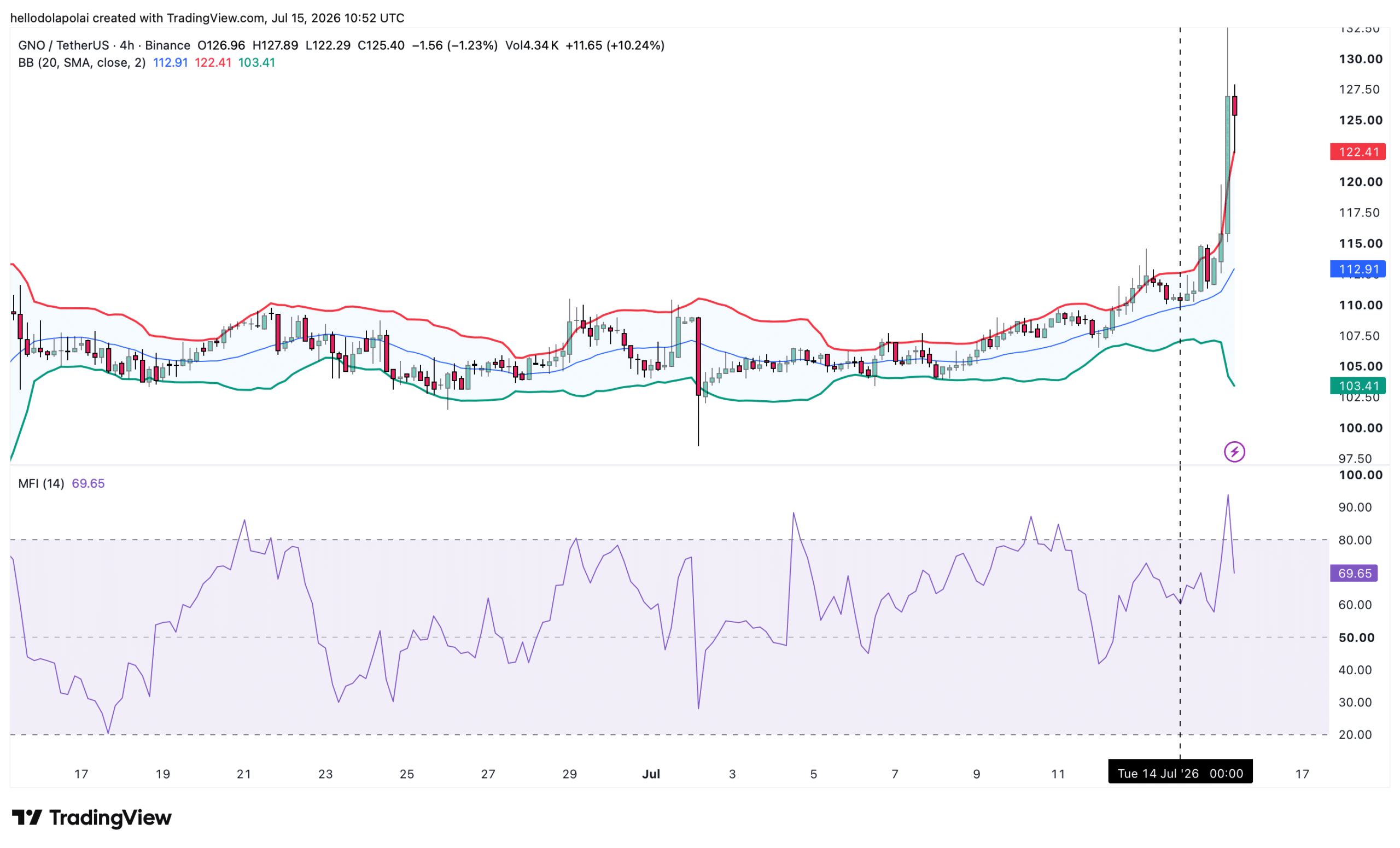
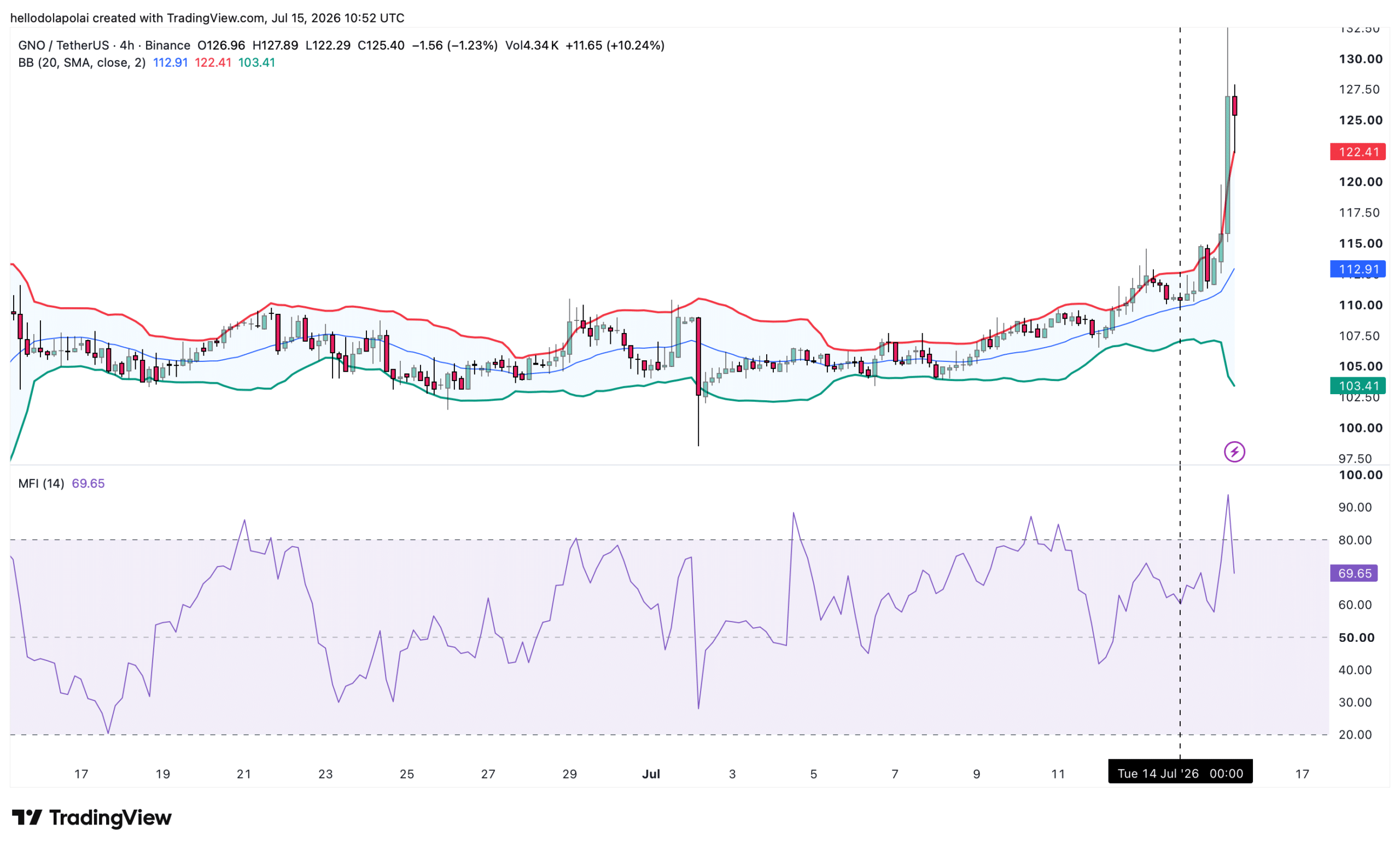
The first signal came from the price pushing into the upper Bollinger Band (BB). The indicator gauges valuation by price position as while a move above the red upper band points to overvaluation, a drop below the lower band signals undervaluation.
Source: TradingView

The price typically retreats after tagging the upper band, often sliding back towards the middle band, which sat at $112.91 in this case. Should that level hold as support, the rebound could resume from there.

Stronger sell pressure, however, could drag the price down to the green lower band at $103.41 before any renewed push towards a fresh high. Lately though, capital has continued to retreat, a sign that sellers remain active.

The Money Flow Index (MFI), which tracks capital moving in and out of an asset, plunged sharply for Gnosis too, pointing to heavier outflows than inflows.

Spot netflow steers GNO’s rally

CoinGlass data revealed that spot activity has been dictating the direction of Gnosis, with derivatives playing little part in the move.

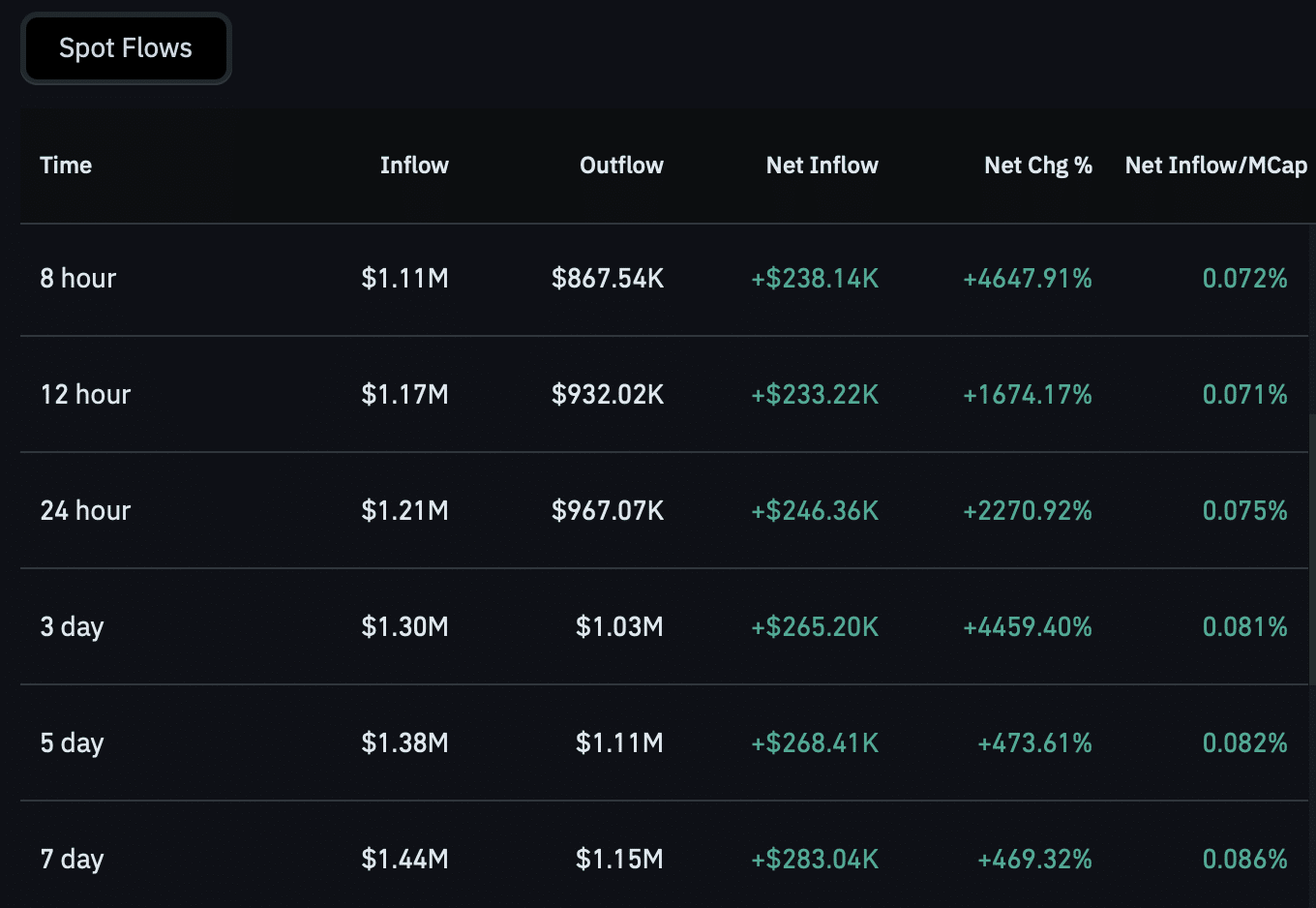
The spot read hinted at heavy profit-taking as Gnosis surged over the past day, with $1.19 million sold into the rally. Buyers failed to keep pace, tipping the balance into a net-seller market and leaving netflow near negative $246,000.
Source: CoinGlass

That reads as classic profit-taking, though a widening netflow from here would leave Gnosis with slim odds of a rebound.

A more constructive read was evident on the seven-day netflow though where sellers held only a $283,000 edge even as the price gained 17% over the same stretch. If that dynamic repeats, any decline would likely amount to a temporary pullback before the advance resumes.

What does GNO need to flip BONK?

Assuming BONK’s market cap holds at $330.07 million—unlikely in a moving market—a somewhat significant hike in the price of Gnosis would complete the flip. As it stands, closing the aforementioned gap would require GNO to climb to $125.48.

However, this move may only materialise once the price settles into a support region or reverses beforehand.


Final Summary

  • Gnosis needs only a small price hike to overtake BONK and claim the 100th spot by market value.
  • Momentum indicators indicated that any move higher may stall or pull back before a flip actually happens.

Trending Cryptos

Related Questions

QAccording to the article, what specific price level does Gnosis (GNO) need to reach to flip BONK in market capitalization, assuming BONK's market cap stays at $330.07 million?

AGNO needs to climb to $125.48 to complete the flip.

QWhat technical indicator signal suggests Gnosis (GNO) has moved into overvalued territory?

AThe price pushing into the upper Bollinger Band (BB) suggests Gnosis has moved into overvalued territory.

QWhat does the Money Flow Index (MFI) data for Gnosis indicate about capital flows?

AThe Money Flow Index (MFI) plunged sharply, pointing to heavier capital outflows than inflows.

QBased on the CoinGlass data mentioned, what type of market activity has been dictating the direction of Gnosis's price movement?

ASpot activity has been dictating the direction of Gnosis's price movement, with derivatives playing little part.

QWhat is the article's conclusion regarding the likelihood of Gnosis immediately flipping BONK based on momentum indicators?

AThe article concludes that momentum indicators suggest any move higher may stall or pull back before a flip actually happens, implying it is not likely to happen immediately.

Related Reads

The Semiconductor Industry's Most Obscure Chokepoint Material: It Has Multiplied in Price Unnoticed, and China Just Banned Its Export

"Helium: The Silent Choke Point in Semiconductors" Helium, despite being the universe's second most abundant element, is critically scarce on Earth. It cannot be synthesized artificially and escapes Earth's gravity once released, making it a non-renewable resource. Yet, it is indispensable for advanced semiconductor manufacturing, requiring ultra-high purity (99.9999%) for processes like wafer etching, leak detection, and thermal management in lithography tools, with no viable substitutes. This low-profile resource, whose price has doubled unnoticed, suddenly gained attention when China imposed an export ban on July 10th. The ban is a response to a severe global shortage triggered months earlier. In March, missile attacks damaged the world's largest helium production hub in Qatar's Ras Laffan, halting a third of global supply with repairs expected to take 3-5 years. Concurrently, Russia tightened export controls, and the US sold off its federal helium reserve. Approximately 200 specialized transport containers, each worth ~$1 million, were stranded with perishable cargo. Global spot prices skyrocketed, and chipmakers like TSMC warned of potential impacts. China, which imports over 84% of its helium (primarily from Qatar and Russia), faces a severe squeeze. Despite being helium-poor, China has developed domestic extraction technology over five years, processing byproduct gases from LNG plants to produce ultra-pure helium. Domestic output, while still only covering less than 20% of demand, enabled the recent export ban aimed at securing domestic supply for its own expanding chip industry. The industry now faces "Helium Shortage 5.0." With key global sources constrained for years, this invisible gas—once wasted on party balloons—has become a critical, geopolitically charged bottleneck for chips, healthcare (MRI machines), and beyond, forcing the world to finally treat it as the finite strategic resource it is.

marsbit29m ago

The Semiconductor Industry's Most Obscure Chokepoint Material: It Has Multiplied in Price Unnoticed, and China Just Banned Its Export

marsbit29m ago

Early Investor of Unitree Bets on a Brain-Computer Interface Company

"Wabo Technologies, a brain-computer interface (BCI) startup, has secured new funding from Vertex Ventures (under Temasek), Hongtai Fund, Chengdu Future Industry Fund, and Huifengda Capital. Vertex Ventures is known for its early bet on Unitree Robotics. Inspired by the sci-fi film "Avatar," founder Zhang Xingzhi has pursued human-machine interaction for over a decade. He established Wabo in late 2025, coinciding with China's push for BCI as a future industry. Unlike companies focused solely on medical hardware, Wabo positions itself as a model company. Its core mission is to develop a "Human Neural Intent Model" that decodes EEG, EMG, and behavioral signals to understand a user's goals, confirmations, corrections, and stop intentions before physical action, translating them into standardized control signals for machines, robots, or smart devices. The young, full-stack team, backed by academic collaborators from Tianjin University and Fudan University, quickly attracted investors. The company had previously raised a seed round from Ceyuan Capital. Investors were impressed by Wabo's systematic capabilities in data collection, signal processing, and engineering, seeing potential beyond a single hardware product toward a reusable layer of human intent interpretation. Applications span medical rehabilitation, smart homes, embodied AI, and even space exploration, with Wabo partnering with Tianjin University on pioneering "space BCI" research. Wabo plans a dual-headquarters strategy, with Shanghai focusing on high-end R&D and model development, and Chengdu handling hardware, product development, and supply chain. The BCI sector in China is heating up, with over 30 financing deals in early 2026. Zhang believes future competition will center on who can build a sustainable data-model-scenario loop. He predicts industry consolidation within three years, with only companies that master this闭环 surviving. The vision from "Avatar" is inching closer to reality."

marsbit44m ago

Early Investor of Unitree Bets on a Brain-Computer Interface Company

marsbit44m ago

ChangXin Technology: A Cyclical Stock Standing Atop the Cycle Peak

Changxin Technology: A Cyclical Stock at the Peak On July 27, 2026, Changxin Technology topped the A-share market with a market capitalization of 3.28 trillion yuan, surging 465% on its first trading day. The company, which lost 16.3 billion yuan in 2023, reported an estimated net profit of 50-57 billion yuan for the first half of 2026. Its dramatic reversal mirrors the volatile DRAM (Dynamic Random Access Memory) cycle. The DRAM industry is inherently cyclical, with booms and busts every 3-4 years. This is due to product standardization and a significant time lag in supply adjustment. When prices rise, manufacturers expand capacity, but new production takes 2-3 years to come online, often leading to oversupply and price crashes when demand cools. Changxin's performance perfectly tracks this cycle. It recorded deep losses in 2023-2024 during the industry downturn, turned its first annual profit in 2025, and saw profits skyrocket in Q1 2026. This surge is primarily price-driven. The AI boom has led major players like Samsung and SK Hynix to shift 70-80% of new capacity to high-margin HBM (High Bandwidth Memory), creating a severe shortage and price explosion in general-purpose DRAM markets where Changxin competes. However, a massive global capacity expansion is underway. The top three manufacturers have announced nearly $70 billion in capital expenditure for 2026. Changxin itself plans to expand from three to seven 12-inch wafer fabs. This investment will translate into significant new supply in 2-3 years. While DRAM prices are expected to remain high through 2026-2027, price growth is already slowing, and a potential downturn is forecast for around 2028 as new capacity ramps up. A key challenge for Changxin is catching up in the critical HBM segment. While it has delivered HBM3 samples, leaders are already mass-producing more advanced HBM3E. Success in HBM is crucial for gaining true cyclical resilience. In conclusion, Changxin is a commendable company that has broken foreign monopolies in DRAM. Its long-term growth narrative—driven by import substitution and AI—is valid. Yet, its current valuation of 5-6x forward P/E, typical for a cyclical stock at its peak, suggests much future growth is already priced in. AI may extend the current cycle but cannot eliminate the industry's inherent volatility. For investors, the critical question is preparedness for the inevitable downturn when the cycle turns.

marsbit49m ago

ChangXin Technology: A Cyclical Stock Standing Atop the Cycle Peak

marsbit49m ago

Trading

Spot

Hot Articles

How to Buy CAP

Welcome to HTX.com! We've made purchasing Cap (CAP) simple and convenient. Follow our step-by-step guide to embark on your crypto journey.Step 1: Create Your HTX AccountUse your email or phone number to sign up for a free account on HTX. Experience a hassle-free registration journey and unlock all features.Get My AccountStep 2: Go to Buy Crypto and Choose Your Payment MethodCredit/Debit Card: Use your Visa or Mastercard to buy Cap (CAP) instantly.Balance: Use funds from your HTX account balance to trade seamlessly.Third Parties: We've added popular payment methods such as Google Pay and Apple Pay to enhance convenience.P2P: Trade directly with other users on HTX.Over-the-Counter (OTC): We offer tailor-made services and competitive exchange rates for traders.Step 3: Store Your Cap (CAP)After purchasing your Cap (CAP), store it in your HTX account. Alternatively, you can send it elsewhere via blockchain transfer or use it to trade other cryptocurrencies.Step 4: Trade Cap (CAP)Easily trade Cap (CAP) on HTX's spot market. Simply access your account, select your trading pair, execute your trades, and monitor in real-time. We offer a user-friendly experience for both beginners and seasoned traders.

884 Total ViewsPublished 2026.06.26Updated 2026.06.26

How to Buy CAP

Discussions

Welcome to the HTX Community. Here, you can stay informed about the latest platform developments and gain access to professional market insights. Users' opinions on the price of CAP (CAP) are presented below.

活动图片