Not AI, Not War: What the US Stock Market Should Worry About Is Japan?

marsbitPublished on 2026-07-24Last updated on 2026-07-24

Abstract

Global markets may be underestimating a systemic risk from Japan. As the yen hits multi-decade lows and domestic asset appeal rises, the world's largest pension fund, the Government Pension Investment Fund (GPIF), faces policy pressure to repatriate substantial assets. Such a shift could pressure U.S. stocks, bonds, and the dollar. GPIF manages roughly $1.8 trillion, with about half invested overseas. Even a modest reallocation to Japan could boost yen demand and Japanese government bond buying, potentially raising U.S. yields and weakening the dollar. Unwinding of yen carry trades could further pressure risk assets. This potential move is driven by improving fundamentals in Japan: rising inflation, economic recovery, and narrowing yield gaps with the U.S. The yen's depreciation to levels not seen since 1986 also enhances domestic investment appeal. While markets currently price in limited risk, key indicators like the dollar-yen cross-currency basis swap are showing subtle shifts. A surge in hedging demand for yen appreciation could tighten liquidity and impact U.S. equities. Conversely, GPIF repatriation could benefit Japanese equities, which trade at a discount to U.S. markets and are driven by corporate governance reforms. However, persistent yen weakness remains a major hurdle for foreign investors' returns.

Author: Zhao Ying

The global market is underestimating a potential systemic risk—Japan. As the yen falls to multi-decade lows and the appeal of domestic Japanese assets rises, the world's largest pension fund is facing policy pressure to repatriate its massive asset holdings back to Japan on a large scale. Once this process begins, the US stock market, bond market, and the US dollar may come under simultaneous pressure.

Recently, Japanese Prime Minister Takaichi Sanae stated that the government will promote the Government Pension Investment Fund (GPIF) and other national pension funds to increase their investment in domestic Japanese financial assets. Finance Minister Katayama Satsuki previously gave a similar signal. Although the GPIF has not announced any formal asset allocation adjustments, the market has already begun to assess its potential impact: if the fund repatriates its overseas holdings back to Japan, US Treasury yields may rise, the US dollar may weaken, and risk assets may come under pressure.

Currently, the market's pricing of the aforementioned risk remains relatively calm, but some technical indicators are already showing subtle changes, and investors should not be complacent.

The $1.8 Trillion Variable

The GPIF manages approximately $1.8 trillion, with domestic and foreign assets each accounting for about half, of which its overseas holdings total about $930 billion. In recent years, the fund's holdings of Japanese government bonds have decreased from about $770 billion to about $515 billion, while its holdings of foreign bonds have increased from about $128 billion to about $470 billion.

This structural change means that even a small-scale asset reallocation could trigger significant waves in the global market. According to a MarketWatch report, analyst Michael Kramer pointed out that if the GPIF repatriates some of its overseas assets back to Japan, it will directly boost demand for the yen and introduce a massive buying wave into the Japanese government bond market—a positive for Japan, but for the US, it implies higher interest rates and a weaker dollar.

At the same time, any large-scale unwinding of yen carry trades (i.e., borrowing low-interest yen, converting to US dollars, and investing in US assets) would further pressure the performance of risk assets.

Yen and JGBs: The Appeal of Domestic Assets Is Rising

Driving the potential GPIF reallocation is a substantial improvement in the fundamentals of Japanese domestic assets. With Japan's inflation recovering and economic growth resuming, the appeal of domestic investment opportunities has significantly increased. In February, the yield spread between US and Japanese two-year government bonds narrowed to its lowest level since early 2022.

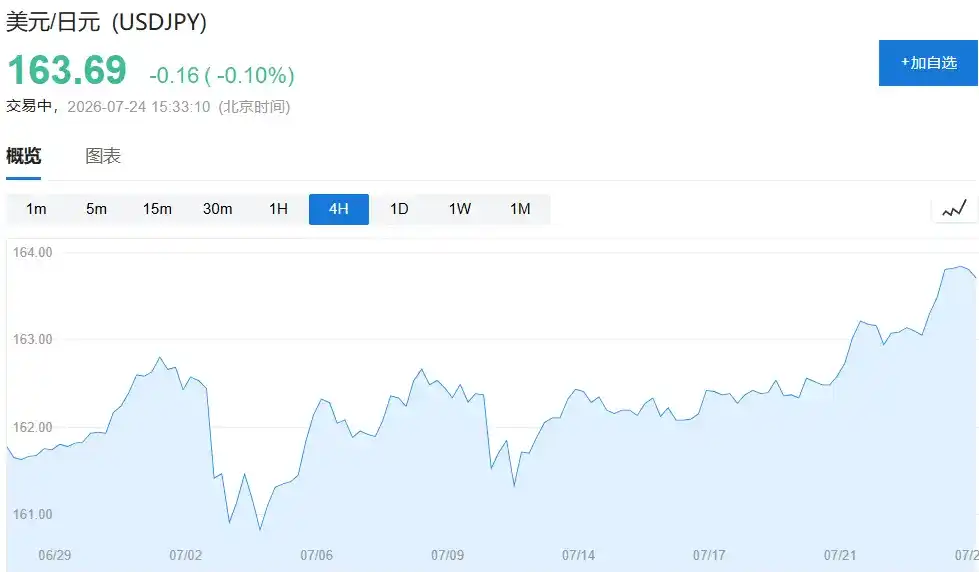
At the same time, the yen has continued to weaken, with USD/JPY breaking above 163, reaching its highest level since 1986. From a technical analysis perspective, if the exchange rate rises further, the next resistance level is around 176. According to a report by the Financial Times, Fredrik Repton of Neuberger Berman believes that if GPIF allocates more funds to domestic assets, this could be a "very elegant solution" to Japan's macroeconomic problems, but other domestic financial institutions would also need to follow suit, and "this process will take a long time."
Japan's 10-year government bond yield recently touched 2.7%, the first time in 30 years. Deutsche Bank analyst Mallika Sachdeva pointed out in a recent report that the focus of Japanese authorities' policy may be shifting from exchange rate management to yield management, and if this shift materializes, it will put further pressure on the yen.

Market Not Yet Pricing It In, But Signals Are Emerging

Currently, the global market's reaction to the risk of Japanese capital repatriation remains relatively restrained. The five-year USD/JPY cross-currency basis swap recently stood at about minus 30 basis points, the narrowest level since this data series began in 2021, indicating that the market's hedging demand for a stronger yen has not yet risen significantly.

However, this indicator itself is a key signal for observing whether capital flows are beginning to shift. Historical data shows that the S&P 500 index and the cross-currency basis swap have moved in sync during multiple periods—whenever hedging demand rises sharply, the US stock market often declines as liquidity tightens accordingly. Once market expectations for yen appreciation heat up, the demand for USD hedging will climb accordingly, and the liquidity tightening effect will become more pronounced.

Japanese Stocks: The Other Side of the Risk

It is worth noting that while the potential asset reallocation by GPIF may bring pressure to US markets, it also provides a new narrative logic for Japanese stocks. The Japanese stock market is benefiting from drivers that are distinctly different from those in the US market: the concentration of the technology sector in the Topix index is much lower than in the S&P 500, its exposure to artificial intelligence is relatively limited, and its valuation still trades at a discount of more than 20% compared to the S&P 500.

Corporate governance reform is a core catalyst for Japanese stocks. Dan Rasmussen of Verdad Advisers points out that there are still about 1,000 companies in Japan whose stock prices are below book value, and among the cheapest quintile of companies, cross-shareholdings still account for about 40% of their market capitalization. As cross-shareholdings are gradually unwound, a large amount of historically accumulated profits is expected to be released, having a materially positive impact on corporate earnings.

However, for foreign investors, the persistently weakening yen is the biggest obstacle—over the past two years, yen depreciation has significantly eroded the real returns of foreign capital in the Japanese stock market. How to handle currency hedging, and whether the hedging cost is bearable, remain core issues facing global investors.


Trending Cryptos

Related Questions

QWhat is the main systemic risk that global markets are currently underestimating according to the article?

AThe article states that global markets are underestimating the potential systemic risk posed by Japan. Specifically, the risk arises from the possibility that Japan's Government Pension Investment Fund (GPIF) and other national pension funds might reallocate a significant portion of their foreign assets back to domestic Japanese investments.

QWhat would be the likely impact on the US if GPIF repatriates a portion of its foreign assets back to Japan?

AIf GPIF repatriates part of its foreign assets, it would likely lead to higher U.S. Treasury yields, a weaker U.S. dollar, and pressure on U.S. risk assets like stocks. This is due to reduced demand for U.S. bonds and dollars, alongside potential unwinding of yen carry trades.

QWhat is the current approximate size of GPIF's foreign asset holdings?

AGPIF's foreign asset holdings amount to approximately $930 billion, which is about half of its total assets under management of roughly $1.8 trillion.

QWhat is one of the key fundamental improvements in Japan that makes domestic assets more attractive, according to the article?

AOne key improvement is the recovery in Japanese inflation and economic growth, which enhances the attractiveness of domestic investment opportunities. This is evidenced by the narrowing yield gap between U.S. and Japanese two-year government bonds.

QWhat is a major catalyst for the Japanese stock market mentioned in the article, distinct from U.S. market drivers?

AA major catalyst for the Japanese stock market is corporate governance reform. This includes the unwinding of cross-shareholdings, which could release historically accumulated profits and substantially boost corporate earnings, unlike the U.S. market which is more driven by technology and AI concentration.

Related Reads

Bitcoin Boom in Full Swing: Saylor's Latest Statement Fuels Buying Speculation

MicroStrategy's Executive Chairman Michael Saylor has fueled speculation about a new Bitcoin purchase by posting "Bitcoin Drive engaged" on August 2, accompanied by the company's customary purchase tracker. This aligns with his pattern of hinting at treasury changes ahead of weekly reports. The accompanying report showed MicroStrategy's Bitcoin holdings at 843,775 BTC, with an average cost of $75,653 per coin and an unrealized loss of -$10.58B. A similar signal preceded the company's July 27 announcement, strengthening expectations for a treasury update on Monday. However, MicroStrategy's real-time ledger reflects two recent Bitcoin sales totaling 3,588 BTC, reducing holdings from 847,363 BTC to the current 843,775 BTC. The company stated these sales funded preferred stock dividends and replenished its U.S. dollar reserve. Recent reports indicate the company made no Bitcoin purchases the week ending July 26 while increasing its dollar reserve to approximately $3.75B. The company faces financial headwinds after reporting an $8.33B operating loss for Q2 2026, including an $8.32B unrealized loss on its digital assets. Management may sell up to $1.25B more in Bitcoin to meet cash obligations. The expected Monday update will reveal if the "Bitcoin Drive" signal marks a return to accumulation as MicroStrategy balances its massive Bitcoin stash against growing cash commitments.

cryptonews.ru2h ago

Bitcoin Boom in Full Swing: Saylor's Latest Statement Fuels Buying Speculation

cryptonews.ru2h ago

Trading

Spot

Hot Articles

How to Buy WAR

Welcome to HTX.com! We've made purchasing WAR (WAR) simple and convenient. Follow our step-by-step guide to embark on your crypto journey.Step 1: Create Your HTX AccountUse your email or phone number to sign up for a free account on HTX. Experience a hassle-free registration journey and unlock all features.Get My AccountStep 2: Go to Buy Crypto and Choose Your Payment MethodCredit/Debit Card: Use your Visa or Mastercard to buy WAR (WAR) instantly.Balance: Use funds from your HTX account balance to trade seamlessly.Third Parties: We've added popular payment methods such as Google Pay and Apple Pay to enhance convenience.P2P: Trade directly with other users on HTX.Over-the-Counter (OTC): We offer tailor-made services and competitive exchange rates for traders.Step 3: Store Your WAR (WAR)After purchasing your WAR (WAR), store it in your HTX account. Alternatively, you can send it elsewhere via blockchain transfer or use it to trade other cryptocurrencies.Step 4: Trade WAR (WAR)Easily trade WAR (WAR) on HTX's spot market. Simply access your account, select your trading pair, execute your trades, and monitor in real-time. We offer a user-friendly experience for both beginners and seasoned traders.

2.6k Total ViewsPublished 2024.03.29Updated 2026.06.02

How to Buy WAR

Discussions

Welcome to the HTX Community. Here, you can stay informed about the latest platform developments and gain access to professional market insights. Users' opinions on the price of WAR (WAR) are presented below.

活动图片












