Crypto Morning Brief: Backpack Plans to Offer Equity to Stakers, WLFI Claims USD1 Was Attacked

marsbitPublished on 2026-02-24Last updated on 2026-02-24

Abstract

Crypto Daily Digest: Key market developments include Backpack's announcement to offer equity to token stakers, allocating 20% of company shares for this program. WLFI reported an attack on its USD1 stablecoin, claiming attackers targeted co-founder accounts to spread FUD and short the token, but the stablecoin held its peg due to its 1:1 asset backing. In policy news, the Trump administration is considering new national security tariffs on six industries, including batteries and telecom equipment. Tether will discontinue its offshore yuan stablecoin (CNH₮) due to low demand. Meanwhile, China’s regulatory approach now distinguishes RWA tokens from virtual currencies, allowing conditional overseas issuance. Ethereum Foundation established a dedicated DeFi team to support permissionless and censorship-resistant protocols. Meme coin TRUMP unveiled a growth plan involving up to 5% of its supply for ecosystem expansion. Bitcoin miner Bitdeer clarified its BTC sales are for liquidity preparation amid land acquisition plans. Other highlights: SBI Holdings launched a $64.5M blockchain bond offering XRP rewards, and private credit firm Blue Owl Capital sold $1.4B in loan assets, sparking concerns about market stress. Market analysis sections cover AI agent teams, yen carry trade impacts on Bitcoin, and shifting institutional capital from tokens to equity.

Author: Deep Tide TechFlow

Yesterday's Market Dynamics

US Media: Trump Administration Considers New National Security Tariffs on Six Major Industries, Covering Batteries, Pig Iron, and Iron Fittings, etc.

According to the Wall Street Journal, the Trump administration is considering imposing new "national security tariffs" on six industries. Sources familiar with the matter revealed that the scope of the tariffs under consideration may cover large batteries, pig iron and iron fittings, plastic pipes, industrial chemicals, as well as power grid and telecommunications equipment industries. These tariffs will be levied under Section 232 of the Trade Expansion Act of 1962. The new US tariffs on the six major industries will be implemented separately from the new global 15% tariff. It is currently unclear when the investigations, which are the responsibility of the Department of Commerce, will be announced, and when the tariffs will ultimately be imposed. Section 232 requires a lengthy investigation before tariffs can be imposed, but once implemented, the president can modify them unilaterally.

US Trade Representative: US Bilateral Trade Agreements Remain Valid After Supreme Court Tariff Ruling

According to Jinshi, US Trade Representative Greer said on CBS's "Face the Nation" on Sunday that those agreements reached with countries such as the EU and South Korea are still valid. He sought to distinguish these agreements from the 15% global tariff that Trump announced plans to implement on Saturday. Greer said: "We want them to understand that these deals will be successful deals. We will fully support these deals. We also expect our partners to fully support these deals." He also stated that other US trade tools, including means to investigate the trade practices of other countries, will provide the US with advantages. He spoke with EU officials this weekend and will also communicate with officials from other major US trading partners to convey a message of reassurance.

WLFI Response: Attacker Hacked WLFI Co-founder's Account to Spread FUD and Heavily Short, But the Attack Was Not Successful

World Liberty Financial officially issued an announcement on social media stating:

"This morning, a coordinated attack was launched against USD1. The attacker hacked the accounts of several WLFI co-founders, hired KOLs to spread panic, and heavily opened short positions on WLFI, attempting to profit from this artificially created chaos.

But this attack was not successful.

Thanks to USD1's robust minting and redemption mechanism and fully 1:1 asset backing, USD1's trading price has remained stable at par value. No fraudster can shake the long-term commitment of the entire WLFI team and co-founders to USD1.

Reminder to users: Please only obtain accurate information through verified official channels."

Meme Coin TRUMP Team Plans to Deploy No More Than 5% of Tokens for Ecosystem Growth Plan

According to official news, the Meme coin TRUMP team announced the next phase of development, focusing on improving market liquidity depth, expanding application scenarios, and promoting long-term value growth through more disciplined capital operations. Based on community feedback, the project will simultaneously advance three initiatives: a revenue and liquidity plan, institutional-grade market structure optimization, and strategic inventory management, to improve trading quality and strengthen the ecosystem.

In terms of liquidity, holders will soon be able to participate in the revenue plan through the Kamino vault, receiving TRUMP and stablecoin rewards. The related incentive scale exceeds $10 million at most to support on-chain liquidity and DEX capital efficiency. At the same time, new professional market makers will strengthen liquidity support in centralized and decentralized markets, improving price discovery capabilities and trading execution stability.

In addition, TRUMP will, according to the public token unlock schedule, strategically use no more than 5% of the unlocked tokens in the coming months for ecological investments, partnerships, and growth plans. This includes an ecological fund of up to $3.5 million, potential acquisitions and partnerships, as well as entertainment and gaming layouts promoted by The TRUMP Game Studio, with the first project being the Web3 game TRUMP Billionaires Club.

Bitdeer Responds to Bitcoin Sale Decision: Preparing Liquidity in Advance for Land Acquisition, Hashrate Growth Plan Unchanged

Bitdeer (BTDR), the bitcoin mining company under Wu Jihan, stated, "The company's decision to sell bitcoin should not cause market-level concerns. This move is aimed at preparing liquidity in advance for several non-binding power land acquisition opportunities currently under evaluation. The company emphasizes that the hashrate will continue to grow, and it will continue to mine for the benefit of shareholders."

Ethereum Foundation Establishes DeFi Team to Support New Protocol Development, Reiterates Belief in "DeFipunk" Philosophy

According to The Block, the Ethereum Foundation is establishing a dedicated decentralized finance (DeFi) department under its Application Relations team to support new protocol development. The Foundation appointed Charles St. Louis, former CEO of DELV and MakerDAO governance architect, as DeFi Protocol Expert, and Ivan (ivangbi), co-founder of Gearbox Protocol, as DeFi Coordinator.

The Ethereum Foundation stated: "We want to see DeFi flourish, but we have a clear view of what it should be: permissionless, censorship-resistant, privacy-first, self-custodial, and open-source." St. Louis added on platform X: "The Ethereum Foundation believes in DeFipunk: not finance that is slightly better than traditional finance, but finance that would not be possible without Ethereum."

The team will support existing DeFi projects while focusing on the development of "tomorrow's DeFi," including innovative directions such as user-controlled artificial intelligence and high-throughput on-chain futures markets.

Backpack Plans to Offer Company Equity to Token Stakers, Company Has Already Reserved 20% of Equity for This Plan

According to Decrypt, the cryptocurrency exchange Backpack plans to allow holders of its upcoming token to obtain company equity through staking. According to a statement by Backpack CEO Armani Ferrante on social media, users can convert their staked tokens into company equity at a fixed ratio after staking for at least one year. The company has already reserved 20% of its equity for this plan.

Ferrante stated that this move aims to improve the existing model, as many projects have failed to deliver on the promise of supporting tokens based purely on utility value. The exchange has not yet announced a token issuance date but has asked users to verify their personal information to determine eligibility for claiming.

Tether Announces Discontinuation of Support for Offshore RMB Stablecoin CNH₮

February 21, according to an official announcement, Tether announced on February 20, 2026, that it will gradually phase out its CNH₮ stablecoin service. Effective immediately, Tether has stopped issuing new CNH₮ tokens and will completely terminate redemption support after one year.

This decision is based on changes in market conditions, low product interest, and limited community demand relative to other assets. Holders of CNH₮ are advised to redeem their assets as soon as possible and must complete the operation before the redemption deadline.

Director of Shanghai Finance and Development Laboratory: Regulators Distinguish RWA Tokens from Virtual Currency for the First Time and Do Not Mandate Absolute Decentralization

Caixin published an article "Strict Management of Overseas RWA," in which Zeng Gang, Director and Chief Expert of the Shanghai Finance and Development Laboratory, stated that the 42nd document jointly issued by eight departments adopts a regulatory framework of "prohibition domestically, strict management overseas," distinguishing RWA tokens from virtual currency for the first time. The China Securities Regulatory Commission (CSRC) has designated "asset-backed security tokens" as the first operable type of RWA, opening a specific path for compliant overseas issuance by domestic enterprises. The regulatory authorities neither deny the potential value of RWA tokens as new financing tools nor relax risk prevention. The 42nd document emphasizes the use of "encryption technology and distributed ledger or similar technology" and does not mandate absolute decentralization. The core principle is: the entire process of overseas issuance must ensure that domestic entities do not come into contact with token transactions, funds entering the country must go through compliant cross-border investment and foreign exchange management channels, and an event reporting mechanism must be established post-issuance to ensure that major events are reported to the CSRC in a timely manner.

US Private Credit Giant Blue Owl Capital Announces Sale of Approximately $1.4 Billion in Loan Assets

According to CoinDesk, US private credit giant Blue Owl Capital announced the sale of approximately $1.4 billion in loan assets to match investor redemption demands from its retail-oriented private credit fund (Blue Owl Capital Corp II). The fund will return about 30% of its net asset value (NAV) to qualified investors, with the assets sold at a price equivalent to 99.7% of face value. Affected by this, Blue Owl stock (OWL) fell nearly 15% this week, with a cumulative decline of over 50% compared to the same period last year; stocks of other private equity firms such as Blackstone, Apollo Global, and Ares Management also fell significantly.

Experts compare this to the "canary in the coal mine" signal before the 2007 financial crisis (such as the Bear Stearns hedge fund collapse), warning that overexpansion in the private credit market (especially AI-related investments) may trigger systemic risks, credit crunches, and bank contagion. If the pressure intensifies, forcing central banks to cut interest rates and inject liquidity, it could replay the post-2020 pandemic scenario, injecting momentum into the Bitcoin and crypto markets and driving the next bull run.

SBI Holdings Launches 10 Billion Yen On-Chain Bond, Rewarding Investors with XRP

According to CoinDesk, Japanese financial giant SBI Holdings announced the issuance of an on-chain bond "SBI START Bonds" worth 10 billion yen (approximately $64.5 million). The bond targets retail investors and is issued, managed, and settled entirely on the blockchain platform "ibet for Fin." Qualified investors (holding an SBI VC Trade account and investing over 100,000 yen) can receive XRP rewards equivalent to the investment amount at the time of issuance and subsequent interest payment dates (until 2029), with every 100,000 yen corresponding to 200 yen worth of XRP. The bond has a three-year term and offers a fixed interest rate. Secondary trading will commence on the Osaka Digital Exchange on March 25, 2026.

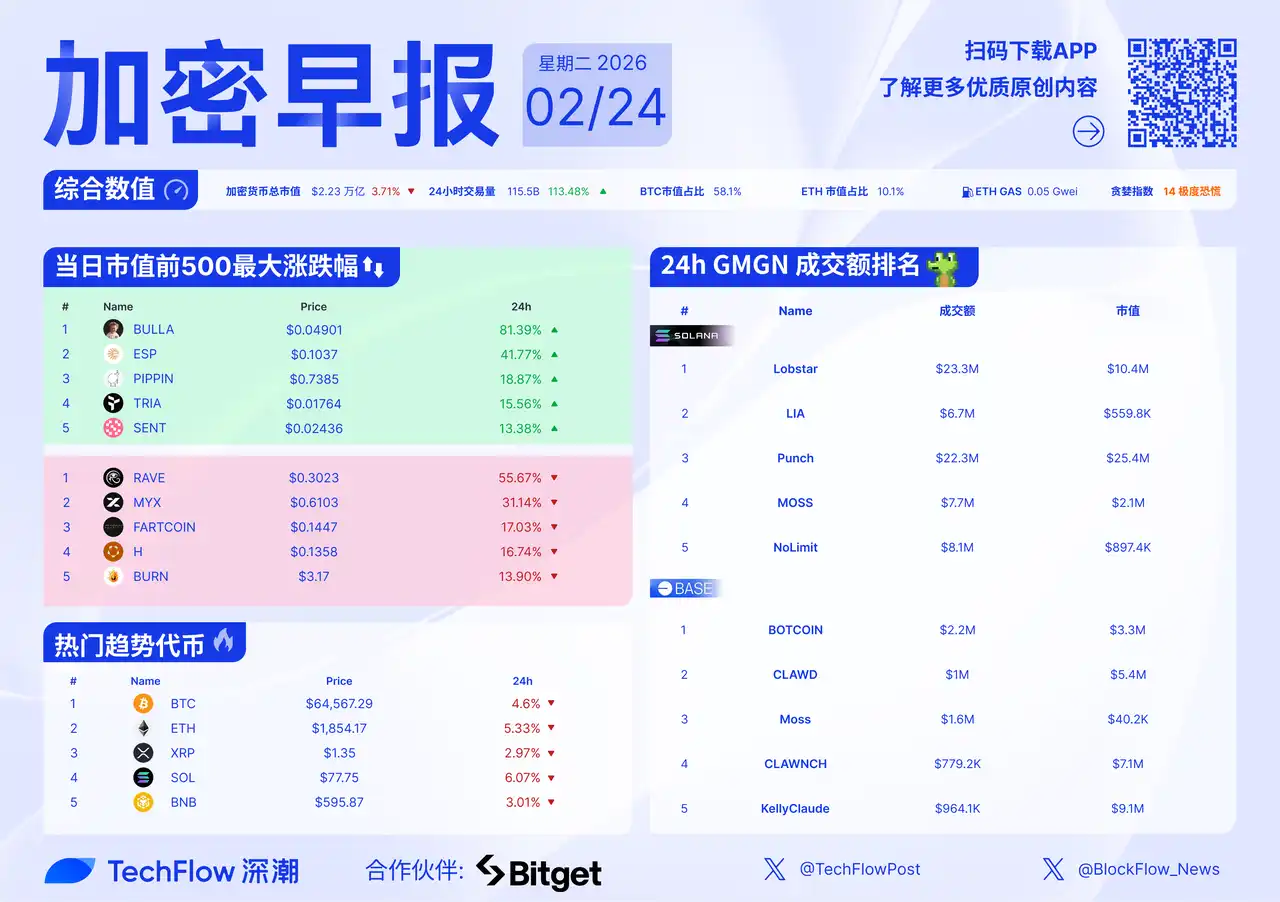
Market Dynamics
Recommended Reading

Google Senior AI Product Manager: 6 Agents Take Over My Daily Tasks, Costing Less Than $400 per Month, Running 24/7

This article details how to build a team of autonomous AI Agents that work together through six different role-based Agents to complete tasks such as research, content creation, code review, and newsletter production. The author shares practical experience, including file structure, cost details, problem-solving, and step-by-step setup suggestions.

In-Depth Analysis: Unwinding of Yen Carry Trade Triggers Chain Reaction of Bitcoin Selling

This article analyzes the mechanism by which the unwinding of the yen carry trade affects Bitcoin price volatility through cross-asset deleveraging and liquidity conditions. Through yen exchange rate fluctuations and official statements, it reveals the potential impact of yen financing channels on the global risk situation and crypto markets, and provides a five-signal early warning framework to identify deleveraging windows.

80% of New Tokens Fall Below Issue Price, Institutional Capital Shifting from Tokens to Crypto Equity

This article explores the capital flow trends in the cryptocurrency market, pointing out that institutional investors are gradually shifting from tokens to crypto equity investments. Behind this trend are the dual drivers of institutional compliance requirements and realistic valuation systems. The article analyzes the price performance of new tokens after listing, noting that most tokens depreciate quickly after listing, while crypto-related IPO and M&A activities have grown significantly. The article also explains why investors prefer crypto equity and the difference between tokens and real businesses.

Wintermute CEO: The Crypto Industry Is Lost, Only Personal Sovereignty Is the Path Worth Taking

This article is a manifesto on the philosophy of the crypto industry written by Wintermute CEO Evgeny Gaevoy, analyzing the current state of the crypto industry and future path choices. Starting from the concept of the "Golden Path" in "Dune," he criticizes the current迷失 (lost state) of the crypto industry and emphasizes the importance of personal sovereignty and independence, while analyzing three possible future development paths and emphasizing the necessity of building systems that cannot be controlled.

First Rise in the Year of the Horse, AI Stocks Go Crazy

This article discusses in detail the performance of the AI large model field in the capital market, focusing on the soaring stock prices of two domestic AI large model companies in the Hong Kong stock market—Zhipu and MiniMax—and the wealth creation effect behind them. The article also mentions the financing situation of other AI large model enterprises and future competition trends in the capital market.


Trending Cryptos

Related Questions

QWhat is Backpack's plan for its token stakers and how much equity has been reserved for this initiative?

ABackpack plans to allow its upcoming token holders to stake their tokens for at least one year to receive company equity at a fixed ratio. The company has reserved 20% of its equity for this program.

QAccording to WLFI, what was the nature of the attack on USD1 and what was the outcome?

AWLFI stated that attackers hacked the accounts of several WLFI co-founders, hired KOLs to spread FUD (Fear, Uncertainty, and Doubt), and took large short positions on WLFI in an attempt to profit from the artificially created chaos. The attack was unsuccessful, and the price of USD1 remained stable at its face value due to its robust minting and redemption mechanism and full 1:1 asset backing.

QWhat major decision did Tether announce regarding its CNH₮ stablecoin and what was the reason behind it?

ATether announced it will gradually cease its CNH₮ (offshore Chinese yuan) stablecoin service. It has stopped issuing new CNH₮ tokens and will completely terminate redemption support after one year. This decision was based on changing market conditions, low product interest, and limited community demand relative to other assets.

QWhat new team has the Ethereum Foundation established and what are its core principles for DeFi?

AThe Ethereum Foundation has established a dedicated DeFi team under its Ecosystem Support Program. The team's core principles for DeFi are that it should be permissionless, censorship-resistant, privacy-first, self-custodial, and open-source. They refer to this belief as 'DeFipunk'—finance that is not just slightly better than traditional finance, but finance that would not be possible without Ethereum.

QWhat significant move did the Japanese financial giant SBI Holdings make involving XRP?

ASBI Holdings issued a 10 billion yen (approximately $64.5 million) on-chain bond called 'SBI START Bonds' on the 'ibet for Fin' blockchain platform. Qualified retail investors who hold an SBI VC Trade account and invest over 100,000 yen will receive XRP rewards equivalent to 200 yen for every 100,000 yen invested, both at issuance and on subsequent interest payment dates until 2029.

Related Reads

After Three Consecutive Quarters of Decline, Can the Crypto Market Find a Window for Stabilization in Q3?

The cryptocurrency market has just concluded its worst-performing quarter since 2022, with total capitalization dropping 12.6% to $2.1 trillion. All core metrics indicate capital is leaving the sector, not just rotating within it. Bitcoin fell 14.2% and Ethereum dropped 25.4% in Q2, breaking their previous correlation with US tech stocks. A key driver is the reversal in US spot Bitcoin ETF flows, which saw a net outflow of approximately $4.67 billion in Q2, including a record monthly outflow near $4.5 billion in June. While recent data suggests long-term holders are accumulating again, sustained ETF outflows mean continued selling pressure. Market focus is now singularly on the Federal Reserve. The upcoming July FOMC meeting is seen as the most critical event for Q3. A dovish signal could support Bitcoin reclaiming a $68,000-$84,000 range, while a hawkish stance might establish a new trading band around $50,000-$56,000. Additionally, regulatory uncertainty persists, with the progress of the crucial *CLARITY Act* stalling in the Senate, reducing its perceived 2026 passage probability to 40-45%. Despite the broad downturn, a few sectors showed growth. Prediction markets saw nominal volume surge 48.7% year-over-year to $113.8 billion, and tokenized collectibles transaction volume rose 143% quarterly to $1.4 billion. The Real-World Asset (RWA) tokenization sector also continued steady growth, now representing ~$28.1 billion in on-chain value. The market's foundation for an extreme crash appears limited, with Bitcoin price hovering near its 200-week moving average. However, the trading paradigm has shifted from narrative-driven speculation to decisions based on price action, policy developments, and interest rate expectations, making a broad sentiment-driven rally unlikely in the near term.

marsbit13h ago

After Three Consecutive Quarters of Decline, Can the Crypto Market Find a Window for Stabilization in Q3?

marsbit13h ago

BIT Trading Moment: BTC Still Suppressed by Weekly 200 EMA, Rejection May Restart Decline; Storage and Semiconductors that Surged Last Night Begin Falling in Evening Trading

**Crypto & Stock Market Wrap: Bitcoin Tests Resistance, Stocks Retreat After AI Surge** Bitcoin consolidates around $66,000, facing key resistance near $68,000—an area seen as a major psychological and technical hurdle where previous rallies have failed. Analysts note the cryptocurrency is caught between its 200-week moving average (~$63,333) and 200-week EMA (~$68,328). A clear break above $68k is needed to signal a stronger bullish trend, while a rejection could lead to a retest of $63k support. Market sentiment remains cautious, with low futures open interest pointing to a low-liquidity rebound rather than a full bull market. Bitcoin spot ETFs saw another $203 million inflow. US stock futures pointed lower after a strong Tuesday session led by a massive rebound in semiconductors and memory stocks. The rally was fueled by renewed optimism about AI-driven hardware demand, with Micron, SanDisk, and SK Hynix surging. However, those gains reversed in pre-market trading. Super Micro Computer (SMCI) soared over 20% after hours on strong guidance and a record backlog. Other standouts included Rocket Lab and nuclear energy plays Oklo and X-Energy. Rising oil prices (Brent above $91) and climbing Treasury yields (10-year near 4.64%), however, are reigniting inflation concerns and acting as a headwind for equities. In Asia, markets were mixed. South Korea's KOSPI pared early gains to close slightly higher as semiconductor stocks like SK Hynix gave back initial surges. Japan's Nikkei edged lower as the yen hit a fresh 38-year low against the dollar, raising fears of potential market intervention. Key events to watch include the Samsung Galaxy launch, AMD's AI event, and a slew of major tech earnings from Alphabet, Tesla, and IBM after the close on Wednesday, followed by the ECB meeting and Intel's earnings on Thursday.

marsbit13h ago

BIT Trading Moment: BTC Still Suppressed by Weekly 200 EMA, Rejection May Restart Decline; Storage and Semiconductors that Surged Last Night Begin Falling in Evening Trading

marsbit13h ago

Former CFTC Chairman, Circle President Tarbert: Preaching Long-Termism While Cashing Out $30 Million Himself

Former CFTC Chairman and Circle President Heath Tarbert has consistently advocated for a long-term vision in public, urging patience from investors as Circle’s stock price has fallen significantly from its peak. However, it has been revealed that since Circle’s IPO, Tarbert has continuously sold his CRCL shares through pre-arranged trading plans, cashing out approximately $30 million, without making any public market purchases. This contrast between his public messaging and personal actions has drawn criticism. Tarbert joined Circle in July 2023 as Chief Legal Officer, leveraging his regulatory experience to help guide the company through its IPO and expansion. Despite promoting stablecoins as long-term infrastructure, he established a 10b5-1 trading plan just before Circle went public, leading to substantial stock sales over the following year. In March 2026, he initiated another plan to sell more shares. His career trajectory highlights a pattern of moving between high-level regulatory roles and influential positions in the financial sector. After resigning as CFTC Chairman in early 2021, he joined Citadel Securities as Chief Legal Officer just 27 days later, during a period of intense regulatory scrutiny for the firm. He later joined Circle, aiding its efforts to navigate regulatory challenges for its public listing. While Tarbert's expertise in policy and compliance is valuable to companies like Circle, his actions—advocating long-term confidence while personally divesting—raise questions about the alignment between his public statements and his private financial decisions, leaving investors who followed his advice to bear the market risks.

marsbit14h ago

Former CFTC Chairman, Circle President Tarbert: Preaching Long-Termism While Cashing Out $30 Million Himself

marsbit14h ago

Gate Research Institute: The 'Wall Street-ization' Wave of Crypto Financial Products – Competition or Integration?

The article titled "Gate Research Institute: Are Crypto Financial Products Sparking a 'Wall Street' Wave—Competition or Convergence?" explores the evolving relationship between the crypto ecosystem and traditional finance (TradFi). The piece begins by reflecting on Bitcoin's original 2009 vision of decentralization, disintermediation, and moving away from banks. It then contrasts this with the 2024 landscape, where key crypto assets like Bitcoin are increasingly held through Wall Street products like ETFs issued by giants like BlackRock. The article questions whether this signifies that TradFi is systematically taking over the rights to issue, price, custody, and distribute crypto financial assets. The core argument is that this is not a zero-sum takeover but rather a bidirectional convergence where each side addresses the other's weaknesses. Crypto offers 24/7 global markets, programmable settlement, and open access but lacks compliant channels, institutional-grade custody, deep fiat liquidity, and mainstream distribution. TradFi possesses these but is constrained by legacy systems, limited operating hours, and slow settlement. Two primary convergence paths are highlighted: * **Path A (CEX to TradFi):** Exemplified by Gate, which has progressed from offering tokenized stocks and CFDs to providing direct, real stock trading (US, Hong Kong, South Korea) within its platform, using USDT. * **Path B (TradFi to Crypto):** Exemplified by Robinhood, which has integrated crypto trading, acquired exchanges like Bitstamp, and is moving traditional assets like stocks onto the blockchain via tokenization and its own Layer 2. Both paths are ultimately competing to become the next-generation, unified financial account—a "super account" where users can seamlessly trade cryptocurrencies, stocks, ETFs, RWA (Real World Assets), and tokenized treasury products in one interface. The growth of RWA and tokenized treasuries (e.g., BlackRock's BUIDL) is presented as the asset-layer fusion, providing stable, yield-bearing assets on-chain and acting as a bridge between the two worlds. In conclusion, the "Wall Street-ization" of crypto is framed as a mutual transformation. Decentralized ideals persist in the protocol layer, while at the application layer, a more efficient, global, and accessible unified capital market is emerging from this convergence. The future competition lies not between crypto exchanges and stockbrokers, but between platforms vying to offer the most comprehensive asset coverage, liquidity, and user experience within a single account.

marsbit14h ago

Gate Research Institute: The 'Wall Street-ization' Wave of Crypto Financial Products – Competition or Integration?

marsbit14h ago

Trading

Spot

Hot Articles

How to Buy WLFI

Welcome to HTX.com! We've made purchasing Official World Liberty Financial (WLFI) simple and convenient. Follow our step-by-step guide to embark on your crypto journey.Step 1: Create Your HTX AccountUse your email or phone number to sign up for a free account on HTX. Experience a hassle-free registration journey and unlock all features.Get My AccountStep 2: Go to Buy Crypto and Choose Your Payment MethodCredit/Debit Card: Use your Visa or Mastercard to buy Official World Liberty Financial (WLFI) instantly.Balance: Use funds from your HTX account balance to trade seamlessly.Third Parties: We've added popular payment methods such as Google Pay and Apple Pay to enhance convenience.P2P: Trade directly with other users on HTX.Over-the-Counter (OTC): We offer tailor-made services and competitive exchange rates for traders.Step 3: Store Your Official World Liberty Financial (WLFI)After purchasing your Official World Liberty Financial (WLFI), store it in your HTX account. Alternatively, you can send it elsewhere via blockchain transfer or use it to trade other cryptocurrencies.Step 4: Trade Official World Liberty Financial (WLFI)Easily trade Official World Liberty Financial (WLFI) on HTX's spot market. Simply access your account, select your trading pair, execute your trades, and monitor in real-time. We offer a user-friendly experience for both beginners and seasoned traders.

6.3k Total ViewsPublished 2025.09.01Updated 2026.06.02

How to Buy WLFI

Discussions

Welcome to the HTX Community. Here, you can stay informed about the latest platform developments and gain access to professional market insights. Users' opinions on the price of WLFI (WLFI) are presented below.

活动图片