# Пов'язані статті щодо Prediction Markets

Центр новин HTX надає останні статті та поглиблений аналіз на тему "Prediction Markets", що охоплює ринкові тренди, оновлення проєктів, технологічні розробки та регуляторну політику в криптоіндустрії.

Base Native Leveraged Prediction Market OmenX Officially Launches on Mainnet

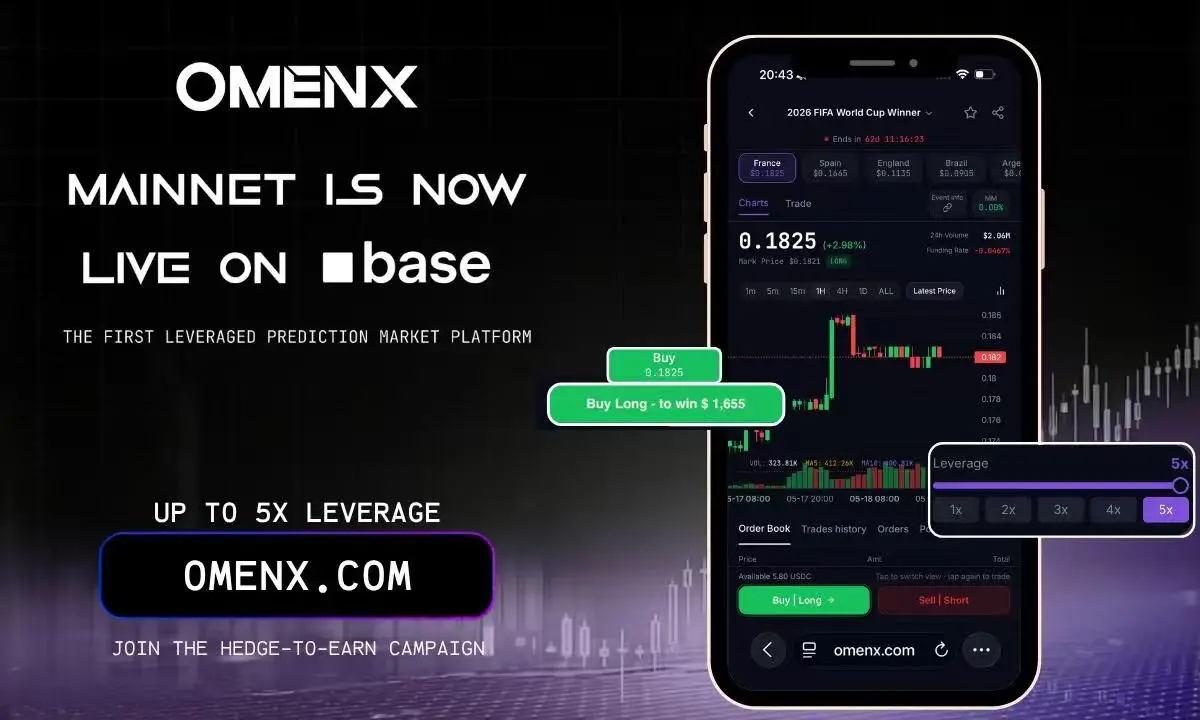
Base-native leveraged prediction market platform OmenX has officially launched on mainnet. It currently supports up to 5x leverage, with plans to increase to 10x based on platform liquidity and market conditions. Unlike traditional prediction markets where users fully collateralize YES/NO positions and wait for settlement, OmenX aims to create a trading platform-like experience. Users can open leveraged positions on event outcomes, and actively trade, adjust, or hedge these positions before the event concludes for greater capital efficiency. Alongside the mainnet launch, OmenX introduced a "Hedge-to-Earn" campaign targeting existing users of other prediction markets (initially Polymarket). This initiative allows users to claim incentives or hedging benefits on OmenX based on their existing positions, aiming to introduce them to leveraged trading and active risk management. OmenX positions itself as a derivatives trading platform for prediction market assets. The team believes that as platforms like Polymarket mainstream prediction markets, event outcomes are becoming a new tradable asset class. The next phase of demand will focus on leverage, liquidity, and advanced trading tools. Post-launch, OmenX plans to expand supported market types, optimize liquidity, and develop APIs and additional trading tools. The team is also in discussions with investors and partners to secure resources for further development.

链捕手2 дні тому 13:35

Base Native Leveraged Prediction Market OmenX Officially Launches on Mainnet

链捕手2 дні тому 13:35

WSJ: Unveiling the Secret Jury That Controls Disputes on Polymarket

Last month, Garrick Wilhelm lost a $567 bet on the Polymarket prediction platform about whether a ceasefire would be reached with Hezbollah. When a truce was announced, some traders argued it counted, but Wilhelm disagreed. The dispute was settled not by Polymarket, but by a decentralized group of UMA token holders who vote on such disagreements. As trading surges, resolving ambiguous outcomes is a growing challenge for prediction markets. Unlike competitors like Kalshi that decide internally, Polymarket outsources dispute resolution to UMA. Its token holders, mostly anonymous and with voting power weighted by holdings, arbitrate cases. Critics argue this system is prone to manipulation, as voters can also bet on the same markets they judge. A Wall Street Journal analysis found that over the past year, at least 60% of active UMA voters had corresponding Polymarket accounts and held positions in disputes they voted on. Voting power is also concentrated among a few large holders. Polymarket says only 0.2% of bets go to UMA and that the system disperses authority. Its founder has acknowledged flaws and promised fixes. UMA's backers deny any proven manipulation, dismissing critics as sore losers. The platform penalizes voters in the minority to incentivize "correct" outcomes. Disputes are rising, covering topics from a streamer's pregnancy announcement to Iran. This model also helps Polymarket argue it's an offshore platform outside U.S. regulation, a shift made after a 2022 settlement with the CFTC. Some losing traders have formed groups to protest, targeting entities like UMA.rocks, which aggregates votes. Its founder says traders often blame UMA for their own mistakes. A recently ousted committee member, Scout, admitted to both betting and voting but argued involved voters research more thoroughly. He highlighted the dilemma: "Either you have conflicted traders deciding, or you have uninformed outsiders voting. There is no perfect answer right now."

marsbit05/18 11:07

WSJ: Unveiling the Secret Jury That Controls Disputes on Polymarket

marsbit05/18 11:07

World Cup Approaches, Prediction Markets Face a Major Test

The 2026 FIFA World Cup represents a major public test for sports prediction markets like Polymarket and Kalshi, which have grown significantly by offering tradable markets on event outcomes. This global event, hosted by the US, Canada, and Mexico, concentrates risks related to sports integrity, cross-border operations, and gambling ecosystems. A key concern is the potential for insider trading on non-public information (e.g., injuries, lineups), which could be exploited in granular prediction markets. FIFA's choice of its official prediction market partner, ADI Predictstreet, has raised significant doubts. The platform, relatively unknown, has faced scrutiny over the integrity of its executives—including past insider trading allegations and associations with a major EU corruption scandal—its rapid licensing in Gibraltar, and the fact its product was not yet live at the time of the announcement. This partnership begins with a "trust deficit." FIFA itself carries historical corruption baggage, and its deepening ties with betting and data industries fuel concerns about maintaining sporting integrity. While FIFA has established monitoring systems, their effectiveness against potential insider trading across decentralized global prediction markets remains unproven. Major US-based prediction platforms have updated rules to prohibit trading based on confidential information. However, the World Cup's complex ecosystem of federations, teams, and officials makes enforcement far more challenging than in domestic leagues. The event will not determine the fate of prediction markets but will critically test whether they can be integrated as a regulated event-trading infrastructure or remain a high-risk gambling-adjacent activity within global sports.

marsbit05/15 05:11

World Cup Approaches, Prediction Markets Face a Major Test

marsbit05/15 05:11

Gate Institute: Polymarket Accelerates Growth, Gate Launches New Portal to Prediction Markets

Gate Research Institute: Polymarket Growth Accelerates, Gate Expands into Prediction Markets with New Portal This analysis examines the growth of the prediction market platform Polymarket, which has evolved from an early experiment into a major event-driven trading venue. Data shows a significant, step-like increase in trading volume and active users, though growth remains heavily tied to major political, sports, and geopolitical events. Fee and revenue growth is driven by both genuine trading demand and recent changes to platform fee structures. Polymarket's market structure is highly concentrated, with over 90% of volume in these few high-profile categories. While it functions as both an information and sentiment market, its price discovery is most active during high-attention news cycles. The platform's core value lies in creating a liquid market for trading the outcome of future events, a unique niche within crypto. Gate's recent integration of Polymarket addresses different challenges. It simplifies access by allowing users to trade with exchange-held USDT, lowering friction for its existing user base. This highlights two emerging pathways for prediction markets: Polymarket's native, on-chain model versus Gate's centralized, low-friction account integration. Both paths will likely coexist, targeting different user segments. Key challenges for Polymarket include ongoing regulatory uncertainty, reliance on cyclical event-driven demand, potential oracle or settlement disputes, and achieving sustainable user retention beyond peak event periods. The platform has proven its commercial viability and ability to scale but has yet to demonstrate it can become a stable, everyday trading category independent of major news cycles.

marsbit05/09 02:07

Gate Institute: Polymarket Accelerates Growth, Gate Launches New Portal to Prediction Markets

marsbit05/09 02:07

活动图片