# Пов'язані статті щодо Futures

Центр новин HTX надає останні статті та поглиблений аналіз на тему "Futures", що охоплює ринкові тренди, оновлення проєктів, технологічні розробки та регуляторну політику в криптоіндустрії.

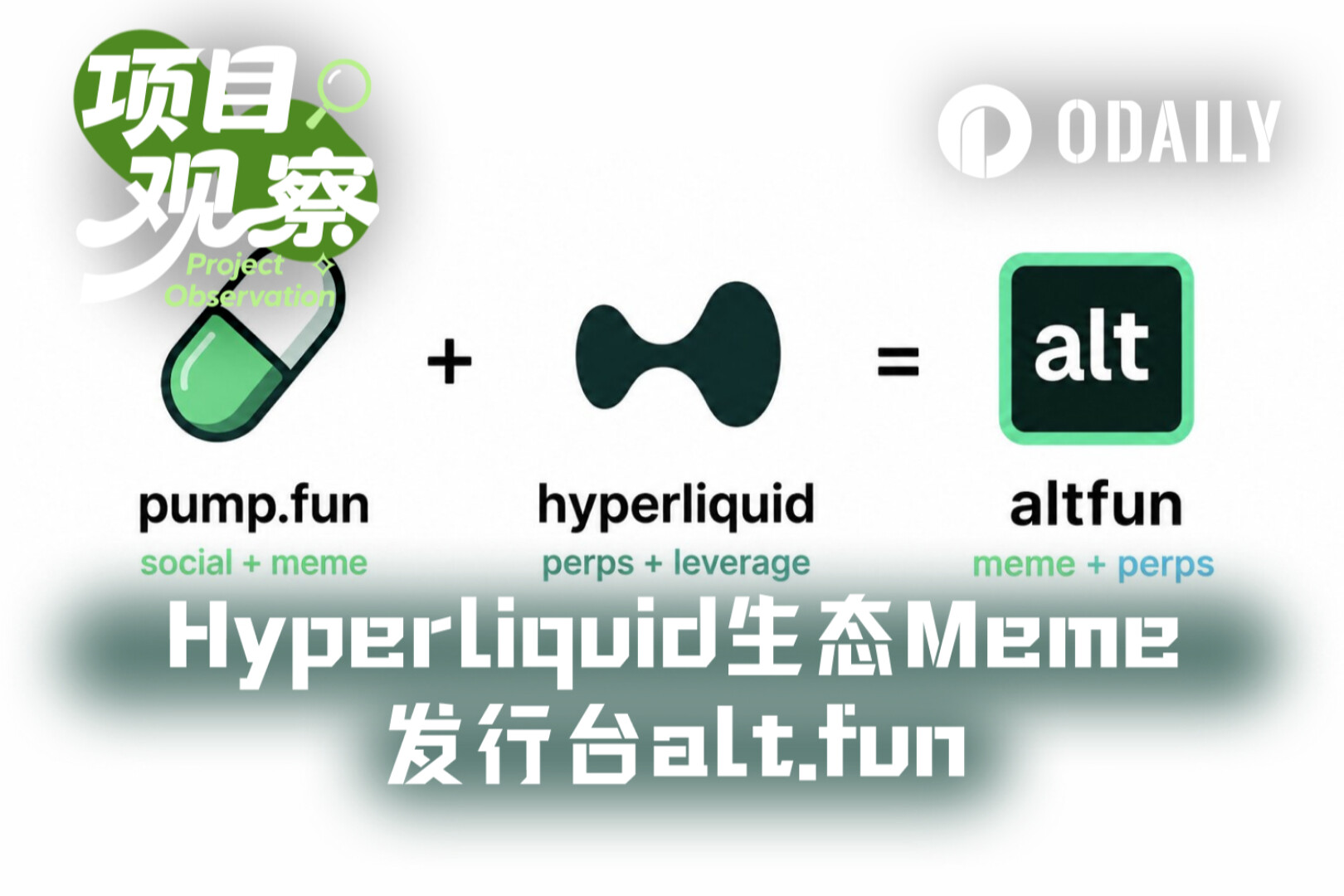
Meme Wrapped Contracts: Is alt.fun Real Innovation or Pseudo-Demand?

"Last week, the new Meme token launch platform alt.fun on Hyperliquid gained significant attention. Its flagship token ALT reached a peak market cap of $8.8 million. The platform's novelty lies in combining the mechanics of Pump.fun with leveraged trading on Hyperliquid. When a user creates a Meme token on alt.fun, they must also open a leveraged long/short position (2x, 3x, or 5x) on an underlying asset like HYPE. The platform then mints a corresponding leveraged token (LT) on BounceTech, which represents that perpetual contract position. Essentially, users are trading a tokenized derivative. This creates a dual price driver: the token's value is influenced both by market buying/selling via a bonding curve and by the performance of its underlying leveraged position. Hence the slogan: 'Your token pumps even when nobody's buying.' Tokens 'graduate' to a liquidity pool when their market cap (effectively the LT's value) reaches $9,000, achievable through either mechanism. However, this model faces key challenges. Gains are amplified only in strong, one-directional markets for the underlying asset. In volatile conditions, the mandatory 'rebalancing' of LTs leads to value decay. More fundamentally, alt.fun struggles to foster the community consensus vital for Meme tokens. Investment is driven primarily by price speculation on the underlying asset, not by narrative or cultural appeal. With limited underlying assets, token differentiation is low. The article concludes that while mechanically innovative, alt.fun may be better suited as a DeFi platform than a true Meme launchpad, as its core product lacks the community-driven essence of successful Memes."

Odaily星球日报2 дні тому 12:41

Meme Wrapped Contracts: Is alt.fun Real Innovation or Pseudo-Demand?

Odaily星球日报2 дні тому 12:41

When Computing Power Becomes Commoditized, How Long Until a GPU Futures Market?

When Compute is Commoditized: How Far Away is a GPU Futures Market? The article explores the potential emergence of a futures market for computing power ("compute"), akin to markets for commodities like oil or electricity. It uses a five-dimension framework to assess the market's maturity for sustaining robust futures trading. **Current Market Assessment (Scorecard):** * **Supply Fragmentation:** 🔴 **Red.** Supply is highly concentrated, dominated by a few hyperscale cloud providers. * **Price Volatility:** 🟢 **Green.** GPU pricing is already highly volatile. * **Physical Settlement Infrastructure:** 🟢 **Green.** Early infrastructure exists at the OTC/broker level. * **Standardization:** 🔴 **Red.** Compute lacks a standardized, tradable unit (e.g., an H100 hour is not uniform). * **Lack of Substitutes:** 🟡 **Yellow.** Vertically integrated players can hedge internally, while others are forced to be long. **Conclusion:** The overall scorecard suggests a robust futures market is premature. The market has volatility and early settlement infrastructure but lacks the necessary supply fragmentation and standardization for large-scale price discovery. Most activity remains OTC. **Key Unanswered Questions & Hypotheses:** The article posits that the market could evolve in the next 1-2 years: 1. **Supply:** May become *moderately more fragmented* due to new cloud providers, cheaper power locations, and demand from long-tail users (e.g., startups running open-source model inference). 2. **Standardization:** Could emerge from the growing **inference** workload (expected to be >65% of AI compute demand by 2029), which has more homogeneous hardware requirements than custom training workloads. Widespread adoption of **open-source model weights** is seen as a key catalyst for democratizing inference and driving infrastructure standardization. 3. **Traded Unit:** The most viable layer for trading is likely the **"chip-instance-hour"** (powered, usable compute time), traded similarly to electricity in regional contracts with spot/futures overlays. Trading at the upstream "chip" layer is unlikely due to supply concentration, while the downstream "token" layer faces challenges due to lack of uniformity across AI models.

链捕手2 дні тому 09:04

When Computing Power Becomes Commoditized, How Long Until a GPU Futures Market?

链捕手2 дні тому 09:04

活动图片