Rhythm X Zhihu Co-host Web4.0 Theme Event: When AI Agent Takes Over On-Chain Permissions

marsbitPublished on 2026-04-01Last updated on 2026-04-01

Abstract

Most discussions about Web 4.0 miss the point. The real question is not whether it is a marketing trend, but rather: who is gaining control over the underlying permissions of the internet? Historically, each iteration of the web has involved a transfer of authority downward: Web 1.0 was read-only; Web 2.0 allowed users to write but platforms owned the data; Web 3.0 enabled true ownership through on-chain assets and private keys. Web 4.0 continues this trend, but the transfer is not to users—it is to AI Agents. The current infrastructure is human-centric, designed around human limitations like attention span and memory. But AI Agents don’t need intuitive UIs, password resets, or sleep. This creates a core tension: an internet built for humans is now being used by entities without human constraints. Two key shifts are underway: the decline of traditional front-end interfaces (replaced by API-driven machine communication) and the replacement of human-centric identity systems (like passwords) with granular, on-chain permissions. A critical enabler is crypto infrastructure. AI can make rapid decisions but lacks independent payment channels and asset sovereignty. Crypto fills this gap. Platforms like Hyperliquid offer 24/7 markets, ideal for non-stop Agent operation. When Agents control wallets and private keys, they can both decide and execute—forming complete economic entities. The real narrative of Crypto × AI isn’t just buzzword synergy—it’s the convergence of complement...

Most people approach Web 4.0 in the wrong way.

They ask: Is this the next marketing cycle? Is Web 4.0 just another wave of concept creation? These questions miss the point. There is only one real question: Who is the underlying authority of the internet transferring from, and to whom?

Placed in a historical context, the answer has always been clear. Web 1.0 was read-only—users were consumers of content, without write permissions. Web 2.0 granted write permissions—you could post, upload, comment, but the platform owned your data. Web 3.0 granted ownership—assets are on-chain, the private key is in your hand, the platform cannot confiscate your wallet.

Each iteration is, at its core, a downward transfer of authority.

Web 4.0 continues this same logical line, but the recipient of this transfer changes. It's not being transferred to the user; it's being transferred to the Agent.

A neglected structural fact: For a long time, the entire architecture of the internet has been absolutely "human-centric."

Web 2.0's UI/UX was designed for human cognitive bandwidth—information density, click paths, color contrast, every parameter is an estimate of the limits of human attention. Web 3.0's KYC verification, seed phrase backups, multi-signature approvals essentially address the physiological flaws of humans being error-prone and susceptible to attacks.

The entire system serves human limitations, not human capabilities.

But in the AI era, this logic begins to break down. When an Agent gains on-chain permissions, it faces the same system designed for humans, but it doesn't need a beautiful UI, password recovery, SMS verification codes, or to sleep on a transaction confirmation.

This is the core contradiction of Web 4.0: an internet infrastructure designed for human cognitive limitations encounters a new type of participant without cognitive limitations. A rebuild is inevitable.

The ongoing rebuild can be observed from two dimensions.

The first dimension is the disintegration of the frontend. Traditional, polished UIs were designed for human visual processing capabilities. Agents primarily communicate through APIs and code logic; the UI is noise to them, not an entry point. Once Agents become the main interactors with protocols, the logic of the frontend shifts from "how to make the user understand" to "how to make the machine read." This is a paradigm shift unlike any in thirty years of frontend development.

The second dimension is the replacement of the identity verification system. Systems based on usernames and passwords assume the logging-in entity is a human with memory limitations—passwords must be short enough to remember but long enough to be secure. This contradiction spawned the entire password management industry. But an Agent doesn't need to remember passwords. On-chain signatures can be granted and revoked in real-time, with permission granular down to a single operation. The account system will be gradually replaced, not because it was poorly designed, but because its design premise is now obsolete.

These changes in both dimensions can be summarized in one sentence: the gateway will shift from a revolving door designed for humans to an API interface designed for machines.

In this process of infrastructure rebuild, there is a specific closed loop worth examining separately.

AI possesses powerful decision-making capabilities, but it inherently lacks two things: an independent payment channel and asset sovereignty.

An Agent can analyze sentiment data across the global gold market in milliseconds and provide the optimal allocation decision—but if it doesn't have an independent capital account, this decision still requires a human to execute. The delay in the execution环节 erodes all the advantage it accumulated in the analysis phase.

Crypto completes this shortcoming.

Take Hyperliquid as an example: Its perpetual contract markets for commodities like gold, silver, and crude oil operate 24/7. This feature is optional for human traders—a position entered at 3 AM can wait until morning. But for an Agent, this is a necessary infrastructure condition because the Agent itself has no concept of sleep; its operation is round-the-clock.

When an Agent takes over the wallet and private key, it extends from the decision layer to the execution layer. AI provides analysis and judgment, Crypto provides the settlement infrastructure. Together, they form a complete economic entity.

The marginal cost of running an Agent tends towards zero. Its output and trade execution are continuous. For DeFi protocols, this is an unprecedented ideal counterparty—not emotional, doesn't forget, doesn't miss the optimal execution window because of a daytime meeting.

This is the real narrative of Crypto × AI: not the叠加 of two buzzwords, but complementary infrastructures connecting at the same historical moment.

Here is a perhaps not entirely appropriate example.

In 1908, the Ford Model T entered mass production. In the first few years, the mainstream opinion among critics was: the car is an upgraded version of the carriage, a toy suitable for the wealthy. No one foresaw that the car would rewrite the spatial logic of entire cities, spawn gas station chains, destroy railroad passenger transport, and turn Detroit into a global manufacturing center.

The missed key point wasn't the car itself, but how the car changed the entire society's function of time and space cost.

The structural significance of Web 4.0 is similar. Surface-level questions—which products will boom, which protocols will win—are like the "which car model will sell best" questions of the Model T era. The real proposition is: When Agents become the main on-chain participants, with scale and concurrency exponentially surpassing humans, in what dimensions will the rules of the economic system shift?


Related Questions

QWhat is the core issue that Web 4.0 addresses, according to the article?

AThe core issue is the transfer of underlying internet permissions from humans to AI Agents, as the current human-centric infrastructure is not designed for AI's capabilities.

QHow does the article define the fundamental evolution from Web 1.0 to Web 3.0?

AWeb 1.0 was read-only (users consumed content), Web 2.0 granted write permissions (users could post but platforms owned data), and Web 3.0 granted ownership (users control assets via private keys on-chain).

QWhat two key dimensions of infrastructure change are highlighted for Web 4.0?

AThe瓦解 of traditional human-designed front-end UIs (replaced by API-driven machine communication) and the replacement of identity verification systems (e.g., passwords with granular, revocable on-chain signatures).

QWhy is Crypto considered essential for AI Agents in Web 4.0?

ACrypto provides independent payment channels and asset sovereignty, enabling AI Agents to execute decisions autonomously and operate 24/7, complementing AI's analytical capabilities with decentralized settlement infrastructure.

QWhat historical analogy does the article use to illustrate the transformative impact of Web 4.0?

AIt compares Web 4.0 to the Ford Model T, which not only improved transportation but reshaped societal spatial logic and economic systems, emphasizing how AI Agents will redefine scale, concurrency, and rules in economic systems.

Related Reads

First Batch of Keynote Speakers and Partners Announced! Web2+3 Summit: Defining the Next Generation of Digital Economy

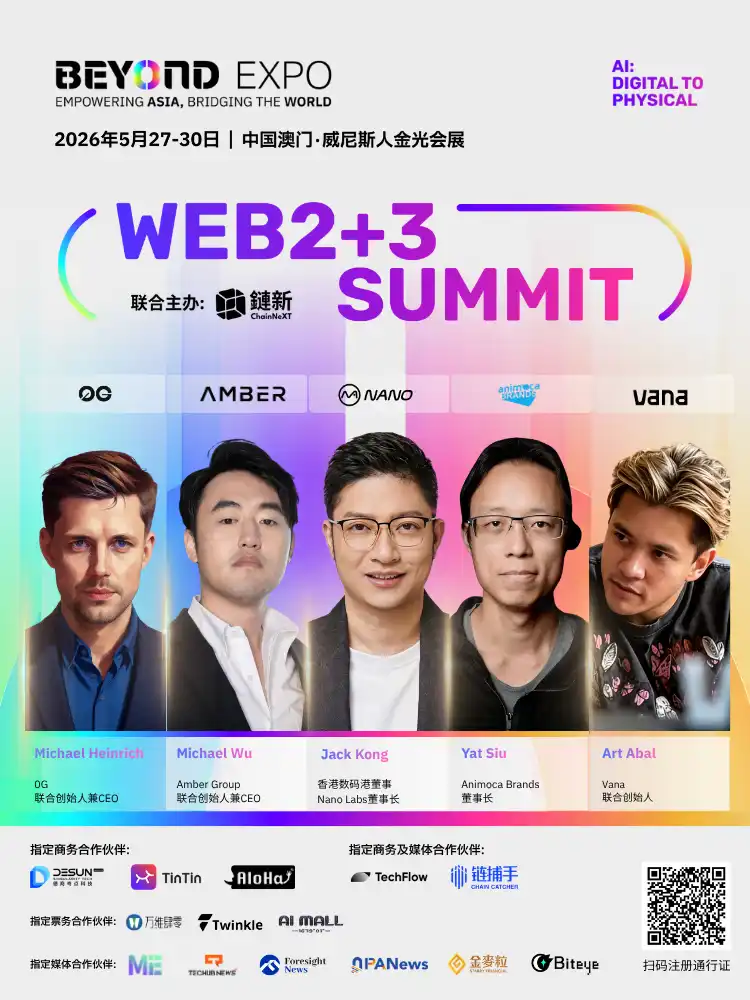
Web2+3 Summit: Defining the Next Generation of Digital Economy The 6th BEYOND International Technology Innovation Expo (BEYOND Expo 2026), Asia's largest tech and ecosystem exhibition, is launching a dedicated Web2+3 stage for the first time. Co-hosted by BEYOND Expo and ChainNeXT Group, the Web3 Summit will take place from May 28–30, 2026. Against the backdrop of accelerating global tech integration, the boundaries between Web2 and Web3 are rapidly blurring. With clearer global regulations for blockchain-driven internet (Web3) and the special issuance of a Hong Kong dollar stable币 license by the Hong Kong SAR government on April 10, 2026, Web3's decentralized principles are quickly merging with traditional industries (Web2) such as e-commerce, finance, and artificial intelligence. Focused on blockchain-driven digital economy elements, the summit will center on three core principles—implementability, commercial viability, and compliance. It will bring together top Web3 experts to discuss key integration areas like stablecoin payment finance (PayFi), real-world asset tokenization (RWA), and decentralized AI (DeAI), unveiling new opportunities for industrial innovation. The first wave of confirmed speakers includes Jack Kong (Director of Hong Kong Cyberport, Chairman of Nano Labs), Yat Siu (Chairman of Animoca Brands), Michael Wu (Co-founder & CEO of Amber Group), Michael Heinrich (Co-founder & CEO of 0G), and Art Abal (Co-founder of Vana). More Web3 ecosystem pioneers, AI, and fintech experts will be announced soon. Core forum topics include: - Web2+DeAI: New AI Paradigms Driven by Decentralized Infrastructure - Web2+RWA: Real-World Asset Tokenization and Global Liquidity - Web2+PayFi: Cross-Border Payments and Financial Innovation Powered by Crypto Infrastructure - Web2+3 AI: Autonomous Agents and the Crypto Economy - Web2+3 Wealth: On-Chain and Off-Chain Integrated Investment Ecosystems - Web2+3 Commerce: A New Landscape for Global Trade Driven by Stablecoins Additional agenda details will be released in the near future.

marsbit4h ago

First Batch of Keynote Speakers and Partners Announced! Web2+3 Summit: Defining the Next Generation of Digital Economy

marsbit4h ago

Trading

Spot
Futures

Hot Articles

How to Buy PEOPLE

Welcome to HTX.com! We've made purchasing ConstitutionDAO (PEOPLE) simple and convenient. Follow our step-by-step guide to embark on your crypto journey.Step 1: Create Your HTX AccountUse your email or phone number to sign up for a free account on HTX. Experience a hassle-free registration journey and unlock all features.Get My AccountStep 2: Go to Buy Crypto and Choose Your Payment MethodCredit/Debit Card: Use your Visa or Mastercard to buy ConstitutionDAO (PEOPLE) instantly.Balance: Use funds from your HTX account balance to trade seamlessly.Third Parties: We've added popular payment methods such as Google Pay and Apple Pay to enhance convenience.P2P: Trade directly with other users on HTX.Over-the-Counter (OTC): We offer tailor-made services and competitive exchange rates for traders.Step 3: Store Your ConstitutionDAO (PEOPLE)After purchasing your ConstitutionDAO (PEOPLE), store it in your HTX account. Alternatively, you can send it elsewhere via blockchain transfer or use it to trade other cryptocurrencies.Step 4: Trade ConstitutionDAO (PEOPLE)Easily trade ConstitutionDAO (PEOPLE) on HTX's spot market. Simply access your account, select your trading pair, execute your trades, and monitor in real-time. We offer a user-friendly experience for both beginners and seasoned traders.

6.2k Total ViewsPublished 2024.03.29Updated 2025.03.21

How to Buy PEOPLE

Discussions

Welcome to the HTX Community. Here, you can stay informed about the latest platform developments and gain access to professional market insights. Users' opinions on the price of PEOPLE (PEOPLE) are presented below.

活动图片