BitMine Copies Saylor’s Strategy Playbook With Ethereum Preferred Stock Offering

bitcoinistPublished on 2026-06-04Last updated on 2026-06-04

Abstract

BitMine Immersion Technologies is following a strategy similar to Michael Saylor's MicroStrategy, but for Ethereum. The company has filed for a public offering of 3 million shares of 9.50% Series A Perpetual Preferred Stock, with a stated value of $100 per share, to raise capital for expanding its Ethereum holdings and staking infrastructure. Proceeds are earmarked for acquiring ETH and other digital assets, expanding its "MAVAN" validator network, and other corporate purposes. The preferred stock will pay cumulative dividends at 9.50% annually and includes provisions for dividend penalties and company redemption options. BitMine has applied to list the shares on the NYSE under the ticker BMNP.

BitMine Immersion Technologies is moving deeper into the public-market crypto treasury trade, filing for a preferred stock offering that could help fund additional Ethereum purchases and validator infrastructure. The structure puts the company closer to the capital-markets model popularized by Michael Saylor’s Strategy, but with ETH rather than Bitcoin as the core reserve asset.

The Norwalk, Connecticut-based company said it intends to offer 3,000,000 shares of 9.50% Series A Perpetual Preferred Stock in a public offering registered under the Securities Act. The preferred shares carry a stated amount of $100 per share, implying a potential $300 million stated-value issuance if sold at that level, though the company said the deal remains subject to market and other conditions.

BitMine Files Yield Offering As It Builds Ethereum Treasury

BitMine framed the proceeds broadly, but Ethereum sits at the center of the filing. The company said it intends to use net proceeds “for general corporate purposes, which may include the acquisition of additional ETH and other digital assets; the expansion of the Company’s staking and validator infrastructure, including through MAVAN; working capital; strategic investments aligned with the Ethereum ecosystem and broader digital asset adoption; and/or repurchases of the Company’s common stock under its share repurchase program.”

BitMine has committed to ETH as its primary treasury reserve asset and says it is using native protocol-level activity, including staking and decentralized finance mechanisms, as part of that strategy. In 2026, the company launched MAVAN, or Made-in America VAlidator Network, as dedicated staking infrastructure for BitMine assets.

The comparison with Saylor’s Strategy comes from the financing mechanism. Strategy built its Bitcoin treasury model not only through common stock and convertible debt, but also through preferred equity products (STRC and STRF) designed to attract yield-oriented investors while raising capital for digital asset accumulation.

BitMine is now applying a similar template to Ethereum: issue a yield-bearing security in the public markets, use the proceeds flexibly, and route part of the capital toward a crypto treasury asset with institutional-market packaging around it.

The preferred stock itself is structured as a cash-paying instrument. BitMine said the Series A Preferred Stock will accumulate cumulative dividends at a fixed rate of 9.50% per year on the $100 stated amount, whether or not dividends are declared or funds are legally available for payment. “Regular dividends on the Series A Preferred Stock will be payable when, as and if declared by BMNR’s board of directors, out of funds legally available for their payment, weekly in arrears,” the company said. “Declared regular dividends on the Series A Preferred Stock will be payable solely in cash.”

The filing also includes a penalty mechanism if dividends are not paid on schedule. Any unpaid accumulated regular dividend would itself begin accumulating additional dividends, compounded weekly. The compounded dividend rate initially equals 9.50% plus 5 basis points, based on a weekly regular dividend period, and increases by another 5 basis points for each subsequent period until paid in full, capped at 15% per year.

BitMine will retain redemption flexibility. The company can redeem the preferred stock in whole or in part for cash at 110% of stated amount during the first 18 months after issuance, 105% from 18 months to three years, and 100% after three years, plus accumulated and unpaid dividends. It can also redeem all outstanding preferred shares if the total remaining falls below 25% of the original issuance, or if certain tax events occur.

Holders also receive protection in the event of a “fundamental change.” If such an event occurs under the certificate of designations, preferred shareholders can require BitMine to repurchase some or all of their shares for cash at the stated amount, plus accumulated and unpaid regular dividends.

BitMine has applied to list the preferred stock on the New York Stock Exchange under the ticker BMNP. If approved, the company expects trading to begin within 30 days after the shares are first issued. Moelis & Company and Cantor are acting as joint lead bookrunners.

At press time, Ethereum traded at $1,793.
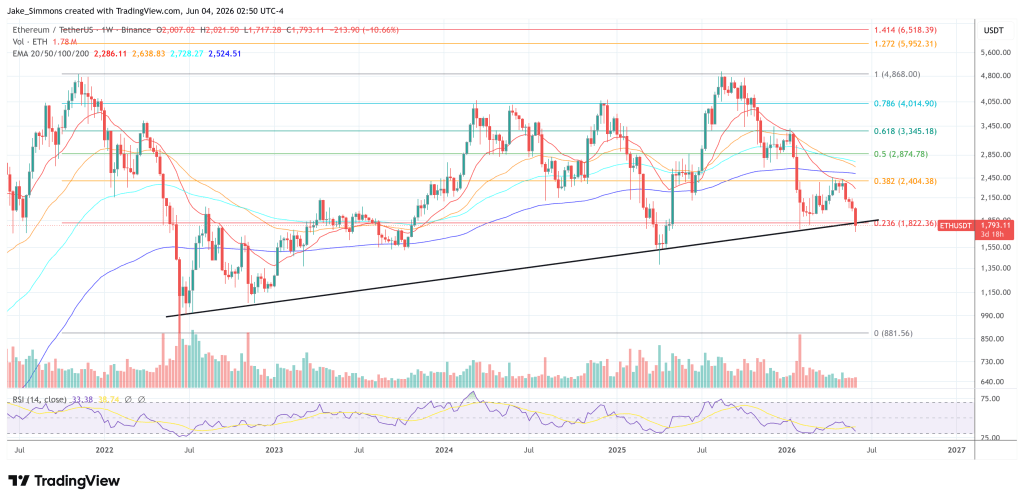
Ethereum bulls must defend the multi-year uptrend, 1-week chart | Source: ETHUSDT on TradingView.com

Related Questions

QWhat type of securities offering is BitMine Immersion Technologies filing for, and what is its primary purpose?

ABitMine is filing for a public offering of 3,000,000 shares of 9.50% Series A Perpetual Preferred Stock. The primary purpose of the proceeds is for general corporate purposes, which include the acquisition of additional Ethereum, the expansion of its staking and validator infrastructure (including through MAVAN), working capital, strategic investments in the Ethereum ecosystem, and/or repurchases of the company's common stock.

QHow does BitMine's strategy compare to Michael Saylor's approach, and what is the key difference?

ABitMine's strategy is compared to Michael Saylor's capital-markets model, which uses financial instruments to raise capital for acquiring a crypto reserve asset. The key difference is that while Saylor's company, MicroStrategy, focuses on Bitcoin as its core reserve asset, BitMine is applying a similar template to Ethereum.

QWhat are the key financial terms of BitMine's Series A Perpetual Preferred Stock?

AThe Series A Perpetual Preferred Stock has a stated amount of $100 per share and accumulates cumulative dividends at a fixed annual rate of 9.50% on that amount. Dividends are payable weekly in arrears, in cash, when declared. If dividends are not paid, they compound weekly with a penalty rate that starts at 9.55% and can increase, capped at 15% per year.

QUnder what conditions can BitMine redeem the preferred shares, and what are the redemption prices?

ABitMine can redeem the preferred stock for cash at 110% of the stated amount within the first 18 months after issuance, at 105% from 18 months to three years, and at 100% after three years, plus any accumulated and unpaid dividends. The company can also redeem all outstanding shares if the total remaining falls below 25% of the original issuance or if certain tax events occur.

QWhat exchange does BitMine plan to list its preferred stock on, and what is the proposed ticker symbol?

ABitMine has applied to list the preferred stock on the New York Stock Exchange (NYSE) under the ticker symbol BMNP.

Related Reads

Bitcoin's 'Rally Ends,' Officially Entering the Later Stage of a Bear Market?

Bitcoin prices declined 13% this week, reversing the recent rebound and signaling a likely transition into the later stages of a bear market. Key on-chain metrics deteriorated, with the short-term holder cost basis falling below the Realized Price—a pattern last seen in early 2022, characteristic of bear market maturity. The rally to ~$82k proved to be a bear market bounce, as evidenced by the 90-day realized profit/loss ratio failing to sustain above the bullish threshold of 2. Daily realized losses surged to $1.35B, including significant selling from long-term holders who accumulated near cycle tops, indicating ongoing supply redistribution. Price was rejected almost precisely at the aggregate US spot ETF cost basis of ~$83k, turning that level into resistance and leaving the average ETF investor underwater again. Spot market selling pressure intensified, with the 7-day volume delta turning significantly negative to its weakest level since February. While a major long liquidation event cleared over $400M in leverage, spot demand has not yet stepped in to absorb the resulting supply. Options markets continue pricing in higher future volatility (elevated volatility risk premium) and maintain a skew toward put options, reflecting persistent demand for downside protection, though not yet panic. Overall, market structure remains fragile. Sustained recovery likely requires a reclaim of the ETF cost basis, a shift back to positive spot demand, and a slowdown in realized loss-taking. Until then, the market risks further downside or extended consolidation within the broader bear trend.

Foresight News1h ago

Bitcoin's 'Rally Ends,' Officially Entering the Later Stage of a Bear Market?

Foresight News1h ago

How Risky is the "Death Spiral" of MSTR and STRC?

Summary: This article explores the perceived "death spiral" risk between MicroStrategy (MSTR), its Bitcoin holdings, and its perpetual preferred stock (STRC), drawing comparisons to the LUNA-UST collapse. While both systems feature price anchors, high yields for holders, and potential feedback loops, their core mechanisms differ fundamentally. The MSTR-STRC structure relies on continuous financing to sustain its high dividend payouts, primarily through stock ATM offerings. A negative feedback cycle could occur: falling MSTR stock price makes raising equity capital harder, increasing pressure to sell Bitcoin, which undermines STRC confidence and further depresses MSTR. However, unlike LUNA-UST's automated, direct linkage, the MSTR-STRC loop is weaker and has brakes: STRC dividends can be deferred or rates lowered, and STRC holders have a $100/share liquidation preference in bankruptcy, providing a price floor. The company's sustainability hinges on its ability to continue financing. Its current ~$900 million USD reserves cover only about 6.3 months of its ~$1.71 billion annual interest/dividend burden. The next six months are critical, aligning with both the potential bottom in Bitcoin's four-year cycle and the depletion timeline of its reserves. While a LUNA-style catastrophic collapse is deemed highly unlikely due to structural differences, the key question is whether MicroStrategy can navigate this period through healthy deleveraging to restart its capital engine.

Foresight News1h ago

How Risky is the "Death Spiral" of MSTR and STRC?

Foresight News1h ago

Trading

Spot
Futures

Hot Articles

Discussions

Welcome to the HTX Community. Here, you can stay informed about the latest platform developments and gain access to professional market insights. Users' opinions on the price of S (S) are presented below.

活动图片