# Ethereum Articoli collegati

Il Centro Notizie HTX fornisce gli articoli più recenti e le analisi più approfondite su "Ethereum", coprendo tendenze di mercato, aggiornamenti sui progetti, sviluppi tecnologici e politiche normative nel settore crypto.

MEV in Detail: Leading Ethereum 'Sandwich Bot' Earned $295 Million, Then Lost $7.5 Million

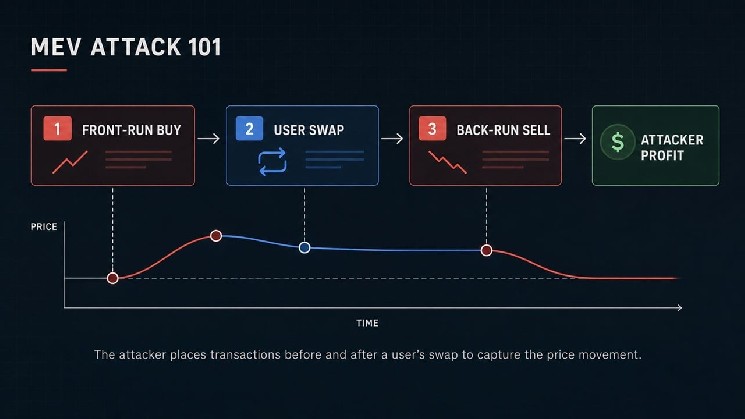
In June, an attacker deployed 66 fake token contracts on Ethereum, impersonating familiar names like WETH, USDC, and USDT. The target was Jaredfromsubway.eth, the most active "sandwich attack" bot operator on the network. Over several hours, the bot's automated trading logic, scanning for arbitrage opportunities, granted spending approvals to the malicious contracts. The attacker then drained at least $7.5 million in ETH and stablecoins from the bot and laundered the funds through Tornado Cash. The incident highlighted the irony of a bot built to exploit others being defeated by its own operational mechanism. However, the scale of this business is immense. Trackers show the bot's main contract has accumulated 117,007 ETH (approx. $295 million) since its first recorded profit extraction in March 2023. MEV (Maximal Extractable Value) is profit gained by reordering, inserting, or censoring transactions. The most consumer-hostile form is the "sandwich attack," where a bot detects a large pending trade in the public mempool, buys the asset just before the victim's transaction (driving the price up), lets the victim's trade execute at the worse price, and immediately sells for a profit. This is a daily occurrence. Bots compete for block order via MEV-Boost, an out-of-protocol auction system used by over 90% of Ethereum validators. This has led to significant centralization, with one builder, Titan, assembling over 50% of blocks, raising concerns about censorship and lack of competitive oversight. While sandwich attack profits have declined from ~$10 million monthly in late 2024 to ~$2.5 million in October 2025 (a 75% drop), largely due to MEV protection tools, analysts estimate peak annual losses for traders were still around $60 million. A structural solution is planned with the enshrined Proposer-Builder Separation (ePBS) in the upcoming Glamsterdam upgrade, which would integrate MEV auctions into the protocol's consensus rules. Until then, MEV on Ethereum remains a significant source of uncertainty and centralization risk.

cryptonews.ru4 h fa

MEV in Detail: Leading Ethereum 'Sandwich Bot' Earned $295 Million, Then Lost $7.5 Million

cryptonews.ru4 h fa

Why Trillion-Dollar Institutions Hesitate to Go On-Chain? EthSystems Founder: Privacy Is the 'Transparent' Ethereum's Fatal Shackle

"Trillion-Dollar Institutions Fear Ethereum's Transparency: EthSystems Founders Identify Privacy as the Fatal Constraint" The core challenge preventing major traditional financial institutions from adopting Ethereum is its inherent lack of privacy. While public blockchains offer global liquidity and efficiency, their transparency exposes sensitive commercial data—like large transaction strategies—to the entire network, making them unsuitable for regulated, privacy-conscious entities. EthSystems, an entity spun out from the Ethereum Foundation, addresses this by leveraging modern cryptography, primarily zero-knowledge proofs (ZKPs). Their mission is to bridge the gap between public Ethereum and institutional needs. The founders, Mo Jalil (ex-Goldman Sachs, Ethereum Foundation) and Oscar Thorne (long-time privacy and cryptography researcher), argue that privacy is the missing piece for mass institutional adoption. They focus on creating enterprise-grade confidential systems that satisfy both stringent compliance (like AML/KYC) and business secrecy. The problem is not a lack of cryptographic primitives; many exist. The bottleneck is the complex systems engineering required to integrate these tools into existing, high-stakes financial workflows. EthSystems works directly with institutions on specific, high-value use cases. Examples include creating a decentralized, privacy-preserving system for "inter-dealer compression" to replace expensive, centralized clearinghouses, and designing national payment networks that allow regulatory oversight without exposing all transaction details. Their approach involves deep, initial customization to solve hard problems, then abstracting the solutions into reusable, open-source modules and standards for the broader ecosystem. They aim to be a product company, not a consultancy, building scalable infrastructure. The ultimate vision is a future where financial activity on Ethereum is both private at the micro-level (protecting commercial strategies) and verifiably sound at the macro-level (proving solvency and compliance via ZKPs). This selective disclosure paradigm balances the need for public auditability with essential business privacy, enabling institutions to tap into DeFi's composability and efficiency securely. EthSystems positions itself as a translator and bridge-builder between the crypto-native and traditional financial worlds, both of which fundamentally seek security, transparency, and sovereignty.

marsbitIeri 02:56

Why Trillion-Dollar Institutions Hesitate to Go On-Chain? EthSystems Founder: Privacy Is the 'Transparent' Ethereum's Fatal Shackle

marsbitIeri 02:56

活动图片