Solana's Historic First Governance Vote Concludes: Why Did SGP-003 Spark Massive Controversy?

marsbitPubblicato 2026-08-28Pubblicato ultima volta 2026-08-28

Introduzione

Solana has completed its first-ever formal on-chain governance vote, marking a shift towards decentralized decision-making. Three proposals, SGP-0001, SGP-0002, and SGP-0003, were voted on. SGP-0001, establishing the foundational governance framework, and SGP-0002, accelerating the reduction of SOL's inflation rate, both passed. However, the most contentious proposal, SGP-0003, failed to reach the required supermajority. SGP-0003 proposed a significant change to Solana's fee structure, introducing a variable "Resource Fee" based on computational unit (CU) consumption, which would be entirely burned. Supporters, including some core developers, argued it would create fairer resource pricing and increase SOL's deflationary pressure. Opponents, led by major DeFi applications like Jupiter and Drift, criticized it as an effective tax on complex applications, warning it would unpredictably increase operational costs and undermine business models built on Solana's low fees. The vote outcome highlights a critical tension within Solana's growing ecosystem: balancing the interests of SOL holders (through deflationary mechanisms), validators (through rewards), and application developers (through cost predictability). As Solana evolves from a high-performance blockchain to one hosting substantial economic activity, governance is becoming central to its future development and competitiveness.

Author: Gu Yu

Solana is undergoing a landmark governance experiment.

On August 23rd, Solana's first formal on-chain governance vote was initiated, with three proposals—SGP-0001, SGP-0002, and SGP-0003—entering the voting phase simultaneously. Their contents concern the governance framework, SOL inflation mechanism, and transaction fee structure, respectively.

This not only signifies that Solana has begun entrusting major decisions to validators and stakers but also indicates that network upgrades, previously coordinated mainly by core developers and ecosystem institutions, are now entering a stage of public contention.

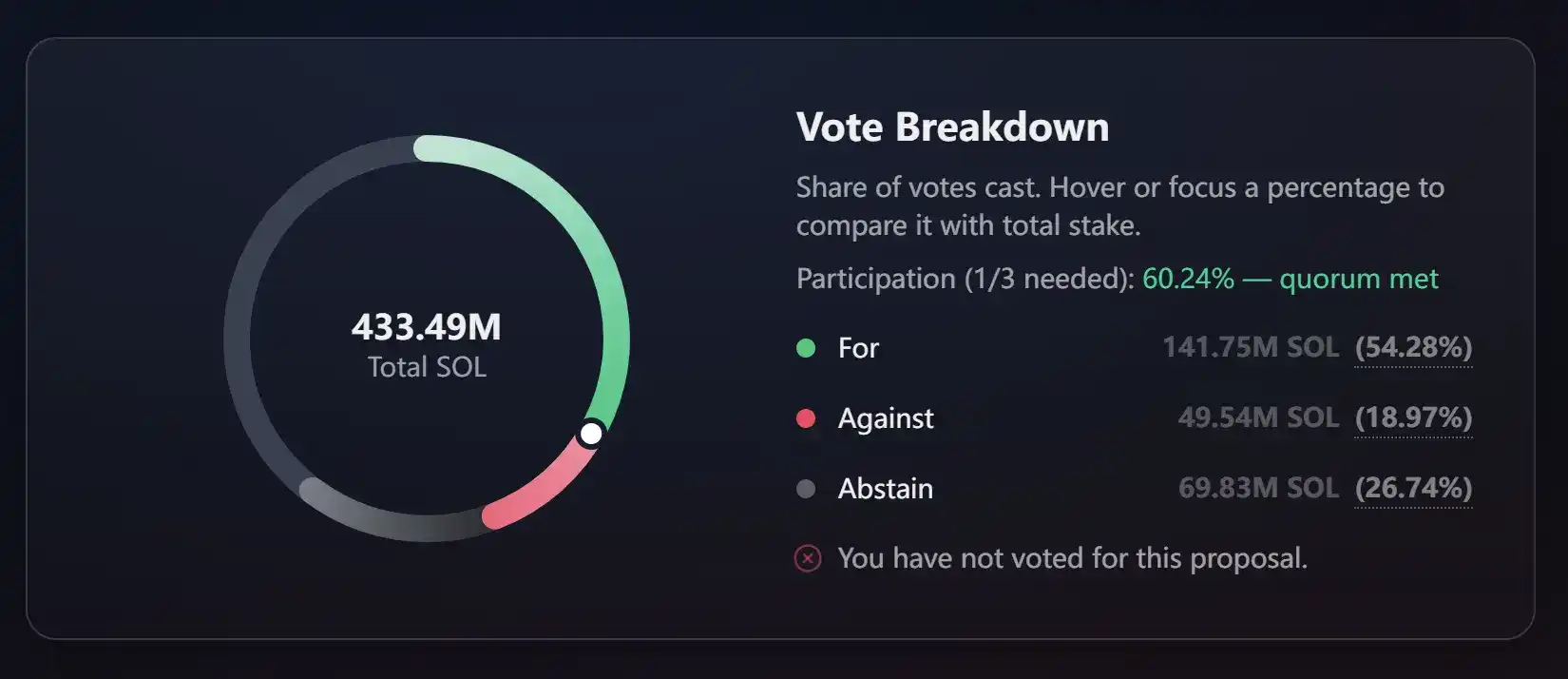
Around 23:00 tonight, the voting for these three governance proposals officially concluded. Proposals SGP-0001 and SGP-0002 both reached the minimum quorum (the proportion of all staked SOL users voting) of one-third and the minimum approval threshold (the proportion of 'yes' votes among all votes cast) of two-thirds and will now formally move to the implementation stage.

However, SGP-0003, which involved a network fee restructuring, was not passed. Its approval rate was 54.3%, still some distance from the 66.6% minimum threshold. Furthermore, the list of opposing votes included a series of well-known projects such as Jupiter, Forward Industries, Anagram Staking, and Solana Company.
So, what do SGP-0001 and SGP-0002 mean for the Solana ecosystem? And why did SGP-0003 face significant controversy on social media and fail to pass?

SGP-0001: Establishing a Formal Governance Framework for the First Time

Previously, Solana lacked a set of clear, standardized on-chain governance procedures similar to Ethereum's governance system. The traditional SIMDs addressed more "how to implement technically," while the newly introduced SGPs attempt to answer another question—whether Solana should move in this direction.

SGP-0001, the "Solana Constitution," is precisely the institutional foundation for this governance mechanism.

According to this framework, any proposal receiving support from at least 15% of active staking can enter formal on-chain voting; voting is weighted by the amount of staked SOL, with validators expressing opinions by default, but stakers can override validator votes using their own staking accounts. To pass a proposal, at least one-third of the network's staked SOL must participate, and at least two-thirds of the participating stake must vote in favor.

Therefore, the significance of SGP-0001 does not lie in changing Solana's performance or token economics but in providing a formal procedure for future controversies.

SGP-0002: Ending the Inflation Reduction Cycle Three Years Early

If SGP-0001 is about institutional construction, then SGP-0002 and SGP-0003 directly touch upon SOL's monetary economic model.

SGP-0002, "Double Disinflation," proposes increasing Solana's current annual inflation reduction rate from 15% to 30%, while not changing the ultimate inflation floor of 1.5%.

The difference lies in the time to reach this endpoint.

According to proposal estimates, Solana would originally have taken approximately 5.7 years to gradually reach the terminal inflation rate of 1.5%. The new plan shortens this time to about 2.8 years, projected to reduce cumulative new issuance by approximately 18.9 million SOL over the next six years.

Supporters believe this is equivalent to accelerating SOL's transition from an early network model of "high inflation, high staking subsidies" to a mature asset model. SOL treasury company Forward Industries argued that reducing new issuance can lessen selling pressure from staking rewards and reduce dilution for long-term holders; the company estimated that 18.9 million SOL, at its price at the time, corresponded to a potential reduction in issuance worth about $1.795 billion.

However, opposition voices were equally direct. For validators, inflation rewards are a significant source of income. The new plan does not magically create new network revenue but reduces future issuance, meaning a decrease in the SOL rewards that validators and stakers can obtain.

This is also a continuation of the SIMD-0228 controversy from 2025 on Solana. A similar inflation reform previously failed despite receiving over 60% support because it did not meet the supermajority threshold.

SGP-0003: The Proposal That Truly Changes Solana's Economic Model

Compared to SGP-0002, SGP-0003 was more controversial because it changes not just SOL issuance but the entire network's pricing model for "block space."

Solana's current base transaction fee primarily charges a fixed fee based on the number of signatures. SGP-0003 proposes splitting it into two parts:

One part is a fixed 2500 Lamports Base Inclusion Fee, paid entirely to the block producer;

The other part is a Resource Fee calculated based on the resources requested by the transaction, with 100% of this fee being burned.

Its core concept is very simple: whoever consumes more network resources pays more.

Currently, Solana burns approximately 648 SOL daily through base fees. Supporters of SGP-0003 believe the new mechanism could increase this number to several thousand SOL per day, with some estimates ranging from 7,500 to 9,000 SOL/day, implying a possible increase in daily burn by about tenfold.

For SOL holders, this seems like an almost natural boon: reducing new issuance on one hand while increasing network burn on the other, significantly slowing the growth rate of SOL supply.

But the problem lies precisely here—the fees don't materialize from thin air. The new fees ultimately fall on traders, applications, and on-chain markets.

Mostly Data simulated different types of applications, finding that ordinary transfers are minimally affected, but complex applications like account creation, CLOB market making, and on-chain routing would bear more noticeable cost increases. For trading protocols like Jupiter, Titan, and DFlow, the average fee per transaction might increase by approximately 0.000068, 0.00010, and 0.00012 SOL, respectively.

Thus, a rare ideological conflict emerged within Solana.

The Biggest Controversy: Is This "Resource Pricing" or a Tax on Applications?

Supporters of SGP-0003 believe Solana's current fee model severely underestimates the network resource consumption of complex transactions.

SGP-0003's proposer, developer Cavey, even publicly admitted this is a "positional proposal."

His goal is not to maintain Solana as a completely neutral general-purpose computing platform but to steer it toward becoming a blockchain more focused on financial markets. For financial applications, fast confirmation, stable execution, censorship resistance, and predictable resource pricing are more important than "any application must be cheap enough."

Solana co-founder Anatoly Yakovenko also supports this direction. He believes the current fixed signature fee for transactions leads to almost identical base costs for transactions of vastly different scales. A transaction consuming only 5,000 CU versus a large transaction consuming 1.4 million CU have an unreasonable price difference under a fixed fee model, so repricing based on CU addresses a real problem.

However, application developers do not accept this explanation.

Ellipsis Labs CEO Eugene Chen was one of the strongest critics. He argued that SGP-0003 is essentially a highly subjective policy disguised as a neutral resource pricing mechanism.

In his view, if an application platform's core economic parameters can suddenly change due to a governance vote, it becomes difficult for application developers to build long-term businesses on it.

He even bluntly stated that SGP-0003 is a "middle finger to every micro-structure-sensitive application on Solana" because it signals to developers that the cost model acceptable today could be completely rewritten tomorrow by a governance vote.

Manifest also expressed clear opposition. The project noted that Solana's truly scarce resource is priority ordering within a block, which is already priced via priority fees. In contrast, a large amount of available block space is not truly scarce yet would be charged extra under SGP-0003.

Manifest further warned that excessively high resource fees could even backfire: to lower CU costs, developers might be forced to reduce on-chain security checks, thereby increasing security risks.

On-chain voting records show Jupiter, Drift, Forward Industries, and Anagram Staking voted against the 0003 proposal; major staking providers like Figment, Staking Facilities, Kiln, and P2P.org explicitly expressed support, while Everstake directly abstained.

Conclusion

From technical progress to market performance, Solana is in a clear expansion phase.

In July, Solana increased the single-block compute limit from 60 million CU to 100 million CU, continuing to release space for higher on-chain transaction density; in August, mainnet Slot time was further shortened to 350ms, with plans to advance toward 200ms. Firedancer is already running on the mainnet, and next-generation consensus upgrades like Alpenglow are also progressing. Meanwhile, financial applications such as RWA, stablecoin payments, and tokenized stocks are expanding, as Solana attempts to translate its high-performance advantage into larger-scale real economic activity.

SOL's price also experienced a rapid rebound, rising from around $75 in August to above $110 at one point. Under the combined effects of technical upgrades, ecosystem expansion, and market expectations, Solana seems to be regaining market pricing for its next growth phase.

But what this first governance vote exposed is another side.

A faster, higher-capacity network does not mean all participants will benefit equally. The passage of SGP-0002 indicates a certain consensus has formed around reducing SOL's long-term inflation; the failure of SGP-0003 to gain sufficient support shows application developers remain highly vigilant about sudden cost increases and the redefinition of economic rules.

This actually represents Solana's most realistic current contradiction: it is striving to become more robust financial infrastructure but has not fully resolved how that infrastructure should be priced.

In the past, Solana's competitive logic was relatively simple—lower fees, higher performance, stronger throughput; but as the chain begins to carry more transactions, market making, payments, and RWA businesses, "low cost" itself is no longer just a user experience feature and starts directly impacting application business models.

Therefore, the true legacy of this first round of governance is not the outcome of any single proposal but a clearer dividing line: Solana can no longer rely solely on its technical roadmap to drive network growth; it must now find a new balance between developer interests, validator revenue, SOL holder value, and long-term network sustainability.

When a public chain transitions from "pursuing performance" to "hosting an economy," governance ceases to be an ancillary mechanism and becomes competitiveness itself. Solana's first governance round may be just the beginning of this contest.

Crypto di tendenza

Domande pertinenti

QWhat were the three SGP proposals voted on in Solana's first-ever formal on-chain governance vote, and which ones passed?

AThe three proposals were SGP-0001 (establishing a formal governance framework), SGP-0002 (accelerating the SOL disinflation rate), and SGP-0003 (restructuring transaction fees). SGP-0001 and SGP-0002 passed, meeting the required thresholds of one-third participation and two-thirds support. SGP-0003 did not pass, receiving only 54.3% support.

QWhy was the SGP-0003 proposal highly controversial and ultimately rejected?

ASGP-0003 was controversial because it proposed restructuring transaction fees by charging based on actual resource consumption (CU). Supporters saw it as fair resource pricing, but major applications like Jupiter and Drift opposed it, arguing it would significantly increase their operational costs and unpredictably change the economic rules they built their businesses on, undermining developer trust in the platform's stability.

QWhat was the core argument made by SGP-0003's proposer, Cavey, and supporters like Anatoly Yakovenko for changing the fee structure?

AThey argued that Solana's current flat-fee model based on signatures is flawed because it does not accurately price the network resources (Computation Units - CU) consumed. A small transaction using 5,000 CU pays a similar base fee as a complex transaction using 1.4 million CU. They believe moving to resource-based pricing is fairer and aligns Solana's economics with its goal of becoming a premier blockchain for financial applications, where predictable resource costs are crucial.

QAccording to the article, what does the failure of SGP-0003 reveal about a key conflict Solana currently faces?

AThe failure of SGP-0003 reveals a conflict between Solana's ambition to become a powerful financial infrastructure and the unresolved question of how that infrastructure should be priced. As Solana moves from 'seeking performance' to 'hosting an economy,' it must balance the competing interests of developers (who need low, predictable costs), validators (who need revenue), SOL holders (who want value appreciation via reduced inflation/burn), and the network's long-term sustainability. Governance is becoming central to its competitiveness.

QWhat significant change to SOL's token economics did the passed SGP-0002 proposal introduce?

ASGP-0002, titled 'Double Disinflation,' proposed doubling the annual rate at which SOL's inflation decreases from 15% to 30%. This change does not alter the terminal inflation rate of 1.5% but accelerates the timeline to reach it from approximately 5.7 years to about 2.8 years. It is estimated to reduce cumulative new SOL issuance by about 18.9 million SOL over six years, potentially reducing selling pressure from staking rewards and benefiting long-term holders.

Letture associate

Attention Bitcoin Investors! Analytical Company Reveals the Levels That Will Determine BTC's Fate! Will It Reach the $100,000 Mark?

Bitcoin Investors Alert: Analysis Firm Reveals Key Levels That Will Determine BTC's Fate! Will It Reach $100,000? Bitcoin recently rose above $81,000 before dropping to around $78,000 following hawkish comments from the Federal Reserve, later recovering to over $79,000. Amid market speculation on Bitcoin's ($BTC) future trend, analytical firm Alphractal has provided an updated assessment using its proprietary "Structured Market Bands" metric. This on-chain indicator calculates support and resistance zones based on UTXO movements and realized cost. According to Alphractal, with BTC above approximately $79,000, the key structural levels are as follows: - Upper Structural Resistance Band: $100,570 - Lower Structural Resistance Band: $75,024 - Upper Structural Support Band: $63,284 - Lower Structural Support Band: $57,228 The firm states that BTC breaking above the lower resistance band of $75,024 indicates it is now moving within the next upper supply zone. It is currently about 27.7% below the $100,570 resistance level. This structure suggests that as the price advances within the resistance zone, selling pressure could intensify. Analysts also noted that these structural bands are trending upward over time. For instance, the lower resistance band has risen from $72,569 on August 9th to $75,024 currently. In conclusion, Bitcoin's ability to hold above the $75,000 level makes the upper resistance zone near $100,000 a key market target. Conversely, a drop below $75,000 could lead to a retest of support levels, particularly in the $63,000-$57,000 range. *This is not investment advice.

cryptonews.ru35 min fa

Attention Bitcoin Investors! Analytical Company Reveals the Levels That Will Determine BTC's Fate! Will It Reach the $100,000 Mark?

cryptonews.ru35 min fa

Trading

Spot

Articoli Popolari

Cosa è SOLANA

HarryPotterWifHatMyroWynn10Inu,$solana: Un’Immersione nel Trendy Meme Coin Project Introduzione Nel panorama in continua evoluzione delle criptovalute, progetti innovativi emergono continuamente, catturando l'immaginazione di investitori ed appassionati. Uno di questi progetti è HarryPotterWifHatMyroWynn10Inu,$solana, una meme coin che ha iniziato a ritagliarsi una sua nicchia all'interno della comunità crypto. Questo articolo ha l'obiettivo di fornirti una panoramica completa del progetto, spiegandone lo scopo, l'architettura, il creatore, gli investitori e i traguardi significativi lungo il percorso. Cos'è HarryPotterWifHatMyroWynn10Inu,$solana? Panoramica HarryPotterWifHatMyroWynn10Inu,$solana è un progetto di meme coin strutturato sulla blockchain di Solana – una piattaforma rinomata per la sua scalabilità e velocità. Con l'intento di portare gioia e creatività nello spazio crypto, questo progetto non solo funge da token di scambio ma anche come catalizzatore per la generazione e la condivisione di contenuti meme. La comunità al suo interno è incoraggiata a partecipare attivamente, fornendo un ecosistema dinamico dove la creatività e la collaborazione prosperano. Obiettivi e Scopi Nella sua essenza, il progetto mira a favorire un ambiente dove gli appassionati di meme possano riunirsi, condividere e creare nuovi contenuti meme. Questo approccio narrativo infonde entusiasmo nella comunità, promuovendo il coinvolgimento e allo stesso tempo evidenziando le robuste funzionalità insite nella blockchain di Solana. Costruendo un progetto incentrato sulla comunità, HarryPotterWifHatMyroWynn10Inu,$solana desidera inoltre esplorare l'impatto sociale delle valute digitali come mezzo di espressione. Chi è il Creatore di HarryPotterWifHatMyroWynn10Inu,$solana? L'identità del creatore dietro HarryPotterWifHatMyroWynn10Inu,$solana rimane avvolta nel mistero. Il progetto è stato strutturato in modo tale che la proprietà sia stata rinunciata; pertanto, prospera come un'iniziativa guidata dalla comunità. Questa decentralizzazione promuove la trasparenza e la partecipazione democratica tra tutti i soggetti coinvolti. Tale approccio è sempre più popolare nel mondo delle meme coin, dove il coinvolgimento della comunità regna sovrano. Chi sono gli Investitori di HarryPotterWifHatMyroWynn10Inu,$solana? Attualmente, non ci sono informazioni pubblicamente disponibili riguardo agli specifici investitori o fondazioni che supportano HarryPotterWifHatMyroWynn10Inu,$solana. L'assenza di investitori noti sottolinea ulteriormente l'etica orientata alla comunità del progetto, che si mantiene indipendente dai tradizionali schemi finanziari. Questa indipendenza consente al progetto di sviluppare la propria identità libera da pressioni esterne, facendo affidamento invece sull'interesse collettivo della sua base utenti. Come Funziona HarryPotterWifHatMyroWynn10Inu,$solana? Modello Economico Il progetto impiega un modello economico unico che sostiene la sua funzionalità e il coinvolgimento degli utenti. Le transazioni all'interno di HarryPotterWifHatMyroWynn10Inu,$solana sono progettate per essere vantaggiose per tutte le parti coinvolte. Ogni operazione comporta una commissione, che viene successivamente redistribuita tra gli attuali possessori, aumentando al contempo il pool di liquidità. I componenti chiave di questo modello includono: Meccanismo di Riflesso: Una parte delle commissioni di transazione viene restituita ai possessori, promuovendo l'investimento a lungo termine nel token. Acquisizione di Pool di Liquidità: I fondi sono destinati a migliorare la liquidità, garantendo che le operazioni di acquisto e vendita possano essere eseguite senza intoppi. Meccanismi di Bruciatura: Una parte dei token potrebbe essere bruciata per creare scarsità, aumentando potenzialmente il valore man mano che la domanda cresce. Questo design incoraggia un ecosistema autosufficiente che prospera grazie alle interazioni e agli investimenti della comunità. Coinvolgimento della Comunità Nel cuore di HarryPotterWifHatMyroWynn10Inu,$solana c'è il valore attribuito al coinvolgimento della comunità. Permettendo agli utenti di partecipare allo sviluppo del progetto attraverso varie attività, come la creazione di meme e promozioni, il progetto favorisce un ecosistema vibrante dove la creatività può fiorire. Cronologia di HarryPotterWifHatMyroWynn10Inu,$solana La traiettoria di HarryPotterWifHatMyroWynn10Inu,$solana presenta diversi eventi degni di nota che hanno plasmato la sua posizione attuale nella comunità crypto: Creazione: La data specifica di creazione rimane non divulgata, ma l'ideazione del progetto è radicata nella cultura meme che permea l'era digitale. Passaggio alla Comunità: Dopo la rinuncia alla proprietà da parte del suo creatore, il progetto è passato a un modello guidato dalla comunità, permettendo a tutti i partecipanti di avere una parte nel suo successo. Audit e Collezione NFT: In un tentativo di aumentare la credibilità, il progetto ha completato un audit approfondito, lanciando simultaneamente una collezione NFT che serve a incarnare la sua etica centrata sui meme. Partnership e Sviluppo: Il progetto è attualmente impegnato a esplorare potenziali partnership con altri token e a organizzare lo sviluppo di un sito web unico e opzioni di merchandising basate sui suoi leggendari meme. Punti Chiave In sintesi, HarryPotterWifHatMyroWynn10Inu,$solana si presenta come un attore notevole nel settore delle meme coin delle criptovalute. Ecco alcuni dei punti salienti: Iniziativa Guidata dalla Comunità: Il progetto prospera come uno sforzo collaborativo, incoraggiando contributi attivi da parte dei membri della comunità mentre si distacca da pretese di proprietà. Modello Economico Innovativo: Utilizzando meccanismi di riflesso, acquisizione di liquidità e bruciatura, crea un ambiente finanziario robusto e coinvolgente per gli utenti. Coinvolgimento con NFT e Merchandising: Con il lancio di una collezione NFT, il progetto mira a approfondire il coinvolgimento all'interno della sua comunità, rafforzando il legame tra cultura meme e valuta digitale. Esplorazione di Partnership: L'iniziativa non è stagnante – lo sviluppo in corso e le potenziali partnership indicano un approccio lungimirante volto alla crescita sostenuta. Conclusione Mentre HarryPotterWifHatMyroWynn10Inu,$solana continua a guadagnare slancio all'interno del panorama delle criptovalute, la sua combinazione unica di coinvolgimento della comunità, strutture economiche innovative e integrazione della cultura meme delineano il suo potenziale percorso futuro. Anche con il mistero che circonda le sue origini e le affiliazioni degli investitori, il progetto cattura una storia intrigante che parla dell'essenza dell'innovazione decentralizzata. In un mondo dove le criptovalute sono spesso viste attraverso una lente puramente finanziaria, HarryPotterWifHatMyroWynn10Inu,$solana dimostra che il movimento crypto incorpora creatività, comunità e collaborazione. Che tu sia un investitore esperto o un neofita, il percorso che si sta sviluppando di questo progetto di meme coin rappresenta sicuramente uno studio di caso coinvolgente degno di attenzione.

716 Totale visualizzazioniPubblicato il 2024.04.04Aggiornato il 2024.12.03

Cosa è SOLANA

Cosa è SOLANA 2.0

BarbieCrashBandicootRFK777Inu, $SOLANA 2.0: Un Nuovo Giocatore nel Paesaggio Cripto Introduzione a BarbieCrashBandicootRFK777Inu, $SOLANA 2.0 Nel paesaggio in continua evoluzione delle criptovalute, nuovi entrant catturano costantemente l'attenzione di investitori ed entusiasti. Tra questi progetti emergenti c'è BarbieCrashBandicootRFK777Inu, rappresentato dal simbolo della criptovaluta $SOLANA 2.0. Questa iniziativa unica combina elementi di glamour, avventura e cultura meme, proponendosi di sfidare le aspettative in un'area estremamente competitiva. Con aspirazioni di crescita e innovazione, questo progetto cattura lo spirito di un underdog che lotta contro giganti affermati. Che cos'è BarbieCrashBandicootRFK777Inu, $SOLANA 2.0? Alla sua essenza, BarbieCrashBandicootRFK777Inu è un progetto di criptovaluta che trae ispirazione da varie riferimenti culturali iconici. Includendo l'eleganza e il fascino associati a Barbie, l'energia dinamica di Crash Bandicoot e la spinta instancabile rappresentata da RFK, il progetto mira a offrire un'esperienza multifattoriale nel mondo delle criptovalute. Il principale obiettivo del progetto BarbieCrashBandicootRFK777Inu è quello di unire questi elementi disparati in un ecosistema coeso che attragga un vasto pubblico. Abbracciando la fantasia della cultura meme, rimanendo però ancorato ai principi di decentralizzazione e empowerment finanziario, il progetto si è posizionato come un'opzione convincente sia per investitori esperti che per neofiti del mondo cripto. Chi è il Creatore di BarbieCrashBandicootRFK777Inu, $SOLANA 2.0? Nonostante l'interesse crescente per BarbieCrashBandicootRFK777Inu, le informazioni riguardanti il suo creatore rimangono per lo più sconosciute. L'anonimato del suo fondatore o team di sviluppo solleva interrogativi sulla struttura e governance del progetto. Nel mondo delle criptovalute, non è raro che i progetti operino senza creatori pubblici. Questa mancanza di informazioni potrebbe scoraggiare alcuni potenziali investitori, mentre altri potrebbero vederla come un'opportunità per abbracciare lo spirito di decentralizzazione che sottende molte iniziative nel campo delle criptovalute. Chi sono gli Investitori di BarbieCrashBandicootRFK777Inu, $SOLANA 2.0? Attualmente, ci sono poche informazioni disponibili riguardo ai fondamenti d'investimento o alle organizzazioni che supportano BarbieCrashBandicootRFK777Inu. La mancanza di un sostegno d'investimento dettagliato per il progetto evidenzia la natura indipendente di numerose criptovalute. In questo caso, resta da vedere se il finanziamento del progetto provenga da un supporto della comunità a livello locale o dal supporto di entità finanziarie più grandi. Come Funziona BarbieCrashBandicootRFK777Inu, $SOLANA 2.0? BarbieCrashBandicootRFK777Inu è progettato con una serie di funzionalità che contribuiscono alla sua unicità all'interno dello spazio cripto affollato. Sebbene i dettagli tecnici specifici rimangano segreti, si prevede che il progetto incorpori funzionalità volte a migliorare il coinvolgimento degli utenti e a promuovere la crescita della comunità. La combinazione di influenze variegate—dalla moda e avventura ai giochi—incoraggia un'atmosfera inclusiva che si rivolge a interessi diversi. Inoltre, i legami del progetto con l'ecosistema $SOLANA 2.0 suggeriscono potenziali vantaggi tecnologici. Questo potrebbe includere velocità di transazione innovative, scalabilità e costi contenuti, allineandosi con le capacità tecniche della blockchain di Solana. I fondatori del progetto sembrano voler sfruttare questa base tecnologica per creare un'esperienza comunitaria duratura e un'offerta di prodotto sostanziale. Timeline di BarbieCrashBandicootRFK777Inu, $SOLANA 2.0 Il percorso di BarbieCrashBandicootRFK777Inu contiene diverse tappe chiave, fornendo spunti sullo sviluppo del progetto fino ad ora: Concettualizzazione del Progetto: Sono emerse idee iniziali riguardo alla fusione di glamour, avventura e cultura meme, dando forma al concetto unico del progetto. Creazione del Token: È stato istituito il token simbolico $SOLANA 2.0, progettato per incarnare le aspirazioni del progetto e attrarre l'interesse di potenziali investitori. Sviluppo del Progetto: Attualmente, il progetto è in fase di ulteriore sviluppo, con un'enfasi sulla sfida ai player consolidati nel campo delle criptovalute e sulla fornitura di offerte innovative. Queste tappe riflettono la traiettoria di crescita del progetto, evidenziando il suo impegno a sviluppare un'esperienza pionieristica nel campo delle criptovalute. Punti Chiave su BarbieCrashBandicootRFK777Inu, $SOLANA 2.0 Concetto Unico: BarbieCrashBandicootRFK777Inu si distingue per la fusione di elementi di glamour, avventura e cultura meme in un unico progetto di criptovaluta. Spirito da Underdog: Il progetto abbraccia una persona underdog, mirante a sfidare progetti di criptovaluta consolidati e ritagliarsi una nicchia nell'industria. Fase di Sviluppo: Sono in corso sforzi di sviluppo attivi, con l'intenzione di fornire offerte fresche e innovative in linea con le aspettative della comunità e degli investitori. Conclusione BarbieCrashBandicootRFK777Inu, rappresentato dal simbolo $SOLANA 2.0, è un nuovo e interessante entrant nel mercato delle criptovalute. La sua combinazione unica di riferimenti culturali e visione ambiziosa potrebbe risuonare con coloro che cercano valori alternativi nei progetti cripto. Sebbene lo stato sconosciuto del suo creatore e degli investitori possa sollevare sopracciglia, l'enfasi del progetto su fascino e avventura presenta una narrativa affascinante che espande i confini di ciò che le criptovalute possono incarnare. Man mano che il progetto continua a svilupparsi, sarà interessante osservare la sua evoluzione all'interno del più ampio paesaggio cripto e come si posizioni tra i suoi concorrenti. Per coloro che vi sono coinvolti, BarbieCrashBandicootRFK777Inu potrebbe svelare esperienze sorprendenti che ridefiniscono l'interazione con gli asset digitali. Per ora, mentre il progetto avanza, il suo percorso rimane un promemoria che l'innovazione nel settore cripto non conosce limiti, offrendo tutto, dall'eccitazione e intrattenimento alla possibilità di empowerment finanziario.

347 Totale visualizzazioniPubblicato il 2024.04.05Aggiornato il 2024.12.03

Cosa è SOLANA 2.0

Come comprare SOL

Benvenuto in HTX.com! Abbiamo reso l'acquisto di Solana (SOL) semplice e conveniente. Segui la nostra guida passo passo per intraprendere il tuo viaggio nel mondo delle criptovalute.Step 1: Crea il tuo Account HTXUsa la tua email o numero di telefono per registrarti il tuo account gratuito su HTX. Vivi un'esperienza facile e sblocca tutte le funzionalità,Crea il mio accountStep 2: Vai in Acquista crypto e seleziona il tuo metodo di pagamentoCarta di credito/debito: utilizza la tua Visa o Mastercard per acquistare immediatamente SolanaSOL.Bilancio: Usa i fondi dal bilancio del tuo account HTX per fare trading senza problemi.Terze parti: abbiamo aggiunto metodi di pagamento molto utilizzati come Google Pay e Apple Pay per maggiore comodità.P2P: Fai trading direttamente con altri utenti HTX.Over-the-Counter (OTC): Offriamo servizi su misura e tassi di cambio competitivi per i trader.Step 3: Conserva Solana (SOL)Dopo aver acquistato Solana (SOL), conserva nel tuo account HTX. In alternativa, puoi inviare tramite trasferimento blockchain o scambiare per altre criptovalute.Step 4: Scambia Solana (SOL)Scambia facilmente Solana (SOL) nel mercato spot di HTX. Accedi al tuo account, seleziona la tua coppia di trading, esegui le tue operazioni e monitora in tempo reale. Offriamo un'esperienza user-friendly sia per chi ha appena iniziato che per i trader più esperti.

2.2k Totale visualizzazioniPubblicato il 2024.12.12Aggiornato il 2026.06.02

Come comprare SOL

Discussioni

Benvenuto nella Community HTX. Qui puoi rimanere informato sugli ultimi sviluppi della piattaforma e accedere ad approfondimenti esperti sul mercato. Le opinioni degli utenti sul prezzo di SOL SOL sono presentate come di seguito.

活动图片