Ethereum's Quantum Security and Privacy: Why Developers Are Reassessing Priorities

cryptonews.ruPubblicato 2026-08-30Pubblicato ultima volta 2026-08-30

Introduzione

The article discusses a major shift in Ethereum's development priorities, focusing on quantum resistance, privacy, and scalability. The new roadmap, updated to 2029, elevates post-quantum cryptography as a critical near-term goal, aiming to prepare the network for future quantum computing threats before they become practical. Privacy is also being integrated at the base protocol level (Private L1), moving beyond an add-on feature, using mechanisms like keyed nonces and zero-knowledge proofs to obscure user activity. Scalability efforts will leverage technologies like STARK proofs and zkVM, while the protocol architecture is being simplified under the "Lean Ethereum" concept. This strategic pivot coincides with significant personnel changes within the Ethereum Foundation and is influenced by external tech trends like AI and the growing market demand for privacy-focused cryptocurrencies. The article concludes that while these updates present long-term technical promise, market volatility and implementation complexities remain considerations for investors.

Ethereum's quantum security has become one of the main focuses of the new roadmap: the team behind the second-largest cryptocurrency by market cap is strengthening its focus on post-quantum cryptography, privacy, and scaling, while some previous technical priorities are taking a backseat. This is not about a one-time upgrade but a shift in priorities: developers are choosing schemes designed to prepare the network for future risks, although a practical quantum threat to $ETH is currently seen as a task for the coming years, not a current widespread hack.

Ethereum is needed as an open blockchain infrastructure for digital finance and applications: the network can verify transactions, run programmable rules, and build services on top of the base layer. Its strengths compared to more rigid networks are update flexibility, a developed ecosystem, support for scaling solutions, and a quick transition towards privacy and new cryptographic schemes.

How Vitalik Buterin Described the New Vision for Ethereum

On August 10, Vitalik Buterin explained that he compared Ethereum's previous development plans with the current Strawmap, calculated until 2029. As a result, the priorities have changed noticeably: quantum attack resistance, base-layer privacy, and a simpler protocol architecture are now at the center of attention. According to his logic, quantum computing can no longer be left out of basic planning: if signatures and keys ever become a weak point, protection will need to be rebuilt in advance, not during a crisis.

The main roadmap, prepared in 2023, was synchronized with the new Strawmap. Buterin compares the modernization approach to the Ship of Theseus: if every part of a ship is gradually replaced, does it remain the same ship? The logic for Ethereum is similar. Developers want to update key system elements without a sharp break from the current network—essentially rebuilding the blockchain while it's in motion.

Such changes are planned to be carried out through a series of hard forks within the Lean Ethereum concept. Its meaning is to simplify the infrastructure, leave fewer complex components, and rely on a limited set of reliable cryptographic primitives. For a network where every transaction must be verifiable and secure, such compactness becomes not just a matter of convenience but a security factor.

What Changed in the Strawmap

Fresh edits to the Strawmap appeared in August. The map still contains upcoming upgrades, including Ethereum Improvement Proposals, as well as the Glamsterdam upgrade in 2026 and the Hegota upgrade in 2027. A separate block is dedicated to long-term priorities—security, scaling, and privacy.

Compared to the 2023 roadmap, the new version changes the balance of forces. Buterin highlights several key shifts.

  • Quantum resistance has risen higher on the priority list.
  • Some EVM improvements have become less important.
  • Some previous technical solutions are being replaced by more modern designs.
  • Ideas not present in the early plan have been added to the Strawmap, primarily due to rapid progress in artificial intelligence and post-quantum cryptography.

These changes show that the team is responding not only to the network's internal problems. External technological trends also influence the plans: the development of AI, growing interest in zero-knowledge proofs, and the anticipation of an era where quantum computers become a practical threat to old protection schemes.

Privacy Moves to the Base Protocol Level

One of the most noticeable shifts is related to privacy. It is now considered not as an additional feature on top of the network but as a requirement for the base level—Private L1. The idea is to make it harder to link network actions to a specific user and allow data verification without revealing unnecessary information.

To this end, keyed nonces and recent roots are being discussed. These mechanisms should help hide connections between operations and participants. Part of the task of protecting sensitive information may also be addressed by FOCIL—a mechanism that fights censorship and forcibly includes transactions in the ledger.

Additionally, developers are considering lean privacy pools and wormholes. The latter idea is related to zero-knowledge proofs and proposal EIP-7503. In such a model, a user can prove the correctness of an action without revealing all details. For a blockchain, this is an important balance: the network remains verifiable, but publicity no longer means complete transparency of every step.

Post-Quantum Cryptography Becomes an Urgent Task

2029 is increasingly mentioned as a possible deadline by which significant digital infrastructure must transition to quantum-resistant solutions.

Specialists from Microsoft, Google, and Cloudflare consider 2029 an important milestone for preparing significant digital infrastructure for quantum risks.

US authorities, in turn, plan to transition federal service cryptography to new standards by 2030.

Simply put, post-quantum cryptography is a set of protection methods designed to withstand attacks not only from ordinary computers but also from future quantum computers. For Ethereum, this means gradually replacing vulnerable elements: primarily signature schemes, proof aggregation methods, and account protection mechanisms.

Ethereum is moving in the same direction. Among the options are replacing some current mechanisms with hash-based signatures like leanXMSS, implementing leanSPHINCS, and aggregation via zkzk-frames. Nicolas Kocinie from the Ethereum Foundation believes that individual solutions for account protection can be implemented without a hard fork.

The problem is particularly important because modern electronic signatures in many systems are built on algorithms that could be weakened by a quantum computer in the future. For cryptocurrencies, this is not an abstract threat: if a vulnerability in computer security affects signatures or keys, user funds will be at risk.

Currently, the main risk does not appear as an instant opportunity to steal $ETH, but as a future scenario: a sufficiently powerful quantum computer could attempt to recover private keys from public data or weaken the signatures that underpin the right to control funds. Therefore, addresses, keys, and wallets that can be transferred to new schemes before such a threat becomes practical are important.

In this context, ECDSA, hash functions, and new signature schemes are discussed. Ethereum's cryptography must be ready for a world where quantum mechanics stops being just a laboratory topic and becomes a practical basis for computation. If an ordinary computer takes too long to solve such tasks, a specialized quantum machine could potentially change the rules of the game.

How Users Can Reduce Future Quantum Risks

For an ordinary $ETH holder, the main task now is not to panic but to monitor network and wallet updates. While developers are preparing quantum-resistant schemes, a reasonable set of actions looks like this.

  • Store seed phrases and private keys offline and do not enter them into third-party services.
  • Use wallets that quickly support Ethereum updates and new account protection standards.
  • After the appearance of recommended quantum-resistant schemes, transfer funds to new addresses or accounts if such a step is suggested by wallet or protocol developers.
  • Do not keep large amounts in old wallets that have not been updated for a long time and may not support new signature mechanisms.

Scaling Through STARK and More Rigid Constructions

Scaling is associated with new state types and recursive STARK proofs. Buterin calls STARK proofs and AI-accelerated formal verification methods full-fledged building blocks upon which Ethereum's future can be designed.

STARK proofs and formal verification, enhanced by artificial intelligence, are becoming some of the reliable components for Ethereum's technical development.

Instead of trying to scale all network activity equally, developers want to use more specialized mechanisms with clear limitations. This approach should help better withstand periods of high load and allocate resources more accurately. For a data transmission protocol in a distributed network, this is fundamental: the clearer the rules, the easier the verification and the lower the risk of unexpected failures.

Blobs, Native Rollups, and the Role of Artificial Intelligence

The new Strawmap includes elements that in 2023 either did not yet exist in their current form or were not seriously considered. Among them are blobs, gas futures, native rollups, and more noticeable integration of artificial intelligence.

Some previous ideas, on the contrary, have become outdated. For example, Verkle trees no longer look like the main direction, and developers plan to gradually transition from them to polynomial binary trees. This is another example of how the roadmap changes along with the technological environment.

Buterin separately talks about zkVM. This concept suggests that the protocol will give users access to a system of commands different from the EVM. Among the main candidates are leanISA and RISC-V. According to Buterin's estimate, such systems are simpler, more modern, and more efficient than the EVM.

Why the Reassessment of Plans Coincided with Personnel Changes

The new priority setting emerged after a series of departures from the Ethereum Foundation. Since 2025, developers and managers have left the organization. Among them:

  • Peter Szilagyi.
  • Tomasz Stanczak.
  • Raul Kripalani.
  • Josh Stark.
  • Tim Beiko.
  • Barnabe Monnot.
  • Julian Ma.
  • Carl Beekhuizen.

Other specialists have also left.

Not all commented on their decisions. Peter Szilagyi, for example, hinted at Vitalik Buterin's too strong influence on the direction of the ecosystem. Buterin himself previously stated that the role of the Ethereum Foundation has been reassessed: it is now more of a "Special Node" with a specific purpose, not the central command hub of the entire network.

Therefore, the roadmap update can be seen not only as a technical process. It is happening against the backdrop of personnel changes, a reassessment of the balance of influence, and a search for a new coordination model within the ecosystem.

Privacy Became a Market Signal

The interest in privacy is not growing in a vacuum. Over the past year, attention to anonymous coins has sharply increased in the cryptocurrency market.

The price picture for this period looks like this:

  • Zcash: around $40 in summer 2025 and $796 now, a roughly 20x increase.
  • Monero: $150 in summer 2025, $443 now, and a rise above $570 in January 2026.
  • Ethereum: over $4,700 in August 2025 and around $2,460 now.

Against this backdrop, the focus on privacy can be explained not only by technical reasons but also by market expectations. Users increasingly want cryptocurrencies to combine blockchain transparency with personal data protection.

At the same time, technologies based on zero-knowledge proofs are useful not only for privacy. They help scale the network and simplify the verification of complex operations. According to Buterin, SNARKs in 2023 were not yet mature enough to be included in the roadmap. By 2026, the situation had changed, so the new paradigm began to look more realistic.

Should You Buy $ETH Now?

The situation around $ETH is ambiguous: the technical roadmap has become clearer regarding privacy, scaling, and quantum resistance, but the price after August 2025 is noticeably lower than previous levels, and there have been personnel changes within the Ethereum Foundation.

  • Arguments in favor of buying could include long-term updates, work with zero-knowledge proofs, a course towards Private L1, and preparation for post-quantum cryptography.
  • Arguments against buying or for caution include volatility, the complexity of hard forks, dependence on development timelines, and the risk that the market has already priced in some of the expectations.
  • A neutral approach is to buy $ETH only with a clear horizon in mind, limit its share in the portfolio, and not use money whose loss would be critical.

Quantum Threat to Bitcoin and the Marketing Effect

Quantum computing could become a problem not only for Ethereum. Bitcoin is also often discussed in this context. Deloitte believes that over 4 million $BTC on early addresses, including about 1 million $BTC from the Patoshi mining period, could be at risk. These coins are potentially associated with Satoshi Nakamoto.

Ledger's CTO, Charles Guillemet, admits that Bitcoin might go through a series of hard forks in the future. The reason is simple: it will be difficult for users to agree on a single modernization method. Ethereum compared to it looks more flexible, although this flexibility is achieved at the cost of constantly refining goals and the noticeable role of key figures like Vitalik Buterin.

There is also a more pragmatic explanation for what is happening. The updated roadmap can work as a signal for investors. After personnel changes and a prolonged price decline, the asset needs to show clear future directions: privacy, scaling, quantum resistance, and more modern cryptography.

What This Means for Ethereum's Future

Ethereum's current course cannot be called entirely new. Many ideas have been discussed for a long time, but now they have received a different order and a clearer place in the development plan. The main shift is that quantum security, privacy, and provable scalability are becoming not peripheral improvements but part of the core of the future architecture.

Developers are adjusting the roadmap to the technological reality: AI is developing faster, zero-knowledge proofs are becoming more practical, and post-quantum cryptography is ceasing to be a distant future topic. For a network that aims to be the basic infrastructure for digital finance, such a reassessment looks not like a sharp turn but an attempt to prepare in advance for the next stage of the industry's development.

end-content
Crypto di tendenza

Domande pertinenti

QAccording to the article, what are the three main new priorities for Ethereum's development roadmap as highlighted by Vitalik Buterin?

AThe three main new priorities are quantum resistance (post-quantum cryptography), base-layer privacy (Private L1), and a simpler protocol architecture.

QWhy has post-quantum cryptography become an urgent task for Ethereum, according to the text?

APost-quantum cryptography has become urgent because significant digital infrastructure is targeting 2029 as a deadline to prepare for quantum risks, with U.S. authorities aiming to transition federal cryptography by 2030. The threat is future-focused: a sufficiently powerful quantum computer could potentially recover private keys from public data or weaken the digital signatures that secure funds.

QWhat is the concept of 'Private L1' mentioned in the article, and how does it differ from previous approaches to privacy on Ethereum?

A'Private L1' refers to treating privacy as a requirement for the base-layer protocol itself, rather than as an additional feature built on top of the network. The goal is to make it harder to link network actions to specific users and to enable data verification without revealing unnecessary information, moving privacy from a peripheral add-on to a core architectural principle.

QThe article mentions that the updated roadmap coincides with personnel changes at the Ethereum Foundation. What reason did one departing developer, Peter Szilágyi, hint at for his departure?

APeter Szilágyi hinted that his departure was due to what he perceived as Vitalik Buterin's excessive influence on the direction of the ecosystem.

QWhat are two specific technical mechanisms or concepts mentioned for improving Ethereum's scalability in the new Strawmap?

ATwo specific concepts for improving scalability mentioned are the use of recursive STARK proofs and the exploration of 'native rollups.'

Letture associate

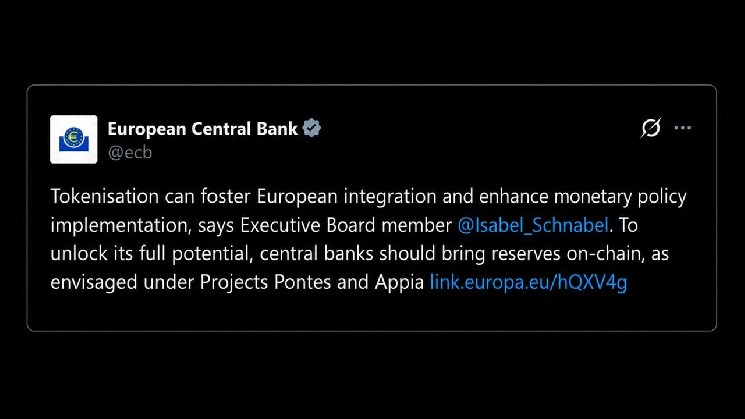
ECB's Schnabel says central bank money 'should move to blockchain'

ECB Executive Board member Isabel Schnabel stated that central bank money "must move onto the blockchain." She argued that stablecoins lack the independent ability to scale liquidity during financial stress—a gap only a central bank can fill. Her proposed solution involves tokenization, which she says can make transactions faster, safer, and more programmable, but only if the safest asset (central bank money) is on the same "rails" as other tokenized assets. This marks a notable shift for the Eurosystem, which had previously viewed Distributed Ledger Technology (DLT) mainly as a tool for regulating stablecoins and crypto, not as infrastructure to adopt directly. The first step is Project Pontes, launching in September. It will initially synchronize the ECB’s existing TARGET services with private DLT platforms. Eventually, it aims to enable settlement finality on a Eurosystem-managed DLT platform with smart contract functionality and 24/7 operation. The long-term strategy is Project Appia, tasked with developing the architecture, standards, and legal framework for a genuine European tokenized asset market by 2028. Trials have already processed around €1.6 billion, and since March 2026, the ECB accepts DLT-based assets as collateral. While not directly impacting Bitcoin's price, these developments signal that a major G7 central bank is preparing to settle transactions on-chain, lending legitimacy to the underlying infrastructure of crypto markets. The ECB's move to avoid "disintermediation" by private tokenization shows that debates in central bank boardrooms are now aligning with discussions long followed in the crypto space.

cryptonews.ru47 min fa

ECB's Schnabel says central bank money 'should move to blockchain'

cryptonews.ru47 min fa

Ripple Labs Warns of a New Challenge for Blockchains

Ripple Labs is preparing the XRP Ledger for quantum threats but now emphasizes a broader challenge: ensuring financial infrastructure can adapt simultaneously to quantum computing and artificial intelligence. Senior Director of Engineering Ayo Akinyele states the goal is not merely anticipating a "Q-Day" but building infrastructure capable of preemptively adopting new security mechanisms without network disruption. The shift to post-quantum cryptography involves more than swapping algorithms; it requires flexible infrastructure, improved key management, and clear upgrade paths. Financial systems were not designed with quantum computers in mind, necessitating a rethink of transaction, identity, asset, and data protection. This is underscored by significant investments, such as the $2 billion U.S.-IBM quantum factory initiative and a 2030 U.S. government mandate for post-quantum cryptography adoption. AI introduces distinct risks by driving automation and autonomous economic activity, increasing demand for an always-on, internet-oriented payment infrastructure. AI agents could soon conduct transactions independently, creating new security requirements. Ripple Labs advocates for proactive, orderly preparation rather than a crisis-driven transition, having outlined a four-phase strategy aiming for a full XRP Ledger transition by 2028, now expanded to address both quantum and AI-driven challenges.

cryptonews.ru47 min fa

Ripple Labs Warns of a New Challenge for Blockchains

cryptonews.ru47 min fa

Trading

Spot

Articoli Popolari

Cosa è ETH 3.0

ETH3.0 e $eth 3.0: Un'Analisi Approfondita del Futuro di Ethereum Introduzione Nel panorama in rapida evoluzione delle criptovalute e della tecnologia blockchain, ETH3.0, spesso indicato come $eth 3.0, è emerso come un argomento di considerevole interesse e speculazione. Il termine comprende due concetti principali che warrantono chiarimenti: Ethereum 3.0: Questo rappresenta un potenziale futuro aggiornamento volto ad aumentare le capacità dell'attuale blockchain di Ethereum, concentrandosi principalmente sul miglioramento della scalabilità e delle prestazioni. ETH3.0 Meme Token: Questo progetto di criptovaluta distinto cerca di sfruttare la blockchain di Ethereum per creare un ecosistema incentrato sui meme, promuovendo il coinvolgimento all'interno della comunità delle criptovalute. Comprendere questi aspetti di ETH3.0 è essenziale non solo per gli appassionati di criptovalute, ma anche per coloro che osservano tendenze tecnologiche più ampie nello spazio digitale. Che cos'è ETH3.0? Ethereum 3.0 Ethereum 3.0 è pubblicizzato come un aggiornamento proposto per la rete Ethereum già stabilita, che è stata la spina dorsale di molte applicazioni decentralizzate (dApps) e contratti smart sin dalla sua nascita. I miglioramenti previsti si concentrano principalmente sulla scalabilità, integrando tecnologie avanzate come lo sharding e le prove a conoscenza zero (zk-proofs). Queste innovazioni tecnologiche mirano a facilitare un numero senza precedenti di transazioni al secondo (TPS), potenzialmente raggiungendo milioni, affrontando così una delle limitazioni più significative della tecnologia blockchain attuale. Il miglioramento non è meramente tecnico, ma anche strategico; è volto a preparare la rete Ethereum per un'adozione e un'utilità diffuse in un futuro contrassegnato da un aumento della domanda di soluzioni decentralizzate. ETH3.0 Meme Token Al contrario di Ethereum 3.0, l'ETH3.0 Meme Token si avventura in un dominio più leggero e giocoso, combinando la cultura dei meme di internet con la dinamica delle criptovalute. Questo progetto consente agli utenti di acquistare, vendere e scambiare meme sulla blockchain di Ethereum, fornendo una piattaforma che promuove il coinvolgimento della comunità attraverso la creatività e interessi condivisi. L'ETH3.0 Meme Token mira a dimostrare come la tecnologia blockchain possa intersecarsi con la cultura digitale, creando casi d'uso che siano sia divertenti che finanziariamente praticabili. Chi è il Creatore di ETH3.0? Ethereum 3.0 L'iniziativa verso Ethereum 3.0 è principalmente propulsa da un consorzio di sviluppatori e ricercatori all'interno della comunità di Ethereum, tra cui Justin Drake. Conosciuto per le sue intuizioni e contributi all'evoluzione di Ethereum, Drake è stato una figura di spicco nelle discussioni riguardanti la transizione di Ethereum verso un nuovo livello di consenso, chiamato “Beam Chain.” Questo approccio collaborativo allo sviluppo significa che Ethereum 3.0 non è il prodotto di un creatore singolo, ma piuttosto una manifestazione di ingegno collettivo focalizzato sul progresso della tecnologia blockchain. ETH3.0 Meme Token I dettagli riguardanti il creatore dell'ETH3.0 Meme Token sono attualmente non rintracciabili. La natura dei token meme conduce spesso a una struttura più decentralizzata e guidata dalla comunità, il che potrebbe spiegare la mancanza di attribuzione specifica. Questo si allinea con l'etica della comunità crypto più ampia, dove l'innovazione spesso nasce da sforzi collaborativi piuttosto che individuali. Chi sono gli Investitori di ETH3.0? Ethereum 3.0 Il supporto per Ethereum 3.0 proviene principalmente dalla Ethereum Foundation insieme a una comunità entusiasta di sviluppatori e investitori. Questa associazione fondamentale fornisce un considerevole grado di legittimità e migliora le prospettive di implementazione di successo poiché sfrutta la fiducia e la credibilità costruite nel corso degli anni di operazioni della rete. Nel clima in rapida evoluzione delle criptovalute, il supporto della comunità gioca un ruolo cruciale nello sviluppo e nell'adozione, posizionando Ethereum 3.0 come un serio contenditore per i futuri progressi della blockchain. ETH3.0 Meme Token Sebbene le fonti attualmente disponibili non forniscano informazioni esplicite riguardo ai fondamenti o alle organizzazioni di investimento che sostengono l'ETH3.0 Meme Token, ciò è indicativo del modello di finanziamento tipico per i token meme, che spesso si basa sul supporto di base e sul coinvolgimento della comunità. Gli investitori in tali progetti sono tipicamente individui motivati dal potenziale per innovazioni guidate dalla comunità e dallo spirito di cooperazione trovato all'interno della comunità crypto. Come Funziona ETH3.0? Ethereum 3.0 Le caratteristiche distintive dell'Ethereum 3.0 risiedono nella sua proposta di implementazione della tecnologia di sharding e zk-proof. Lo sharding è un metodo di partizionamento della blockchain in pezzi più piccoli e gestibili o “shard,” che possono elaborare transazioni in modo concorrente piuttosto che sequenziale. Questa decentralizzazione dell'elaborazione aiuta a prevenire la congestione e garantisce che la rete rimanga reattiva anche sotto un carico pesante. La tecnologia delle prove a conoscenza zero (zk-proof) contribuisce con un ulteriore livello di sofisticazione consentendo la validazione delle transazioni senza rivelare i dati sottostanti coinvolti. Questo aspetto non solo migliora la privacy, ma aumenta anche l'efficienza complessiva della rete. Si parla anche di incorporare una macchina virtuale Ethereum a conoscenza zero (zkEVM) in questo aggiornamento, amplificando ulteriormente le capacità e l'utilità della rete. ETH3.0 Meme Token L'ETH3.0 Meme Token si distingue capitalizzando sulla popolarità della cultura dei meme. Stabilisce un mercato per gli utenti che desiderano partecipare al trading di meme, non solo per divertimento, ma anche per potenziale guadagno economico. Integrando funzioni come lo staking, la fornitura di liquidità e meccanismi di governance, il progetto promuove un ambiente che incentiva l'interazione e la partecipazione della comunità. Offrendo una miscela unica di intrattenimento e opportunità economica, l'ETH3.0 Meme Token mira ad attrarre un pubblico variegato, che va dagli appassionati di crypto ai semplici intenditori di meme. Timeline di ETH3.0 Ethereum 3.0 11 Novembre 2024: Justin Drake accenna al prossimo aggiornamento ETH 3.0, incentrato sui miglioramenti della scalabilità. Questo annuncio segna l'inizio delle discussioni formali riguardo l'architettura futura di Ethereum. 12 Novembre 2024: La proposta attesa per Ethereum 3.0 dovrebbe essere svelata a Devcon a Bangkok, preparando il terreno per un feedback più ampio della comunità e potenziali passi successivi nello sviluppo. ETH3.0 Meme Token 21 Marzo 2024: L'ETH3.0 Meme Token viene ufficialmente elencato su CoinMarketCap, segnando il suo ingresso nel dominio pubblico delle criptovalute e aumentando la visibilità per il suo ecosistema basato sui meme. Punti Chiave In conclusione, Ethereum 3.0 rappresenta una significativa evoluzione all'interno della rete Ethereum, concentrandosi sul superamento delle limitazioni riguardanti scalabilità e prestazioni attraverso tecnologie avanzate. I suoi aggiornamenti proposti riflettono un approccio proattivo alle future esigenze e usabilità. D'altra parte, l'ETH3.0 Meme Token incarna l'essenza della cultura guidata dalla comunità nello spazio delle criptovalute, sfruttando la cultura dei meme per creare piattaforme coinvolgenti che incoraggiano la creatività e la partecipazione degli utenti. Comprendere gli scopi e le funzionalità distinte di ETH3.0 e $eth 3.0 è fondamentale per chiunque sia interessato ai continui sviluppi nello spazio crypto. Con entrambe le iniziative che tracciano percorsi unici, esse sottolineano collettivamente la natura dinamica e multifacetica dell'innovazione blockchain.

379 Totale visualizzazioniPubblicato il 2024.04.04Aggiornato il 2024.12.03

Cosa è ETH 3.0

Cosa è ETHEREUM

HarryPotterTrumpHomerSimpson777Inu: Panoramica di un Progetto Crypto Web3 Introduzione Nel mondo in rapida evoluzione delle criptovalute e della finanza decentralizzata, progetti innovativi emergono frequentemente, catturando l'interesse della comunità degli investitori e degli appassionati di crypto. Uno di questi progetti è HarryPotterTrumpHomerSimpson777Inu, una criptovaluta che si trova all'incrocio tra cultura popolare e tecnologia blockchain. Questo token guidato dalla comunità mescola personaggi e figure politiche ben noti, con l'obiettivo di creare una piattaforma coinvolgente e promuovere un'adozione diffusa. Che cos'è HarryPotterTrumpHomerSimpson777Inu? HarryPotterTrumpHomerSimpson777Inu è un token costruito sulla blockchain di Ethereum, progettato per essere accessibile e divertente per un pubblico diversificato. L'unicità di questo progetto deriva dal suo approccio tematico, che intreccia elementi di fantasia, politica e intrattenimento. Sfruttando il fascino nostalgico di personaggi amati, il progetto cerca di creare un'esperienza di criptovaluta coinvolgente, incoraggiando il coinvolgimento e la partecipazione della comunità. L'obiettivo principale di HarryPotterTrumpHomerSimpson777Inu è stabilire un token che risuoni con gli utenti a livello personale, promuovendo sia il divertimento che il coinvolgimento nell'ambito crypto. Questo branding distintivo mira ad attrarre individui che in precedenza potrebbero non essersi interessati alle criptovalute, facilitando un nuovo punto di ingresso per utenti potenziali. Creatore di HarryPotterTrumpHomerSimpson777Inu L'identità del creatore dietro HarryPotterTrumpHomerSimpson777Inu rimane sconosciuta. Questa non è una pratica rara nel dominio delle criptovalute, dove l'anonimato è spesso preferito dai fondatori come mezzo di protezione della privacy e promozione di un ethos decentralizzato. Questa oscurità non diminuisce il valore del progetto; al contrario, riflette una tendenza più ampia all'interno del settore, dove molti progetti di successo sono emersi da origini anonime. Investitori di HarryPotterTrumpHomerSimpson777Inu Le informazioni pubbliche riguardo agli investitori di HarryPotterTrumpHomerSimpson777Inu sono limitate. La natura del progetto, incentrata sul coinvolgimento della comunità, suggerisce una dipendenza da investimenti di piccole dimensioni da parte di singoli appassionati piuttosto che da sostegni sostanziali da fondazioni di investimento consolidate o corporation. Questo livello di trasparenza nel finanziamento è tipico di molti progetti di criptovaluta guidati dalla comunità, dove il supporto spesso proviene da movimenti di base piuttosto che da investitori istituzionali. Come Funziona HarryPotterTrumpHomerSimpson777Inu? Operando sulla blockchain di Ethereum, HarryPotterTrumpHomerSimpson777Inu sfrutta la sua solida infrastruttura per facilitare transazioni e promuovere interazioni tra gli utenti all'interno della comunità. Ciò che distingue questo progetto è il suo posizionamento tematico: canalizzando il carisma di personaggi iconici provenienti da diversi ambiti culturali, crea un'identità di marca distintiva. Questo approccio non solo attrae gli utenti, ma coltiva anche una comunità fedele attorno al token. Le meccaniche operative del progetto si concentrano sul coinvolgimento della comunità. Adotta un modello decentralizzato che incoraggia la partecipazione, consentendo agli utenti di interagire attraverso vari canali mentre promuovono lo scambio di idee e esperienze. Inoltre, il progetto abbraccia i principi del Web3, privilegiando la sovranità degli utenti e la decentralizzazione, che sono i pilastri del futuro di Internet. Timeline di HarryPotterTrumpHomerSimpson777Inu La storia di HarryPotterTrumpHomerSimpson777Inu è segnata da diversi eventi decisivi: 12 agosto 2023: L'inizio di HarryPotterTrumpHomerSimpson777Inu, segnando il suo ingresso nell'ecosistema delle criptovalute. Fase di Sviluppo: Un periodo focalizzato sulla costruzione di una strategia completa per stimolare la crescita guidata dalla comunità e il coinvolgimento degli utenti. Listing sugli Scambi: Sebbene i dettagli specifici di listing non siano stati divulgati, il progetto è stato reso accessibile su vari scambi di criptovalute, migliorando la sua visibilità nel mercato. Coinvolgimento della Comunità: Sforzi continui per coinvolgere attivamente la comunità, stabilendo canali di dialogo e promuovendo la partecipazione attraverso varie attività, tra cui concorsi, discussioni e votazioni comunitarie. Aspetti Chiave di HarryPotterTrumpHomerSimpson777Inu Focus sulla Comunità Un tratto distintivo di HarryPotterTrumpHomerSimpson777Inu è la sua forte enfasi sul coinvolgimento della comunità. Il progetto incoraggia attivamente gli utenti a partecipare a discussioni, condividere idee e contribuire all'evoluzione del progetto. Questa interazione coltiva un senso di appartenenza e di ownership tra i membri della comunità, essenziale per la sostenibilità a lungo termine del token. Utilizzo della Blockchain di Ethereum La scelta di costruire sulla blockchain di Ethereum consente a HarryPotterTrumpHomerSimpson777Inu di sfruttare le sue caratteristiche di sicurezza ben consolidate e architettura decentralizzata. Questa base garantisce affidabilità per le transazioni e fornisce un framework affidabile su cui sviluppare varie funzionalità. Approccio Tematico Unico Fusione di elementi della cultura pop nella sua identità, HarryPotterTrumpHomerSimpson777Inu crea una narrazione coinvolgente che lo differenzia da altre criptovalute. L'amalgama di personaggi e temi genera riconoscimento e intrigo immediati, rendendo il token relazionabile a un'ampia gamma di utenti potenziali. Anonimato nello Sviluppo Il creatore anonimo del progetto rimane una caratteristica ricorrente in molte iniziative di criptovaluta. Questo aspetto evidenzia un ethos di decentralizzazione, introducendo anche un livello di mistero che potrebbe affascinare un segmento della comunità crypto, attirando l'attenzione sul progetto e invitando l'impegno da parte di utenti che supportano l'idea di un'iniziativa decentralizzata e gestita dalla comunità. Conclusione HarryPotterTrumpHomerSimpson777Inu si presenta come un'aggiunta distintiva al panorama delle criptovalute, combinando il fascino della cultura popolare con le meccaniche innovative della tecnologia blockchain. Sebbene i dettagli riguardanti il creatore e gli investitori specifici rimangano non divulgati, il focus del progetto sulla comunità e il suo approccio tematico lo contraddistinguono come un potenziale attore influente nel contesto del Web3 e delle criptovalute. Man mano che l'ecosistema delle criptovalute continua ad espandersi, iniziative come HarryPotterTrumpHomerSimpson777Inu ci ricordano le molteplici modalità in cui la blockchain può connettere le comunità globali attraverso narrazioni e valori condivisi.

1.4k Totale visualizzazioniPubblicato il 2024.04.06Aggiornato il 2024.12.03

Cosa è ETHEREUM

Come comprare ETH

Benvenuto in HTX.com! Abbiamo reso l'acquisto di Ethereum (ETH) semplice e conveniente. Segui la nostra guida passo passo per intraprendere il tuo viaggio nel mondo delle criptovalute.Step 1: Crea il tuo Account HTXUsa la tua email o numero di telefono per registrarti il tuo account gratuito su HTX. Vivi un'esperienza facile e sblocca tutte le funzionalità,Crea il mio accountStep 2: Vai in Acquista crypto e seleziona il tuo metodo di pagamentoCarta di credito/debito: utilizza la tua Visa o Mastercard per acquistare immediatamente EthereumETH.Bilancio: Usa i fondi dal bilancio del tuo account HTX per fare trading senza problemi.Terze parti: abbiamo aggiunto metodi di pagamento molto utilizzati come Google Pay e Apple Pay per maggiore comodità.P2P: Fai trading direttamente con altri utenti HTX.Over-the-Counter (OTC): Offriamo servizi su misura e tassi di cambio competitivi per i trader.Step 3: Conserva Ethereum (ETH)Dopo aver acquistato Ethereum (ETH), conserva nel tuo account HTX. In alternativa, puoi inviare tramite trasferimento blockchain o scambiare per altre criptovalute.Step 4: Scambia Ethereum (ETH)Scambia facilmente Ethereum (ETH) nel mercato spot di HTX. Accedi al tuo account, seleziona la tua coppia di trading, esegui le tue operazioni e monitora in tempo reale. Offriamo un'esperienza user-friendly sia per chi ha appena iniziato che per i trader più esperti.

3.5k Totale visualizzazioniPubblicato il 2024.12.10Aggiornato il 2026.06.02

Come comprare ETH

Discussioni

Benvenuto nella Community HTX. Qui puoi rimanere informato sugli ultimi sviluppi della piattaforma e accedere ad approfondimenti esperti sul mercato. Le opinioni degli utenti sul prezzo di ETH ETH sono presentate come di seguito.

活动图片