Wintermute Reveals: Are Retail Investors No Longer Trading Crypto?

marsbitDipublikasikan tanggal 2026-03-02Terakhir diperbarui pada 2026-03-02

Abstrak

Wintermute, a leading crypto market maker, reveals a significant shift in retail investor behavior: instead of simultaneously investing in both cryptocurrencies and stocks as in the past, retail traders are now choosing between them. Since late 2024, activity in crypto and equities has become negatively correlated—when retail buys stocks, crypto activity stagnates, and vice versa. Key factors driving this change include the structural compression of crypto’s volatility premium relative to stocks, reducing its appeal as a high-risk, high-reward asset. Technical developments, such as smoother on/off ramps via fintech integrations, make it easier for capital to flow between asset classes. Additionally, the rise of LLM-powered analysis tools gives retail a perceived edge in stock markets—a feeling absent due to crypto’s lack of clear valuation frameworks. As a result, traditional crypto indicators like M2 money supply are becoming less reliable. Investors should now view crypto through a multi-asset portfolio lens, acknowledging it as one option among many rather than the primary speculative arena.

Author: Jasper De Maere, Wintermute

Compiled and Edited: BitpushNews

Bitpush Note:

As a leading market maker in the crypto industry, Wintermute handles hundreds of billions of dollars in daily trading volume. Compared to ordinary researchers, they can cut through the fog and see the most authentic flow of retail funds. In this latest report, Wintermute puts forward an alarming view for the crypto circle: the "retail faith" that once supported the crypto market is wavering. In the past, cryptocurrencies and stocks usually rose and fell together, but since the end of 2024, this relationship has completely reversed—retail investors have begun to make a "binary choice" between the two.

Main Text:

Retail activity drives the cryptocurrency market. Through speculation, reflexive buying on dips, and agile capital rotation within the token world, retail investors define every major market cycle. However, new data suggests that the relationship between retail investors and cryptocurrencies is changing. For some time, we have observed that the stock market is attracting retail attention at the expense of altcoins. New data from J.P. Morgan's strategy department, combined with our own flow data, now indicates that stocks and cryptocurrencies are increasingly becoming complementary risk assets.

Key Points

  • Reversal Phenomenon: Retail investment activity in cryptocurrencies and stocks used to move in the same direction. But since the end of 2024, the two have shown an inverse relationship: when retail buys stocks, they are quiet in the cryptocurrency market, and vice versa.

  • Compressed Volatility Premium: The volatility premium of cryptocurrencies relative to stocks, which was once their biggest attraction to retail, is now structurally compressing. Volatility is no longer a diversifying product feature in cryptocurrency investment.

  • Technical Drivers: Some underappreciated technical reasons have accelerated this shift. For example, easier access to cryptocurrencies has dismantled the "captive audience" effect; meanwhile, large language model (LLM)-driven analysis is narrowing the cognitive advantage gap in the stock market, a phenomenon that has not yet occurred in the cryptocurrency space.

  • Traditional Indicators Fail: Traditional leading indicators of crypto risk appetite (such as M2 money supply) are failing. Investors should increasingly view cryptocurrencies through a multi-asset portfolio lens, similar to how they treat other mature asset classes.

Reversal Phenomenon

By overlaying Wintermute's proprietary crypto retail flow data with J.P. Morgan's retail stock inflow data, we gain a new perspective on the relationship between retail stock and crypto activity.

Historically, the two have maintained a synchronized trend until the end of 2024. At that time, high risk appetite drove buying in both, as they both acted as outlets for excess capital (see M2) and risk appetite.

However, since the end of 2024, this relationship has broken down: as retail flooded into the stock market at an unprecedented rate, they remained inactive in cryptocurrencies, and the divergence between the two has now reached a historical extreme.
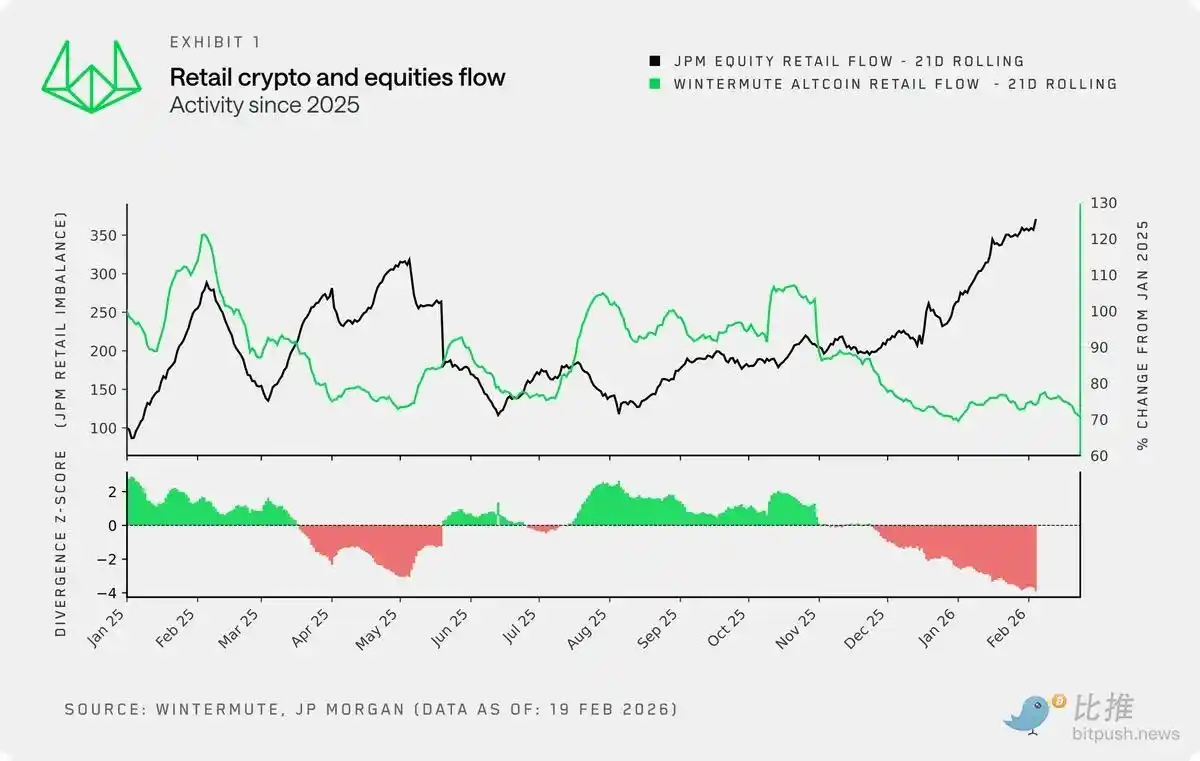
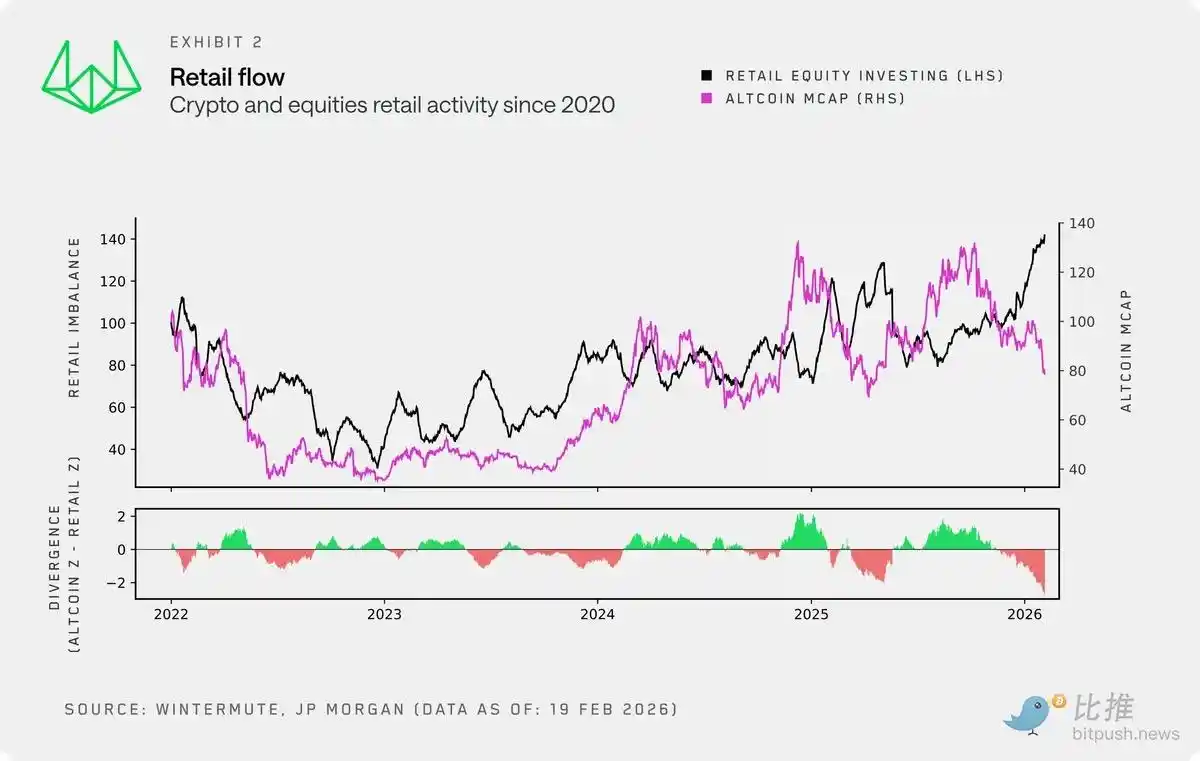
Zooming in, we use altcoin market capitalization as a long-term proxy for retail crypto activity.

It closely aligns with our retail flow data and has an unbiased and longer history. Between 2022 and the end of 2024, cryptocurrencies and stocks fluctuated roughly in sync, both being viewed by the retail sector as a type of high-risk investment portfolio. The decoupling at the end of 2024 is very noticeable, reflecting that retail activity has become more short-term driven, volatile, and to some extent, lacking in sustainability.
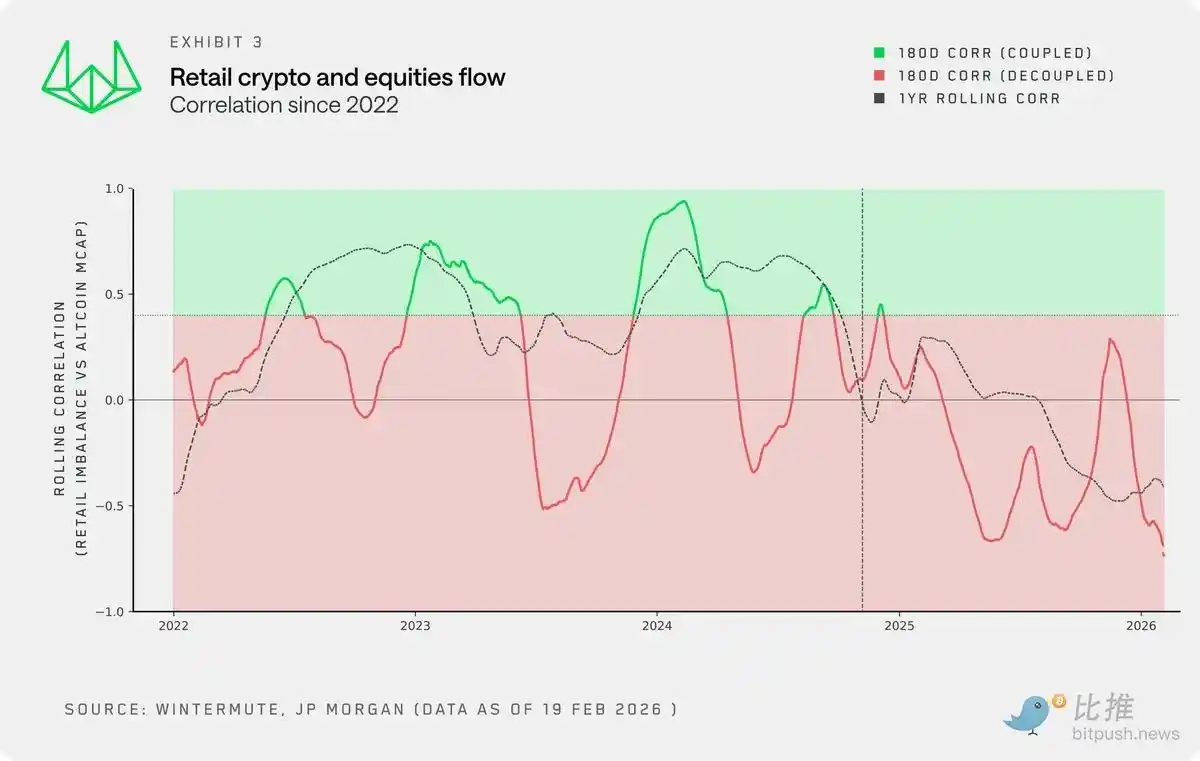
The rolling correlation between retail activity and altcoin market capitalization confirms this shift. What was once a volatile but generally positive relationship has turned negative. Retail is now allocating between the two, rather than injecting funds into both simultaneously.
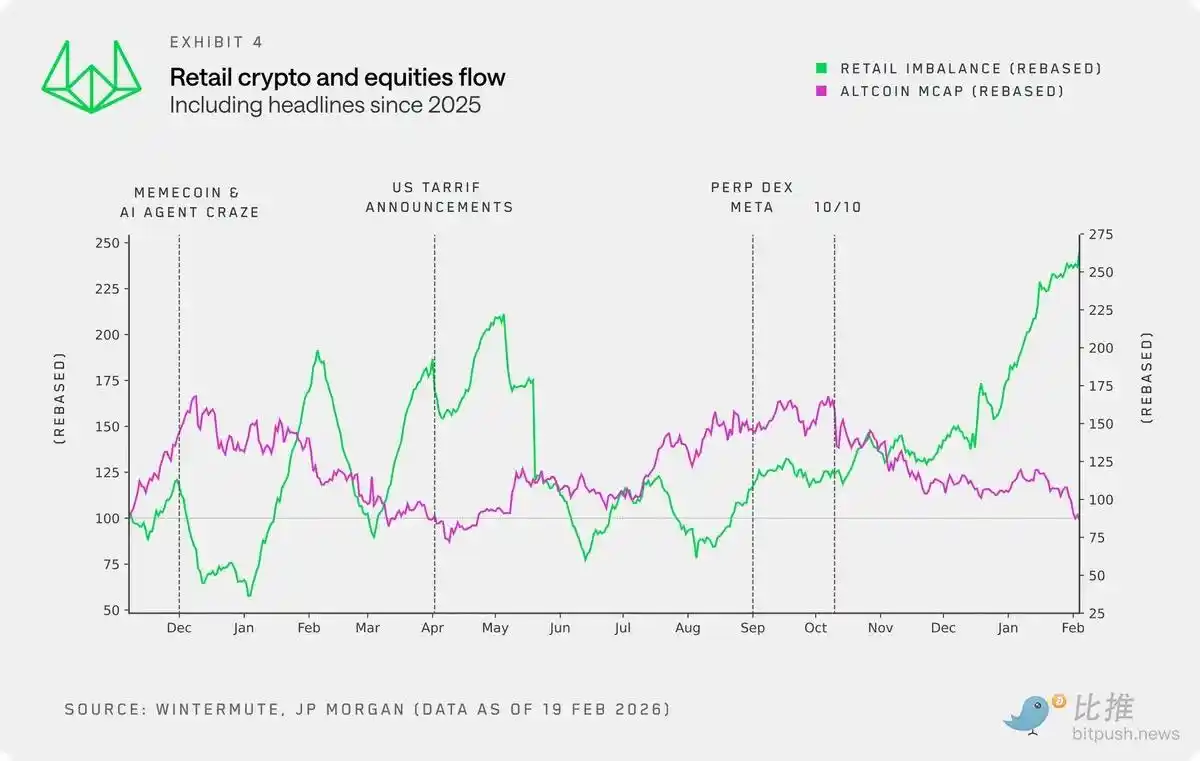
Focusing on 2025 and overlaying key catalysts makes this dynamic clearer. Several points are noteworthy:

  • Memecoins and AI agents had their moments in the spotlight when stock market activity stalled, as retail found speculative outlets elsewhere.

  • Retail continued to buy the dip aggressively in the stock market, both during the tariff policy announcement in April 2025 and in recent market volatility.

  • After October 10th, the market almost completely shifted to stocks, and this trend continues.

Causality

The rolling correlation between retail activity and altcoin market capitalization confirms this shift. The once volatile but overall positive relationship has now turned negative. Retail is now choosing between the two, rather than investing in both.

This new data also confirms this. Retail activity in the stock market has become a new variable that cryptocurrency investors should closely monitor to identify windows of opportunity where retail funds might more sustainably flow into cryptocurrencies.
Volatility = The Product Itself

One reason retail is attracted to and remains active in cryptocurrency is the asset's volatility characteristics. Volatility is the product. It was the initial force that drew retail into the crypto space.

However, although the actual volatility of cryptocurrencies still far exceeds that of stocks, a structural contraction trend has formed, and this trend is difficult to reverse in the short term. The volatility ratio of BTC to the Nasdaq Index (NDX) continues to decline, even compressing to below 2x in the first half of 2025.
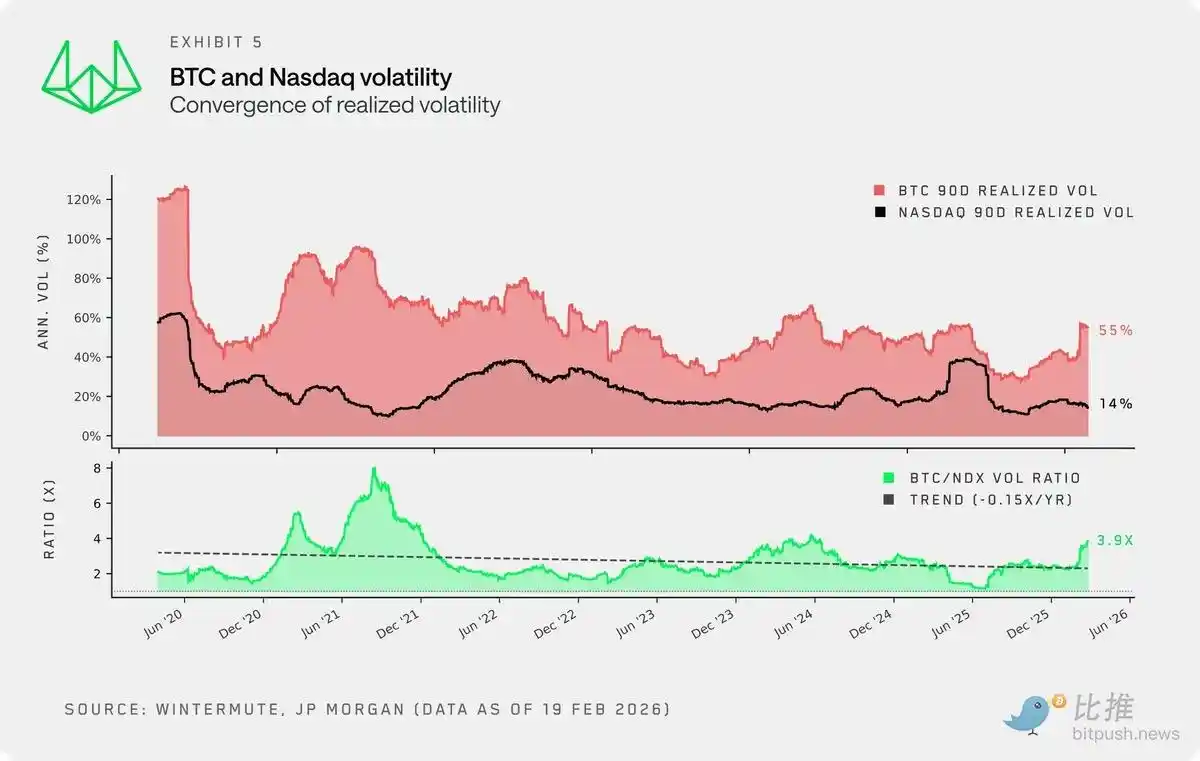
Thoughts on key drivers:

  • Market Maturation: With the increasing number of sophisticated investors and new liquidity tools such as ETFs and DATs, the reflexive volatility peaks that defined earlier cycles have been smoothed out.

  • Market Capacity: At a market capitalization of $2.3 trillion (even 40% below the all-time high), the market requires far greater capital flows to move than it did five years ago.

As volatility compresses, the core selling point of cryptocurrencies to retail erodes. The "excess volatility" that defined the 21-22 cycle and attracted a generation of retail investors is gone. For volatility-seeking retail, stocks are becoming increasingly attractive.

Technical Factors

In addition to the structural changes in the crypto market itself, some technical factors are also accelerating this shift, which is rarely mentioned.

  • Facilitation of Crypto Access — The integration of crypto trading by fintech companies and traditional brokerage platforms (or the introduction of stock trading by crypto-native platforms) has indeed lowered the barrier to entry, but its more profound impact is on the exit process. In previous cycles, the cumbersome process of depositing funds meant that once money entered the crypto market, it was easily "locked in" and naturally circulated among various tokens. Now, these smooth entry and exit channels mean that funds can flow freely between the stock market and the crypto market without significant obstacles.

  • Gaining an Information Edge — Retail seems to be increasingly attracted to the stock market, partly because they are gaining an unprecedented "analytical advantage" through artificial intelligence (AI). Large language models (LLMs) have greatly enhanced the analytical capabilities of retail investors, giving them a sense that they can compete on an equal footing with institutions.

This feeling does not exist in the cryptocurrency market. Although data-based analysis of cryptocurrencies is feasible, the crypto market lacks a consensus valuation framework, the value capture mechanisms of tokens are unclear, and the number of investable assets continues to膨胀, making it difficult for retail to gain that sense of "having an edge."

Conclusion

Retail investors, once the most reliable source of self-reinforcing demand for the crypto market, are increasingly satisfying their risk appetite elsewhere.

The stock market not only offers increasingly competitive volatility but also a growing analytical advantage, and the ability to seamlessly switch from crypto to stock trading through applications already on retail investors' phones.

Cryptocurrencies still have a place in retail investment portfolios, but they are now just one of many choices, no longer the main battlefield for speculation.

This shift should also reshape how investors view the market. Some proven traditional indicators have failed. For crypto investors, simply finding leading indicators of risk appetite and combining them with a crypto-native framework is no longer enough to win. Investors need to increasingly view cryptocurrencies through a cross-asset portfolio lens, just as is standard practice in stocks and fixed income.


Pertanyaan Terkait

QAccording to Wintermute, what major shift in retail investor behavior has occurred since late 2024 regarding stocks and crypto?

ASince late 2024, the relationship between retail investment in stocks and cryptocurrencies has reversed. Instead of moving in the same direction, they now show an inverse relationship. When retail investors buy stocks, they are inactive in the crypto market, and vice versa.

QWhat core attraction of cryptocurrency for retail investors is structurally compressing, according to the report?

AThe volatility premium of cryptocurrencies relative to stocks, which was a major attraction for retail investors, is structurally compressing. The high volatility that defined earlier market cycles and attracted a generation of retail traders no longer exists in the same way.

QWhat are two technical factors mentioned that are accelerating the shift of retail attention away from crypto?

ATwo technical factors are: 1) The facilitation of crypto on-ramps/off-ramps through fintech and traditional broker platforms, which allows capital to flow freely between stocks and crypto instead of being 'locked' in the crypto ecosystem. 2) The use of Large Language Models (LLMs) by retail investors, which provides them with a perceived 'analytical edge' in the stock market—a feeling of advantage that does not exist in the less structured crypto market.

QHow does the report suggest investors should now view cryptocurrency in light of these changes?

AThe report suggests that cryptocurrency should now be viewed through a multi-asset portfolio lens, similar to how other traditional asset classes like stocks and fixed income are analyzed. Relying solely on crypto-native frameworks and traditional leading indicators is no longer sufficient.

QWhat does the data show about the correlation between retail activity and altcoin market cap since the shift occurred?

AThe rolling correlation between retail activity and altcoin market cap, which was once volatile but generally positive, has turned negative. This indicates that retail investors are now allocating capital between stocks and crypto rather than injecting funds into both simultaneously.

Bacaan Terkait

Dialog dengan Ray Dalio: Saat Ini Berada dalam Gelembung AI, 1% Portofolio Investasi Adalah Bitcoin

Sumber: The Diary Of A CEO Ray Dalio, pendiri Bridgewater Associates yang meramalkan krisis keuangan 2008, memperingatkan bahwa ledakan AI saat ini menunjukkan tanda-tanda klasik gelembung ekonomi yang dapat pecah dan memicu resesi. Dalam wawancara podcast, dia menjelaskan dinamika "siklus besar" yang didorong oleh ketimpangan kekayaan, defisit pemerintah, dan perubahan geopolitik. Dalio mengidentifikasi pola di mana antusiasme berlebihan terhadap teknologi revolusioner baru, seperti AI, menyebabkan harga aset melambung dan pinjaman berlebihan. Ketika kondisi berubah (seperti kenaikan suku bunga atau kebutuhan tunai), gelembung ini dapat pecah, menyebabkan penurunan harga aset, kerugian luas, dan kontraksi ekonomi. Untuk melindungi kekayaan di masa ketidakpastian, Dalio sangat menekankan pentingnya **diversifikasi portofolio**—termasuk saham, obligasi, emas, dan real estat—daripada mengandalkan uang tunai saja. Dia mengungkapkan bahwa sekitar **1% portofolionya adalah Bitcoin**, yang diakuinya sebagai aset keras, tetapi dia lebih menyukai **emas fisik** karena sejarahnya sebagai penyimpan nilai dan aset bebas liabilitas. Mengenai dampak AI, Dalio percaya bahwa teknologi ini akan menggantikan tidak hanya tenaga fisik tetapi juga kemampuan kognitif manusia, berpotensi memperlebar kesenjangan antara pemilik modal dan pekerja. Masa depan akan menguntungkan mereka yang dapat memadukan kecerdasan manusia (seperti emosi dan intuisi) dengan kemitraan AI. Secara geopolitik, Dalio menggambarkan dunia yang memasuki fase "penurunan" dalam tatanan global, dengan Amerika Serikat menghadapi tantangan internal dan eksternal, termasuk konflik seperti di Iran yang mengungkap kelemahannya. Dia memprediksi dunia mungkin menjadi lebih terregionalisasi di masa depan. Secara keseluruhan, kunci untuk navigasi melalui periode kompleks ini adalah pemahaman akan pola sejarah, adaptasi, dan diversifikasi yang cermat.

marsbit2j yang lalu

Dialog dengan Ray Dalio: Saat Ini Berada dalam Gelembung AI, 1% Portofolio Investasi Adalah Bitcoin

marsbit2j yang lalu

Rekor! Beli Bersih Asing 7,2 Triliun Won dalam Sehari, Wall Street: Tekanan Likuiditas di Pasar Saham Korea Telah Mereda

**Ringkasan: Rekor Pembelian Asing dan Peningkatan Likuiditas di Pasar Saham Korea** Aliran modal asing menunjukkan perubahan signifikan di pasar saham Korea (KOSPI). Pada 31 Juli, investor asing melakukan pembelian bersih rekor sebesar 7,2 triliun Won Korea dalam sehari, menandai pembalikan dari tren penjualan bersih besar-besaran dalam beberapa bulan terakhir. Secara bulanan, penjualan bersih asing menyusut drastis menjadi 9,8 triliun Won di Juli, turun dari 48,4 triliun dan 44,5 triliun Won pada Juni dan Mei. Tekanan penjualan dari lembaga domestik juga mereda. Dana pensiun dan reksa dana domestik justru menjadi pembeli bersih 1,0 triliun Won di Juli, setelah dua bulan sebelumnya menjadi penjual bersih. Faktor pendukung lainnya adalah peraturan baru dari Komisi Jasa Keuangan (FSC) yang memberlakukan syarat lebih ketat bagi investor ritel untuk masuk ke ETF leverage saham tunggal, yang langsung mengurangi volume perdagangan instrumen tersebut hingga sekitar 50%. Kebijakan ini diperkirakan dapat menekan volatilitas pasar. Citigroup mempertahankan target indeks KOSPI di level 10.000 poin, menyoroti memudarnya angin penentu likuiditas. Analis mereka menilai faktor fundamental seperti industri chip memori yang solid, valuasi historis yang rendah, fundamental ekonomi Korea yang kuat, dan dukungan kebijakan berpotensi menjadi pendorong bagi pasar.

marsbit2j yang lalu

Rekor! Beli Bersih Asing 7,2 Triliun Won dalam Sehari, Wall Street: Tekanan Likuiditas di Pasar Saham Korea Telah Mereda

marsbit2j yang lalu

Pembaruan! AI Generasi Berikut OpenAI Pecahkan 10 Masalah Kelas Medali Fields

**OpenAI Model Astra Pecahkan 10 Masalah Matematika Kelas Fields Medal!** OpenAI mengumumkan terobosan besar dari model internal terbarunya, Astra. Model ini dilaporkan telah membuat kemajuan signifikan dalam **10 masalah matematika yang belum terpecahkan**, dengan biaya komputasi hanya sekitar **$2000**. Hasilnya dipublikasikan dalam makalah setebal 249 halaman. Beberapa pencapaian utama meliputi: 1. **Menyelesaikan masalah "non-sofic group"** yang diajukan Mikhail Gromov tahun 1999, dengan membangun contoh kelompok yang tak hingga dan finitely presented yang bukan sofic. Ini dianggap sebagai kemajuan bersejarah. 2. **Memecahkan batas lama dalam masalah pengepakan bola berdimensi tinggi** (sphere packing), meningkatkan batas yang telah bertahan sejak 1978 untuk dimensi tak hingga. 3. **Menyangkal dugaan "Connes Rigidity"** dengan membangun keluarga tak terhitung dari kelompok berbeda yang menghasilkan aljabar von Neumann yang sama persis. Semua bukti telah diverifikasi menggunakan asisten pembuktian formal Lean 4, memastikan ketepatannya. Para ahli matematika menyebut temuan ini sebagai **momen bersejarah**, setara dengan prestasi penghargaan Fields Medal, dan menandai kemampuan AI untuk melakukan penalaran matematika mendalam di berbagai bidang. OpenAI juga membagikan proses penalaran model, menunjukkan langkah maju yang besar menuju AGI (Artificial General Intelligence).

marsbit4j yang lalu

Pembaruan! AI Generasi Berikut OpenAI Pecahkan 10 Masalah Kelas Medali Fields

marsbit4j yang lalu

Bagaimana Membuat Diri Sendiri Tak Tergantikan oleh Kecerdasan Buatan

**Ringkasan: Bagaimana Membuat Diri Anda Tak Tergantikan oleh AI** Artikel ini membahas ancaman nyata dalam era AI: bukan kehilangan pekerjaan, tetapi "perbudakan gaji"—ketergantungan pada sistem dan orang lain untuk bertahan hidup. Solusinya adalah menjadi "individu super" yang "tak bisa dipekerjakan" dengan membangun bisnis atau karya sendiri. Kunci untuk bertahan dan berkembang di masa depan bukan sekadar keterampilan teknis, tetapi menguasai lima elemen yang sulit digantikan AI: 1. **Otonomi (Agency):** Kemampuan bertindak tanpa menunggu perintah. 2. **Rasa (Taste):** Pengalaman untuk mengetahui apa yang bernilai untuk ditawarkan. 3. **Kemampuan Persuasi (Persuasion):** Keterampilan menarik perhatian dan pengakuan. 4. **Ketekunan (Persistence):** Memahami bahwa kegagalan adalah bagian dari proses. 5. **Iterasi (Iteration):** Kemampuan memperbaiki kesalahan berdasarkan umpan balik. Lima elemen ini dapat dikembangkan dengan **membuat konten** (media). Dibandingkan pemrograman (code), konten lebih unggul karena nilainya subjektif, membutuhkan penilaian manusia, dan merupakan alat distribusi yang ampuh untuk membangun koneksi dan otoritas. Untuk memulai transformasi: 1. **Ubah lingkungan** Anda secara drastis untuk memicu perubahan identitas. 2. **Gali "bahan mentah"** Anda: Identifikasi pengetahuan mendalam, masalah yang pernah Anda selesaikan, dan minat unik masa kecil Anda. 3. **Temukan "poros pemikiran balik"**: Tentukan pendapat kontra-intuitif atau keyakinan Anda yang bertentangan dengan arus utama dalam bidang Anda. 4. **Luncurkan ide pertama** Anda besok. Gabungkan jawaban dari langkah 2 dan 3, lalu publikasikan. Umpan balik nyata dari dunia adalah guru terbaik. Intinya, bangunlah *karier seumur hidup* yang autentik berdasarkan pengalaman dan sudut pandang unik Anda. Dengan memanfaatkan AI sebagai alat dan fokus pada pengembangan diri yang tak tergantikan, Anda dapat mengambil kendali atas hidup dan masa depan Anda.

marsbit4j yang lalu

Bagaimana Membuat Diri Sendiri Tak Tergantikan oleh Kecerdasan Buatan

marsbit4j yang lalu

Kunci Bitcoin Disimpan Offline Berkat Lemparan Dadu, Tetapi Tidak Semua Orang Akan Melakukannya

Berdasarkan insiden kerentanan generator angka acak pada perangkat hardware wallet Coldcard, artikel ini membahas metode pembuatan kunci Bitcoin menggunakan dadu untuk menghasilkan entropi mandiri. Claude Shannon mengukur ketidakpastian dengan konsep entropi, di mana satu lemparan dadu enam sisi setara dengan sekitar 2,585 bit. Praktik melempar dadu 50 hingga 99 kali dapat menghasilkan frasa pemulihan 12 kata yang aman (128 bit entropi), melampaui ketergantungan pada generator perangkat. Namun, insiden Coldcard mengungkap bahwa meskipun seed utama dibuat dari dadu aman, fungsi lain seperti dompet kertas, kunci kloning, dan password masih berpotensi menggunakan generator cacat. Peneliti keamanan Kevin Loaec menekankan bahwa perlindungan hanya berlaku untuk seed utama, bukan keseluruhan sistem. Proses manual ini membutuhkan ketelitian tinggi, rentan kesalahan, dan tidak praktis bagi kebanyakan pengguna baru. Oleh karena itu, meski kuat secara matematis, metode ini lebih cocok untuk pengguna berpengalaman. Artikel menyarankan pemilik Coldcard untuk memperbarui firmware, memeriksa fungsi yang pernah digunakan, dan mempertimbangkan skema multisignature dengan perangkat dari produsen berbeda untuk mitigasi risiko. Tujuan jangka panjang adalah perangkat yang dapat menghasilkan keacakan kuat secara mandiri, tanpa memerlukan prosedur rumit dari pengguna.

cryptonews.ru8j yang lalu

Kunci Bitcoin Disimpan Offline Berkat Lemparan Dadu, Tetapi Tidak Semua Orang Akan Melakukannya

cryptonews.ru8j yang lalu

Trading

Spot
活动图片




