Why Only Dollar-Cost Averaging Can Capture Bitcoin's Long-Term Dividends?

比推Dipublikasikan tanggal 2026-03-06Terakhir diperbarui pada 2026-03-06

Abstrak

This article argues that dollar-cost averaging (DCA) is the optimal strategy for capturing Bitcoin's long-term gains, supported by historical backtesting and forward-looking models. The strategy involves investing a fixed amount regularly, regardless of market conditions. A five-year DCA simulation, starting in January 2021 with weekly $250 investments, resulted in a total investment of $67,500, acquiring approximately 1.65 BTC at an average price of $40,884. At a price of $71,000, the portfolio was worth ~$120,500, a 76% gain. Projections show even higher returns at $100,000 and the expected 2025 cycle peak of ~$126,000. A shorter-term DCA example starting in January 2024 showed an initial paper loss at current prices but significant projected profits at higher future price points. A comparison over five years also demonstrated that DCA into Bitcoin outperformed DCA into the S&P 500. Long-term modeling, based on Bitcoin's power-law growth curve, projects a median price of around $430,000 by 2030. A four-year DCA plan starting in 2026 could accumulate roughly 0.30 BTC, leading to substantial returns even under conservative price estimates. The key conclusion is that while entry timing affects the magnitude of gains, the duration of the holding period is the most critical factor for maximizing returns.

Written by: Cointelegraph

Compiled by: AididiaoJP, Foresight News

Original title: Why Only Dollar-Cost Averaging Can Capture Bitcoin's Long-Term Dividends?


Both backtest data and forward-looking models indicate that using a dollar-cost averaging (DCA) strategy to buy Bitcoin is the best way to invest in BTC. Will this method still work in the next bull market?

Bitcoin has experienced a 50% plunge over the past 5 months, and savvy investors adjust their strategies during such bear markets and correction periods. This strategy is called dollar-cost averaging (DCA), which involves investing a fixed amount regularly, regardless of market conditions.

By examining historical market cycle data and BTC price forward simulations, we can more clearly see how this steady investment approach performs across different entry times and investment horizons.

Five Years of DCA in Bitcoin Yields Substantial Net Gains

Starting from January 2021, investing $250 weekly in Bitcoin via DCA, the total investment over five years would be $67,500. According to DCA simulation data, this strategy would have accumulated 1.65097905 BTC, with an average purchase price of $40,884.

At Bitcoin's current price of nearly $71,000, this 1.65097905 BTC is worth approximately $120,500, resulting in a profit of $53,000 (a 76% increase). If Bitcoin rises to $100,000, the holdings would be worth about $165,000; and at the cycle peak of nearly $126,000 in October 2025, the holdings would reach a value of $208,000.
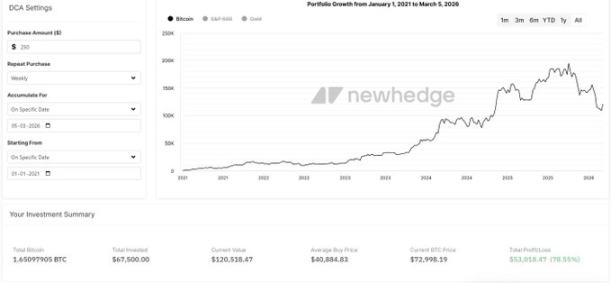
Bitcoin DCA Cycle 2021-2026 Source: Newhedge

Now consider a shorter investment period to see the impact of entry timing on early returns. Starting weekly $250 DCA from January 2024, the total investment is $28,500, accumulating 0.36863166 BTC with an average purchase price of $77,312.

At the current price of $71,000, this Bitcoin is worth approximately $26,909, representing a 6% paper loss. At a price of $100,000, the holdings would be worth $36,863; at the cycle peak of $126,000, the holdings would be worth $46,448.

In February this year, Swan Bitcoin analyst Adam Livingston compared on platform X the returns of DCA into BTC versus the S&P 500 index over the past five years. Investing $100 weekly resulted in $42,508 for BTC and $37,470 for the S&P 500, with returns of 62.9% and 43.6% respectively.

Livingston noted that although Bitcoin is highly volatile, historical data shows that persisting with DCA during downturns leads to higher long-term gains.
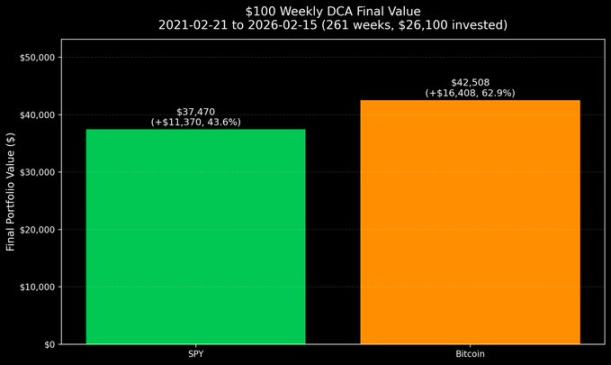
Weekly $100 DCA: BTC vs. S&P 500 Source: Adam Livingston/X

Long-Term Models: Time is the Key

Forward-looking simulation studies have also tested the effectiveness of DCA starting in 2026. Starting a weekly $250 DCA from January 2026 until March 2030 would mean a total investment of approximately $54,250.

The price prediction is based on Bitcoin's long-term power law growth curve (which tracks the historical relationship between Bitcoin's price and time on a logarithmic scale). This model generates a rising support band and a median trendline, largely consistent with previous market cycles.
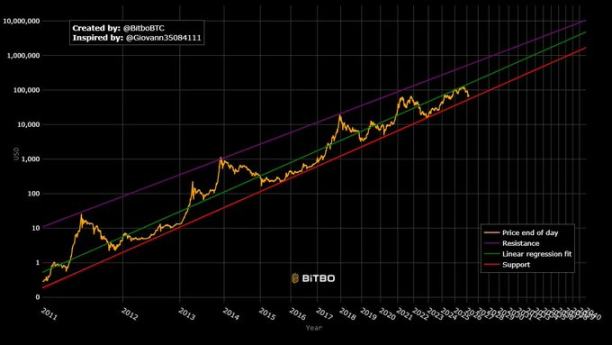
Bitcoin Power Law Growth Curve Source: Bitbo.io

Based on this model, analysts estimate the long-term trend support could break above $100,000 by 2028, which also serves as the foundational assumption for future DCA modeling. Bitcoin Well's simulation shows that by March 2030, the median price projection is approximately $430,000.

Accounting for potential price deviations, the model also considers the upper and lower bounds of the power law channel, providing a lower estimate (approx. $274,000) and a higher estimate (approx. $900,000).

Based on these assumptions, four years of DCA would accumulate roughly 0.30 BTC:

  • If BTC price is $274,000, holdings value ~$82,200.

  • If BTC price is $430,000 (median projection), holdings value ~$129,000.

  • If BTC price is $900,000, holdings value ~$270,000.
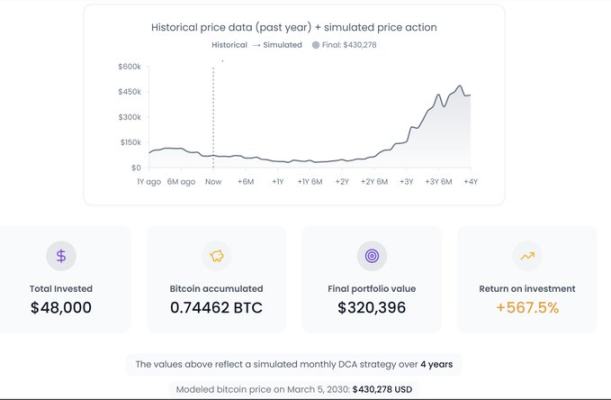
DCA Investment Results as of March 2030 Source: Bitcoin Well

In November 2025, Bitcoin researcher Sminston With conducted a study using a similar predictive model to test the impact of entry time on long-term returns. The findings revealed that even buying at a price 20% higher than the then price of $94,000 and selling at a price 20% lower than the projected 2035 median price, the remaining holdings after ten years would still yield a profit of nearly 300%.

In this simulation, the final total assets were 7.7 times the initial investment.

The study concluded: Entry timing affects the level of returns, but the duration of holding is the key determinant of the magnitude of gains.



Original link:https://www.bitpush.news/articles/7617498

Pertanyaan Terkait

QWhat is the main investment strategy discussed in the article for capturing Bitcoin's long-term gains?

AThe main investment strategy discussed is Dollar-Cost Averaging (DCA), which involves investing a fixed amount of money at regular intervals, regardless of market conditions.

QAccording to the backtest data, how much profit was generated from a 5-year DCA strategy starting in January 2021 with a weekly investment of $250?

AThe 5-year DCA strategy generated a profit of $53,000, a 76% increase, with the total investment of $67,500 growing to approximately $120,500 at a Bitcoin price of $71,000.

QWhat model is used to predict Bitcoin's future price in the long-term simulations mentioned in the article?

AThe long-term price predictions are based on Bitcoin's power-law growth curve model, which tracks the historical relationship between Bitcoin's price and time on a logarithmic scale.

QHow does the performance of a DCA strategy compare to investing in the S&P 500 index over a five-year period, as cited in the article?

AOver a five-year period, a weekly DCA investment of $100 in Bitcoin yielded $42,508 (a 62.9% return), outperforming the S&P 500 index, which yielded $37,470 (a 43.6% return).

QWhat is the key conclusion from the research by Bitcoin researcher Sminston With regarding the timing of entry and long-term holding?

AThe key conclusion is that while the timing of entry affects the magnitude of returns, the duration of holding (long-term holding) is the primary determinant of the overall profit size.

Bacaan Terkait

Narasi BTC sebagai 'Emas Digital' Apakah Sudah Gagal?

Artikel ini menganalisis Bitcoin dari sudut pandang "aset digital" atau "emas digital", tanpa memberikan saran investasi. Penulis membahas tiga hal utama: **1. Bagaimana Memandang Bitcoin sebagai Aset:** Bitcoin dianggap sebagai kelas aset baru yang unggul dibandingkan emas dalam hal: jumlah terbatas (21 juta koin), kemampuan transfer yang mudah dan aman (kunci pribadi), dan transparansi/auditabilitas penuh (blockchain). Meski awalnya digunakan di area abu-abu, regulasi semakin mengatur. Adopsi global crypto saat ini sekitar 3-4%, menandakan fase awal dengan volatilitas tinggi namun juga potensi pertumbuhan jangka panjang. **2. Memahami Penurunan Harga Terkini:** Penurunan ~50% dari puncak $126k (Okt 2025) ke ~$61k (Feb 2026) dipandang sebagai penjualan siklis yang terprediksi pasca-*halving*, dan sebagai proses "peralihan kepemilikan" historis dari *early holders* ke investor institusional melalui ETF. Data historis menunjukkan tren penurunan persentase *drawdown* setiap siklus (dari >90% ke ~50%), mengindikasikan aset yang semakin matang. **3. Pandangan Jangka Panjang:** Kerangka analisisnya adalah membandingkan kapitalisasi pasar Bitcoin (~$1.4T pada $70k) dengan emas (~$20T). Bitcoin baru mencapainya sekitar 7%. Jika narasi "emas digital" terealisasi sebagian (misal, 30-50% kapitalisasi emas), ruang naiknya masih signifikan. Risiko terbesar bukanlah Bitcoin menjadi nol, melainkan manajemen portofolio yang buruk (seperti *all-in* atau pakai leverage) dan kurangnya pemahaman mendalam, yang bisa membuat investor *exit* dipaksakan sebelum potensi jangka panjang terwujud. Kesimpulan: Volatilitas tinggi adalah "harga" untuk potensi imbal hasil tinggi. Pertanyaan kuncinya adalah apakah penurunan ini menandakan kegagalan narasi "emas digital" atau hanya fase peralihan dalam evolusinya dari aset spekulatif ke aset alokasi. Jawabannya bergantung pada keyakinan mendasar terhadap aset ini.

marsbit9j yang lalu

Narasi BTC sebagai 'Emas Digital' Apakah Sudah Gagal?

marsbit9j yang lalu

Dari Kode ke Kognisi: Panduan Panjang Evolusi Otak Robot

**Dari Kode ke Kognisi: Evolusi Otak Robot** Era robot sebelumnya bergantung pada kode yang dirancang dengan hati-hati untuk persepsi, perencanaan, dan kontrol (seperti PID), membatasi kemampuan generalisasi. Kemajuan datang dengan pembelajaran mendalam untuk persepsi visual dan pembelajaran penguatan untuk kontrol motorik, tetapi kebijakan tetap sempit. Titik balik terjadi dengan munculnya Model Bahasa Besar (LLM). LLM bertindak sebagai perencana tingkat tinggi, menerjemahkan instruksi bahasa alami menjadi urutan keterampilan atomik untuk dieksekusi oleh sistem robot tradisional (seperti ROS2). Ini adalah lompatan besar, tetapi LLM hanya penjadwal cerdas, bukan penggerak langsung. Lompatan berikutnya adalah Model Visi-Bahasa-Aksi (VLA). Model ini menggabungkan persepsi visual dan instruksi bahasa langsung ke dalam satu jaringan neural untuk menghasilkan perintah gerakan, menyatukan penalaran dan tindakan. Ini memungkinkan generalisasi yang lebih baik. Arsitektur populer (seperti di Figure AI, NVIDIA GR00T) menggunakan sistem "otak ganda": Model S2 yang besar dan lambat (7-9Hz) untuk penalaran tingkat tinggi, dan model S1 yang kecil dan cepat (200Hz) untuk menghasilkan gerakan halus. Lapisan S0 (1kHz) menangani keseimbangan dan koordinasi refleksif. Komputasi untuk kontrol keselamatan yang kritis dijalankan secara lokal di papan (mis., pada NVIDIA Jetson) karena masalah latensi dan keandalan jaringan. Cloud digunakan untuk antarmuka percakapan dan pembelajaran kumpulan data. Model sumber terbuka (seperti OpenVLA, NVIDIA GR00T, π0) sangat penting, memungkinkan startup mengadaptasi model dasar dengan data robot mereka sendiri, mempercepat inovasi. Namun, VLA masih memiliki keterbatasan: pemulihan kesalahan, efisiensi sampel, generalisasi lintas platform, perencanaan jangka panjang, dan pemahaman fisika yang mendalam. Di sinilah **Model Dunia** menjadi kunci. Model Dunia adalah jaringan neural yang memprediksi keadaan dunia masa depan berdasarkan keadaan saat ini dan tindakan yang diusulkan (misalnya, menghasilkan video yang disimulasikan). Ini memungkinkan robot untuk "berpikir sebelum bertindak", mensimulasikan berbagai skenario, mengevaluasi hasil, dan memilih tindakan terbaik sebelum eksekusi. Pendekatan ini meningkatkan pemulihan, generalisasi, perencanaan, keamanan, dan memungkinkan pembangkitan data sintetis skala besar. Arsitektur utama termasuk difusi video tingkat piksel (Cosmos/Sora), JEPA (LeCun), dan model dunia tindakan laten (Genie). Masa depan robot humanoid mungkin menggabungkan VLA dengan Model Dunia untuk perencanaan berbasis simulasi. Data (terutama melalui operasi jarak jauh) tetap menjadi penghalang utama. Sementara narasi "momen ChatGPT" untuk robot agak menyesatkan (saat ini lebih mirip era GPT-2), kemajuan menuju robot yang mampu beradaptasi secara umum sangat cepat. Evolusi dari kode buatan ke model dunia yang dipelajari secara perlahan memindahkan kecerdasan dari pikiran insinyur ke dalam sistem yang mampu memahami dan membayangkan dunia.

marsbit10j yang lalu

Dari Kode ke Kognisi: Panduan Panjang Evolusi Otak Robot

marsbit10j yang lalu

Trading

Spot
Futures
活动图片



