Why Does the Automated Market Maker (AMM) Mechanism Fail in the Prediction Market Field?

marsbitDipublikasikan tanggal 2026-04-14Terakhir diperbarui pada 2026-04-14

Abstrak

The article explores why Automated Market Makers (AMMs), particularly the x*y=k model popularized by Uniswap, fail in prediction markets despite their success in decentralized finance (DeFi). AMMs excel in DeFi by enabling permissionless liquidity provision and continuous trading for tokens that fluctuate indefinitely. However, prediction markets involve binary outcomes where assets settle to either $1 or $0 at expiration. This structural difference causes inherent flaws: liquidity providers (LPs) inevitably suffer losses as pools automatically rebalance toward the losing side upon settlement—making "impermanent loss" permanent. Additionally, AMMs distort price discovery for probability-based markets due to slippage and low liquidity. Early prediction platforms like Polymarket and Augur experimented with AMMs but abandoned them for Central Limit Order Books (CLOBs), which better handle precise probabilistic pricing and binary settlements. The article concludes that while AMMs revolutionized token swaps, their mechanics are mismatched for prediction markets, requiring alternative infrastructure that accommodates binary outcomes and mandatory settlement.

Author: Melee

Compiled by: AididiaoJP, Foresight News

In July 2017, Hayden Adams was laid off by his employer Siemens, where he worked as a mechanical engineer. His college roommate Karl Floersch was working at the Ethereum Foundation at the time and often told him about smart contracts. Adams had previously paid no attention. Now unemployed and looking for something to do, he decided to listen.

The Birth of the Automated Market Maker (AMM)

Floersch recommended a blog post by Vitalik Buterin about running an on-chain exchange using a mathematical formula instead of an order book. The principle was not to match buyers and sellers, but to allow traders to exchange with a pool of assets, with the price automatically set based on the ratio of tokens in the pool. No working version existed at the time. Adams took it on as a learning project, received a $65,000 grant from the Ethereum Foundation, and launched Uniswap in November 2018.
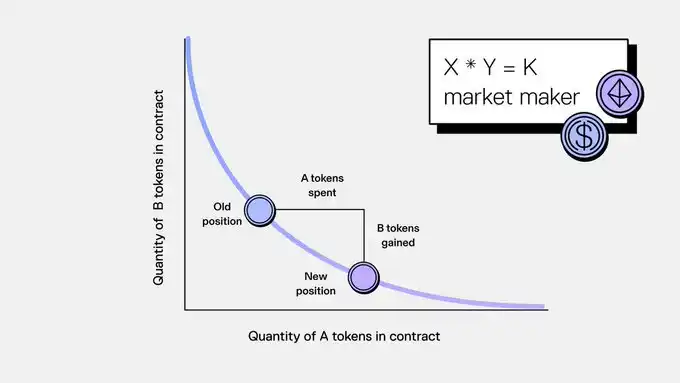
Its formula was deceptively simple: x * y = k.

Two tokens are placed in a pool, and the product of their quantities remains constant. When someone buys one token, they must deposit the other token, changing the ratio within the pool and adjusting the price accordingly. No order book, no matching engine, no professional market makers needed. Anyone can deposit tokens into the pool and earn fees from every transaction.

The automated market maker thus became the cornerstone of decentralized finance. Uniswap, Curve, Balancer, and dozens of other protocols handle billions of dollars in trading volume. On-chain order books are slow and expensive, and traditional market makers have no interest in tokens with only two hundred holders. Automated market makers allow anyone to create a liquid market for any asset at any time. Before AMMs, listing a new asset required permission and infrastructure. After AMMs, all you need is a liquidity pool.

The benefits were obvious. So, prediction markets naturally tried to adopt them too.

Automated Market Makers and Prediction Markets

Prediction markets face the same cold-start problem as token markets. You need liquidity before people are willing to trade, and you need traders before people are willing to provide liquidity. Little known is that Robin Hanson had proposed an automated market making solution for prediction markets years earlier in his 2002 Logarithmic Market Scoring Rule.

He thought he had theoretically solved the cold-start problem. However, in practice, the solution suffered from the same fundamental issue that every subsequent attempt to automate liquidity for prediction markets encountered: the formula couldn't distinguish between perpetually fluctuating tokens and equity certificates that expire.

Prediction market outcomes are binary. They ultimately settle to one or zero. In a token swap pool, both assets can fluctuate indefinitely, and the AMM formula works precisely because neither token is designed to go to zero.

Early Polymarket used an AMM based on the logarithmic market scoring rule. Augur also experimented with similar schemes. If automated liquidity pools worked for token swaps, they should, in theory, work for election betting too.

They didn't.

Why AMMs Fail in Prediction Markets

When a prediction market event settles, one side is worth one dollar, the other zero. For anyone providing liquidity to the pool, the mathematical outcome is nearly brutal. As the market moves towards settlement, the pool automatically rebalances towards the losing side.

Impermanent Loss

What decentralized finance traders call "impermanent loss" becomes completely "permanent" here. Every market settles, and every pool will eventually hold a pile of worthless shares.

In regular DeFi pools, trading fees can offset impermanent loss over time.
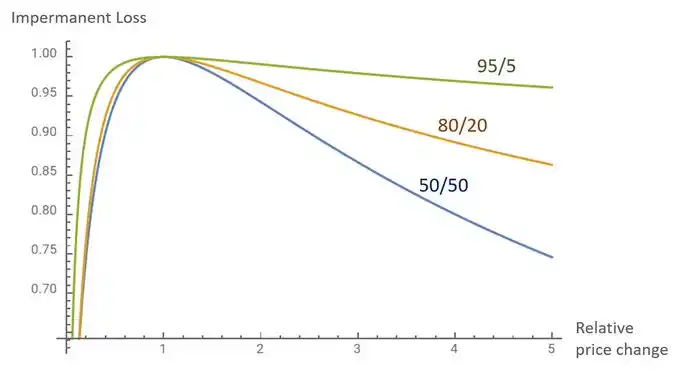
But in prediction markets, the loss is a structural certainty. The only question is how much the liquidity provider loses. Protocols have tried to persuade users to deposit assets into these pools through liquidity mining, reward programs, and various incentive structures. All of these are just different ways to subsidize users to lose money at a slower rate.

Price Discovery

Then there is the issue of price discovery. AMMs price assets based on the pool ratio and a fixed formula. For tokens, the "correct price" is a moving target, and a formula-driven approximation is sufficient. Prediction market prices are supposed to represent probabilities. The slippage introduced by the constant product curve distorts the signal, especially in low-liquidity markets, where a single trade can swing the implied probability by several basis points.

Is the Central Limit Order Book (CLOB) Better Than AMMs?

Polymarket realized this early on. In late 2022, the platform migrated from a logarithmic market scoring rule-based AMM to a central limit order book. AMMs were designed for continuous token swaps across a price range. Prediction markets require precise probability pricing on binary outcomes with known terminal values. They are entirely different problems.

The characteristics that made AMMs revolutionary for tokens—permissionless market creation, instant liquidity bootstrapping, no reliance on professional market makers—are exactly what prediction markets desperately need. The problem is that the specific mechanism, the constant function formula built for token swaps, breaks down when faced with the reality of binary outcomes and inevitable settlement.

The challenge for prediction markets is to replicate these effects with infrastructure that reflects how these markets actually settle.


Pertanyaan Terkait

QWhat is the core mathematical formula behind the Automated Market Maker (AMM) mechanism introduced by Uniswap?

AThe core mathematical formula is x * y = k, where x and y represent the quantities of two tokens in the pool, and k is a constant product.

QWhy do AMMs fail in the prediction market space according to the article?

AAMMs fail in prediction markets because these markets involve binary outcomes that eventually settle to $1 or $0, causing structural and certain losses for liquidity providers, unlike in token swaps where both assets can fluctuate indefinitely and fees can offset impermanent loss.

QWhat did early prediction market platforms like Polymarket and Augur experiment with?

AEarly platforms like Polymarket used an AMM based on Robin Hanson's Logarithmic Market Scoring Rule, and Augur also experimented with similar automated liquidity solutions.

QWhat is the key difference between token trading and prediction markets that makes AMMs unsuitable for the latter?

AToken trading involves assets designed to never go to zero and allows for continuous price fluctuations, while prediction markets have binary outcomes that definitively settle to $1 or $0, making AMM-induced losses certain rather than 'impermanent'.

QWhat solution did Polymarket eventually adopt to address the limitations of AMMs?

APolymarket migrated from an AMM based on the Logarithmic Market Scoring Rule to a Central Limit Order Book (CLOB) to better handle precise probability pricing and binary settlement in prediction markets.

Bacaan Terkait

"Gergaji Musim Panas" Berlanjut: Breakout $67.000 Akan Menjadi Awal Kenaikan Bitcoin

Harga Bitcoin terus terkonsolidasi dalam kisaran $58.000–$67.000 sejak awal Juni, dengan harga terkini di sekitar $62.217 pada 1 Agustus. Para analis pasar mempertimbangkan beberapa skenario kunci. Secara teknis, pergerakan di atas $66.000 dianggap penting untuk mengubah momentum. Beberapa trader seperti Crypto Candy memprediksi kemungkinan penurunan menuju $60.000 jika level $66.000 tidak tertembus. Trader lain, Jelle, menggambarkan situasi ini sebagai "gergaji musim panas" yang berkepanjangan dan mempertahankan strategi rata-rata biaya dengan pembelian berkala. Di sisi lain, skenario breakout ke atas tetap ada. Daan Crypto Trades menekankan bahwa keberhasilan menembus $67.000 sangat penting untuk menghindari fase konsolidasi yang berlarut-larut. Roman bahkan memperkirakan bahwa breakout dengan volume yang kuat dapat mendorong harga dengan cepat ke zona $70.000–$80.000. Dari perspektif jangka panjang, analis Gert van Lagen melihat fase ini sebagai periode akumulasi, dengan Bitcoin menguji pola grafik besar "cangkir dengan pegangan". Dia mencatat bahwa pemegang jangka panjang masih enggan menjual, yang ditunjukkan oleh metrik NUPL mereka yang masih jauh dari zona kapitulasi. Kesimpulannya, pasar Bitcoin saat ini berada dalam fase akumulasi yang menentukan. Level $60.000 dan $67.000 menjadi kunci, dan breakout dari level mana pun kemungkinan akan menentukan arah tren berikutnya. Skenario AI dalam artikel juga mempertanyakan apakah konsolidasi saat ini dapat membentuk fondasi yang lebih kuat, atau apakah setiap ujian di level $67.000 akan terus menghadapi hambatan psikologis yang sama dari pemegang aset jangka pendek.

cryptonews.ru45m yang lalu

"Gergaji Musim Panas" Berlanjut: Breakout $67.000 Akan Menjadi Awal Kenaikan Bitcoin

cryptonews.ru45m yang lalu

Perhatian Wajib Pekan Depan|Undang-Undang CLARITY Diperkirakan Akan Masuk ke Pemungutan Suara Senat; SpaceX dan Circle Umumkan Laporan Keuangan (3-9 Agustus)

**Ringkasan Acara Penting Pekan Depan (3-9 Agustus)** Pekan depan diwarnai sejumlah pengumuman keuangan penting dan perkembangan regulasi kripto di AS. **Laporan Keuangan & Acara Perusahaan:** * **SpaceX** akan merilis laporan keuangan Q2 2026 pada 4 Agustus, diikuti gelombang pencairan saham internal pertama (hingga 12%) pada 6 Agustus. * **Circle** (penerbit USDC) dan **Hut 8** (penambang Bitcoin) masing-masing akan mengumumkan laporan kuartalan pada 5 Agustus dan 4 Agustus. * **American Bitcoin (ABTC)**, perusahaan tambang kripto yang dikaitkan dengan keluarga Trump, merilis laporan Q2 pada 3 Agustus. * Perusahaan robotika **宇树科技 (Unitree Robotics)** akan melakukan penawaran saham perdana (IPO) di pasar STAR China, dengan hari penentuan harga awal pada 5 Agustus. **Regulasi Kripto AS:** * **CLARITY Act**, undang-undang kerangka kerja federal untuk aset kripto, berpeluang dilakukan pemungutan suara penuh di Senat AS minggu ini. Para negosiator harus merampungkan aturan tentang konflik kepentingan sebelum masa reses 7 Agustus. RUU ini memerlukan 60 suara untuk disetujui. **Pengumuman Data & Teknologi:** * **Laporan Non-Farm AS** untuk Juli akan dirilis pada 7 Agustus, menjadi fokus pasar. * **Grok AI** versi 4.6 (dengan 1,5 triliun parameter) diperkirakan diluncurkan sekitar 7 Agustus, diikuti versi 4.7 yang lebih kuat beberapa minggu setelahnya. * **XRP Ledger** versi 3.3.0 dengan lima fitur baru, termasuk transaksi batch, dijadwalkan rilis minggu depan. **Penutupan & Perubahan Layanan:** * Beberapa layanan kripto akan berhenti beroperasi: **Zapper** (pelacak portofolio DeFi) dan **Ctrl Wallet** pada 3 Agustus, serta **LayerZero** akan menghentikan relayernya untuk v1 pada tanggal yang sama. Bursa Korea **Upbit** akan menghapus perdagangan pasangan **AQT** dan **AERGO** pada 3 Agustus. **Acara Lainnya:** * **BIP-110**, sebuah proposal peningkatan jaringan Bitcoin, akan memulai fase pengiriman sinyal wajib sekitar 8 Agustus.

marsbit1j yang lalu

Perhatian Wajib Pekan Depan|Undang-Undang CLARITY Diperkirakan Akan Masuk ke Pemungutan Suara Senat; SpaceX dan Circle Umumkan Laporan Keuangan (3-9 Agustus)

marsbit1j yang lalu

Saham Jatuh Lebih Parah daripada Kripto, Ke Mana Uangnya Pergi?

Penulis: Cathy,白话区块链 Pada 28 dan 29 Juli di Seoul, indeks Kospi memicu *circuit breaker* dua hari berturut-turut, suatu peristiwa yang belum pernah terjadi dalam sejarah pasar saham Korea. Saham-saham semikonduktor global, termasuk SK Hynix yang turun sekitar 23% dalam dua hari, mengalami penurunan drastis. Penarikan dana (pullback) Kospi pada Juli mencapai 40% dari titik tertinggi Juni, menjadikannya bulan terburuk yang tercatat. Produk leverage seperti ETF 2x Long SK Hynix bahkan anjlok hingga 83%, menghapus lebih dari 1 triliun HKD dalam nilai pasar. Ironisnya, Bitcoin justru naik hampir 15% dari titik terendah Juli, menunjukkan perilaku yang tidak biasa: **saham yang jatuh seperti aset kripto, sementara Bitcoin relatif stabil.** Penurunan ini bukan kepanikan pasar luas, melainkan "peledakan tertarget" terhadap perdagangan yang paling ramai (*crowded trades*), dipicu oleh laporan keuangan SK Hynix yang meski mencetak rekor laba tetapi di bawah perkiraan, serta IPO besar-besaran ChangXin Memory (CXMT) dari China. Ditambah dengan potensi likuidasi posisi *carry trade* Yen Jepang yang masif, pasar mengalami de-leverage paksa. Lalu, apakah uang yang keluar dari saham mengalir ke Bitcoin? Jawabannya tidak. Bitcoin tampak "tahan jatuh" karena sudah mengalami koreksi lebih dulu—jatuh sekitar 21% selama periode arus keluar ETF berkelanjutan pada Mei-Juni. Uang yang mencari perlindungan justru mengalir ke emas, yang harganya naik lebih dari 20% secara tahunan. Koefisien korelasi Bitcoin dengan emas mencapai -0.88, mengindikasikan bahwa institusi kini memandangnya sebagai aset yang berbeda: **emas untuk perlindungan, Bitcoin untuk potensi pertumbuhan.** Agar aliran dana besar-besaran benar-benar masuk ke Bitcoin, diperlukan tiga kondisi: tekanan likuidasi global mereda, The Fed menurunkan suku bunga tanpa memicu resesi, dan disahkannya RUU CLARITY di AS untuk memberikan kejelasan regulasi. Meski RUU tersebut tertunda di Senat, arahnya sudah jelas. **Harga saham teknologi ditentukan oleh pengeluaran modal AI dan laba perusahaan, sedangkan harga Bitcoin ditentukan oleh likuiditas global.** Ketidakselarasan ini justru menciptakan daya tarik bagi institusi yang ingin mendiversifikasi portofolio mereka. Kesimpulannya, Bitcoin saat ini bukan tempat perlindungan (*safe haven*), melainkan aset yang sudah terkoreksi lebih dulu dan sudah berada di posisi yang siap. **Dana belum datang, tetapi posisinya sudah dipersiapkan.** Ketika badai berlalu dan modal global mencari tempat baru untuk dialokasikan, Bitcoin berada di urutan terdepan dalam antrian.

marsbit1j yang lalu

Saham Jatuh Lebih Parah daripada Kripto, Ke Mana Uangnya Pergi?

marsbit1j yang lalu

Dialog dengan Ray Dalio: Saat Ini Berada dalam Gelembung AI, 1% Portofolio Investasi Adalah Bitcoin

Sumber: The Diary Of A CEO Ray Dalio, pendiri Bridgewater Associates yang meramalkan krisis keuangan 2008, memperingatkan bahwa ledakan AI saat ini menunjukkan tanda-tanda klasik gelembung ekonomi yang dapat pecah dan memicu resesi. Dalam wawancara podcast, dia menjelaskan dinamika "siklus besar" yang didorong oleh ketimpangan kekayaan, defisit pemerintah, dan perubahan geopolitik. Dalio mengidentifikasi pola di mana antusiasme berlebihan terhadap teknologi revolusioner baru, seperti AI, menyebabkan harga aset melambung dan pinjaman berlebihan. Ketika kondisi berubah (seperti kenaikan suku bunga atau kebutuhan tunai), gelembung ini dapat pecah, menyebabkan penurunan harga aset, kerugian luas, dan kontraksi ekonomi. Untuk melindungi kekayaan di masa ketidakpastian, Dalio sangat menekankan pentingnya **diversifikasi portofolio**—termasuk saham, obligasi, emas, dan real estat—daripada mengandalkan uang tunai saja. Dia mengungkapkan bahwa sekitar **1% portofolionya adalah Bitcoin**, yang diakuinya sebagai aset keras, tetapi dia lebih menyukai **emas fisik** karena sejarahnya sebagai penyimpan nilai dan aset bebas liabilitas. Mengenai dampak AI, Dalio percaya bahwa teknologi ini akan menggantikan tidak hanya tenaga fisik tetapi juga kemampuan kognitif manusia, berpotensi memperlebar kesenjangan antara pemilik modal dan pekerja. Masa depan akan menguntungkan mereka yang dapat memadukan kecerdasan manusia (seperti emosi dan intuisi) dengan kemitraan AI. Secara geopolitik, Dalio menggambarkan dunia yang memasuki fase "penurunan" dalam tatanan global, dengan Amerika Serikat menghadapi tantangan internal dan eksternal, termasuk konflik seperti di Iran yang mengungkap kelemahannya. Dia memprediksi dunia mungkin menjadi lebih terregionalisasi di masa depan. Secara keseluruhan, kunci untuk navigasi melalui periode kompleks ini adalah pemahaman akan pola sejarah, adaptasi, dan diversifikasi yang cermat.

marsbit5j yang lalu

Dialog dengan Ray Dalio: Saat Ini Berada dalam Gelembung AI, 1% Portofolio Investasi Adalah Bitcoin

marsbit5j yang lalu

Trading

Spot
活动图片




