The White House Did the Math: How Much More Could Banks Lend If Stablecoin Interest Is Banned?

marsbitDipublikasikan tanggal 2026-04-13Terakhir diperbarui pada 2026-04-13

Abstrak

The White House Council of Economic Advisers (CEA) refuted a previous claim that interest-bearing stablecoins could reduce bank lending by $1.5 trillion, estimating the actual impact at just $2.1 billion—nearly 700 times smaller. The key argument centers on where stablecoin reserves are allocated. Most major issuers, like Tether and Circle, hold the majority of reserves in U.S. Treasuries and repurchase agreements, not bank deposits. Only a small portion (around 12% for USDC) is held in bank deposits subject to 100% reserve requirements—the only scenario that meaningfully reduces bank lending capacity. Even if a ban on stablecoin interest payments drove an estimated $54.4 billion back to banks, only 12% of that would affect lending capacity. After accounting for reserve requirements and banks’ existing excess liquidity, the net increase in lending would be minimal. The report also highlights negative side effects: an $800 million annual welfare loss for stablecoin holders and potential reduced foreign demand for U.S. Treasuries, which could raise borrowing costs. The cost-benefit ratio of an interest ban is estimated at 6.6, making it an inefficient policy with clear costs and uncertain benefits.

Written & Compiled by: KarenZ, Foresight News

Last summer, during the debate over the "GENIUS Act" in the U.S. Congress, economist Andrew Nigrinis threw out a number—if stablecoins could pay interest, bank loans could evaporate by $1.5 trillion.

This number spread quickly in Washington. Banking lobby groups used it as an argument, some lawmakers used it as a reason, and ultimately a clear prohibition was added to the bill: any stablecoin issuer is prohibited from paying interest or returns to holders. The logic is straightforward—if you can earn more money on-chain, who would still deposit money in banks? With fewer deposits, banks have no ammunition, and borrowers suffer as a result.

Sounds reasonable, right?

However, the "GENIUS Act" did not explicitly restrict third-party platforms from offering interest-like yields. But parts of the currently proposed "CLARITY Act" attempt to plug this loophole.

In April this year, the White House Council of Economic Advisers (CEA) released a research report saying: wait, this claim might be a bit overblown. The CEA directly responded to this logic using a full set of equilibrium models and reached a possibly unexpected conclusion: banning stablecoins from distributing yields has a very small effect on protecting bank lending.

The number they calculated is: $2.1 billion, not $1.5 trillion—a difference of nearly 700 times.

Where Does a Dollar Go After Entering a Stablecoin?

The statement "stablecoins suck away deposits" sounds very visual, but it skips a key step—what does the issuer do with that money after it's used to buy the stablecoin?

The CEA breaks it down into three scenarios:

Scenario 1: The issuer buys Treasury bonds with the reserves:

A user withdraws $1 from Bank A to buy a stablecoin. The issuer takes this $1 and immediately buys a Treasury bond from a dealer. The dealer, after selling the bond, deposits the received $1 into Bank B. The final result: Bank A has one less deposit, Bank B has one more deposit. The total amount of deposits in the entire banking system remains unchanged; it just changed which bank owns it.

Scenario 2: The issuer deposits the reserves as cash in a bank, but the bank is required to hold 100% reserves:

Again, $1 enters the stablecoin system, and the issuer deposits it into Bank C. The book deposit of Bank C remains unchanged, but regulations require Bank C to back this deposit with 100% central bank reserves—meaning this $1 is "locked up" and cannot be expanded into loans via the credit multiplier. This is the true meaning of loss of bank lending capacity.

Scenario 3: Reserves flow into a money market fund:

If the fund then buys Treasury bonds, the logic returns to Scenario 1.

If the fund deposits the cash into the Fed's overnight reverse repo facility (ON RRP), this money becomes a liability of the Fed and is no longer a commercial bank deposit—but the CEA points out that this phenomenon is common to the entire non-bank financial system, not unique to stablecoins.

Therefore, the core of the issue is not the total amount of deposits, but the structure of the deposits—what proportion of stablecoin reserves actually enter that "100% reserved, un-lendable" pocket?

The CEA breaks this down. The two largest issuers in the current market, Tether and Circle, together account for over 80% of the stablecoin market share. What they do with the USD they receive from users is basically one thing: buying U.S. short-term Treasury bonds. Circle's reserve report for the end of 2025 shows that 88% of USDC reserves are held in Treasury bonds and repurchase agreements, with only 12% held in the form of bank deposits. Tether is even more extreme; out of its $147.2 billion in reserves, bank deposits are only $34 million, not even a fraction.

The only scenario that truly affects bank lending capacity is when the issuer deposits the reserves in a bank, and regulations require that bank to hold 100% reserves against that money. That is, for Circle's USDC reserves, only 12% of the reserves take this path. The remaining 88% continues to circulate within the banking system.

Even If It Leaks Out, It Has to Be Caught by Three Nets

Assume stablecoins no longer pay interest, and users start moving money back to banks. But for this capital to become actual bank loans, it must pass through three checkpoints.

First checkpoint: How much capital would actually flow back to banks? The report, referencing historical elasticity data from money market funds for calibration, estimates that under the baseline scenario, approximately $54.4 billion would shift from stablecoins back to traditional deposits due to the yield dropping to zero. This number itself is already high—a significant portion of stablecoin holders are not in it for the yield at all; they want the speed of cross-border transfers or a dollar account independent of their local banking system. Whether it pays interest or not has little impact on their decision.
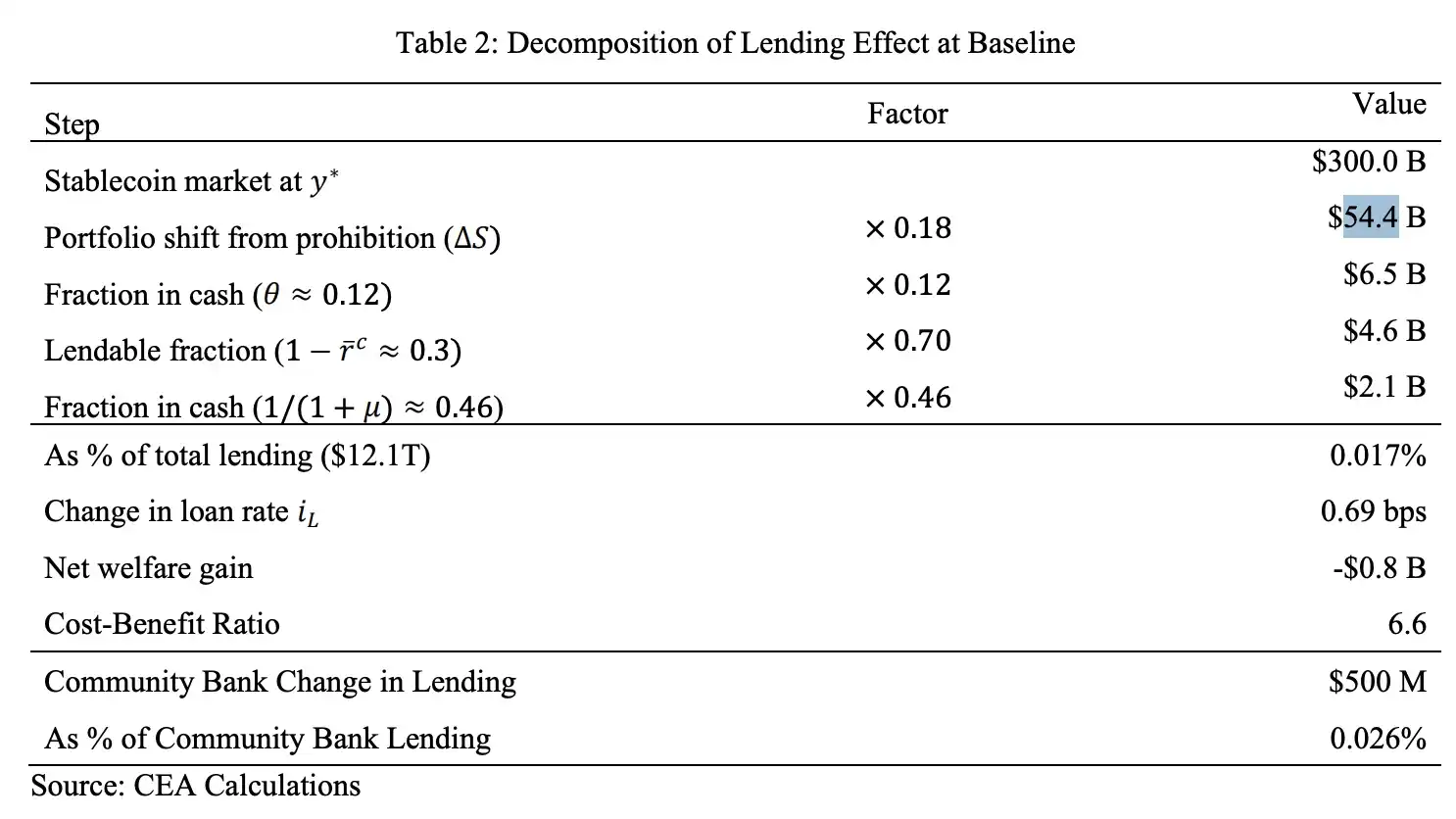
Second checkpoint: Out of this $54.4 billion, how much actually changes bank lending capacity? Only the 12% (in the case of USDC) portion, which is about $6.5 billion. The other 88% was circulating in the Treasury market before and after the ban, having no net impact on bank lending capacity.

Third checkpoint: Can the $6.5 billion entering banks be fully lent out? No. Banks need to hold reserves. The current effective reserve ratio in the U.S. banking system is about 30%, leaving 70% as lendable funds. Moreover, the Fed currently maintains an "ample reserves" framework, with banks collectively holding over $1 trillion in excess liquidity buffers—for every new dollar of lending capacity, ultimately less than 50 cents becomes a real loan, with the rest being actively absorbed by banks into their liquidity buffers.

After passing through these three checkpoints, $54.4 billion becomes $2.1 billion, only 0.02% of total loans (about $12 trillion).

Then calculate the cost on the other side: stablecoin holders lose the approximately 3.5% annualized yield they could have obtained, resulting in a net welfare loss of about $800 million per year.

In the CEA's words, the cost-benefit ratio of this ban is 6.6, meaning the cost is 6.6 times the benefit, making it very inefficient.

How Was That $1.5 Trillion Calculated?

Since the White House model gives $2.1 billion, where did the original $1.5 trillion come from?

The CEA traces its origins in the report. Nigrinis's (2025) estimate directly borrowed the model established by Whited, Wu, and Xiao (2023) for Central Bank Digital Currency (CBDC)—CBDC, as a liability of the Fed, would directly withdraw deposits from the commercial banking system; for every dollar entering, bank loans decrease by about 20 cents. Nigrinis directly applied this multiplier to the stablecoin scenario, while assuming stablecoins would expand massively after offering competitive yields, ultimately推算 (推算 - calculated/derived) the $1.5 trillion loan contraction.

The problem is, there is an essential difference between CBDC and stablecoins: CBDC is a central bank liability; deposits entering it leave the commercial banking system. The reserves of stablecoins mostly flow back to commercial banks through the Treasury market. Nigrinis's model did not track where this money went; it only saw deposits decreasing at one bank, not increasing at another.

This is the fundamental difference between partial equilibrium and general equilibrium. Mistaking the loss of one bank for the loss of the entire system naturally leads to an error of orders of magnitude.

Another Overlooked Account

The report specifically points out an effect not covered by the model but working in the opposite direction: stablecoins' overseas demand for U.S. Treasury bonds.

Over 80% of stablecoin transactions occur outside the U.S.,背后是 (behind which are) ordinary users in countries with unstable currencies using dollar stablecoins as savings tools. This group supports real demand for U.S. Treasury bonds; IMF data shows that the scale of U.S. Treasury bonds held by stablecoin issuers has surpassed that of Saudi Arabia. BIS research shows that every $3.5 billion inflow into stablecoins can depress the 3-month Treasury yield by 5 to 8 basis points. If the ban suppresses stablecoin adoption, this overseas demand channel contracts, U.S. Treasury financing costs rise, and this cost might directly offset that tiny increment on the bank lending side.

So, what does all this actually illustrate?

It's not that stablecoins have no impact on banks, but rather that the source of that impact, to a very large extent, is not "whether they can pay interest." The真正关键的 (truly crucial) thing is what proportion of the stablecoin issuer's reserves are placed in that must-be-100%-reserved lockbox. If regulations push this proportion higher in the future, the impact would才开始变得显著 (begin to become significant).

Regarding the ban on paying interest, for bank lending, the cost-benefit ratio is 6.6; for the stablecoin ecosystem, it cuts off its ability to provide competitive yields to ordinary users; for U.S. Treasury financing, it might even be counterproductive.

One piece of legislation, with no clear beneficiary, but with clear losers. This is what is truly thought-provoking about this report.


Pertanyaan Terkait

QWhat was the original claim made by economist Andrew Nigrinis regarding stablecoin interest and bank lending?

AAndrew Nigrinis claimed that if stablecoins could pay interest, bank loans could be reduced by $1.5 trillion.

QAccording to the White House CEA report, what is the estimated impact on bank lending from banning stablecoin interest payments?

AThe CEA report estimates that banning stablecoin interest payments would only increase bank lending by $2.1 billion, not $1.5 trillion.

QWhat is the key difference between a CBDC and a stablecoin that the CEA report highlights to explain the discrepancy in the estimates?

AThe key difference is that a CBDC is a central bank liability that removes deposits from the commercial banking system, while stablecoin reserves largely flow back into the commercial banking system through the Treasury market.

QWhat percentage of Circle's USDC reserves are held in Treasury bonds and repurchase agreements, according to the article?

A88% of Circle's USDC reserves are held in Treasury bonds and repurchase agreements.

QWhat unintended consequence does the article suggest could result from suppressing stablecoin adoption through an interest ban?

ASuppressing stablecoin adoption could reduce foreign demand for U.S. Treasury bonds, potentially increasing U.S. Treasury financing costs.

Bacaan Terkait

Trump Serukan ke-38 Kali 'Perjanjian Segera Tercapai', Pasar Saham Global Sambut Lonjakan Tajam ala TACO

Dalam konteks ketegangan geopolitik yang berkepanjangan, pernyataan Presiden Amerika Serikat Donald Trump untuk ke-38 kalinya tentang "kesepakatan akhir yang akan segera tercapai" mengenai Iran memicu reli pasar keuangan global yang dijuluki "TACO". Pasar saham AS, Jepang, dan Korea melonjak, dengan KOSPI Korea bahkan sempat mengaktifkan circuit breaker. Kenaikan ini juga didorong oleh data inflasi inti AS (CPI) yang mencapai level tertinggi dalam tiga tahun, yang meredakan ekspektasi kenaikan suku bunga dari Federal Reserve. Namun, optimisme pasar dihadapkan pada sejumlah peringatan. Situasi konflik AS-Iran belum menunjukkan perubahan signifikan, dengan Iran menegaskan tidak akan berkompromi di bawah tekanan. Beberapa analis dan institusi, seperti Barclays dan BofA Securities, mulai menyuarakan kehati-hatian, memperingatkan potensi koreksi mendalam di pasar saham AS karena kondisi overbought, sentimen yang terlalu panas, dan sinyal bearish yang bermunculan. Pasar Korea juga menunjukkan tanda-tanda hati-hati melalui peningkatan pesanan opsi jual (put). Faktor tambahan yang menguji likuiditas pasar adalah IPO besar-besaran SpaceX, yang telah menarik permintaan langganan melebihi kapasitas penawaran, berpotensi mengalihkan dana dari saham-saham yang ada. Meski ada kemungkinan SpaceX masuk indeks utama dengan cepat, IPO ini menciptakan ketidakpastian. Pada intinya, pasar global tetap rentan terhadap dinamika likuiditas, kebijakan domestik, dan perkembangan geopolitik, dengan pernyataan Trump yang terus berubah menjadi faktor volatilitas utama.

Odaily星球日报31m yang lalu

Trump Serukan ke-38 Kali 'Perjanjian Segera Tercapai', Pasar Saham Global Sambut Lonjakan Tajam ala TACO

Odaily星球日报31m yang lalu

Ekosistem Ritel Meredup, ZKsync Berharap pada Percontohan Perbankan untuk Menemukan Solusi

Mengingat ekosistem investor ritel yang terus menyusut, ZKsync sekarang memfokuskan strateginya pada lembaga keuangan tradisional, terutama perbankan, untuk mencari terobosan. ZKsync menawarkan solusi layer-2 dengan teknologi zero-knowledge yang memungkinkan bank memproses dan memverifikasi transaksi tanpa mengungkapkan data sensitif, sekaligus menyelesaikannya di Ethereum. Fitur privasi dan kepatuhan ini menarik minat institusi seperti Deutsche Bank dan platform Tradable. Sementara proyek seperti Kinexys JPMorgan (jaringan privat) dan R3 Corda (konsorsium) menjadi pesaing, keunggulan ZKsync terletak pada kemampuannya untuk diverifikasi secara publik tanpa mengorbankan privasi dan ketahanannya karena tidak bergantung pada entitas tunggal. Namun, peralihan fokus ke klien institusional ini diiringi dengan merosotnya aktivitas DeFi ritel, seperti ditunjukkan oleh penarikan protokol Aave dan penurunan TVL. Tantangan utama ZKsync adalah model tata kelola yang terdesentralisasi. Biaya dan aturan jaringan dapat diubah melalui pemungutan suara komunitas pemegang token ZK, menciptakan ketidakpastian bagi perencanaan keuangan institusi. Meski memiliki mekanisme "komite keamanan" untuk intervensi darurat, kendali akhir tetap berada di tangan komunitas. ZKsync bertaruh pada adopsi jangka panjang oleh bank-bank yang cenderung enggan berpindah platform sekali berinvestasi. Hasil dari strategi ini, apakah akan sukses sebagai infrastruktur keuangan utama atau gagal karena perbedaan model tata kelola, diharapkan terlihat dalam 18 bulan ke depan.

Foresight News43m yang lalu

Ekosistem Ritel Meredup, ZKsync Berharap pada Percontohan Perbankan untuk Menemukan Solusi

Foresight News43m yang lalu

Peringatan Anthropic tentang AI Rekursif, Perusahaan Baru Tian Yuandong Baru Saja Melangkahkan 'Langkah Pertama'

Beberapa hari lalu, Anthropic merilis artikel "When AI Builds Itself" yang memicu diskusi luas. Artikel tersebut mengungkap data internal yang mengejutkan: hingga Mei 2026, lebih dari 80% kode di basis kode Anthropic ditulis oleh Claude, dan jumlah kode yang digabungkan oleh insinyur setiap hari adalah 8 kali lipat dari tahun 2024. Anthropic mengarahkan lintasan ini menuju tujuan yang lebih dalam: **perbaikan diri rekursif** — sistem AI secara mandiri merancang, membangun, dan melatih versi penerusnya sendiri, tanpa manusia mengendalikan setiap langkah. Mereka juga menyerukan koordinasi industri untuk memiliki opsi menunda atau menghentikan sementara pengembangan AI terkini ketika momen perbaikan diri rekursif tiba. Kini, Recursive Superintelligence, perusahaan baru yang didirikan bersama oleh Tian Yuan Dong, baru saja **mengambil langkah pertama menuju penelitian AI otomatis**. Mereka merilis sistem penemuan pengetahuan otomatis terbuka pertama mereka dan mencapai hasil SOTA pada tiga pengujian patokan. Intinya, mereka berhasil membuat AI menjalankan eksperimen untuk Anda. Sistem ini bekerja secara otomatis untuk mengusulkan ide eksperimen, menerapkan kode, menjalankan verifikasi, belajar dari hasilnya, dan memutuskan langkah pencarian berikutnya, membentuk loop penelitian otomatis. Sistem ini diuji pada tiga skenario berbeda: 1. **Pelatihan model kecil dengan anggaran komputasi tetap (NanoChat Autoresearch):** Meningkatkan validasi BPB dari 0.9372 menjadi 0.9109. 2. **Balapan kecepatan pelatihan ekstrem (NanoGPT Speedrun):** Memangkas waktu pelatihan dari 79,7 detik menjadi 77,5 detik. 3. **Optimasi inti GPU (SOL-ExecBench):** Meningkatkan skor SOL dari 0,699 menjadi 0,754 pada 235 tugas penulisan inti. Recursive Superintelligence, didirikan akhir 2025/awal 2026, baru keluar dari mode siluman bulan lalu dan telah mengumpulkan pendanaan $6,5 miliar. Tim pendirinya termasuk para ahli ternama seperti Richard Socher, Alexey Dosovitskiy, dan Peter Norvig. Misi inti perusahaan adalah membangun sistem AI yang secara rekursif meningkatkan kemampuan penelitiannya sendiri. Pencapaian Recursive ini mewakili fajar paradigma penelitian AI baru: **sistem AI mengambil peran utama dalam penelitian**. Logika intinya adalah AI meningkatkan kemampuan penelitian AI, dan AI yang ditingkatkan kemudian dapat meningkatkan dirinya sendiri lebih efektif, menciptakan siklus yang berulang. Ini berpotensi mengubah kecepatan dan kurva biaya kemajuan AI. Langkah ini terjadi bersamaan dengan peringatan dari Anthropic tentang perlunya kesiapan menghadapi perbaikan diri rekursif. Sementara Recursive mengakui ini baru **"langkah pertama"** dan tantangan seperti pencegahan kecurangan dalam sistem hadir, sebuah loop tertutup telah mulai berputar. Pertanyaan selanjutnya adalah seberapa cepat ia akan berputar.

marsbit50m yang lalu

Peringatan Anthropic tentang AI Rekursif, Perusahaan Baru Tian Yuandong Baru Saja Melangkahkan 'Langkah Pertama'

marsbit50m yang lalu

Tinjauan On-Chain Terbaru: Perdagangan Tanpa Tema Utama di Tengah Guncangan Saham AS

Dalam tinjauan on-chain terkini, aktivitas degen telah kembali ke Solana setelah pasar ETH melandai. Namun, tren di Solana sulit dikatakan memiliki alur yang jelas, dan dapat digambarkan sebagai tarik-menarik antara "pertarungan perhatian" dan "kembalinya komunitas." Di sisi "pertarungan perhatian," pasar meme coin masih bergantung pada metode lama seperti endorsemen selebriti, peristiwa viral, dan kecepatan dalam trading. Contohnya adalah $JOTCHUA, yang melonjak setelah pengakuan kreator meme, serta $WORLDCUP di Solana yang naik karena analisis KOL, sementara konsep serupa di Base ($PITCH) terpuruk. Platform pump.fun memperkenalkan fitur "pump fun GO" yang memungkinkan pembuatan tugas berhadiah untuk memicu perhatian, tetapi sering berakhir dengan citra negatif, seperti kasus $Bountywork yang memberikan hadiah untuk tato di dahi. Di sisi lain, terdapat tren "kembalinya komunitas" dengan token yang bertahan berkat komunitas organik dan ideologi yang kuat. Contohnya termasuk $neet (tentang anti-work), $troll, $buttcoin, dan $triplet, yang memiliki komunitas aktif dan nilai yang relatif stabil. KOL Ansem menekankan bahwa token yang baik didukung oleh komunitas yang gigih, bukan hanya bergantung pada figur tunggal. Proyek seperti $KINS dari game Kintara juga menunjukkan bagaimana pengiriman produk yang konsisten dan pembangunan komunitas dapat membangun kepercayaan, meski tanpa promosi besar-besaran. Pasar saat ini dihadapkan pada pilihan antara spekulasi cepat yang berfokus pada perhatian dan pembangunan jangka panjang yang berbasis komunitas. Refleksi ini diharapkan dapat mengarah pada ekosistem yang lebih sehat dan berkelanjutan.

marsbit57m yang lalu

Tinjauan On-Chain Terbaru: Perdagangan Tanpa Tema Utama di Tengah Guncangan Saham AS

marsbit57m yang lalu

Trading

Spot
Futures

Artikel Populer

Cara Membeli HOUSE

Selamat datang di HTX.com! Kami telah membuat pembelian Housecoin (HOUSE) menjadi mudah dan nyaman. Ikuti panduan langkah demi langkah kami untuk memulai perjalanan kripto Anda.Langkah 1: Buat Akun HTX AndaGunakan alamat email atau nomor ponsel Anda untuk mendaftar akun gratis di HTX. Rasakan perjalanan pendaftaran yang mudah dan buka semua fitur.Dapatkan Akun SayaLangkah 2: Buka Beli Kripto, lalu Pilih Metode Pembayaran AndaKartu Kredit/Debit: Gunakan Visa atau Mastercard Anda untuk membeli Housecoin (HOUSE) secara instan.Saldo: Gunakan dana dari saldo akun HTX Anda untuk melakukan trading dengan lancar.Pihak Ketiga: Kami telah menambahkan metode pembayaran populer seperti Google Pay dan Apple Pay untuk meningkatkan kenyamanan.P2P: Lakukan trading langsung dengan pengguna lain di HTX.Over-the-Counter (OTC): Kami menawarkan layanan yang dibuat khusus dan kurs yang kompetitif bagi para trader.Langkah 3: Simpan Housecoin (HOUSE) AndaSetelah melakukan pembelian, simpan Housecoin (HOUSE) di akun HTX Anda. Selain itu, Anda dapat mengirimkannya ke tempat lain melalui transfer blockchain atau menggunakannya untuk memperdagangkan mata uang kripto lainnya.Langkah 4: Lakukan trading Housecoin (HOUSE)Lakukan trading Housecoin (HOUSE) dengan mudah di pasar spot HTX. Cukup akses akun Anda, pilih pasangan perdagangan, jalankan trading, lalu pantau secara real-time. Kami menawarkan pengalaman yang ramah pengguna baik untuk pemula maupun trader berpengalaman.

455 Total TayanganDipublikasikan pada 2025.04.27Diperbarui pada 2026.06.02

Cara Membeli HOUSE

Diskusi

Selamat datang di Komunitas HTX. Di sini, Anda bisa terus mendapatkan informasi terbaru tentang perkembangan platform terkini dan mendapatkan akses ke wawasan pasar profesional. Pendapat pengguna mengenai harga HOUSE (HOUSE) disajikan di bawah ini.

活动图片












