The Person Who 'Killed' PayPal Wants to Buy It

比推Dipublikasikan tanggal 2026-02-24Terakhir diperbarui pada 2026-02-24

Abstrak

A potential acquisition that could reshape the global payments landscape is under discussion, as Stripe—valued at $159 billion—is reportedly considering acquiring all or parts of PayPal, which has a market cap of just $43 billion. The news drove PayPal’s stock up nearly 7%. PayPal has faced significant challenges: its stock fell 46% over the past year amid rising competition from Apple Pay, Google Pay, and agile rivals like Adyen and Stripe. Despite its vast user network of 438 million active accounts and strong presence in cross-border transactions, PayPal has struggled to keep pace with shifting user behaviors and the rise of embedded and social payments. However, PayPal retains valuable assets, including Braintree (processing around $700 billion annually), Venmo (with 100 million monthly active users), and a deeply entrenched global payments infrastructure. A key underlying motive for the deal is stablecoins. PayPal launched its own stablecoin, PYUSD, adopting a centralized approach to digital currency. In contrast, Stripe has pursued an infrastructure-focused strategy, acquiring stablecoin infrastructure firm Bridge and launching “Open Issuance”—a platform that enables businesses to issue their own stablecoins. Stripe is also developing Tempo, a Layer-1 blockchain aimed at challenging traditional settlement networks like SWIFT. A combined Stripe-PayPal entity could create a powerful Web3 payment ecosystem, integrating PYUSD with Tempo’s fast, low-cost transactions and...

A transaction that could rewrite the global payment industry landscape is quietly brewing.

On February 24, Bloomberg reported: Private payment giant Stripe, led by the Collison brothers, is considering acquiring all or part of the business of the veteran payment pioneer PayPal. On the day the news broke, PayPal's stock price surged nearly 7%.
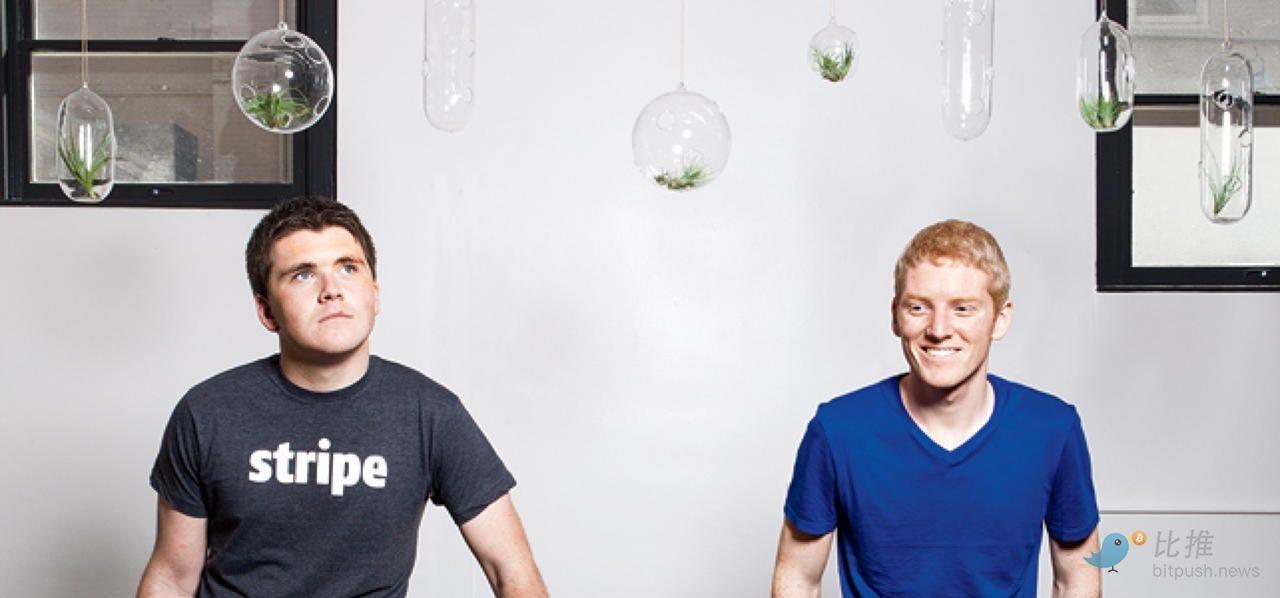
One is a private unicorn valued at $159 billion, the other is a former king with a market cap of only $43 billion but a vast user network. Behind this potential deal lies not just a shift in market share, but a deeper game about the future form of payments—especially crypto/stablecoin payments.

PayPal's Dilemma and Trump Cards

To understand why this potential deal has caused such a stir, first look at two sets of numbers.

Over the past 12 months, PayPal's stock price has fallen nearly 46%, with its market capitalization hovering around $40 billion. Meanwhile, the yet-to-be-publicly-listed Stripe recently valued itself at $159 billion in an employee stock buyback—the former is less than a third of the latter.
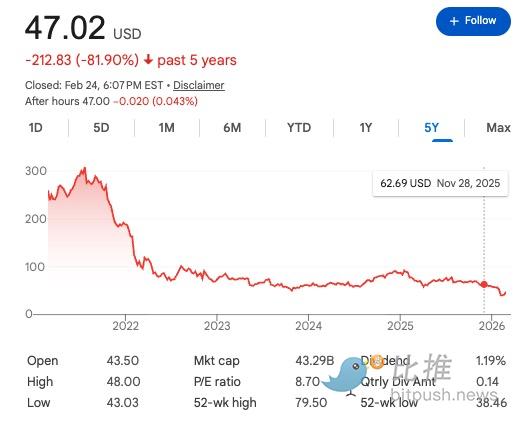
Behind this inversion is PayPal's business being squeezed from multiple dimensions.

The competitive landscape has long been turned upside down. Apple Pay and Google Pay have locked down the consumer entry point via mobile operating systems, while new forces like Adyen and Stripe are constantly encroaching on the territory with their technical flexibility on the business side. PayPal, which once made its name as a "third-party guarantor," is gradually losing the scarcity of being a connector in an era of increasingly diversified payment entry points.
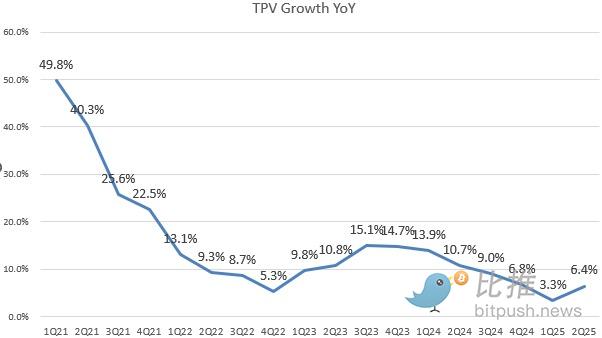
User habits are also quietly evolving. With the explosion of social payments and embedded finance, people prefer to complete transactions at the moment of consumption rather than jumping to a heavy third-party page. Whether it's Stripe's one-click payment or Apple Pay's biometrics, they seem more convenient than that blue icon interface that requires remembering a password. Although PayPal holds the social ace Venmo, it has always struggled to convert it into a commercial engine.

The most fundamental pain point is the loss of market confidence in its growth potential. In the old world of fiat payments, PayPal's imagination has nearly reached its ceiling; in its foray into crypto, it launched the stablecoin PYUSD but was criticized for being "compliant but lacking endogenous transaction demand," failing to penetrate the DeFi ecosystem or create unique value in its own B2B cross-border scenarios.

However, despite its beleaguered fundamentals, PayPal still holds several "chips" that tech giants covet.
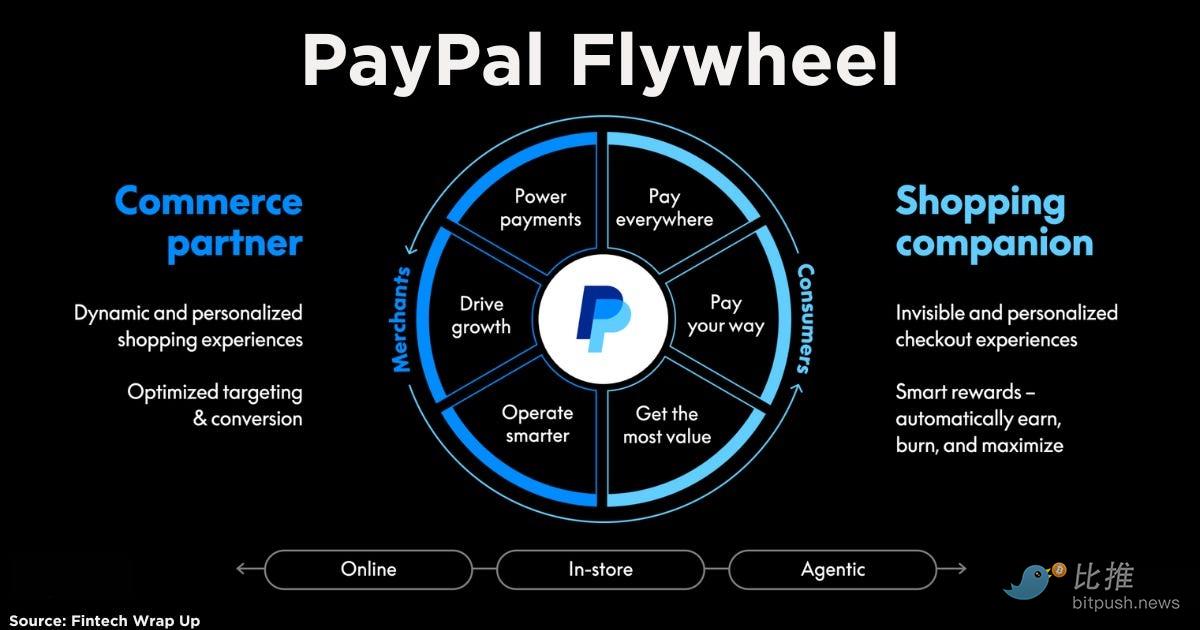
First is Braintree, processing about $700 billion in payments annually, valued by Bernstein at $10 to $15 billion. If acquired, Stripe's total payment volume would jump to $2.1 trillion, widening the gap in competition with rivals like Adyen.

Second is Venmo, a P2P app with over 100 million monthly active users, valued at about $5 billion. For Stripe, which has long "stayed behind the scenes," this is a valuable consumer touchpoint: a form of "last-mile visibility."

Third is a global network沉淀 (precipitated) over nearly three decades: clearing infrastructure deeply embedded in cross-border trade across more than 200 countries, and 438 million active accounts with real card bindings and credit history. Although it appears old, it is the most stable bridge to the global commercial periphery. PayPal recently launched the PayPal World plan, potentially reaching over 2 billion users through partnerships with Tenpay, UPI, etc. This "interoperability" connecting Eastern and Western payment systems is precisely the strategic entry ticket that is difficult for any competitor to replicate.

Nearly three decades of accumulation have not been in vain. It's just a pity that the one who best knows how to use this ticket may no longer be PayPal itself.

Stablecoins Become the Hidden Main Line

However, a word repeatedly mentioned by Wall Street analysts reveals the deeper ambition of this deal: stablecoins.

"A combined Stripe and PayPal could become a significant player in the stablecoin space, as stablecoins are increasingly becoming a more critical part of global commerce," Mizuho analyst Dan Dolev said bluntly.

Looking at the actions of both companies over the past two years, it's not hard to see that cryptocurrency—especially stablecoins—has become a future they are both betting on. But their strategic paths are截然不同 (distinctly different).

PayPal has chosen a path of "controlling the network with a coin," its underlying logic继承 (inheriting) and延续 (continuing) the centralized thinking of the SWIFT era. PayPal crafted PYUSD as a carefully designed "digital dollar." When ordinary consumers see PYUSD in their PayPal wallet, they don't need to understand whether it's a digital currency or fiat, nor whether the underlying settlement is blockchain or the traditional banking system. The familiar UI interface makes the digital currency just another foreign currency type. PayPal aims to extend the advantages of its payment network to the on-chain world, thereby building a closed-loop ecosystem centered on PYUSD. In April this year, it even launched a "PYUSD Hold Rewards Program," offering users a 3.7% annualized yield, hoping to drive growth in cross-border payment business through stablecoin transaction volume.
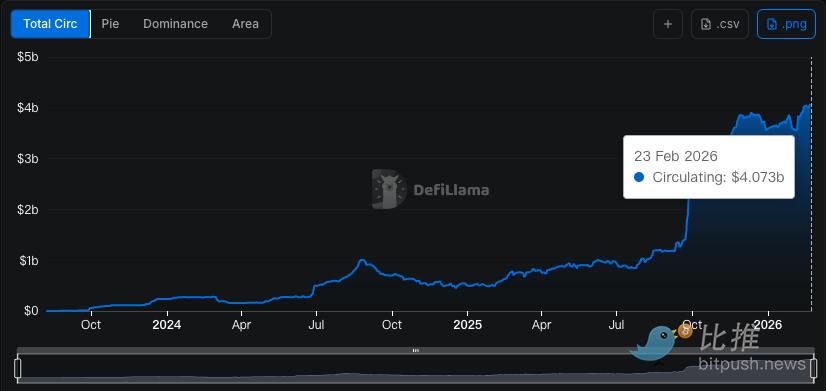
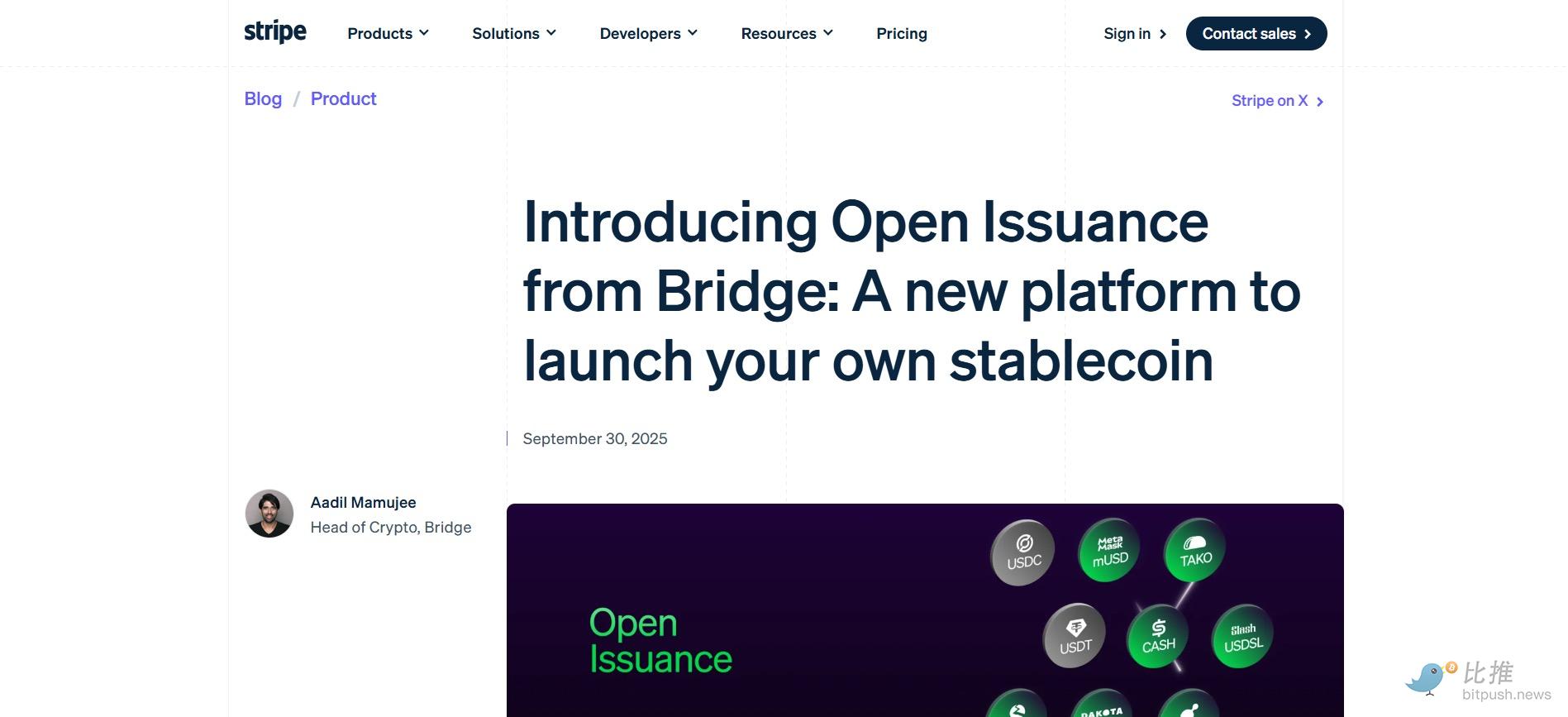
Stripe's layout is more systematic. In 2024, it acquired stablecoin infrastructure company Bridge for $1.1 billion, its largest acquisition to date. But the true ambition only became fully apparent with the launch of its "Open Issuance" platform—it is not fully betting on issuing its own stablecoin but is striving to become the "arsenal" in the stablecoin payment field, empowering other enterprises to issue, manage, and use stablecoins by building powerful infrastructure and developer tools.

The core of "Open Issuance" is that every enterprise can issue its own stablecoin through Stripe and enjoy reserve interest income. This "issuance as a service" model cleverly shifts value capture: while other traditional stablecoin issuers are still calculating basis point spreads, Stripe abandons reliance on reserve interest and instead builds a new profit model based on service fees. It shifts the value focus from "issuance" to "distribution."
The most critical piece is Tempo. Stripe is building this Layer 1 public chain focused on payments in partnership with Paradigm, targeting traditional clearing networks like SWIFT. Overlaying these two strategic maps, the logic behind Stripe's potential acquisition of PayPal becomes clearer: Stripe has the future-facing on-chain payment infrastructure (Tempo, Open Issuance), while PayPal has a ready-made user network (400 million accounts) and a market-tested stablecoin product (PYUSD).

If PYUSD is connected to the Tempo chain, leveraging its sub-second confirmation and low-cost features, and then reaching hundreds of millions of consumers through Venmo, a "Web3 payment closed loop"游离 (operating) outside the traditional banking clearing system would become a reality for the first time. This is not just complementary at the product level but a dimensional reduction strike on the existing global financial infrastructure.

An even more imaginative scenario is AI Agent payments. Unlike the traditional banking system, an AI Agent can have its own crypto wallet address, through which it can receive, store, and send funds. This makes automatic清算 (clearing) between AIs very convenient and efficient, especially suitable for micro-payment scenarios that are small in amount and have transaction context. The x402 payment protocol launched by Stripe this year is paving the way for this future—allowing developers to conduct automatic machine-to-machine settlements via the Base chain using USDC, expanding the payment scenario from "person-to-person" to "machine-to-machine." And PayPal's 400 million accounts are恰好 (precisely) the ideal "withdrawal exit" for these AI Agents.

Regulatory and Integration Challenges

Of course, the final落地 (landing) of this deal still faces huge uncertainties. Insiders emphasized that discussions are still in the early stages, and whether an agreement can be reached is still unknown.

Regulation is the sword of Damocles hanging overhead. The combination of two payment giants (combined TPV nearly $3.7 trillion) will inevitably attract high attention from antitrust agencies. Raymond James analysts believe potential acquirers could include large tech companies like Alphabet, Meta, Microsoft, Amazon, and Apple, but the feasibility of a deal is questionable given the limited financial information available for the private company Stripe.

Furthermore, the difficulty of cultural integration should not be underestimated. Stripe is known for its geek culture and developer-friendly approach, with co-founder John Collison recently stating the company is "in no rush to go public"; while PayPal is a publicly listed company with 400 million C-end users. How to reconcile these two截然不同 (distinctly different) genes will be a challenge the Collison brothers must face.

Even so, the rumor itself is symbolic enough. It marks that the global payment industry is undergoing a profound revaluation: the scale of the old era is no longer a moat, and the infrastructure capability面向未来 (facing the future) is becoming the key weight determining discourse power.

For Stripe, if the acquisition of PayPal succeeds, it will be an intergenerational "snake swallowing an elephant"; if it fails, at least the market has seen its ambition: it not only wants to become the payment base of the internet but also wants to become the rule-maker of the next generation of the financial world.

Author: Coconut Shell


Twitter:https://twitter.com/BitpushNewsCN

Bitpush TG Discussion Group:https://t.me/BitPushCommunity

Bitpush TG Subscription: https://t.me/bitpush

Original link:https://www.bitpush.news/articles/7614231

Pertanyaan Terkait

QWhat is the potential impact of Stripe's rumored acquisition of PayPal on the global payments industry?

AThe acquisition could reshape the global payments landscape by combining Stripe's modern infrastructure and focus on crypto/stablecoin payments with PayPal's vast user network and cross-border capabilities, potentially creating a dominant force in both traditional and next-generation financial systems.

QWhy is PayPal's market valuation significantly lower than Stripe's despite its larger user base?

APayPal's valuation is lower due to declining investor confidence in its growth potential, increased competition from Apple Pay, Google Pay, and Adyen, and its struggle to adapt to evolving user habits and emerging technologies like embedded finance and crypto payments.

QWhat strategic assets does PayPal possess that make it attractive for acquisition?

APayPal holds valuable assets including Braintree (processing $700B annually), Venmo (100M monthly active users), a global network spanning 200+ countries, 438M active accounts, and deep cross-border payment infrastructure through initiatives like PayPal World.

QHow do Stripe and PayPal differ in their approaches to stablecoin and cryptocurrency integration?

APayPal adopts a 'coin-controlled network' approach with its PYUSD stablecoin, focusing on a centralized ecosystem, while Stripe pursues an infrastructure strategy with its 'Open Issuance' platform and Tempo blockchain, enabling businesses to issue stablecoins and capture value through service fees rather than reserve interest.

QWhat are the major challenges facing a potential acquisition of PayPal by Stripe?

AKey challenges include regulatory antitrust scrutiny due to the combined $3.7T total payment volume, cultural integration between Stripe's developer-focused private company ethos and PayPal's public consumer-facing structure, and the uncertainty of deal feasibility given Stripe's private financial status.

Bacaan Terkait

Dialog dengan Ray Dalio: Saat Ini Berada dalam Gelembung AI, 1% Portofolio Investasi Adalah Bitcoin

Sumber: The Diary Of A CEO Ray Dalio, pendiri Bridgewater Associates yang meramalkan krisis keuangan 2008, memperingatkan bahwa ledakan AI saat ini menunjukkan tanda-tanda klasik gelembung ekonomi yang dapat pecah dan memicu resesi. Dalam wawancara podcast, dia menjelaskan dinamika "siklus besar" yang didorong oleh ketimpangan kekayaan, defisit pemerintah, dan perubahan geopolitik. Dalio mengidentifikasi pola di mana antusiasme berlebihan terhadap teknologi revolusioner baru, seperti AI, menyebabkan harga aset melambung dan pinjaman berlebihan. Ketika kondisi berubah (seperti kenaikan suku bunga atau kebutuhan tunai), gelembung ini dapat pecah, menyebabkan penurunan harga aset, kerugian luas, dan kontraksi ekonomi. Untuk melindungi kekayaan di masa ketidakpastian, Dalio sangat menekankan pentingnya **diversifikasi portofolio**—termasuk saham, obligasi, emas, dan real estat—daripada mengandalkan uang tunai saja. Dia mengungkapkan bahwa sekitar **1% portofolionya adalah Bitcoin**, yang diakuinya sebagai aset keras, tetapi dia lebih menyukai **emas fisik** karena sejarahnya sebagai penyimpan nilai dan aset bebas liabilitas. Mengenai dampak AI, Dalio percaya bahwa teknologi ini akan menggantikan tidak hanya tenaga fisik tetapi juga kemampuan kognitif manusia, berpotensi memperlebar kesenjangan antara pemilik modal dan pekerja. Masa depan akan menguntungkan mereka yang dapat memadukan kecerdasan manusia (seperti emosi dan intuisi) dengan kemitraan AI. Secara geopolitik, Dalio menggambarkan dunia yang memasuki fase "penurunan" dalam tatanan global, dengan Amerika Serikat menghadapi tantangan internal dan eksternal, termasuk konflik seperti di Iran yang mengungkap kelemahannya. Dia memprediksi dunia mungkin menjadi lebih terregionalisasi di masa depan. Secara keseluruhan, kunci untuk navigasi melalui periode kompleks ini adalah pemahaman akan pola sejarah, adaptasi, dan diversifikasi yang cermat.

marsbit2j yang lalu

Dialog dengan Ray Dalio: Saat Ini Berada dalam Gelembung AI, 1% Portofolio Investasi Adalah Bitcoin

marsbit2j yang lalu

Rekor! Beli Bersih Asing 7,2 Triliun Won dalam Sehari, Wall Street: Tekanan Likuiditas di Pasar Saham Korea Telah Mereda

**Ringkasan: Rekor Pembelian Asing dan Peningkatan Likuiditas di Pasar Saham Korea** Aliran modal asing menunjukkan perubahan signifikan di pasar saham Korea (KOSPI). Pada 31 Juli, investor asing melakukan pembelian bersih rekor sebesar 7,2 triliun Won Korea dalam sehari, menandai pembalikan dari tren penjualan bersih besar-besaran dalam beberapa bulan terakhir. Secara bulanan, penjualan bersih asing menyusut drastis menjadi 9,8 triliun Won di Juli, turun dari 48,4 triliun dan 44,5 triliun Won pada Juni dan Mei. Tekanan penjualan dari lembaga domestik juga mereda. Dana pensiun dan reksa dana domestik justru menjadi pembeli bersih 1,0 triliun Won di Juli, setelah dua bulan sebelumnya menjadi penjual bersih. Faktor pendukung lainnya adalah peraturan baru dari Komisi Jasa Keuangan (FSC) yang memberlakukan syarat lebih ketat bagi investor ritel untuk masuk ke ETF leverage saham tunggal, yang langsung mengurangi volume perdagangan instrumen tersebut hingga sekitar 50%. Kebijakan ini diperkirakan dapat menekan volatilitas pasar. Citigroup mempertahankan target indeks KOSPI di level 10.000 poin, menyoroti memudarnya angin penentu likuiditas. Analis mereka menilai faktor fundamental seperti industri chip memori yang solid, valuasi historis yang rendah, fundamental ekonomi Korea yang kuat, dan dukungan kebijakan berpotensi menjadi pendorong bagi pasar.

marsbit2j yang lalu

Rekor! Beli Bersih Asing 7,2 Triliun Won dalam Sehari, Wall Street: Tekanan Likuiditas di Pasar Saham Korea Telah Mereda

marsbit2j yang lalu

Pembaruan! AI Generasi Berikut OpenAI Pecahkan 10 Masalah Kelas Medali Fields

**OpenAI Model Astra Pecahkan 10 Masalah Matematika Kelas Fields Medal!** OpenAI mengumumkan terobosan besar dari model internal terbarunya, Astra. Model ini dilaporkan telah membuat kemajuan signifikan dalam **10 masalah matematika yang belum terpecahkan**, dengan biaya komputasi hanya sekitar **$2000**. Hasilnya dipublikasikan dalam makalah setebal 249 halaman. Beberapa pencapaian utama meliputi: 1. **Menyelesaikan masalah "non-sofic group"** yang diajukan Mikhail Gromov tahun 1999, dengan membangun contoh kelompok yang tak hingga dan finitely presented yang bukan sofic. Ini dianggap sebagai kemajuan bersejarah. 2. **Memecahkan batas lama dalam masalah pengepakan bola berdimensi tinggi** (sphere packing), meningkatkan batas yang telah bertahan sejak 1978 untuk dimensi tak hingga. 3. **Menyangkal dugaan "Connes Rigidity"** dengan membangun keluarga tak terhitung dari kelompok berbeda yang menghasilkan aljabar von Neumann yang sama persis. Semua bukti telah diverifikasi menggunakan asisten pembuktian formal Lean 4, memastikan ketepatannya. Para ahli matematika menyebut temuan ini sebagai **momen bersejarah**, setara dengan prestasi penghargaan Fields Medal, dan menandai kemampuan AI untuk melakukan penalaran matematika mendalam di berbagai bidang. OpenAI juga membagikan proses penalaran model, menunjukkan langkah maju yang besar menuju AGI (Artificial General Intelligence).

marsbit4j yang lalu

Pembaruan! AI Generasi Berikut OpenAI Pecahkan 10 Masalah Kelas Medali Fields

marsbit4j yang lalu

Bagaimana Membuat Diri Sendiri Tak Tergantikan oleh Kecerdasan Buatan

**Ringkasan: Bagaimana Membuat Diri Anda Tak Tergantikan oleh AI** Artikel ini membahas ancaman nyata dalam era AI: bukan kehilangan pekerjaan, tetapi "perbudakan gaji"—ketergantungan pada sistem dan orang lain untuk bertahan hidup. Solusinya adalah menjadi "individu super" yang "tak bisa dipekerjakan" dengan membangun bisnis atau karya sendiri. Kunci untuk bertahan dan berkembang di masa depan bukan sekadar keterampilan teknis, tetapi menguasai lima elemen yang sulit digantikan AI: 1. **Otonomi (Agency):** Kemampuan bertindak tanpa menunggu perintah. 2. **Rasa (Taste):** Pengalaman untuk mengetahui apa yang bernilai untuk ditawarkan. 3. **Kemampuan Persuasi (Persuasion):** Keterampilan menarik perhatian dan pengakuan. 4. **Ketekunan (Persistence):** Memahami bahwa kegagalan adalah bagian dari proses. 5. **Iterasi (Iteration):** Kemampuan memperbaiki kesalahan berdasarkan umpan balik. Lima elemen ini dapat dikembangkan dengan **membuat konten** (media). Dibandingkan pemrograman (code), konten lebih unggul karena nilainya subjektif, membutuhkan penilaian manusia, dan merupakan alat distribusi yang ampuh untuk membangun koneksi dan otoritas. Untuk memulai transformasi: 1. **Ubah lingkungan** Anda secara drastis untuk memicu perubahan identitas. 2. **Gali "bahan mentah"** Anda: Identifikasi pengetahuan mendalam, masalah yang pernah Anda selesaikan, dan minat unik masa kecil Anda. 3. **Temukan "poros pemikiran balik"**: Tentukan pendapat kontra-intuitif atau keyakinan Anda yang bertentangan dengan arus utama dalam bidang Anda. 4. **Luncurkan ide pertama** Anda besok. Gabungkan jawaban dari langkah 2 dan 3, lalu publikasikan. Umpan balik nyata dari dunia adalah guru terbaik. Intinya, bangunlah *karier seumur hidup* yang autentik berdasarkan pengalaman dan sudut pandang unik Anda. Dengan memanfaatkan AI sebagai alat dan fokus pada pengembangan diri yang tak tergantikan, Anda dapat mengambil kendali atas hidup dan masa depan Anda.

marsbit4j yang lalu

Bagaimana Membuat Diri Sendiri Tak Tergantikan oleh Kecerdasan Buatan

marsbit4j yang lalu

Kunci Bitcoin Disimpan Offline Berkat Lemparan Dadu, Tetapi Tidak Semua Orang Akan Melakukannya

Berdasarkan insiden kerentanan generator angka acak pada perangkat hardware wallet Coldcard, artikel ini membahas metode pembuatan kunci Bitcoin menggunakan dadu untuk menghasilkan entropi mandiri. Claude Shannon mengukur ketidakpastian dengan konsep entropi, di mana satu lemparan dadu enam sisi setara dengan sekitar 2,585 bit. Praktik melempar dadu 50 hingga 99 kali dapat menghasilkan frasa pemulihan 12 kata yang aman (128 bit entropi), melampaui ketergantungan pada generator perangkat. Namun, insiden Coldcard mengungkap bahwa meskipun seed utama dibuat dari dadu aman, fungsi lain seperti dompet kertas, kunci kloning, dan password masih berpotensi menggunakan generator cacat. Peneliti keamanan Kevin Loaec menekankan bahwa perlindungan hanya berlaku untuk seed utama, bukan keseluruhan sistem. Proses manual ini membutuhkan ketelitian tinggi, rentan kesalahan, dan tidak praktis bagi kebanyakan pengguna baru. Oleh karena itu, meski kuat secara matematis, metode ini lebih cocok untuk pengguna berpengalaman. Artikel menyarankan pemilik Coldcard untuk memperbarui firmware, memeriksa fungsi yang pernah digunakan, dan mempertimbangkan skema multisignature dengan perangkat dari produsen berbeda untuk mitigasi risiko. Tujuan jangka panjang adalah perangkat yang dapat menghasilkan keacakan kuat secara mandiri, tanpa memerlukan prosedur rumit dari pengguna.

cryptonews.ru7j yang lalu

Kunci Bitcoin Disimpan Offline Berkat Lemparan Dadu, Tetapi Tidak Semua Orang Akan Melakukannya

cryptonews.ru7j yang lalu

Trading

Spot
活动图片





