The Evolution of Listing Cycles: Yesterday's Wind Won't Fly Today's Kite

marsbitDipublikasikan tanggal 2026-02-17Terakhir diperbarui pada 2026-02-17

Abstrak

The article "The Evolution of Listing Cycle: Yesterday's Wind Can't Fly Today's Kite" uses a dental braces metaphor to describe the structural evolution of cryptocurrency exchange listing processes from 2017 to 2025. It outlines four distinct phases: 1. **Community-Priced Era (2017-2018)**: A chaotic "milk teeth" period where listings were driven by community votes and loud narratives, with exchanges acting as passive platforms seeking user growth. 2. **Exchange-Priced Era (2019-2022)**: The "teeth-growing" phase where exchanges (e.g., via IEOs/Launchpads) became gatekeepers, providing due diligence and using new listings to empower their own ecosystem tokens. 3. **VC-Priced Collapse (2023-2024)**: A "malocclusion" period where high FDV, low float VC deals dominated, causing token prices to peak at launch. Excountered, exchanges intervened with measures like HODLer airdrops to redistribute value to retail users and counter VC dominance. 4. **Market/Derivatives-Priced Era (2025)**: The "orthodontic" phase marked by industrialization. Price discovery shifts to derivatives, with pre-market perpetual合约 trading allowing price formation before spot listing. Mechanisms like Binance Alpha act as a sandbox, requiring projects to prove market resilience. Concurrently, the "listing fee" model evolved: from direct payments to exchanges, to sharing tokens with the exchange's ecosystem, and finally to a current model where projects must allocate a significant portion of their token su...

If the crypto industry is compared to a set of teeth, the path of listing over the years is like a process of "industry orthodontics." From the chaos of 2017 to the industrialized assembly line of 2025, every method of token distribution is essentially a correction of the industry's structural deformities and a challenge to the chip structure.

In this process, the path for projects to pursue top liquidity has evolved from the early "volume game" to the current "sky-high bride price model" of spending heavily to win over; exchanges, for survival, traffic, and fees, have also shifted from early listing logic to pricing logic.

How exchanges, projects, VCs, and traders destroy and love each other; slander and achieve each other.

For you, a thousand times over.

Introduction

Teeth are a very "magical" organ in the human body. Why is that? Because teeth are the only organ that allows us to undergo deep customization, movement, and transformation through physical and biological means after adulthood.

This "plasticity" allows us to combat misalignment caused by genetics and the wear and discomfort brought by time.

We usually think of bones as hard and fixed, and teeth, growing in the alveolar bone, should be immovable. But orthodontics (wearing braces)恰恰利用了 the characteristic that bone is a "dynamic and active tissue." When braces apply a constant light force to the teeth, the alveolar bone on the pressured side senses the pressure, and the body sends "osteoclasts" to absorb the bone here, making way for the teeth; on the side where the teeth move away, the body sends "osteoblasts" to fill in new bone.

Teeth "destroy" bone on one side and "rebuild" it on the other,从而实现 slow movement within the bone.

This is something no other hard organ in the human body can do. After all, unless you are extraordinarily gifted, you cannot shorten your femur or change the position of your ribs by applying pressure, but teeth can.

The rules and policies of listings are the same.

Part One: Listing = The Struggle and Transfer of Asset Pricing Power

This article divides the path of listing into four stages: Baby Teeth — Growing Teeth — Deformity — Orthodontics. The core running through the four evolutionary stages of listing is: who masters the pricing power of assets.
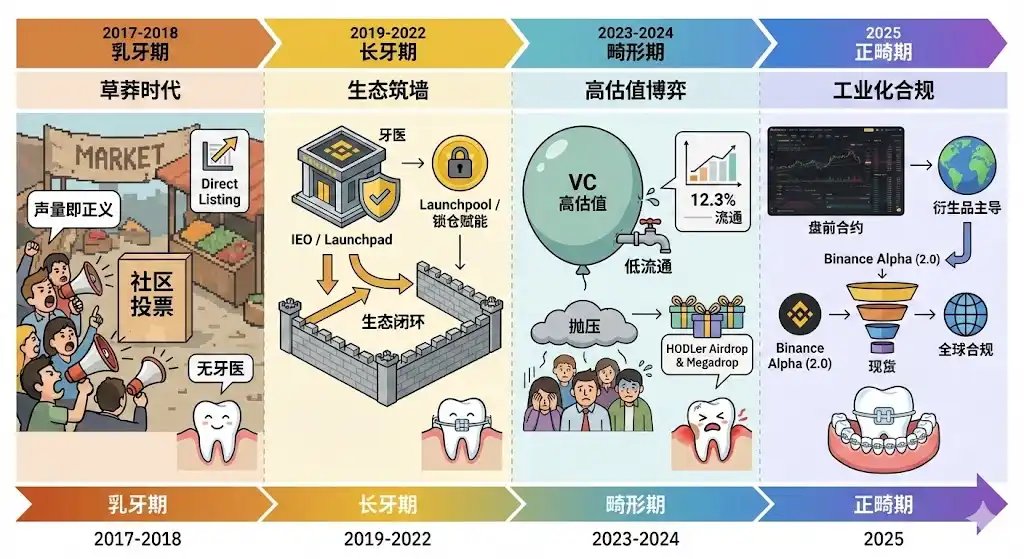
Stage One (Community Pricing)

Pricing power lies in the hands of "shouters" and grassroots communities. Traffic is king, whoever has the loudest voice is right. The result is bad money driving out good, and the market is full of noise.

Stage Two (Exchange Pricing)

Exchanges reclaim pricing power through IEO/Launchpad, acting as "gatekeepers" and "investment banks." The exchange's credibility背书 becomes the core support for asset prices.

Stage Three (The Collapse of VC Pricing)

VCs掌握了 too high pricing power in the primary market, leaving no profit in the secondary market. Exchanges are forced to intervene, trying to "rob the rich to help the poor" through强制手段 (Airdrop), but this is only a painkiller, not a cure.

Stage Four (Market/Derivatives Pricing)

On-field博弈 funds are not in spot trading, so pricing power is handed over to more mature financial mechanisms. Through "contract trading" and pre-market trading, the market forms a fair price after full博弈, no longer relying on a single narrative or VC valuation reports.

Part Two: The Era Background, Logic, and Evolution of Listings

Stage One: 2017-2018 "Baby Teeth Period" — The Lawless Era Where Volume Was Justice

Core Path: Direct Listing, Community Voting

The industry was in a "no dentist" state during this period. The listing logic had a strong founder and community sovereignty color. As long as a project could rally fans, it could get an entry ticket.

Era Background

This was the "Genesis" stage of Crypto. The industry was still in a pure trading platform era, with users mainly concerned with convenience, speed, and low cost of trading. Mainstream exchanges at the time were mostly slow and unstable. New platforms built口碑 through "extreme simplicity," with no complex learning systems or social functions, and interfaces designed entirely for experienced professional traders.

Reasons

Customer Acquisition Anxiety: Startup platforms needed to attract traffic from competitors efficiently and at low cost. "Community voting" was not just about selecting coins but also a battle for community归属感.

Regulatory Vacuum: Global regulation had not yet intervened, giving exchanges extremely high decision-making freedom. The logic was极其简单: whichever project had the most fans was the guarantee of liquidity.

Play: Represented by Binance's "Monthly Community Vote Listing," users paid a tiny amount of tokens (e.g., 0.1 BNB) to vote. Winning projects (e.g., Zilliqa, Pundi X) almost got top流量 for free, but also led to severe market misalignment due to vote manipulation, eventually forcing its abandonment.

Stage Two: 2019-2022 "Teeth Growing Period" — Ecosystem Wall-Building and Premium Issuance

Core Path: IEO (New Coin Offering), Launchpad, Launchpool, Direct Listing

The industry began to wear an orthodontic appliance called "ecosystem." Exchanges were no longer just intermediaries but became "dentists" with deep due diligence capabilities.

Era Background

After the ICO bubble burst in 2017, fraud and technical vulnerabilities left the industry信用扫地. The market needed a safer,背书的 way to raise funds. Meanwhile, the arrival of DeFi Summer (2020) made "liquidity mining" an industry consensus.

Reasons

Credit Repair: Exchanges introduced "bank-level" due diligence through Launchpad, acting as industry dentists,筛选 serious teams and tech projects, upgrading the ICO model to the more secure IEO (Initial Exchange Offering).

Ecosystem Loop: To consolidate user stickiness, platforms forced value accrual to their own ecosystem coins (e.g., BNB) through Launchpool, allowing users to obtain new coins by "holding" rather than "snatching," reducing participation risk.

19-20 (New Coin Frenzy):

Launchpad (e.g., Bittorrent) introduced a pricing issuance model. Projects not only had to pass technical review but also accept the exchange's pricing "suggestions" to ensure some "wealth effect" after listing.

21-22 (Lock-up Empowerment):

Launchpool became mainstream, empowering platform tokens, marking a shift from "buying new coins" to "mining new coins." Users obtained new coin distributions by locking up platform tokens,强行 binding project利益 to the platform ecosystem.

Stage Three: 2023-2024 "Deformity Period" — High Valuation, Low Float博弈 and Mechanism Upgrade

Core Path: HODLer Airdrop, Launchpool

Era Background

Venture capital (VC) returned to the market on a large scale,催生 a large number of projects with valuations of hundreds of millions of dollars but extremely low listing float (median only 12.3%). This structure left little profit space for retail investors in the secondary market, only continuous unlock selling pressure. Meanwhile, paying huge fines and CZ going to jail shifted the focus from "wild growth" to "global compliance and stability."

Reasons

Pricing Power Conflict: VC-driven projects peaked at listing, depriving the market of price discovery功能. To protect the ecosystem, exchanges had to correct this through强制手段, "returning profits to the people."

Compliance Pressure: Starting May 2024, rules clearly favored small and medium-sized projects with high distribution ratios, requiring projects to reduce the float portion, aiming to打击 VC manipulation of pricing.

Corrective Measures: Introduced HODLer Airdrop and Megadrop targeting long-term holders,强行 giving the "bride price" directly to retail.

This is the most painful "periodontitis" stage of industry orthodontics. VCs催生大量 "peak at listing" projects, with token float median dropping to 12.3%. Binance's industry report showed that仅2024's new projects had about $155 billion in potential selling pressure over the next 12-24 months.

Because VC manipulated pricing, retail bought high, listing was the peak, causing a暴跌 in market confidence. Poor secondary market performance led to萎缩 in spot trading volume.

To maintain platform token attractiveness,引流, and trading demand, platforms began大规模推行 HODLer Airdrop (airdrops for long-term holders) and Megadrop (distribution combined with Web3 tasks). Listing policies gradually tilted towards small and medium-sized projects with high distribution ratios.

Starting in the second half of 2024, exchange contract mechanisms underwent major upgrades,开始 supporting a wider range of small-cap and new coin perpetual contracts, allowing risk hedging and early pricing through derivatives before spot liquidity matured. Exchange traffic and revenue sources also shifted towards perpetual contract trading.

Stage Four: 2025 "Orthodontics Period" — Multi-tiered, Industrialized Compliance Matrix

Core Path: Binance Alpha Airdrop, Pre-Market Trading, Web3 Wallet integration

Era Background

2025 is called the "Year of Crypto Industrialization." Total digital asset market cap突破 $4 trillion, Bitcoin became a macro asset. Perpetual contracts have become dominant in the derivatives market, accounting for over 75% of global crypto derivatives trading volume.

Reasons

Pricing Power Change: The market is no longer driven by narratives and shouting, but by ETF flows, corporate earnings, and protocol revenue.

Efficiency Optimization: Pre-market contract trading (Futures First) allows pricing through derivatives before new coins list on spot. 2025 data shows this path's conversion cycle shortened to 14 days, the fastest通道 into the mainstream.

Pre-Market Futures First: This is the most important mechanism change in 2025. Introduced "Pre-Market Trading," allowing users to trade perpetual contracts with up to 5x leverage based on external price feeds before the token is officially listed on the spot market.

Small-Cap Deep Liquidity: Because contract trading and pre-market trading attracted huge traffic, it attracted many small and medium market makers, greatly enhancing the博弈 space and liquidity of small-cap contracts. This allowed new coins like ESP, AZTEC, KITE, which had not yet listed on spot, to quickly establish derivative liquidity, becoming the fastest path into the mainstream, with an average cycle from listing to正式发币 of about 14 days.

Binance Alpha (2.0): As a "pre-listing token selection pool," projects must first "level up" here, proving their secondary market performance (including price trends and trading volume), to gradually upgrade: contract → spot.

Part Three: The Shift of Power from "Lawless" to "Industrialized Orthodontics"
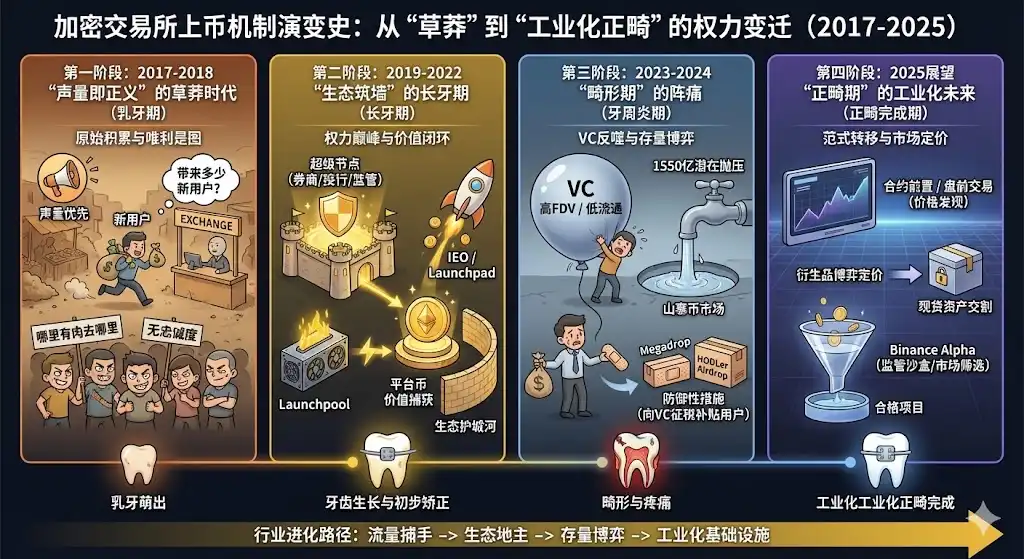
Stage One: The Lawless Era of "Volume is Justice" (2017-2018)

This was the "primitive accumulation" period for exchanges. They had almost no ability to discern project quality, nor did they need to. They only needed to answer one question: "How many new users will listing this coin bring me?"

This model cultivated the first batch of "profit-only" crypto users, loyal to neither platforms nor projects, going wherever there was meat, sowing the seeds for the later liquidity mining tragedy.

Stage Two: The "Ecosystem Wall-Building" Teeth Growing Period (2019-2022)

Exchanges reached the peak of power, becoming the top of the food chain. They were not just trading venues but became super nodes integrating broker, investment bank, and regulator. IEO was the best tool for exchanges to monetize their brand premium.

Stage Three: The阵痛 of the "Deformity Period" (2023-2024)

This was a backlash against the overexpansion of VCs in the previous bull market. High FDV, low float projects were essentially institutionalized harvesting of retail by VCs using information asymmetry and capital advantage.

The aforementioned "$155 billion potential selling pressure" is an astonishing number. It explains why the altcoin market was lifeless even as Bitcoin hit new highs. Because the market not only lacked new funds but was also constantly being drained by unlocks from old projects.

This shows the helplessness of exchanges:明知 they are pits, they still have to list new ones to maintain competitiveness. Megadrop and HODLer Airdrop seem innovative but are actually defensive measures where exchanges are forced to "tax" VCs and subsidize users to maintain ecosystem activity. This is a painful "stock game."

Stage Four: The Industrialized Future of the "Orthodontics Period" (2025 Outlook)

In this stage, the industry finally realized that relying solely on spot markets and simple IEOs, airdrops, and KOL rounds could no longer bear the increasingly complex capital demands and community pressures.

In this stage, contracts replace spot as the primary means of price discovery, along with pre-market trading.

First, this is a huge paradigm shift. It used to be "assets first, then derivatives"; the future is "derivatives博弈 pricing first, then spot asset delivery." This greatly accelerates the price discovery process. How much a project is worth doesn't need to wait for the暴涨暴跌 at listing; it is completed in advance through the long-short battle in pre-market contracts.

The emergence of Binance Alpha also provides a前置 window for "industrialized listing." Alpha is essentially a "talent show sandbox" or a "decentralized curated market." It requires projects to prove their liquidity and resilience in the real残酷 market before they can qualify for "promotion." This replaces the manual due diligence of Stage Two with market mechanisms.

Part Four: The Evolution of Listing Fees: From Listing Fee — Toll Money — Share Money

This section does not target any specific exchange, only叙述 based on public information..

The evolution of "listing fees" through these four stages is essentially a process of power transfer within the industry: from the initial "paying the platform toll money" to the current "spending the family fortune to娶 traffic." We can see how the industry has evolved step by step through this "bride price" perspective.


The following is a discussion of the four stages of listing fee models:

Stage One (2017-2018): From "Toll Money" to "Share Money"

Early on, in the chaotic period, rumors of huge listing fees were rampant. Exchanges were in a state of judging dishes by their plates, with numerous fee items: listing fees, activity fees, promotion fees, deposit fees, etc.

Stage Two (2019-2022): The利益 Exchange of "Ecosystem Dividends"

During this period, the direct cash model was abandoned. Replaced by "ecosystem empowerment," project方 needed to allocate tokens to the platform's users (mainly platform token holders).

Taking Binance as an example, through Launchpad for priced issuance, or through Launchpool for liquidity mining.

Although there was no名义 "listing fee," projects had to set aside a certain percentage of tokens (usually 2~3%+ of the total supply) as distribution chips. This money no longer went into the exchange's pocket but into the hands of "partners" who could support the platform's ecosystem.

Stage Three (2023-2024): "强制 Quotas" to Fight VC Monopoly

With the横行 of "high valuation, low float" tokens, exchanges began to强制 intervene in利益分配. At this time, the famous "x% token listing fee" rumor emerged at Binance, sparking a major industry debate. The official later responded that the so-called project tokens were not given to the exchange but were required to be used by the project for user airdrops and community rewards.

Promoted methods like HODLer airdrops, Launchpool, Megadrop, etc.,强制 project方 to massively distribute tokens at the early listing stage to "dilute" VC pricing power.Stage Four (2025~): The Value-Inverted "Bankrupting Dowry"

By 2025, the "bride price" to enter the现货主板 has reached the peak of内卷. The following phenomena emerged:

  1. Distribution Ratio Increase: The average distribution ratio stabilized between 3% to 7% of the total token supply. (From Alpha to spot)

  2. Deposit Mechanism: Besides tokens, projects usually need to pay a security deposit of about $250,000 (refundable after 1-2 years), and prepare at least $500,000 worth of BNB to form a liquidity pool.

  3. Marketing Package: About 1% of the supply for platform marketing. .

From 2017 to 2025, the logic of listing fees completed three major leaps:

  1. 2017-2018: Platform takes money (Toll).

  2. 2019-2022: Ecosystem sharing (Empowerment).

  3. 2023-2025: Scatter wealth to save the market (Correction).

The current "listing fee" has completely evolved into acustomer acquisition cost. The value of tokens paid by project方 to obtain顶级 platform liquidity often exceeds their total fundraising amount. This "bride price model," while guaranteeing initial user收益, also leaves many projects几乎掏空 future growth chips on their "wedding day."

Part Five: As an Industry Participant, What Should We Say?

This text is not only a review of history but also an evolutionary report on the survival philosophy of exchanges and projects.

<极-key="1ftl8-0-0">Future listings are no longer simple "bell-ringing ceremonies" but complex, multi-layered financial engineering. For project方, the era of just writing whitepapers and pulling VC funding is彻底 over; for retail, the window of getting rich by blindly buying new coins has also closed. The future requires more professional trading skills and an understanding of derivative tools.

What? You say the exchange's listing rules are tough?

Aren't teeth also very hard?😂

Correction takes timeFor you, a thousand times over.

Postscript

The cover is from "The Kite Runner." Highly recommend reading the original book when you have time. (Watching the movie is also fine)

After watching the movie, come back and read this article. Your feelings might be different — what does it mean to destroy and achieve each other? What does it mean to be good again?

Pertanyaan Terkait

QWhat is the core theme of the article 'The Evolution of Listing Cycles: Yesterday's Wind Can't Fly Today's Kite'?

AThe article uses the metaphor of dental orthodontics to describe the evolution of cryptocurrency exchange listing processes, arguing that each shift in token distribution methods is a correction of structural industry flaws and a challenge to the chip (token) structure. It traces the transfer of asset pricing power from communities to exchanges, then to VCs, and finally to market/derivatives mechanisms.

QAccording to the article, what were the four main stages of the listing evolution and their core characteristics?

AThe four stages are: 1) Community Pricing (2017-2018): Pricing power was with 'shouters' and grassroots communities. 2) Exchange Pricing (2019-2022): Exchanges reclaimed pricing power through IEOs/Launchpads, acting as 'gatekeepers'. 3) VC Pricing Collapse (2023-2024): VC dominance in primary markets led to unprofitable secondary markets, forcing exchanges to intervene. 4) Market/Derivatives Pricing (2025): Pricing power is handed over to mature financial mechanisms like futures and pre-market trading.

QHow did the role of cryptocurrency exchanges change from the 'Community Era' to the 'Industrial Orthodontics Era'?

AExchanges evolved from being simple 'traffic catchers' reliant on community votes in the early era, to 'ecological landlords' building moats through IEOs and Launchpools, to finally becoming 'industrial financial infrastructure' that uses complex, multi-layered mechanisms like pre-market futures trading and sandbox environments (e.g., Binance Alpha) for price discovery and listing.

QWhat was the significant problem caused by Venture Capital (VC) involvement in the 'Deformity Period' (2023-2024)?

AVCs mastered excessive pricing power in the primary market, leading to projects with high Fully Diluted Valuations (FDV) and extremely low initial circulation (a median of just 12.3%). This resulted in no profit space for secondary market retail investors, only continuous unlock selling pressure, crippling market confidence and causing spot trading volumes to shrink.

QHow has the concept of 'listing fees' transformed from 2017 to the projected 2025 scenario?

AListing fees evolved through three major shifts: 1) 2017-2018: 'Toll Money' paid directly to exchanges. 2) 2019-2022: 'Ecological Dividend' where fees were replaced by requiring project token allocations (2-3%+) to be distributed to the exchange's users (e.g., via Launchpool). 3) 2023-2025: 'Wealth Distribution for Market Correction' where projects are essentially a 'dowry' or customer acquisition cost, often requiring 3-7% of token supply for distribution, plus cash deposits and marketing packages, to secure top-tier liquidity.

Bacaan Terkait

Cara Menjadi Peneliti yang Baik: Melatih Kemampuan Sebenarnya yang Dapat 'Dilatih Secara Sengaja'

Tidak ada yang benar-benar mengajarimu cara melakukan penelitian. Kamu hanya mendapat meja kerja, masalah yang dipilih orang lain, dan instruksi samar untuk "menghasilkan sesuatu yang baru". Kebanyakan orang akhirnya belajar hanya bagaimana "terlihat" seperti peneliti, bukan menjadi peneliti yang sebenarnya. Kemampuan penelitian yang sesungguhnya adalah tumpukan keterampilan kecil yang hampir semuanya dapat dikembangkan melalui *deliberate practice*. **Pilihlah Masalahmu Sendiri:** Jangan hanya menyerap masalah dari mentor atau tren terkini. Ikuti metode John Schulman: pilih hasil yang benar-benar kamu inginkan, lalu rancang eksperimen untuk mencapainya. Ini menciptakan orisinalitas. "Selera" penelitian seperti otot; latihlah dengan memprediksi hasil eksperimen atau makalah sebelum melihat hasil aslinya, dan uji prediksimu dari waktu ke waktu. **Tingkatkan Input-mu:** Jika bacaanmu hanya dari arXiv atau grup diskusi tren, idemu akan sama dengan orang lain dan tidak berharga. Hargai sumber lama (misalnya, *The Bitter Lesson* dari Richard Sutton tahun 2019 atau pidato Claude Shannon tahun 1952). Kedalaman dan keluasan sama pentingnya. Pinjam pengetahuan dari bidang lain. Baca makalah asli, terutama bagian lampiran dan batasan, bukan sekadar ringkasannya. **Tuliskan Semuanya:** Seperti dikemukakan Paul Graham, sebuah ide baru terasa matang sampai kamu mencoba menuliskannya. Menulis adalah mekanisme pertahanan termurah untuk mengungkap celah dan asumsi yang tidak teruji. Terapkan prinsip Feynman: jangan menipu dirimu sendiri. Ikuti kebiasaan Darwin: catat segera fakta yang bertentangan dengan teorimu. Buatlah log eksperimen (hipotesis, pengaturan, prediksi, hasil, pemahaman baru). Membaca ulang catatanmu dari bulan lalu adalah pelajaran kerendahan hati yang paling efektif.

marsbit43m yang lalu

Cara Menjadi Peneliti yang Baik: Melatih Kemampuan Sebenarnya yang Dapat 'Dilatih Secara Sengaja'

marsbit43m yang lalu

Beralih Sepenuhnya ke Era AI, Alipay Bertaruh pada Percakapan, WeChat Mempertahankan Sosial

**Ringkasan: Era AI Penuh, Alipay Bertaruh pada Percakapan, WeChat Mempertahankan Sosial** Pada pertengahan 2026, Alipay dan WeChat, dua platform raksasa dengan miliaran pengguna, menunjukkan dua jalur berbeda dalam mengintegrasikan AI ke dalam layanan inti mereka. **Alipay: Menulis Ulang Antarmuka dengan Percakapan** Alipay sedang menguji versi AI radikal bernama "Proyek Bao". Alih-alih menambahkan asisten, pengguna dapat beralih ke antarmuka baru yang sepenuhnya digerakkan oleh percakapan. Tujuannya adalah mengompresi serangkaian tugas (misalnya memesan taksi dan kopi) menjadi satu perintah percakapan, di mana AI akan memahami maksud, memecah tugas, dan menjalankan layanan yang sesuai. Keputusan ini didasari oleh kegagalan aplikasi AI independen "Zhi Xiaobao" dan pertimbangan untuk memanfaatkan basis pengguna yang ada tanpa biaya migrasi. Untuk kompatibilitas dengan layanan yang belum diadaptasi, AI Alipay menggunakan teknik "membaca layar" untuk meniru klik pengguna, sambil mendorong pengembang untuk mengadopsi standar MCP/Skill. **WeChat: Menanamkan AI dalam Hubungan Sosial** Berbeda dengan Alipay, WeChat mengambil pendekatan yang sangat hati-hati. Menurut presiden Tencent, AI cerdas WeChat akan terintegrasi secara mendalam dengan hubungan sosial, kemampuan komunikasi, akun publik, dan Channels. AI akan beroperasi sebagai "agen" di dalam konteks yang ada (seperti obrolan grup), membantu pengguna tanpa menggantikan atau mengganggu antarmuka percakapan inti. Untuk memungkinkan AI mengoperasikan layanan mini-program, WeChat menawarkan dua mode kepada pengembang: "Mode Otomatis" (membutuhkan akses ke kode sumber mini-program) atau "Mode Pengembang" (membutuhkan pembungkusan ulang layanan ke dalam Skill standar). Pendekatan ini berpotensi memberatkan pengembang, terutama yang kecil. **Perbedaan Kunci & Dampaknya** * **Strategi Kompatibilitas:** Alipay mengandalkan "membaca layar" sebagai jembatan sementara, sementara WeChat meminta akses kode sumber atau upaya pengembangan ulang dari pengembang. * **Ekonomi Agen:** Alipay telah meluncurkan "Token Pay" dan "Dompet AI" untuk memfasilitasi pembayaran frekuensi tinggi dan otonom oleh AI, dengan lebih dari 300 juta transaksi AI yang divalidasi. WeChat belum mengungkapkan rencana serupa untuk pembayaran berbasis agen. * **Dampak Ekosistem:** Pendekatan Alipay dapat secara pasif "meng-AI-kan" banyak layanan panjang, mungkin memaksa adaptasi. Pendekatan WeChat berisiko meminggirkan pengembang kecil yang enggan atau tidak mampu memenuhi persyaratan akses kode sumber/pengembangan ulang. Pada akhirnya, kedua raksasa ini sedang memperebutkan kepercayaan pengguna untuk mendelegasikan tugas "bantu saya mengerjakan ini". Alipay menawarkan pintu masuk percakapan yang terpusat, sementara WeChat bertujuan untuk menyematkan bantuan AI ke dalam aliran sosial yang ada. Hasilnya akan ditentukan oleh bagaimana jutaan mini-program beradaptasi dan bagaimana miliaran pengguna akhirnya mengadopsi perintah "bantu saya" ini dalam kehidupan digital mereka.

marsbit1j yang lalu

Beralih Sepenuhnya ke Era AI, Alipay Bertaruh pada Percakapan, WeChat Mempertahankan Sosial

marsbit1j yang lalu

Rantai Pasokan, Energi, dan Pengelompokan Blok: Melacak Tema Inti Investasi AI 2026

Skenario investasi global pada tahun 2026 akan sangat dibentuk oleh pergeseran geopolitik besar-besaran, bergerak dari sistem global yang terintegrasi menuju formasi 'blok-blok' atau 'kubu' strategis yang lebih terdefinisi, dengan Amerika Serikat sebagai porosnya. Kerangka investasi utama harus beralih dari analisis siklus tradisional ke penilaian terhadap kubu strategis, penataan ulang rantai pasokan, dan arah belanja modal. Blok yang disukai AS akan mencakup ekonomi dengan aliansi strategis, stabilitas politik, dan kemampuan produksi yang kredibel, seperti Jepang, Korea Selatan, dan mitra di Eropa. Amerika Latin akan mendapatkan perhatian strategis sebagai 'halaman belakang' AS untuk keamanan dan integrasi rantai pasokan. **Energi dan jaringan listrik** menjadi hambatan fisik utama untuk relokasi manufaktur, sehingga akan mendorong investasi besar-besaran dalam energi terbarukan, nuklir, jaringan listrik, dan terutama **penyimpanan energi (baterai)**. Di Eropa, peluang investasi terletak pada perusahaan-perusahaan kelas dunia yang menyediakan 'sekop dan pacul' untuk siklus belanja modal global ini, seperti peralatan kelistrikan, otomasi industri, dan infrastruktur jaringan listrik, terlepas dari pertumbuhan makro regional yang lambat. **Kecerdasan Buatan (AI)** tetap menjadi medan persaingan inti AS-China, yang akan terus mendorong belanja modal besar-besaran dalam komputasi, listrik, jaringan, dan robotika, dengan fokus pada infrastruktur daripada profitabilitas aplikasi dalam jangka pendek. Implikasi portofolio menyarankan **rotasi keluar dari saham teknologi AS besar yang sudah ramai**, menuju aset global yang diuntungkan dari restrukturisasi ini: otomasi industri, infrastruktur kelistrik dan energi, bagian-bagian penting pertahanan, serta pasar non-AS yang diuntungkan dari desain ulang rantai pasokan.

marsbit1j yang lalu

Rantai Pasokan, Energi, dan Pengelompokan Blok: Melacak Tema Inti Investasi AI 2026

marsbit1j yang lalu

Trading

Spot
Futures

Artikel Populer

Cara Membeli KITE

Selamat datang di HTX.com! Kami telah membuat pembelian Kite AI (KITE) menjadi mudah dan nyaman. Ikuti panduan langkah demi langkah kami untuk memulai perjalanan kripto Anda.Langkah 1: Buat Akun HTX AndaGunakan alamat email atau nomor ponsel Anda untuk mendaftar akun gratis di HTX. Rasakan perjalanan pendaftaran yang mudah dan buka semua fitur.Dapatkan Akun SayaLangkah 2: Buka Beli Kripto, lalu Pilih Metode Pembayaran AndaKartu Kredit/Debit: Gunakan Visa atau Mastercard Anda untuk membeli Kite AI (KITE) secara instan.Saldo: Gunakan dana dari saldo akun HTX Anda untuk melakukan trading dengan lancar.Pihak Ketiga: Kami telah menambahkan metode pembayaran populer seperti Google Pay dan Apple Pay untuk meningkatkan kenyamanan.P2P: Lakukan trading langsung dengan pengguna lain di HTX.Over-the-Counter (OTC): Kami menawarkan layanan yang dibuat khusus dan kurs yang kompetitif bagi para trader.Langkah 3: Simpan Kite AI (KITE) AndaSetelah melakukan pembelian, simpan Kite AI (KITE) di akun HTX Anda. Selain itu, Anda dapat mengirimkannya ke tempat lain melalui transfer blockchain atau menggunakannya untuk memperdagangkan mata uang kripto lainnya.Langkah 4: Lakukan trading Kite AI (KITE)Lakukan trading Kite AI (KITE) dengan mudah di pasar spot HTX. Cukup akses akun Anda, pilih pasangan perdagangan, jalankan trading, lalu pantau secara real-time. Kami menawarkan pengalaman yang ramah pengguna baik untuk pemula maupun trader berpengalaman.

743 Total TayanganDipublikasikan pada 2025.11.03Diperbarui pada 2026.06.02

Cara Membeli KITE

Diskusi

Selamat datang di Komunitas HTX. Di sini, Anda bisa terus mendapatkan informasi terbaru tentang perkembangan platform terkini dan mendapatkan akses ke wawasan pasar profesional. Pendapat pengguna mengenai harga KITE (KITE) disajikan di bawah ini.

活动图片

Kategori Populerright-arrow

Tag Populerright-arrow