Author: Sequoia Capital
Key Points
• This article is an action guide for entrepreneurs on heart health: systematically compiling the most essential knowledge entrepreneurs need to know, from risk factors, self-assessment through check-ups, daily prevention, to emergency response for sudden incidents.
• The daily life of an entrepreneur is itself a high-risk checklist: chronic high stress, sleep deprivation, overwork, neglect of traditional risk factors—these are often not occasional for entrepreneurs but structurally coexist.
• There is one indicator often overlooked in health check-up packages: a slight elevation in troponin, even without acute heart disease symptoms, indicates high risk.
• "I'm still young" and "I exercise regularly" can be false senses of security: many sudden problems are hard to predict, and the vast majority of cardiac arrests occur precisely in "low-risk populations"; exercise is good, but excessive and anaerobic exercise can be a trigger for a heart with underlying issues.
• In case of a sudden heart attack, the first step is to call 120: ambulances are equipped with devices and medical staff who can begin treatment en route.
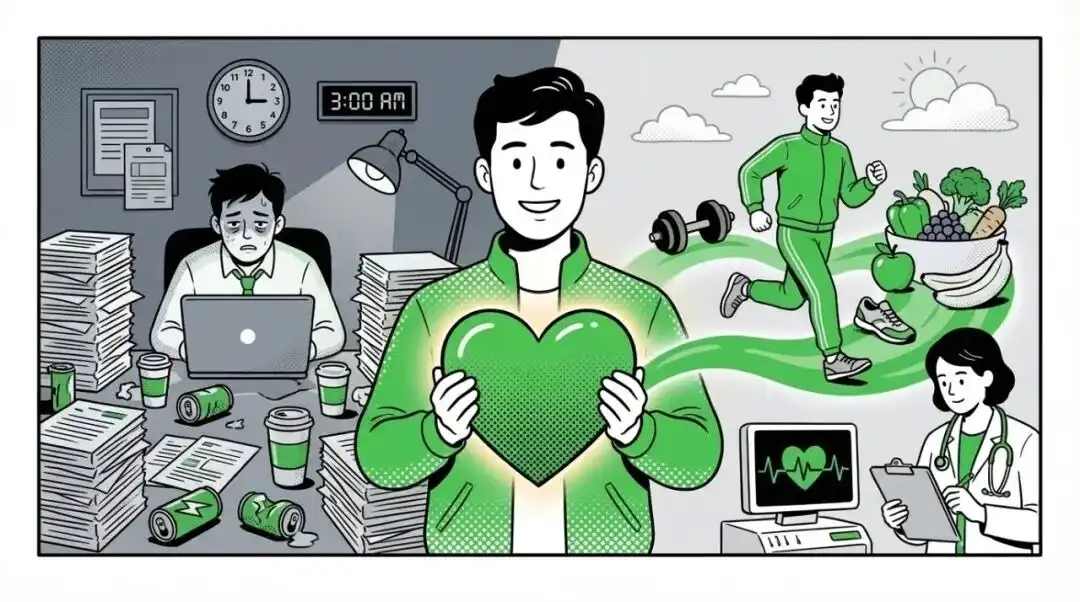
Why Entrepreneurs?
Data shows that there are about 1 million new cases of myocardial infarction in China each year, with the proportion of cases under 50 years old continuously rising. Entrepreneurs are one of the highest-risk groups due to long-term high pressure, sleep deprivation, overwork, and other reasons. Therefore, we have compiled an action guide for entrepreneurs on heart health: from risk identification, self-assessment through check-ups, daily prevention, to emergency response, hoping to provide some help to those who are entrepreneuring.
1. Chronic High Stress: Cortisol Is Quietly Damaging Your Blood Vessels
Stress is not just emotional exhaustion. Sustained psychological stress leads to chronically high cortisol levels in the body, and cortisol directly damages the inner walls of blood vessels, accelerating the process of atherosclerosis—one of the core pathological mechanisms of heart disease. The pressure entrepreneurs face is持续的高压 that is hard for ordinary people to match: funding pressure, market pressure, team pressure... These pressures don't disappear because of a good pitch or impressive data; they are structural and long-term.
2. Sleep Deprivation: Less Sleep, More Burden on the Heart
Sleeping less than 6 hours a day leads to持续升高 blood pressure, increasing the risk to the heart and brain, and significantly raising the risk of death. Research also points out that working more than 13 hours a day is a critical line that requires special vigilance.
3. Overwork: Not a Metaphor, but a Medical Diagnosis
"Death from overwork" sounds like a sociological concept, but its real killer is heart disease. People with vascular lesions or coronary heart disease, under持续高压 and excessive fatigue, can experience a sharp rise in blood pressure in a short time,中断心脏供血, leading to sudden death.
4. Traditional Risk Factors: Amplified in Entrepreneurs
Smoking, high blood pressure, high cholesterol, diabetes—the Framingham Heart Study, over decades, systematically confirmed that these four factors are the core triggers of heart disease. Among entrepreneurs, these factors are often长期忽视 due to "too busy to care," and by the time they are discovered, it's often not just a single issue.
How Is Your Heart Doing Now?
When was the last time many people had a check-up? Two years ago? Three years ago? Or simply can't remember? Busy is the most common excuse. But the heart doesn't pause its changes because you're busy.
Check-ups: These Items Must Be Checked
Health check-up packages are varied; which ones really matter for the heart? Below is a core list summarized by multiple professional institutions, with reference values.
■ Basic Blood Indicators
• Blood lipids (Total cholesterol, LDL-C, HDL-C, Triglycerides): LDL-C is the most critical item—coronary heart disease patients need to keep it <1.8mmol/L; if acute myocardial infarction has occurred more than twice in a year, or accompanied by habits like hypertension, diabetes, smoking, it needs to be further reduced to <1.4mmol/L.
• Blood sugar (Fasting blood glucose + Glycated hemoglobin HbA1c): HbA1c reflects the average blood sugar level over the past 2–3 months; diabetic patients need to keep it <7%, fasting blood glucose between 4.4-7mmol/L.
• Blood pressure: Target value <140/90mmHg; for those with diabetes or kidney disease, stricter control is needed, at <130/80mmHg.
■ Heart Structure
• Electrocardiogram (常规 + Holter): One thing must be known—a normal ECG does not mean there are no coronary artery lesions. Atherosclerosis cannot be seen on an ECG; a Holter can record continuously for 24 hours, capturing occasional rhythm abnormalities.
• Echocardiogram: Evaluates the structure and function of the heart; this is the next step when abnormalities are found on a regular ECG.
■ Body Shape Indicators
• BMI: Keep between 18.5–23.9kg/m2; waist circumference male <90cm, female <85cm. Abdominal obesity often poses a more direct threat to the heart than weight itself.
■ The Most Important Indicator Worth Highlighting: Troponin
The BMJ (British Medical Journal) once published a big data study involving over 250,000 patients, finding that a slight elevation in troponin—even without acute heart disease symptoms—increased the risk of death by over 10 times in people aged 18–29 compared to normal individuals. This indicator was traditionally only tested in emergencies to confirm myocardial infarction, but new research shows it also has significant value for early risk screening.
If you have a family history of heart disease, long-term high stress, or have found other abnormal indicators in check-ups, you can proactively ask your doctor to test troponin. Those with a family history or existing abnormalities can further consult their doctor to see if additional tests like coronary CT/angiography, cardiac MRI, or cardiac electrophysiology studies are needed.
Self-Assessment: Daily Risk Identification
Check-ups are annual "snapshots," but the heart operates in real-time. Below are some self-monitoring methods suggested by the American Heart Association that can be done daily.
■ Smartwatch:
The Lowest Barrier Heart Rate Monitoring Tool
Smartwatches that support heart rate monitoring can continuously record resting and exercise heart rates, alerting you when heart rate deviates from the normal range. For entrepreneurs, this is the lowest barrier tool to感知心脏状态. Some new devices already support blood oxygen monitoring and arrhythmia alerts—if the device gives an abnormal alert, don't ignore it; get a formal ECG confirmation.
■ Blood Pressure Monitor:
Should Have One at Home
It is recommended to regularly measure resting pulse and blood pressure to monitor heart health. Blood pressure monitors are inexpensive and easy to use; measure once after waking up in the morning, and the numbers will directly tell you your state today.
■ Self-Check List:
Don't Ignore These Signals
The following symptoms, any one of them is worth serious attention, especially for men over 35:
• Unexplained dizziness, blackouts, especially after physical activity;
• Chest tightness, unexplained cold sweats, lasting more than a few minutes, not significantly relieved by rest;
• Shortness of breath, getting winded more easily than before doing the same things;
• Palpitations, feeling irregular heartbeat or sudden acceleration.
Or you can conduct the following self-assessment:
• Do you sleep less than 7 hours a day?
• Do you feel "anxious or highly tense" more than 3 days a week?
• Do you sit for long periods (continuously over 90 minutes) without leaving your chair?
• Have you used "no time" as an excuse to not exercise for over 2 weeks straight?
• Do you rely on caffeine, energy drinks to maintain work状态?
• Have you gone over 3 months without completely "emptying" and resting?
• Do you feel持续疲劳, but even休息 doesn't restore you?
If you answer "yes" to more than 3 items, your cardiovascular risk is significantly higher than normal levels.
What Can You Do Daily to Truly Protect Your Heart?
Knowing the risks and which indicators to check—this is the awareness level. But awareness cannot replace action. This part is about: what can entrepreneurs concretely do in their daily lives. Start with cognition, because there are several misconceptions that, if not debunked first, the following habit suggestions might be "selectively filtered" out by your brain.
Misconception 1:
"I exercise regularly, so I'm safer"
Exercise is not wrong, but exercise is not a talisman. Instead, excessive exercise intensity itself is a risk factor. More serious exercise complications, including myocardial infarction and sudden cardiac death, increase in risk with the intensity, frequency, and duration of exercise. Additionally, sudden cardiac death is hard to predict—a significant portion of cardiac arrests occur precisely in so-called "low-risk populations."
Exercise is an important way to protect the heart, but the premise is moderation, aerobic, and gradual progression. High-intensity anaerobic exercise can be the last straw for a heart with potential vascular issues.
Misconception 2:
"I'm still young, these things are far from me"
According to recent statistics from the Chinese Journal of Cardiology, China has over a million new cases of myocardial infarction each year, with the proportion of cases under 50 years old持续攀升. "Youth" is becoming a false sense of security. Heart damage is a long-term process;隐患埋下 in your 30s can发作 in your early 40s.
Misconception 3:
"There will be obvious feelings before a heart attack"
Not necessarily. Sudden cardiac death has almost no warning; even for heart attacks, a significant proportion present with atypical symptoms—elderly people might just feel fatigued and dizzy, diabetics might even be completely asymptomatic, medically termed "silent myocardial infarction." Relying on "feeling" to judge your safety is a dangerous bet.
Then, turn these things into habits.
■ Exercise:
150 minutes of aerobic exercise per week
The recommendation from many cardiovascular专业指南 is: at least 150 minutes of moderate-intensity aerobic exercise per week—brisk walking, jogging, swimming, cycling all count, increasing gradually. There is a red line to remember: heart disease patients should尽量避免高强度无氧运动 (sprinting, heavy weight lifting, high-intensity interval training, etc.). For those not yet diagnosed but with multiple risk factors, it's best to do an exercise stress test before high-intensity exercise.
■ Diet:
The Two Most Worthwhile Things to Do
No need to turn diet into an engineering project. There are two things that are very effective if done:
• Control salt: Daily salt intake <5g (about one beer bottle cap). High salt is the most direct driver of high blood pressure, which is one of the core risk factors for heart disease.
• Increase dietary fiber: Daily target above 25g—vegetables (300-500g/day), fruits (200-350g/day), whole grains (50-150g/day) are all sources. Most people's actual intake is far below this standard.
■ Sleep:
6 hours is the bottom line, not the goal
Sleeping less than 6 hours a day leads to持续升高 blood pressure, significantly increasing the burden on the heart. "6 hours" is the safety bottom line, not a number to be proud of. If it's really hard to guarantee sleep duration, at least guarantee sleep quality:固定入睡 and wake-up times, put down the phone 1 hour before bed.
The above three—exercise, diet, sleep—essentially do the same thing: reduce the body's long-term chronic inflammation burden, reduce the持续损耗 of the cardiovascular system. Doing any one of them is adding life to the heart.
■ Quit smoking and limit alcohol:
Harder than imagined, but worth adhering to
Tobacco's damage to the cardiovascular system is direct and持续, secondhand smoke同样. As for the upper limit of alcohol consumption: male daily alcohol intake ≤25g, female ≤15g. In business场合, "drinking a little less" is often harder than imagined—but this is a line worth坚守.
■ Regular check-ups, keep a first aid kit at home
An annual comprehensive heart-related check-up is the lowest-cost risk management. Additionally, it is recommended to always have the following items at home and ensure family members also know where they are and how to use them: Nitroglycerin (sublingual for acute angina发作), Aspirin (chew in case of suspected heart attack, note contraindicated for those with allergy history or gastrointestinal bleeding history), blood pressure monitor.
One last thing: Know where the nearest AED is. Many people think AEDs are only at airports and subway stations, but they are actually distributed in shopping malls, office buildings, community service centers. Knowing the location in advance, every second saved in a critical moment is life-saving time.
What If It Really Happens Suddenly?
Earlier we talked about prevention. But the reality is: even after doing everything right, sudden situations can still occur. So, when that moment comes, what can be done?
■ First, identify:
When these symptoms appear, immediately go on alert
• Pressing,闷胀性 pain behind the sternum or in the precordial area, lasting more than 30 minutes, not relieved by rest, not completely eliminated by sublingual nitroglycerin;
• Pain can "radiate" to the left shoulder, left arm, neck, jaw, back; some people present with upper abdominal pain, easily mistaken for stomach issues or indigestion;
• Accompanied by: profuse sweating (cold sweat), pale complexion, cold and clammy limbs, difficulty breathing, nausea and vomiting.
Remember one principle: Better to misjudge than to miss. Once any of the above appears, do not wait and see, immediately initiate emergency procedures.
■ Four Steps of First Aid:
Every step is crucial
Step 1: Immediately call 120, do not wait, do not drive yourself.
Many people's first reaction is "wait a bit longer" or "take a taxi to the hospital." Both choices can be fatal.
The 120 ambulance has equipment and medical staff who can begin treatment on the way. Going on your own means giving up the most critical medical intervention opportunity during this time.
When calling 120, say three things clearly: precise location (down to the house number or specific floor), symptom description (how many minutes the chest pain has lasted), past medical history (any heart disease history, what medications are being taken).
Step 2: Lie flat on the spot, loosen the collar, keep the airway clear.
Make the patient stop all activities immediately, lie flat on the spot, do not stand, do not walk. Unbutton the collar, loosen the belt, keep breathing smooth.
If carrying nitroglycerin, can sublingually含服 1 tablet (0.5mg), can repeat every 5 minutes, up to 3 times.
Additionally, pay attention to contraindications for nitroglycerin: blood pressure below 90/60mmHg, heart rate below 50 beats/min, history of glaucoma, prohibit use.
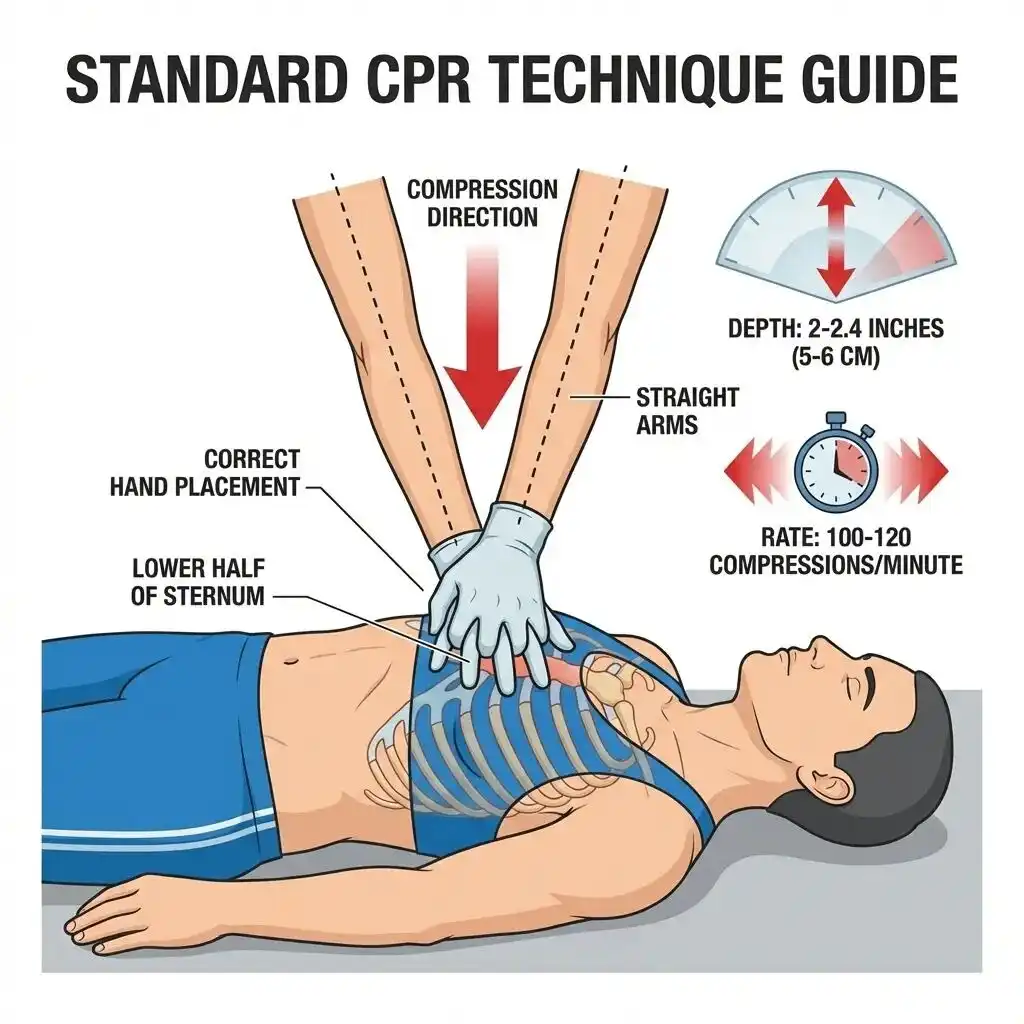
Step 3: If the patient loses consciousness—immediately begin CPR.
Unconscious + no normal breathing (or only agonal gasps) + no carotid pulse—if these three occur simultaneously, need to immediately begin cardiopulmonary resuscitation on the patient.
• Position: Hands stacked, heel of palm on the midpoint of the line between nipples;
• Force: Press vertically down 5–6cm, after each press completely relax, let the chest naturally recoil;
• Frequency: 100–120 times/minute, press and relax time roughly equal;
• Artificial respiration: After 30 compressions, give 2人工呼吸. Those who can't do artificial respiration, doing only chest compressions is also effective, don't stop because you can't do artificial respiration.
CPR's role is to maintain basic blood circulation, buy time for defibrillation—keep doing it until急救人员 arrive.
Step 4: Find an AED, turn it on and operate.
AED (Automated External Defibrillator) is a device that can be operated by ordinary people, the machine will voice guide each step. Operation process: Turn on → attach the two electrode pads as prompted → AED automatically analyzes rhythm → defibrillate as prompted → immediately continue CPR until急救人员 take over.
Final Words
There is only one heart. There are about 2-3 billion心肌细胞, a severe heart attack can permanently lose about 1 billion—they do not regenerate.
Maybe many entrepreneurs occasionally bet in uncertainty and use透支 to exchange for speed. But your own heart is not a bet, health cannot be透支. Develop the habit of check-ups, go to bed early—this is also the most important long-term investment you can make for your company.







