Small-Cap Tokens Hit Four-Year Low, Is the 'Altcoin Bull Run' Completely Hopeless?

marsbitDipublikasikan tanggal 2025-12-16Terakhir diperbarui pada 2025-12-16

Abstrak

Small-cap cryptocurrency tokens have plummeted to multi-year lows, with indices tracking altcoins significantly underperforming both major cryptocurrencies and traditional equities. In 2024–2025, while the S&P 500 and Nasdaq 100 delivered strong double-digit returns with limited drawdowns, altcoin indices like the CoinDesk 80 and MarketVector Small-Cap Index fell sharply—by nearly 40% and to November 2020 lows, respectively. These altcoin indices showed high correlation (0.9) with large-cap crypto assets like Bitcoin and Ethereum but delivered deeply negative returns, higher volatility, and worse risk-adjusted performance (negative Sharpe ratios). Liquidity is increasingly concentrated in high-value, institutionally supported assets such as Bitcoin, Ethereum, SOL, and XRP, indicating a structural shift away from speculative small-cap tokens. The data suggests that altcoins offered no diversification benefits and instead magnified losses during a period of broader market growth.

Author: Gino Matos

Compiled by: Luffy, Foresight News

Since January 2024, the performance comparison between cryptocurrencies and stocks indicates that the so-called new "altcoin trading" is essentially just a substitute for stock trading.

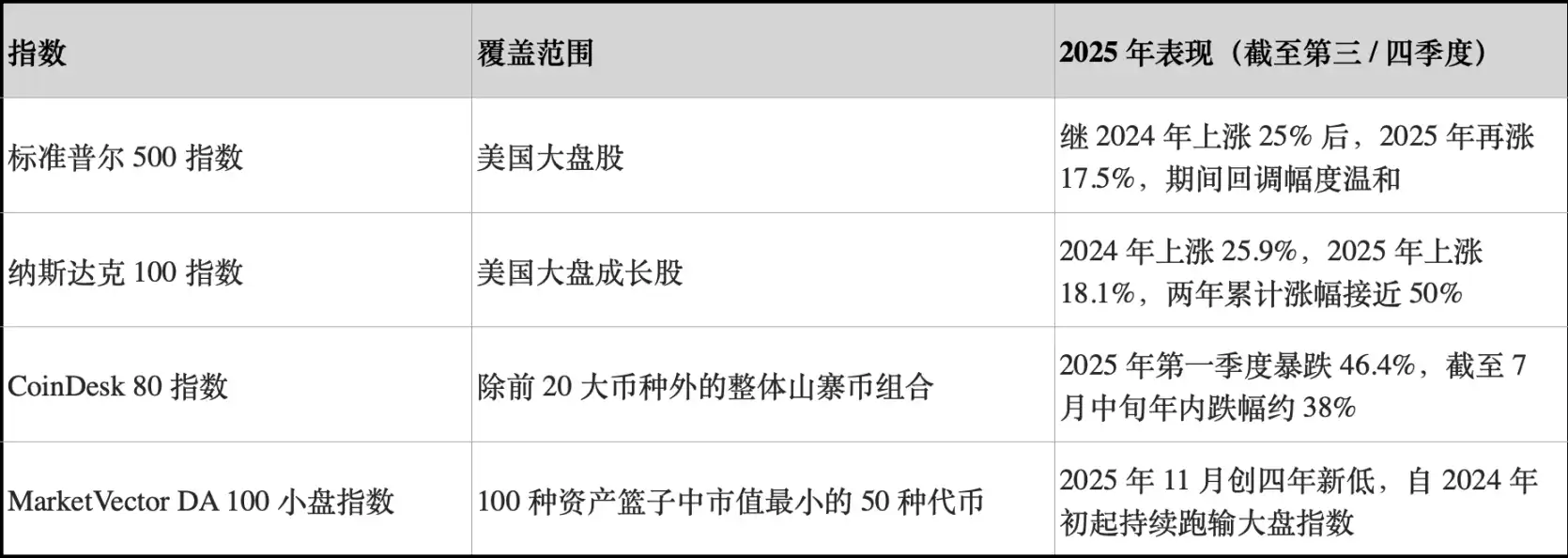
In 2024, the S&P 500 index had a return of approximately 25%, and in 2025 it reached 17.5%, with a cumulative two-year increase of about 47%. During the same period, the Nasdaq 100 index rose by 25.9% and 18.1% respectively, with a cumulative increase of nearly 49%.

The CoinDesk 80 Index, which tracks 80 assets outside the top 20 cryptocurrencies by market capitalization, plummeted 46.4% in the first quarter of 2025 alone, and by mid-July, its year-to-date decline was about 38%.

By the end of 2025, the MarketVector Digital Assets 100 Small-Cap Index fell to its lowest level since November 2020, wiping out over $1 trillion in total cryptocurrency market capitalization.

This divergence in performance is by no means a statistical error. Not only did the overall altcoin portfolio have a negative return, but its volatility was comparable to or even higher than that of stocks; in contrast, major U.S. stock indices achieved double-digit growth with controllable drawdowns.

For Bitcoin investors, the core question is: Can allocating to small-cap tokens deliver risk-adjusted returns? Or is such an allocation merely taking on exposure to a negative Sharpe ratio while maintaining similar correlations to stocks? (Note: The Sharpe ratio is a core metric for measuring the risk-adjusted return of an investment portfolio. Its calculation formula is: Annualized portfolio return - Annualized risk-free rate / Annualized volatility of the portfolio.)

Choosing a Reliable Altcoin Index

For analysis, CryptoSlate tracked three altcoin indices.

The first is the CoinDesk 80 Index, launched in January 2025. This index covers 80 assets outside the CoinDesk 20 Index, providing a portfolio of diversified assets beyond Bitcoin, Ethereum, and other major tokens.

The second is the MarketVector Digital Assets 100 Small-Cap Index. This index selects the 50 smallest tokens by market cap from a basket of 100 assets, serving as a barometer for the market's "junk assets."

The third is a small-cap index launched by Kaiko. This is a research product, not a tradable benchmark, offering a clear sell-side quantitative perspective for analyzing the small-cap asset group.

These three depict the market landscape from different dimensions: the overall altcoin portfolio, high-beta small-cap tokens, and a quantitative research perspective. Yet, the conclusions they point to are highly consistent.

In contrast, the benchmark performance of the stock market shows a completely opposite trend.

In 2024, major U.S. indices achieved gains of around 25%, and in 2025, they also saw double-digit increases, with relatively limited drawdowns during the period. During this time, the maximum intra-year drawdown of the S&P 500 index was only in the mid-to-high single digits, while the Nasdaq 100 index maintained a strong upward trend throughout.

Both major indices achieved compounded annual growth without significant givebacks of gains.

The trend of the overall altcoin indices, however, is vastly different. Reports from CoinDesk Indices show that the CoinDesk 80 Index plummeted 46.4% in the first quarter alone, while the large-cap tracking CoinDesk 20 Index fell 23.2% during the same period.

By mid-July 2025, the CoinDesk 80 Index was down 38% year-to-date, whereas the CoinDesk 5 Index, which tracks Bitcoin, Ethereum, and three other major tokens, achieved a gain of 12% to 13% during the same period.

Andrew Baehr of CoinDesk Indices, in an interview with ETF.com, described this phenomenon as "identical correlation, vastly different profit and loss performance."

The correlation between the CoinDesk 5 Index and the CoinDesk 80 Index is as high as 0.9, meaning their price movements are completely aligned in direction, but the former achieved a slight double-digit growth while the latter plunged nearly 40%.

It turns out that the diversification benefits of holding small-cap altcoins are minimal, while the performance cost is extremely heavy.

The performance of the small-cap asset sector is even worse. According to Bloomberg, by November 2025, the MarketVector Digital Assets 100 Small-Cap Index had fallen to its lowest level since November 2020.

Over the past five years, the return of this small-cap index has been approximately -8%, while the corresponding large-cap index has surged about 380%. Institutional funds clearly favor large-cap assets and avoid tail risks.

Looking at the performance of altcoins in 2024, the Kaiko small-cap index fell over 30% for the year, and mid-cap tokens also struggled to keep up with Bitcoin's gains.

Market winners were highly concentrated in a few top tokens, such as SOL and Ripple. Although the share of altcoin trading volume once rebounded to the 2021 high in 2024, 64% of the trading volume was concentrated in the top ten altcoins.

Liquidity in the cryptocurrency market has not disappeared but has shifted towards higher-value assets.

Sharpe Ratio and Drawdown Magnitude

If compared from the perspective of risk-adjusted returns, the gap widens further. The CoinDesk 80 Index and various small-cap altcoin indices not only have returns deep in negative territory but also have volatility comparable to or even higher than stocks.

The CoinDesk 80 Index plummeted 46.4% in a single quarter; the MarketVector small-cap index fell to pandemic-era lows in November after another round of declines.

The overall altcoin index experienced multiple index-level halving drawdowns: the Kaiko small-cap index fell over 30% in 2024, the CoinDesk 80 Index crashed 46% in Q1 2025, and the small-cap index fell again to 2020 lows by the end of 2025.

In contrast, the S&P 500 and Nasdaq 100 indices achieved cumulative returns of 25% and 17% over two years, with maximum drawdowns only in the mid-to-high single digits. The U.S. stock market had fluctuations, but they were overall controllable; the volatility of cryptocurrency indices, however, was highly destructive.

Even if the high volatility of altcoins is considered a structural feature, their unit risk return from 2024 to 2025 was still far lower than that of holding major U.S. stock indices.

From 2024 to 2025, the overall altcoin index had a negative Sharpe ratio; meanwhile, the S&P and Nasdaq indices had strong Sharpe ratios even without volatility adjustment. After volatility adjustment, the gap between them further widened.
Bitcoin Investors and Cryptocurrency Liquidity

The first insight from the above data is the trend of liquidity concentration and migration towards high-value assets. Reports from Bloomberg and Whalebook on the MarketVector small-cap index both pointed out that since early 2024, small-cap altcoins have consistently underperformed, and institutional funds have instead flowed into Bitcoin and Ethereum ETFs.

Combined with Kaiko's observations, although the share of altcoin trading volume rebounded to 2021 levels, funds were concentrated in the top ten altcoins. The market trend is already clear: liquidity has not completely left the cryptocurrency market but has shifted towards higher-value assets.

The previous altcoin bull market was essentially just a basis trade strategy, not a structural outperformance of assets. In December 2024, the CryptoRank Altcoin Bull Index once soared to 88 points, then plummeted to 16 points in April 2025, completely giving back all gains.

The 2024 altcoin bull market ultimately turned into a typical bubble burst; by mid-2025, the overall altcoin portfolio had almost given back all its gains, while the S&P and Nasdaq indices continued to compound growth.

For wealth advisors and asset allocators considering diversification beyond Bitcoin and Ethereum, the data from CoinDesk provides a clear case reference.

As of mid-July 2025, the large-cap tracking CoinDesk 5 Index achieved a slight double-digit growth year-to-date, while the diversified altcoin index CoinDesk 80 plummeted nearly 40%, yet their correlation was as high as 0.9.

Investors allocating to small-cap altcoins did not obtain substantial diversification benefits but instead suffered far higher return losses and drawdown risks compared to Bitcoin, Ethereum, and U.S. stocks, while still being exposed to the same macro drivers.

Current capital views most altcoins as tactical trading targets, not strategic allocation assets. From 2024 to 2025, Bitcoin and Ethereum spot ETFs had significantly better risk-adjusted returns, and U.S. stocks also performed brilliantly.

Liquidity in the altcoin market is increasingly concentrating towards a few "institutional-grade coins," such as SOL, Ripple, and other tokens with independent positive factors or clear regulatory prospects. Asset diversity at the index level is being squeezed by the market.
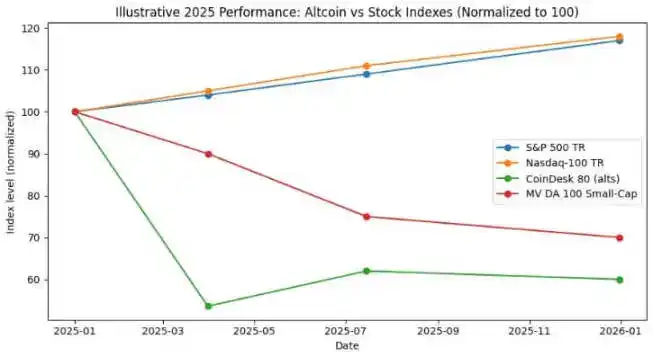
In 2025, the S&P 500 and Nasdaq 100 indices rose about 17%, while the CoinDesk 80 cryptocurrency index fell 40%, and small-cap cryptocurrencies fell 30%

What Does This Mean for Liquidity in the Next Market Cycle?

The market performance from 2024 to 2025 tested whether altcoins could achieve diversification value or outperform in an environment of rising macro risk appetite. During this period, U.S. stocks achieved double-digit growth for two consecutive years with controllable drawdowns.

Bitcoin and Ethereum gained institutional recognition through spot ETFs and benefited from a moderating regulatory environment.

In contrast, the overall altcoin index not only had negative returns and larger drawdowns but also maintained high correlations with major crypto tokens and stocks, yet failed to provide corresponding compensation for the additional risks investors undertook.

Institutional capital always chases performance. The five-year return of the MarketVector small-cap index is -8%, while the corresponding large-cap index surged 380%. This gap reflects the migration of capital towards assets with clear regulation, sufficient derivatives market liquidity, and well-developed custody infrastructure.

The CoinDesk 80 Index's 46% plunge in the first quarter and its 38% year-to-date decline by mid-July indicate that the trend of capital migration towards high-value assets is not reversing but accelerating.

For Bitcoin and Ethereum investors evaluating whether to allocate to small-cap crypto tokens, the data from 2024 to 2025 provides a clear answer: the absolute returns of the overall altcoin portfolio underperformed U.S. stocks, and the risk-adjusted returns were inferior to Bitcoin and Ethereum; despite a correlation as high as 0.9 with major crypto tokens, it provided no diversification value.


Pertanyaan Terkait

QWhat was the performance difference between the S&P 500 and the CoinDesk 80 Index in 2025?

AIn 2025, the S&P 500 index rose by approximately 17.5%, while the CoinDesk 80 Index plummeted by 40%.

QAccording to the article, what is the main reason for the poor performance of small-cap altcoins?

AThe main reason is that institutional capital is migrating towards high-value assets like Bitcoin and Ethereum ETFs, which are seen as having clearer regulatory prospects and better infrastructure, leaving small-cap altcoins with negative returns and high volatility.

QWhat was the correlation between the CoinDesk 5 Index and the CoinDesk 80 Index, and what does this imply?

AThe correlation between the CoinDesk 5 Index and the CoinDesk 80 Index was as high as 0.9. This implies that their price directions moved almost identically, yet the performance was drastically different, with the former achieving double-digit gains while the latter fell nearly 40%, offering no meaningful diversification benefit.

QTo what level did the MarketVector Digital Assets 100 Small-Cap Index fall by the end of 2025?

ABy the end of 2025, the MarketVector Digital Assets 100 Small-Cap Index fell to its lowest level since November 2020.

QWhat does the article conclude about allocating to small-cap tokens for Bitcoin investors?

AThe article concludes that allocating to small-cap tokens did not provide a risk-adjusted return benefit. Instead, it resulted in significantly worse returns and higher drawdown risks compared to holding Bitcoin, Ethereum, or U.S. stocks, while still being exposed to the same macroeconomic factors.

Bacaan Terkait

Perhatian Wajib Pekan Depan|Undang-Undang CLARITY Diperkirakan Akan Masuk ke Pemungutan Suara Senat; SpaceX dan Circle Umumkan Laporan Keuangan (3-9 Agustus)

**Ringkasan Acara Penting Pekan Depan (3-9 Agustus)** Pekan depan diwarnai sejumlah pengumuman keuangan penting dan perkembangan regulasi kripto di AS. **Laporan Keuangan & Acara Perusahaan:** * **SpaceX** akan merilis laporan keuangan Q2 2026 pada 4 Agustus, diikuti gelombang pencairan saham internal pertama (hingga 12%) pada 6 Agustus. * **Circle** (penerbit USDC) dan **Hut 8** (penambang Bitcoin) masing-masing akan mengumumkan laporan kuartalan pada 5 Agustus dan 4 Agustus. * **American Bitcoin (ABTC)**, perusahaan tambang kripto yang dikaitkan dengan keluarga Trump, merilis laporan Q2 pada 3 Agustus. * Perusahaan robotika **宇树科技 (Unitree Robotics)** akan melakukan penawaran saham perdana (IPO) di pasar STAR China, dengan hari penentuan harga awal pada 5 Agustus. **Regulasi Kripto AS:** * **CLARITY Act**, undang-undang kerangka kerja federal untuk aset kripto, berpeluang dilakukan pemungutan suara penuh di Senat AS minggu ini. Para negosiator harus merampungkan aturan tentang konflik kepentingan sebelum masa reses 7 Agustus. RUU ini memerlukan 60 suara untuk disetujui. **Pengumuman Data & Teknologi:** * **Laporan Non-Farm AS** untuk Juli akan dirilis pada 7 Agustus, menjadi fokus pasar. * **Grok AI** versi 4.6 (dengan 1,5 triliun parameter) diperkirakan diluncurkan sekitar 7 Agustus, diikuti versi 4.7 yang lebih kuat beberapa minggu setelahnya. * **XRP Ledger** versi 3.3.0 dengan lima fitur baru, termasuk transaksi batch, dijadwalkan rilis minggu depan. **Penutupan & Perubahan Layanan:** * Beberapa layanan kripto akan berhenti beroperasi: **Zapper** (pelacak portofolio DeFi) dan **Ctrl Wallet** pada 3 Agustus, serta **LayerZero** akan menghentikan relayernya untuk v1 pada tanggal yang sama. Bursa Korea **Upbit** akan menghapus perdagangan pasangan **AQT** dan **AERGO** pada 3 Agustus. **Acara Lainnya:** * **BIP-110**, sebuah proposal peningkatan jaringan Bitcoin, akan memulai fase pengiriman sinyal wajib sekitar 8 Agustus.

marsbit3m yang lalu

Perhatian Wajib Pekan Depan|Undang-Undang CLARITY Diperkirakan Akan Masuk ke Pemungutan Suara Senat; SpaceX dan Circle Umumkan Laporan Keuangan (3-9 Agustus)

marsbit3m yang lalu

Saham Jatuh Lebih Parah daripada Kripto, Ke Mana Uangnya Pergi?

Penulis: Cathy,白话区块链 Pada 28 dan 29 Juli di Seoul, indeks Kospi memicu *circuit breaker* dua hari berturut-turut, suatu peristiwa yang belum pernah terjadi dalam sejarah pasar saham Korea. Saham-saham semikonduktor global, termasuk SK Hynix yang turun sekitar 23% dalam dua hari, mengalami penurunan drastis. Penarikan dana (pullback) Kospi pada Juli mencapai 40% dari titik tertinggi Juni, menjadikannya bulan terburuk yang tercatat. Produk leverage seperti ETF 2x Long SK Hynix bahkan anjlok hingga 83%, menghapus lebih dari 1 triliun HKD dalam nilai pasar. Ironisnya, Bitcoin justru naik hampir 15% dari titik terendah Juli, menunjukkan perilaku yang tidak biasa: **saham yang jatuh seperti aset kripto, sementara Bitcoin relatif stabil.** Penurunan ini bukan kepanikan pasar luas, melainkan "peledakan tertarget" terhadap perdagangan yang paling ramai (*crowded trades*), dipicu oleh laporan keuangan SK Hynix yang meski mencetak rekor laba tetapi di bawah perkiraan, serta IPO besar-besaran ChangXin Memory (CXMT) dari China. Ditambah dengan potensi likuidasi posisi *carry trade* Yen Jepang yang masif, pasar mengalami de-leverage paksa. Lalu, apakah uang yang keluar dari saham mengalir ke Bitcoin? Jawabannya tidak. Bitcoin tampak "tahan jatuh" karena sudah mengalami koreksi lebih dulu—jatuh sekitar 21% selama periode arus keluar ETF berkelanjutan pada Mei-Juni. Uang yang mencari perlindungan justru mengalir ke emas, yang harganya naik lebih dari 20% secara tahunan. Koefisien korelasi Bitcoin dengan emas mencapai -0.88, mengindikasikan bahwa institusi kini memandangnya sebagai aset yang berbeda: **emas untuk perlindungan, Bitcoin untuk potensi pertumbuhan.** Agar aliran dana besar-besaran benar-benar masuk ke Bitcoin, diperlukan tiga kondisi: tekanan likuidasi global mereda, The Fed menurunkan suku bunga tanpa memicu resesi, dan disahkannya RUU CLARITY di AS untuk memberikan kejelasan regulasi. Meski RUU tersebut tertunda di Senat, arahnya sudah jelas. **Harga saham teknologi ditentukan oleh pengeluaran modal AI dan laba perusahaan, sedangkan harga Bitcoin ditentukan oleh likuiditas global.** Ketidakselarasan ini justru menciptakan daya tarik bagi institusi yang ingin mendiversifikasi portofolio mereka. Kesimpulannya, Bitcoin saat ini bukan tempat perlindungan (*safe haven*), melainkan aset yang sudah terkoreksi lebih dulu dan sudah berada di posisi yang siap. **Dana belum datang, tetapi posisinya sudah dipersiapkan.** Ketika badai berlalu dan modal global mencari tempat baru untuk dialokasikan, Bitcoin berada di urutan terdepan dalam antrian.

marsbit3m yang lalu

Saham Jatuh Lebih Parah daripada Kripto, Ke Mana Uangnya Pergi?

marsbit3m yang lalu

Dialog dengan Ray Dalio: Saat Ini Berada dalam Gelembung AI, 1% Portofolio Investasi Adalah Bitcoin

Sumber: The Diary Of A CEO Ray Dalio, pendiri Bridgewater Associates yang meramalkan krisis keuangan 2008, memperingatkan bahwa ledakan AI saat ini menunjukkan tanda-tanda klasik gelembung ekonomi yang dapat pecah dan memicu resesi. Dalam wawancara podcast, dia menjelaskan dinamika "siklus besar" yang didorong oleh ketimpangan kekayaan, defisit pemerintah, dan perubahan geopolitik. Dalio mengidentifikasi pola di mana antusiasme berlebihan terhadap teknologi revolusioner baru, seperti AI, menyebabkan harga aset melambung dan pinjaman berlebihan. Ketika kondisi berubah (seperti kenaikan suku bunga atau kebutuhan tunai), gelembung ini dapat pecah, menyebabkan penurunan harga aset, kerugian luas, dan kontraksi ekonomi. Untuk melindungi kekayaan di masa ketidakpastian, Dalio sangat menekankan pentingnya **diversifikasi portofolio**—termasuk saham, obligasi, emas, dan real estat—daripada mengandalkan uang tunai saja. Dia mengungkapkan bahwa sekitar **1% portofolionya adalah Bitcoin**, yang diakuinya sebagai aset keras, tetapi dia lebih menyukai **emas fisik** karena sejarahnya sebagai penyimpan nilai dan aset bebas liabilitas. Mengenai dampak AI, Dalio percaya bahwa teknologi ini akan menggantikan tidak hanya tenaga fisik tetapi juga kemampuan kognitif manusia, berpotensi memperlebar kesenjangan antara pemilik modal dan pekerja. Masa depan akan menguntungkan mereka yang dapat memadukan kecerdasan manusia (seperti emosi dan intuisi) dengan kemitraan AI. Secara geopolitik, Dalio menggambarkan dunia yang memasuki fase "penurunan" dalam tatanan global, dengan Amerika Serikat menghadapi tantangan internal dan eksternal, termasuk konflik seperti di Iran yang mengungkap kelemahannya. Dia memprediksi dunia mungkin menjadi lebih terregionalisasi di masa depan. Secara keseluruhan, kunci untuk navigasi melalui periode kompleks ini adalah pemahaman akan pola sejarah, adaptasi, dan diversifikasi yang cermat.

marsbit3j yang lalu

Dialog dengan Ray Dalio: Saat Ini Berada dalam Gelembung AI, 1% Portofolio Investasi Adalah Bitcoin

marsbit3j yang lalu

Rekor! Beli Bersih Asing 7,2 Triliun Won dalam Sehari, Wall Street: Tekanan Likuiditas di Pasar Saham Korea Telah Mereda

**Ringkasan: Rekor Pembelian Asing dan Peningkatan Likuiditas di Pasar Saham Korea** Aliran modal asing menunjukkan perubahan signifikan di pasar saham Korea (KOSPI). Pada 31 Juli, investor asing melakukan pembelian bersih rekor sebesar 7,2 triliun Won Korea dalam sehari, menandai pembalikan dari tren penjualan bersih besar-besaran dalam beberapa bulan terakhir. Secara bulanan, penjualan bersih asing menyusut drastis menjadi 9,8 triliun Won di Juli, turun dari 48,4 triliun dan 44,5 triliun Won pada Juni dan Mei. Tekanan penjualan dari lembaga domestik juga mereda. Dana pensiun dan reksa dana domestik justru menjadi pembeli bersih 1,0 triliun Won di Juli, setelah dua bulan sebelumnya menjadi penjual bersih. Faktor pendukung lainnya adalah peraturan baru dari Komisi Jasa Keuangan (FSC) yang memberlakukan syarat lebih ketat bagi investor ritel untuk masuk ke ETF leverage saham tunggal, yang langsung mengurangi volume perdagangan instrumen tersebut hingga sekitar 50%. Kebijakan ini diperkirakan dapat menekan volatilitas pasar. Citigroup mempertahankan target indeks KOSPI di level 10.000 poin, menyoroti memudarnya angin penentu likuiditas. Analis mereka menilai faktor fundamental seperti industri chip memori yang solid, valuasi historis yang rendah, fundamental ekonomi Korea yang kuat, dan dukungan kebijakan berpotensi menjadi pendorong bagi pasar.

marsbit3j yang lalu

Rekor! Beli Bersih Asing 7,2 Triliun Won dalam Sehari, Wall Street: Tekanan Likuiditas di Pasar Saham Korea Telah Mereda

marsbit3j yang lalu

Pembaruan! AI Generasi Berikut OpenAI Pecahkan 10 Masalah Kelas Medali Fields

**OpenAI Model Astra Pecahkan 10 Masalah Matematika Kelas Fields Medal!** OpenAI mengumumkan terobosan besar dari model internal terbarunya, Astra. Model ini dilaporkan telah membuat kemajuan signifikan dalam **10 masalah matematika yang belum terpecahkan**, dengan biaya komputasi hanya sekitar **$2000**. Hasilnya dipublikasikan dalam makalah setebal 249 halaman. Beberapa pencapaian utama meliputi: 1. **Menyelesaikan masalah "non-sofic group"** yang diajukan Mikhail Gromov tahun 1999, dengan membangun contoh kelompok yang tak hingga dan finitely presented yang bukan sofic. Ini dianggap sebagai kemajuan bersejarah. 2. **Memecahkan batas lama dalam masalah pengepakan bola berdimensi tinggi** (sphere packing), meningkatkan batas yang telah bertahan sejak 1978 untuk dimensi tak hingga. 3. **Menyangkal dugaan "Connes Rigidity"** dengan membangun keluarga tak terhitung dari kelompok berbeda yang menghasilkan aljabar von Neumann yang sama persis. Semua bukti telah diverifikasi menggunakan asisten pembuktian formal Lean 4, memastikan ketepatannya. Para ahli matematika menyebut temuan ini sebagai **momen bersejarah**, setara dengan prestasi penghargaan Fields Medal, dan menandai kemampuan AI untuk melakukan penalaran matematika mendalam di berbagai bidang. OpenAI juga membagikan proses penalaran model, menunjukkan langkah maju yang besar menuju AGI (Artificial General Intelligence).

marsbit5j yang lalu

Pembaruan! AI Generasi Berikut OpenAI Pecahkan 10 Masalah Kelas Medali Fields

marsbit5j yang lalu

Trading

Spot
活动图片




