Source: RootData
From January 30 to February 8, 2026, Web3 asset data platform RootData officially launched the Transparency Bounty Activities for Rounds 3 and 4. This event continued the previous mechanism, focusing on热门 projects recently listed on mainstream exchanges. It invited the community to participate in information verification and supplementation around core financial data such as funding structure, team information, token unlocking, and key timeline milestones.
This event featured two main thematic directions: "In-Depth Look at the Transparency of Binance Listing Projects from the Past Year" and "Reviewing the Transparency of Mainstream Exchange Listing Projects in 2026".
Prior to this, RootData had already consecutively held 2 rounds of transparency bounty activities,持续 focusing on verifying information for the most market-attended trading assets. This round not only continued the previous data co-construction mechanism but also further expanded the review scope, placing the discussion focus on the core industry issue of "the completeness of information for projects listed on exchanges".
Approval Rate Below 30%, Exposing Structural Issues
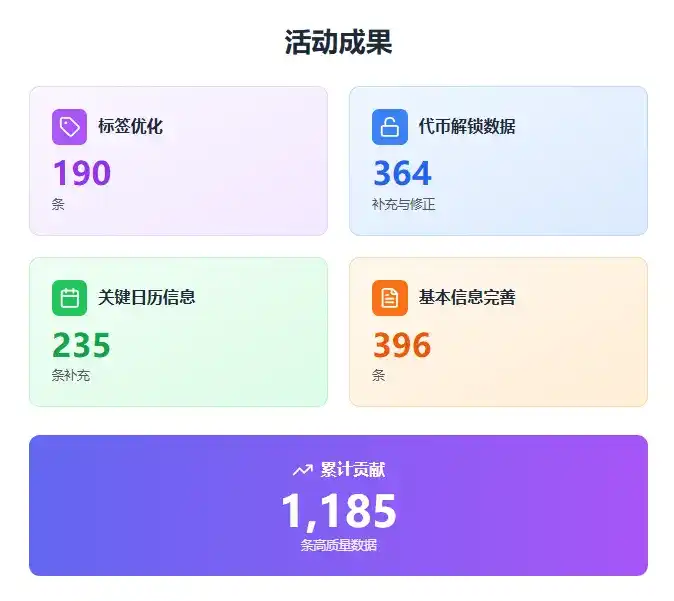
During the 10-day event period, over 160 users participated in submissions. After multiple rounds of review and cross-verification, this event resulted in 190 tag optimizations,364 token unlock data additions and corrections,235 key calendar information additions,and 396 basic information improvements.
The overall average approval rate for this event was less than 30%. This is not due to lack of participation enthusiasm but rather reflects the many objective obstacles in the current disclosure structure of Web3 projects. During the review process, RootData identified the following typical issues:
1、Incomplete Unlock Data Disclosure
Some project official documents only disclose部分 token allocation components, for example, only公开 the schedule for 3 out of 5 allocation categories, making it impossible to accurately record the overall release structure.
2、Official Information Denies or Avoids Historical Documents
After community members submitted original documents,个别 project parties denied their validity or did not provide clear clarification regarding historical version information, leaving the data sources in a gray area.
3、Complex Structure of Inflationary Token Models
Projects using continuous inflation mechanisms, due to their non-linear, non-fixed cycle release methods, make it difficult to standardize the录入 of traditional unlock structures, increasing data processing difficulty.
4、AI-Generated Data Lacks Factual Support
In key calendar data, the review team found multiple instances of疑似 AI-generated content, lacking clear source links or verifiable evidence. In this regard, RootData explicitly advocates: Leverage AI tools to improve efficiency, but must adhere to a rigorous, verifiable data attitude."Reasonable inference" without factual links is not equivalent to valid information.
Cumulative Observations from Bounty Activities: Transparency is a Process, Not a Conclusion
As of now, RootData has held 4 rounds of transparency bounty activities, primarily focusing on热门 exchange assets, conducting持续 scrutiny on the funding structure, team background, and token release mechanisms of the underlying projects.
The cumulative record total reached 719 entries, involving 526 unique projects. Among them, 361 projects appeared once, and 165 projects appeared repeatedly, with a repetition rate of approximately 31.4%.
This data indicates that some projects have been repeatedly submitted and verified at different stages and in different activities, showing the community's持续关注 on their information completeness.
It is worth noting that ,River and Audiera were submitted and repeatedly verified in every round of activities. Their relevant data transparency has significantly improved after multiple rounds of supplementation, becoming typical cases of transparency improvement under the community co-construction mechanism.
Even after multiple rounds of verification, the transparency improvement for some projects remains limited. This phenomenon further confirms that transparency is not something that can be completed with a single supplement but rather a process requiring持续 verification and dynamic updates.
A Sustainable Mechanism for Co-building Data Transparency
In the process of promoting transparency, RootData adheres to the following principles:
1、Transparency Only Does "Fact Disclosure", Not "Value Judgment"
RootData does not make subjective evaluations of project quality, risk level, etc. The platform only presents whether the information is complete, verifiable, and持续 updated.
2、Transparency Has a "Layered" Phenomenon; Cannot View Exchange Listing Transparency with a "One-Size-Fits-All" Approach
Information disclosure has差异性. RootData uses data status labeling and structured entry to allow users to understand the information completeness of different projects, rather than simply labeling them as "good" or "bad".
3、The Executing Body of Transparency Must Be a Third Party
Exchanges and project parties themselves find it difficult to simultaneously play the roles of discloser and evaluator. As an independent data platform, RootData's responsibility is to record, verify, and公开 information status, not to participate in investment decisions.
In summary, Web3, as a highly market-driven financial environment, lacks a unified mandatory disclosure system. In this context, the improvement of transparency indispensably relies on community participation and third-party持续 recording. RootData will continue to advance the transparent infrastructure of the Web3 data ecosystem through public bounties, data disclosure, and community co-construction mechanisms, providing the community with verifiable, traceable information records for the market.