Robinhood vs. Coinbase: The Final Showdown of Financial Super Apps in 2026

比推Dipublikasikan tanggal 2025-12-30Terakhir diperbarui pada 2025-12-30

Abstrak

The article analyzes the escalating competition between Robinhood and Coinbase to become the dominant financial "super app" by 2026. Robinhood is building a traditional, all-in-one platform for managing personal banking, spending, and investing. Its strategy focuses on product aggregation, targeting a younger demographic with its Robinhood Gold subscription (offering a credit card, high-yield cash, and IRA matching). Its revenue is diversified across options, crypto (21%), and net interest income (35%). Coinbase is also building a super app but with a crypto-native approach and a dual strategy. It aims to be a front-end for users' on-chain and off-chain financial lives (with new stock trading, prediction markets, and a DEX aggregator) while simultaneously acting as the essential backend infrastructure for traditional finance (TradFi) institutions. Its "Crypto as a Service" platform, custody for major ETFs, and stablecoin services form a robust B2B revenue stream, with subscription services now making up 41% of its income. While both are encroaching on each other's territories with plans for 24/7 trading and prediction markets, their core visions differ. Robinhood bets on being the primary platform for the great wealth transfer to a younger generation. Coinbase bets on the broader migration of the global economy on-chain, positioning itself as the indispensable infrastructure provider. Both face risks: Robinhood's costly incentives and Coinbase's stagnant user growth. Ulti...

Source: Bankless

Author: David Christopher

Compiled and Edited by: BitpushNews


The debate between Coinbase and Robinhood has been discussed many times by many observers—including us.

But the system update released by Coinbase on December 17th gives us a reason to revisit this topic in depth. The company announced the launch of 24/5 commission-free stock and ETF trading, native prediction market integration via Kalshi, and a decentralized exchange (DEX) aggregator providing instant access to millions of tokens—a clear step towards becoming an "everything app" that can rival the breadth of Robinhood.

These announcements clarify the future Coinbase is building and allow us to compare it more comprehensively with Robinhood. Their competitive goal is now unmistakable: to become the single platform for users to manage their entire financial lives. By mastering users' fund balances, they aim to master user behavior. But the way they are building this "super app" theory reveals two very different philosophies–and 2026 will test which foundation is more solid.

HOOD (Robinhood)

Robinhood is building the financial super app the old-fashioned way—by continuously stacking products until users can manage their entire financial lives on one platform.

In addition to stock, options, and cryptocurrency trading, Robinhood offers its 3.9 million Robinhood Gold subscription users a suite of products that give it functionality comparable to a digital neobank. This subscription service, which grew 77% year-over-year, bundles a 3% cash-back credit card, 3.25% cash interest, and a 3% IRA (Individual Retirement Account) match. Users' salaries, savings, investments, and daily spending are all concentrated in the same interface—a data advantage that traditional brokerages cannot match.

This positioning seems particularly relevant when you consider demographics—75% of Robinhood's 26.9 million funded customers are under the age of 44, a highly mobile-first and "financially conscious" user base. As argued by Omar Kanji of Dragonfly and others, this foundation helps position the company to be a major beneficiary of the expected over $10 trillion wealth transfer over the next decade, as older generations pass assets down to younger ones. These inheritors are likely to consolidate assets into the platforms they use every day—and Robinhood is making itself very suitable for daily use.

Beyond digital banking features, Robinhood's revenue sources are already quite diversified. Options trading remains its "cash cow." Cryptocurrency contributes 21% of total revenue. Net interest income accounts for 35% of revenue. And the prediction market business conducted through Kalshi has reached an annualized revenue of $100 million.

The data supports this:

  • Transaction-based revenue increased 129% year-over-year, primarily driven by cryptocurrency.

  • Q3 net profit reached a record $556 million—a 271% increase year-over-year.

  • Operating expenses have remained flat since September 2022.

COIN (Coinbase)

Coinbase is also building a super app—but with a distinct "crypto-native" flavor and an underlying Layer 2 ambition.

On the front end, Coinbase wants to be the single place for users to manage their on-chain and off-chain financial lives, although it is still primarily focused on the former for now. The December system update made this clear: 24/5 commission-free stock and ETF trading, prediction markets via Kalshi, and ongoing on-chain integrations for instant access to millions of tokens. Add in direct deposit, high-yield savings via USDC lending rates, borrowing up to $5 million against BTC (up to $1 million against ETH), and earning crypto rewards for spending with a debit card—the pieces of the super app are falling into place.

While cryptocurrency prices have fallen, the builders and deliverers are still in action.

However, Coinbase is not just building products for its own users. Its grander vision seems to be turning every product it offers into plug-and-play infrastructure that powers all other institutions coming on-chain.

The theory here is that TradFi giants like JPMorgan, Fidelity, and Morgan Stanley will not build their own crypto infrastructure. They will outsource to Coinbase because it's cheaper, they lack the technical expertise, and Coinbase has 13 years of proven security. Over 200 institutions are already using Coinbase's "Crypto as a Service" platform—meaning users might be trading crypto on the front end of a traditional bank, but Coinbase is handling everything behind the scenes.

This focus on infrastructure extends across the business. Coinbase holds Bitcoin and Ethereum for most major spot ETFs—a near-monopoly position in crypto custody. They are allowing institutions to leverage Coinbase's infrastructure to issue their own stablecoins. The acquisition of Echo brought financing and token issuance in-house. And the acquisition of Deribit captured about 90% of Bitcoin options open interest.

The revenue structure reflects this dual focus. Q3 2025 revenue was $1.8 billion, with subscription and service revenue hitting a quarterly record of $747 million (41% of total revenue). Stablecoin revenue from the USDC partnership contributed $354.7 million, up 44% year-over-year. Staking brought in $185 million. Custodial assets, driven by ETF inflows, exceeded $300 billion, with custody fees reaching approximately $143 million.
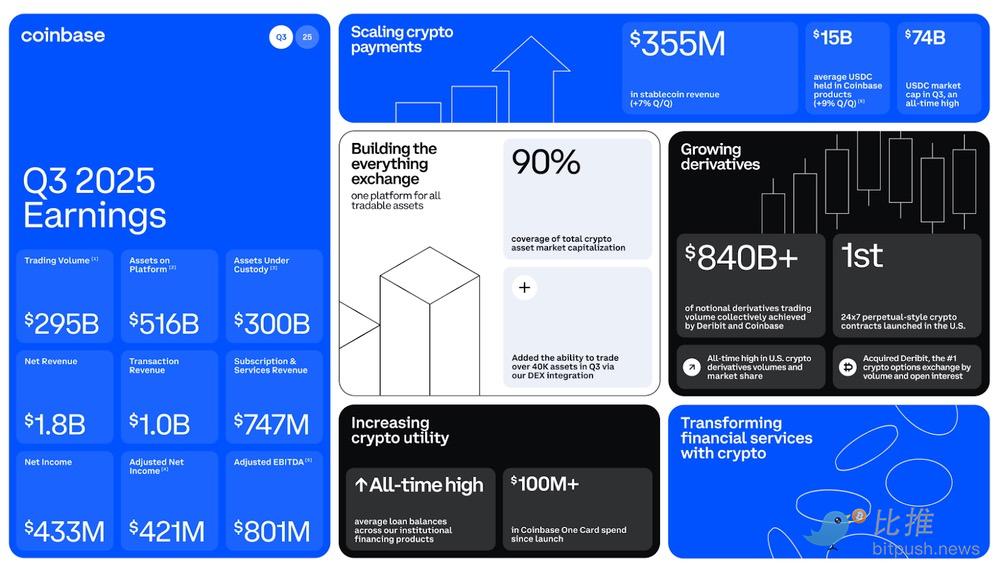
Robinhood's grand vision is to be the go-to place for handling all matters of personal financial life, while Coinbase is playing two games at once: building the best crypto super app for its own users, while simultaneously becoming the backend that powers the crypto products for everyone else.

Diverging Crypto Strategies

Both companies see cryptocurrency as core to their super app ambitions, but their approaches reflect their origins.

Robinhood treats cryptocurrency as just another asset class alongside stocks and options. It is a revenue driver that fits perfectly into the existing product suite. The acquisition of Bitstamp ($200 million) provided it with global licenses and institutional infrastructure. Tokenized equities—currently around 800 listed in the EU, including private companies like OpenAI and SpaceX—expand the product offering. The real test will be the success of the Robinhood Chain, which should make many of these tokenized equities more fungible (e.g., for loans), although we currently have few details on the extent of "DeFi" or other on-chain activities the chain will support.

Beyond that, Robinhood faces more immediate limitations, such as token selection. In the US, users have access to fewer than 50 tokens on the platform, while Coinbase offers nearly unlimited tokens indirectly (via Jupiter and Base) and directly supports over 200.

Coinbase's cryptocurrency approach is clearly different, offering everything from its own Layer 2 network to the various products mentioned in the previous section. It has set the standard for "crypto-specific" products to the point that it now seems to be pivoting to focus on building the rails for others to use. We see x402, aimed at becoming the industry standard for agent-to-agent (A2A) payments, and Coinbase's announcement that it will offer a "Stablecoin-as-a-Service" platform for companies to create whitelabel stablecoins, with Coinbase managing all the complexity. From issuance to trading to custody, Coinbase occupies every stage of the asset lifecycle.

2026 Outlook

The roadmaps for both companies are very aggressive—and increasingly overlapping.

Coinbase's December 2025 system update, with stock and ETF trading beyond traditional market hours (thanks to tokenization) and the announcement of stock perps launching next year, strongly encroached on Robinhood's territory. Native Kalshi integration brought prediction markets. Then there's Coinbase Business and Coinbase Tokenize, the former an all-in-one crypto-powered business operations platform, and the latter an "end-to-end" platform for institutional tokenization.

Robinhood's 2026 plans delve deeper into crypto infrastructure. Tokenized stocks will achieve 24/7 trading via Bitstamp in early 2026 and become withdrawable and composable in DeFi by late 2026. In prediction markets, Robinhood is moving from a distribution partner to launching its own market. The platform hopes to offer crypto staking, pending regulatory approval. It also has ambitions to "socialize" trading with Robinhood Social, an upcoming feed where traders can post content and display their actual trades and P&L. And of course, there's the Robinhood Chain.

The challenge for the Robinhood Chain will be building a developer ecosystem—an area where Base has already built momentum. Crypto-native culture is hard to manufacture artificially.

Conclusion

Perhaps a better framework here is "COIN and HOOD," rather than "COIN vs. HOOD." These two companies occupy different lanes, touching but not fully overlapping.

Robinhood is both a "super app" bet and a demographic wealth transfer bet. With 75% of its users under 44 and a full-stack digital bank keeping assets on the platform, the company is poised to become a new hub for deposits, spending, investing, and speculation.

Coinbase is a bet on a technological transition. It bets that the global economy is moving on-chain, and Coinbase will be the infrastructure layer that powers everyone else—from ETF custody to stablecoin backends to crypto-as-a-service for traditional banks.

Both face risks. Robinhood's generous Gold incentives (3% match, 3% cash back, 3.25% cash interest) are costly and have already shown vulnerability to rate cuts—the rate was recently 4-5% and is directly tied to the Fed rate. Adoption of tokenization depends on issuer decisions, which are beyond Robinhood's control. For Coinbase, user growth remains a significant risk, with its monthly active user count stagnating since 2021.

Moreover, both stocks may already be at high levels. Over the past few years, these two stocks have been major market winners—as of this writing, Coinbase (COIN) is up about 7x from its 2022 lows, and Robinhood (HOOD) is up 15x. Although they have pulled back from recent all-time highs, their valuations remain elevated after such staggering gains. This is worth investors pondering.

Ultimately, while both companies are building financial super apps—and encroaching on each other's turf in the process—their visions actually serve different goals.

  • Robinhood is committed to building an all-in-one financial platform—allowing users to manage all aspects of their financial life, from banking and daily spending to trading and investing, all in one place without leaving the platform.
    Coinbase focuses on building the infrastructure to get everyone on-chain—it does build a crypto super app for its own users, but more importantly, it is becoming the backend rails that financial institutions, fintech companies, and even traditional banks rely on when entering the crypto space.

One aims to be your financial home, the other aims to be the plumbing underneath everyone's financial home. Both could succeed.


Twitter:https://twitter.com/BitpushNewsCN

Bitpush TG Discussion:https://t.me/BitPushCommunity

Bitpush TG Subscription: https://t.me/bitpush

Original link:https://www.bitpush.news/articles/7599259

Kripto yang Sedang Tren

Pertanyaan Terkait

QWhat are the key differences between Robinhood and Coinbase's approaches to building a financial super app?

ARobinhood is building a traditional financial super app by layering products like banking, stocks, options, and crypto into a single platform for daily financial management. Coinbase is building a crypto-native super app with a dual focus: creating a front-end app for users and providing backend infrastructure (like custody and 'crypto as a service') for other institutions entering the crypto space.

QWhat major product update did Coinbase announce on December 17th, and how does it compete with Robinhood?

ACoinbase announced 24/5 commission-free stock and ETF trading, native prediction market integration via Kalshi, and a DEX aggregator for instant access to millions of tokens. This update directly competes with Robinhood by expanding into traditional equity trading and broadening its product suite to become a more comprehensive 'everything app'.

QWhat is Robinhood's primary revenue driver and how has its business diversified?

AOptions trading remains Robinhood's 'cash cow.' Its business has diversified with crypto contributing 21% of total revenue, net interest income making up 35%, and its prediction market business (via Kalshi) generating an annualized $100 million in revenue.

QWhat is Coinbase's larger, second-layer ambition beyond its consumer super app?

ACoinbase's larger ambition is to become the backend infrastructure provider for the entire crypto economy. It aims to offer 'crypto as a service' to traditional financial institutions (TradFi), provide custody for major ETFs, allow institutions to issue their own stablecoins, and power on-chain finance through its various infrastructure products and acquisitions.

QWhat are the primary demographic and opportunities for Robinhood, according to the article?

A75% of Robinhood's 26.9 million funded customers are under the age of 44. This positions the company to be a major beneficiary of the anticipated $10+ trillion wealth transfer over the next decade, as younger generations are likely to consolidate inherited assets onto the modern, mobile-first platform they already use daily.

Bacaan Terkait

Kirim Pesan Bisa Transfer Koin? Telegram Akan 'Suntik' Dompet Kripto untuk 1 Miliar Pengguna Musim Panas Ini

Pendiri Telegram, Pavel Durov, mengumumkan bahwa musim panas ini dompet kripto non-penampung (non-custodial) asli, "Gram wallet", akan dibangun ke dalam semua aplikasi Telegram. Langkah ini menargetkan lebih dari 1 miliar pengguna bulanan, menawarkan transfer aset kripto instan dan tanpa biaya. Dompet baru ini berbeda dari bot @wallet pihak ketiga yang sudah ada, karena dikembangkan langsung oleh Telegram dan pengguna mengontrol kunci pribadi mereka sendiri. Pengumuman tersebut mendorong harga GRAM (sebelumnya Toncoin) naik sekitar 8%. Namun, harga saat ini masih jauh dari titik tertinggi sebelumnya. Keputusan Durov ini adalah bagian dari roadmap "Make TON Great Again" (MTONGA), menandai kembalinya Telegram ke proyek blockchain TON setelah sebelumnya berkonflik dengan SEC pada 2018-2020. Langkah Telegram terjadi di tengah persaingan ketat fitur pembayaran di aplikasi super. X Money pimpinan Elon Musk fokus pada rute fiat yang sesuai regulasi, sementara Meta mengeksplorasi pembayaran stablecoin. Telegram memilih jalur asli kripto dengan dompet non-penampung, memanfaatkan basis pengguna besar dan kedekatan alami dengan komunitas kripto. Namun, janji "tanpa biaya" dan detail teknis lainnya, seperti dukungan aset selain GRAM serta strategi edukasi pengguna baru, masih belum diungkap. Jadwal peluncuran yang tepat juga hanya disebut "musim panas ini".

marsbit14m yang lalu

Kirim Pesan Bisa Transfer Koin? Telegram Akan 'Suntik' Dompet Kripto untuk 1 Miliar Pengguna Musim Panas Ini

marsbit14m yang lalu

7 Bulan Setelah Runtuhnya Huiwang, Lanskap Platform Jaminan Asia Tenggara Menghadapi Reshuffle Besar

Setelah platform garansi terkenal Asia Tenggara, "Huiwang Pay", runtuh pada Desember tahun lalu, pasar menyaksikan perubahan besar dan kemunculan platform-platform baru yang mengisi kekosongan. Platform-platform seperti XinBi, JinBei/JinBo, DaLi/TianCheng, Fulilai, dan LingHang kini beroperasi di wilayah gelap, terutama melayani industri abu-abu dan ilegal. Data dari Bitrace menunjukkan bahwa pendapatan platform XinBi telah melebihi 1,6 miliar USDT. Sementara itu, platform LingHang secara terbuka menyediakan layanan garansi untuk transaksi yang terkait dengan perdagangan manusia. JinBei, yang terkait erat dengan bisnis kasino, telah berganti nama menjadi JinBo. DaLi mewarisi banyak bisnis dari platform "Tudou" yang sebelumnya terkait dengan Huiwang. Adapun Fulilai terkait dengan kelompok kriminal keluarga Liu di Myanmar Utara. Meskipun platform-platform ini sering dijuluki "Alipay Asia Tenggara", fungsi sebenarnya jauh dari itu. Seperti yang ditunjukkan dalam laporan Elliptic, pasar garansi Huiwang telah menangani lebih dari 310 miliar dolar AS, menjadikannya pasar ilegal online terbesar yang pernah ada, yang terutama melayani pencucian uang, penipuan, perjudian, dan perdagangan manusia. Kebangkitan platform-platform baru ini mencerminkan ekosistem keuangan bawah tanah yang terus beradaptasi dan berkembang di Asia Tenggara, menunggu tindakan penegakan hukum lebih lanjut.

Odaily星球日报26m yang lalu

7 Bulan Setelah Runtuhnya Huiwang, Lanskap Platform Jaminan Asia Tenggara Menghadapi Reshuffle Besar

Odaily星球日报26m yang lalu

Cahaya Tak Semenarik Dulu: Apa yang Sedang Dialami oleh VC Kripto?

Krisis Dana Ventura Kripto Khusus: Pergeseran Menuju Infrastruktur dan Masa Depan yang Terpolarisasi Dana ventura khusus kripto, seperti Paradigm yang baru saja mengalihkan fokus ke AI dan robotika, sedang menghadapi tantangan eksistensial. Artikel ini membahas apakah dana semacam ini sedang menuju kepunahan, dengan menarik paralel dari siklus hidup dana khusus sebelumnya di sektor energi bersih dan SPAC. Inti masalahnya adalah runtuhnya *information advantage* (keunggulan informasi) yang dulunya dimiliki dana khusus. Saat teknologi kripto matang dan diadopsi raksasa tradisional seperti Stripe dan BlackRock, pengetahuan mendalam tentang MEV atau ekonomi validator tidak lagi menjadi penghalang masuk. Dana generalis besar (seperti a16z, Sequoia) kini dapat menilai proyek kripto dengan logika yang sama seperti fintech biasa. Industri ventura mengalami polarisasi "barbell": di satu ujung, platform besar multifokus; di ujung lain, dana kecil niche yang bisa bertahan dengan satu "home run". Dana khusus kripto ukuran menengah terjepit di "zona kematian", karena ukurannya terlalu besar untuk bergantung pada investasi seed kecil, namun terlalu kecil untuk bersaing di putaran growth. Ini memaksa banyak dana, seperti Framework Ventures, untuk melebarkan mandat investasi. Bahkan dana yang tetap berlabel "kripto" seperti Dragonfly dan a16z kini mendefinisikan ulang fokus mereka terutama pada infrastruktur keuangan berbasis blockchain (stablecoin, pasar prediksi), yang juga diminati dana generalis. Perubahan ini didorong oleh tekanan dari Limited Partner (LP) yang haus akan hasil di tengah kinerja buruk portofolio kripto mereka, dan teralihkan oleh daya tarik AI yang menyedot 70% modal ventura. Implikasi bagi startup kripto adalah tantangan baru: bersaing dengan proyek AI untuk mendapatkan perhatian di dana generalis, dan kehilangan sponsor jangka panjang untuk riset infrastruktur dasar yang kurang komersial (seperti yang pernah didanai Paradigm). Kesimpulannya, "dana ventura kripto" sebagai kategori mandiri mungkin akan usang, mirip dengan "dana internet". Kripto berevolusi menjadi infrastruktur dasar. Masa depan akan mengikuti pola barbell: dana besar multifokus mendanai pertumbuhan, sementara dana kecil khusus akan muncul untuk niche eksperimental baru (seperti tokenisasi). Dana ukuran menengah yang hanya fokus pada kripto akan menghadapi kesulitan bertahan.

Foresight News46m yang lalu

Cahaya Tak Semenarik Dulu: Apa yang Sedang Dialami oleh VC Kripto?

Foresight News46m yang lalu

Ketika Konsensus Semakin Cepat, Apa yang Ditaruhkan oleh Investor Muda?

Dengan kemajuan teknologi yang semakin cepat, terutama di bidang AI, robotika, dirgantara, dan komputasi kuantum, para investor muda berhadapan dengan perubahan logika investasi. Mereka tidak lagi cukup mengandalkan model keuangan dan pengalaman industri lama, tetapi juga harus memahami bahasa teknologi, menerima rute yang belum konvergen, dan membuat keputusan sebelum konsensus terbentuk. WAIC merilis daftar "Alpha Youth Investment Leaders," yang mencerminkan beberapa tren utama dalam investasi teknologi saat ini. Tren pertama adalah pergeseran AI dari layar ke dunia fisik. Perhatian kini beralih ke perangkat ujung, robot, mobil, sistem industri, dan infrastruktur luar angkasa. Meskipun robot humanoid dan kecerdasan emboddied menarik perhatian, fokus utama adalah kemampuan pengiriman dan ROI yang nyata, bukan hanya demonstrasi yang mengesankan. Kecerdasan ujung menjadi kunci, dengan perangkat keras AI yang membangun hubungan data dan layanan berkelanjutan dengan pengguna. Tren kedua adalah beralihnya fokus kompetisi dari model dasar ke "roda terbang cerdas." Manfaat model besar belum sepenuhnya terealisasi dalam merekonstruksi produktivitas. Nilai jangka panjang terletak pada perusahaan yang dapat mengintegrasikan kemampuan model ke dalam alur kerja nyata, membentuk siklus tertutup data, pelatihan, dan umpan balik pengguna yang saling memperkuat (roda terbang cerdas). Ini menciptakan nilai yang bertahan melampaui sekadar pembaruan model. Tren ketiga adalah munculnya teknologi dasar baru untuk mengatasi hambatan data. Ketika data manusia yang berkualitas tinggi menjadi langka, pembelajaran penguatan, permainan mandiri, dan model dasar ilmiah menjadi arah yang diperhatikan. Model-model ini bertujuan untuk membangun kemampuan yang lebih mendasar dan universal dalam bidang seperti ilmu kehidupan dan material, menggunakan data dan umpan balik eksperimen khusus untuk mendorong pertumbuhan kemampuan AI selanjutnya. Tren keempat adalah perlunya modal yang sabar untuk teknologi keras. Di bidang seperti dirgantara komersial, komputasi kuantum, dan energi canggih, siklus validasi lebih panjang dan penuh ketidakpastian teknis. Investasi di bidang ini memerlukan pemahaman awal tentang kemampuan teknik dan ketahanan tim, dengan harapan pengembalian dalam skala waktu yang lebih panjang, sambil mendorong perkembangan industri dan akumulasi kemampuan dasar. Peran investor muda adalah memahami teknologi lebih awal, masuk lebih dalam ke industri, dan membuat pilihan jangka panjang di tengah ketidakpastian.

marsbit1j yang lalu

Ketika Konsensus Semakin Cepat, Apa yang Ditaruhkan oleh Investor Muda?

marsbit1j yang lalu

Trading

Spot

Artikel Populer

Cara Membeli SUPER

Selamat datang di HTX.com! Kami telah membuat pembelian SuperFarm (SUPER) menjadi mudah dan nyaman. Ikuti panduan langkah demi langkah kami untuk memulai perjalanan kripto Anda.Langkah 1: Buat Akun HTX AndaGunakan alamat email atau nomor ponsel Anda untuk mendaftar akun gratis di HTX. Rasakan perjalanan pendaftaran yang mudah dan buka semua fitur.Dapatkan Akun SayaLangkah 2: Buka Beli Kripto, lalu Pilih Metode Pembayaran AndaKartu Kredit/Debit: Gunakan Visa atau Mastercard Anda untuk membeli SuperFarm (SUPER) secara instan.Saldo: Gunakan dana dari saldo akun HTX Anda untuk melakukan trading dengan lancar.Pihak Ketiga: Kami telah menambahkan metode pembayaran populer seperti Google Pay dan Apple Pay untuk meningkatkan kenyamanan.P2P: Lakukan trading langsung dengan pengguna lain di HTX.Over-the-Counter (OTC): Kami menawarkan layanan yang dibuat khusus dan kurs yang kompetitif bagi para trader.Langkah 3: Simpan SuperFarm (SUPER) AndaSetelah melakukan pembelian, simpan SuperFarm (SUPER) di akun HTX Anda. Selain itu, Anda dapat mengirimkannya ke tempat lain melalui transfer blockchain atau menggunakannya untuk memperdagangkan mata uang kripto lainnya.Langkah 4: Lakukan trading SuperFarm (SUPER)Lakukan trading SuperFarm (SUPER) dengan mudah di pasar spot HTX. Cukup akses akun Anda, pilih pasangan perdagangan, jalankan trading, lalu pantau secara real-time. Kami menawarkan pengalaman yang ramah pengguna baik untuk pemula maupun trader berpengalaman.

268 Total TayanganDipublikasikan pada 2024.12.11Diperbarui pada 2026.06.02

Cara Membeli SUPER

Diskusi

Selamat datang di Komunitas HTX. Di sini, Anda bisa terus mendapatkan informasi terbaru tentang perkembangan platform terkini dan mendapatkan akses ke wawasan pasar profesional. Pendapat pengguna mengenai harga SUPER (SUPER) disajikan di bawah ini.

活动图片













