OpenAI Completely Overhauls Codex, Grows Its Own Mouse, Schedules Itself to Outwork Humans

marsbitDipublikasikan tanggal 2026-04-17Terakhir diperbarui pada 2026-04-17

Abstrak

OpenAI has fundamentally transformed Codex from a coding assistant into a versatile AI agent capable of autonomous computer control. The updated Codex can now operate in the background with its own independent cursor, allowing it to run applications like Xcode, test software, and fix bugs without interrupting the user’s workflow. It features a built-in browser for real-time visual editing of web pages, enabling developers to make changes through direct UI interactions. The release also introduces over 90 plugins for tools like JIRA, CircleCI, and SharePoint, integrating end-to-end development and productivity workflows. A new "heartbeat" feature allows Codex to self-schedule tasks, maintain context across sessions, and work autonomously over extended periods. Additional enhancements include memory capabilities, support for handling GitHub code reviews, multi-tab terminals, and built-in file generation for Excel, PDF, and PowerPoint. Currently, advanced computer control is available on macOS (excluding EU/UK users), with Windows support limited to data retrieval. This expansion positions Codex as a foundational step toward OpenAI’s planned "super-app," combining coding, automation, and multi-tool integration into a single platform.

Just now, OpenAI has turned Codex upside down!

Yesterday you were still using Codex to write code.

Today it can already view your screen, click your mouse, remember your preferences from last week, and schedule its own tasks.

Multiple AI Agents work for you in the background simultaneously, without affecting your mouse and keyboard at all.
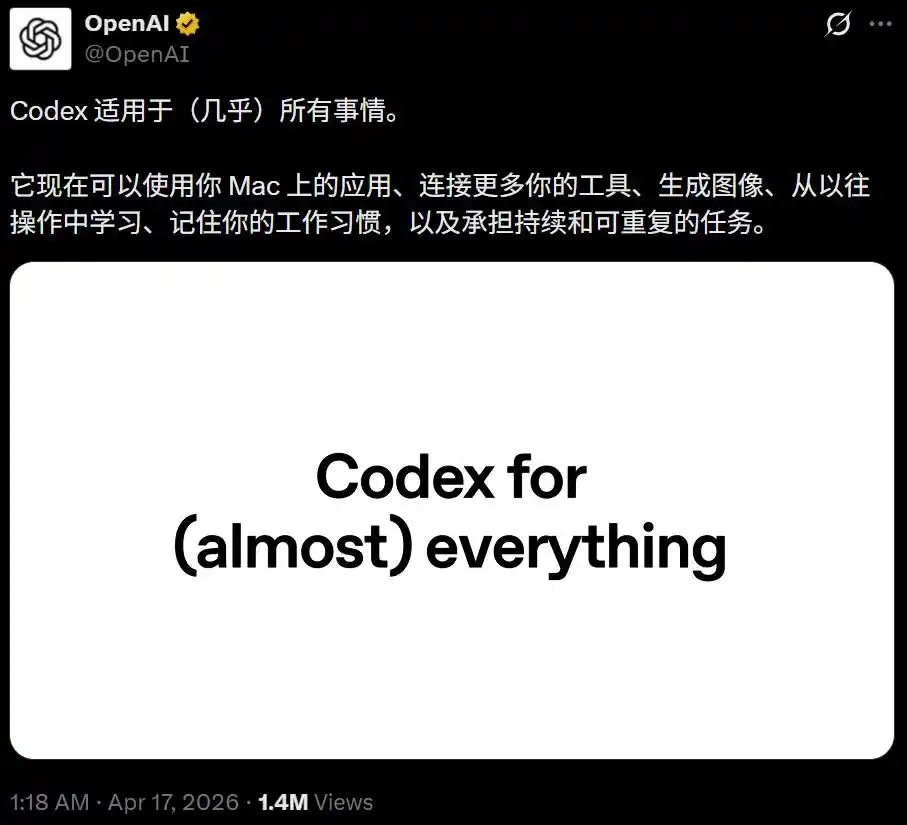
Codex's "Secret Sauce": It can use apps directly in the background without taking over your entire computer.

From today, this tool used weekly by 3 million developers is no longer just a programming Agent.

You Do Your Work, It Runs Xcode in the Background

Now, Codex has its own cursor, which does not interfere with your mouse.

You write documents while it runs Xcode to test an App next to you, both happening at the same time.

This feature has significant origins; its lead, Ari Weinstein, is the co-creator of Apple Shortcuts, whose team was acquired by OpenAI last fall.

To understand what it can do, just watch a demo.

First, the user gives the command: "Run this Tic-Tac-Toe App in Xcode, play a game to test it yourself, and fix any bugs you find."

Then, Codex opens Xcode by itself, starts the iOS simulator, and begins playing with its own cursor.

During testing, it discovers a logic bug—after a human move, the computer draws two O's simultaneously.

After some thought, Codex decisively switches back to the code interface and locates the position of the bug.

After modifying the Swift code, it immediately recompiles and performs a second round of complete testing for verification.

In less than a minute. Run → Test → Find bug → Fix → Regression verification, the entire Debug closed loop, all in one go.

Currently, Computer Use only supports macOS; users in the EU and UK cannot use it for now.

The Windows version can pull information from other apps into Codex but does not yet support background cursor-level control.
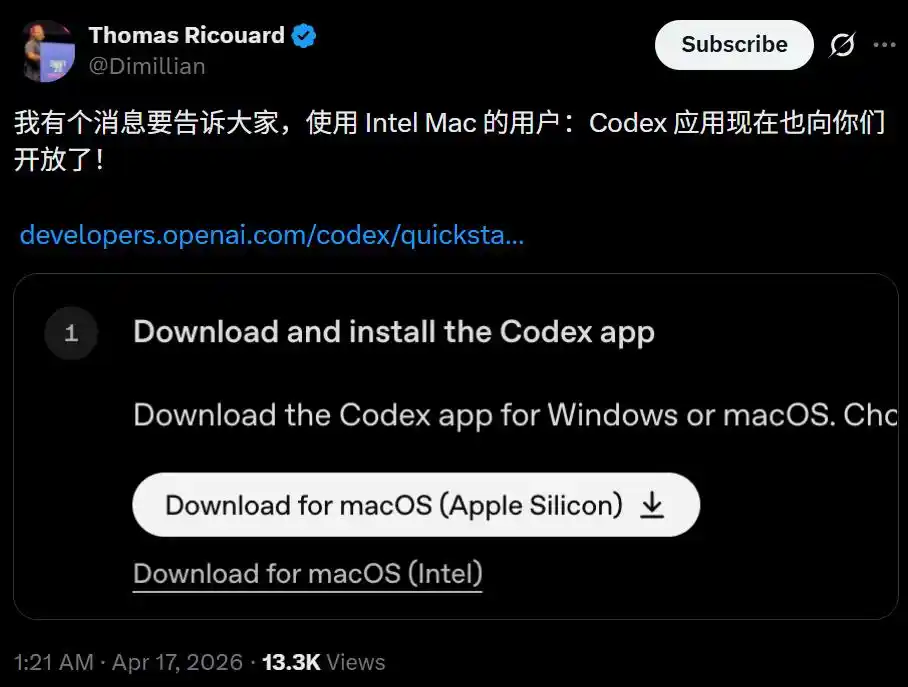
In this update, Codex gains support for Intel Macs for the first time.

Click to Modify, No More Code Hunting for Front-End Debugging

The Codex client now has a built-in browser,底层 powered by OpenAI's own Atlas engine.

In practical terms,以前 front-end developers adjusting UI had to jump back and forth between code and the browser. Now you can operate on the rendered webpage.

Click the main title, leave a comment "Reduce font size and shorten the slogan"; click the top left corner, "Add a logo";发现 the chart's X-axis legend is out of bounds, click the error spot, write "Fix the out-of-bounds issue".

Codex understands visual and spatial context,修改 code in the background instantly, and the page refreshes in real-time.
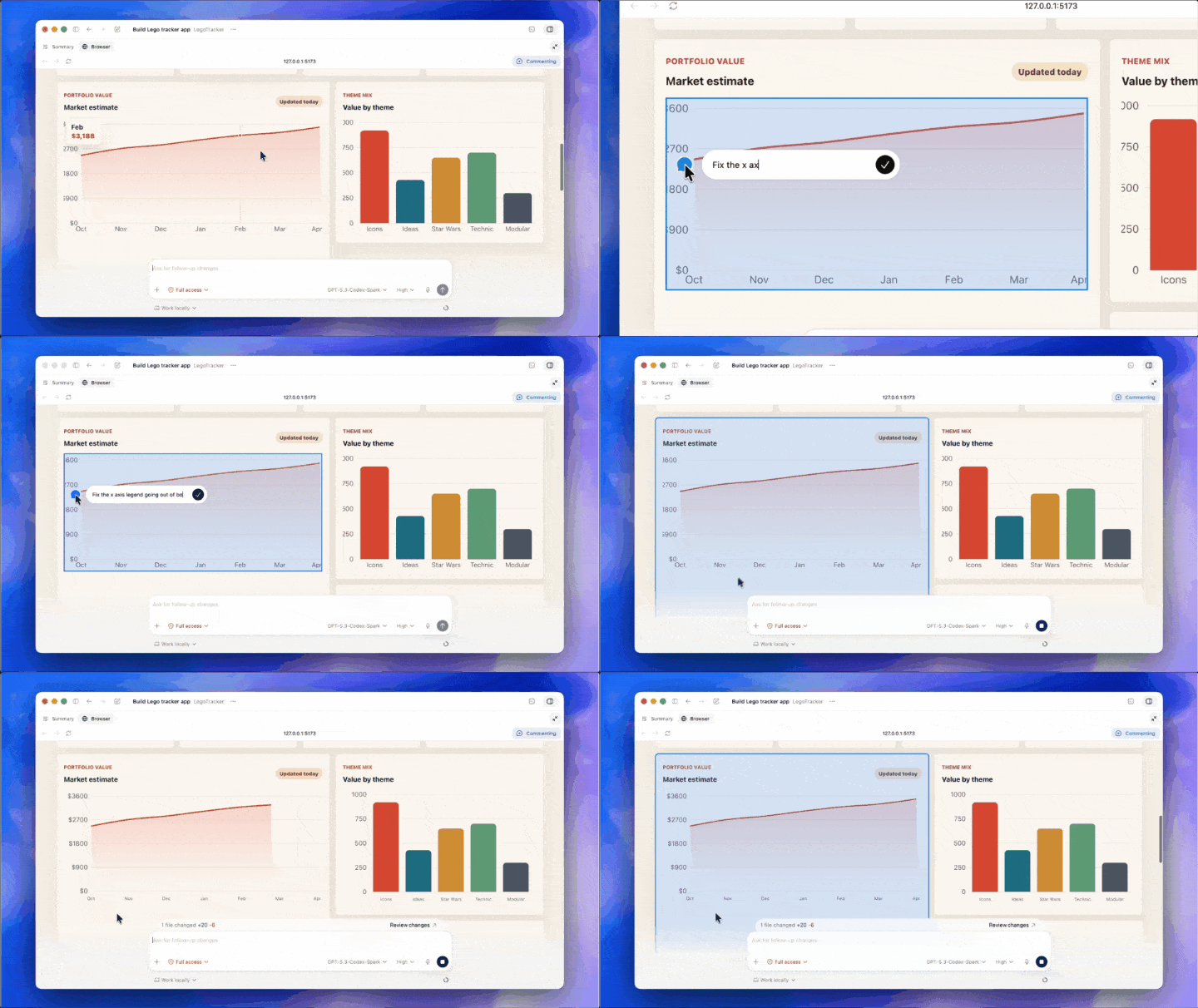
OpenAI used a web application called Brickfolio, a Lego set tracker, for the demo.

Codex wrote the code from scratch, configured the environment, started the local server, and opened the rendered page in the built-in browser. The whole process took just seconds.

Then came the WYSIWYG (What You See Is What You Get) modification experience. It feels like reviewing a design mockup; you just annotate the problems, and all underlying iterations are handled by the AI.

In other words, the user只需 clicks and marks here and there on the page, and Codex changes the code in the background, producing results in real-time on the front end.

The built-in browser is currently limited to localhost preview. OpenAI stated that future expansions will include full browser control capabilities.

Over 90 Plugins Launched, The Entire Toolchain Welded into Codex

On the plugin front, OpenAI launched over 90 in one go.

Atlassian Rovo manages JIRA, CircleCI handles CI/CD, GitLab Issues tracks requirements, Microsoft Suite processes documents, Neon by Databricks operates databases—covering almost all tools a development team uses daily.
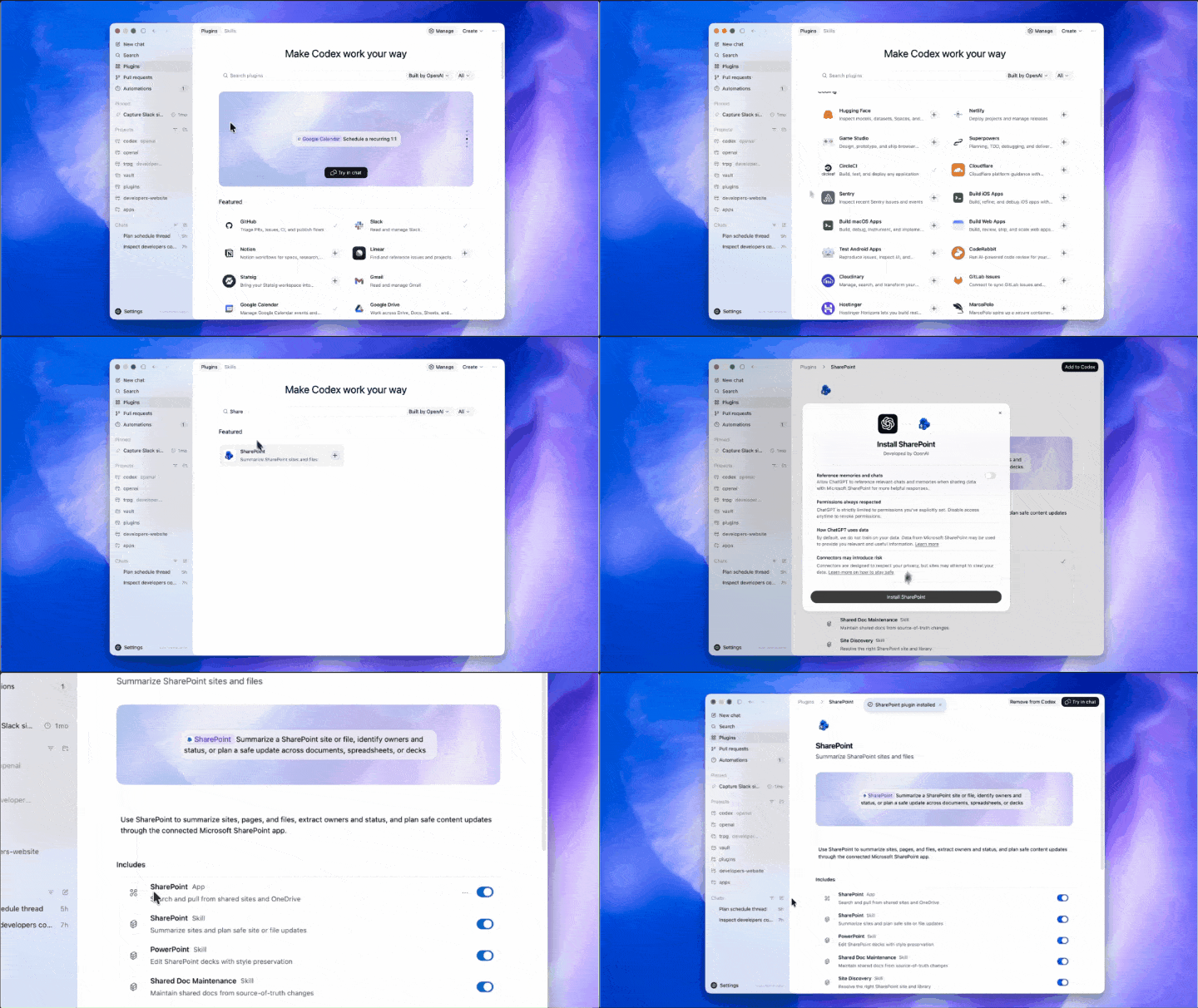
Usage is simple: just @ the plugin name in the input box.

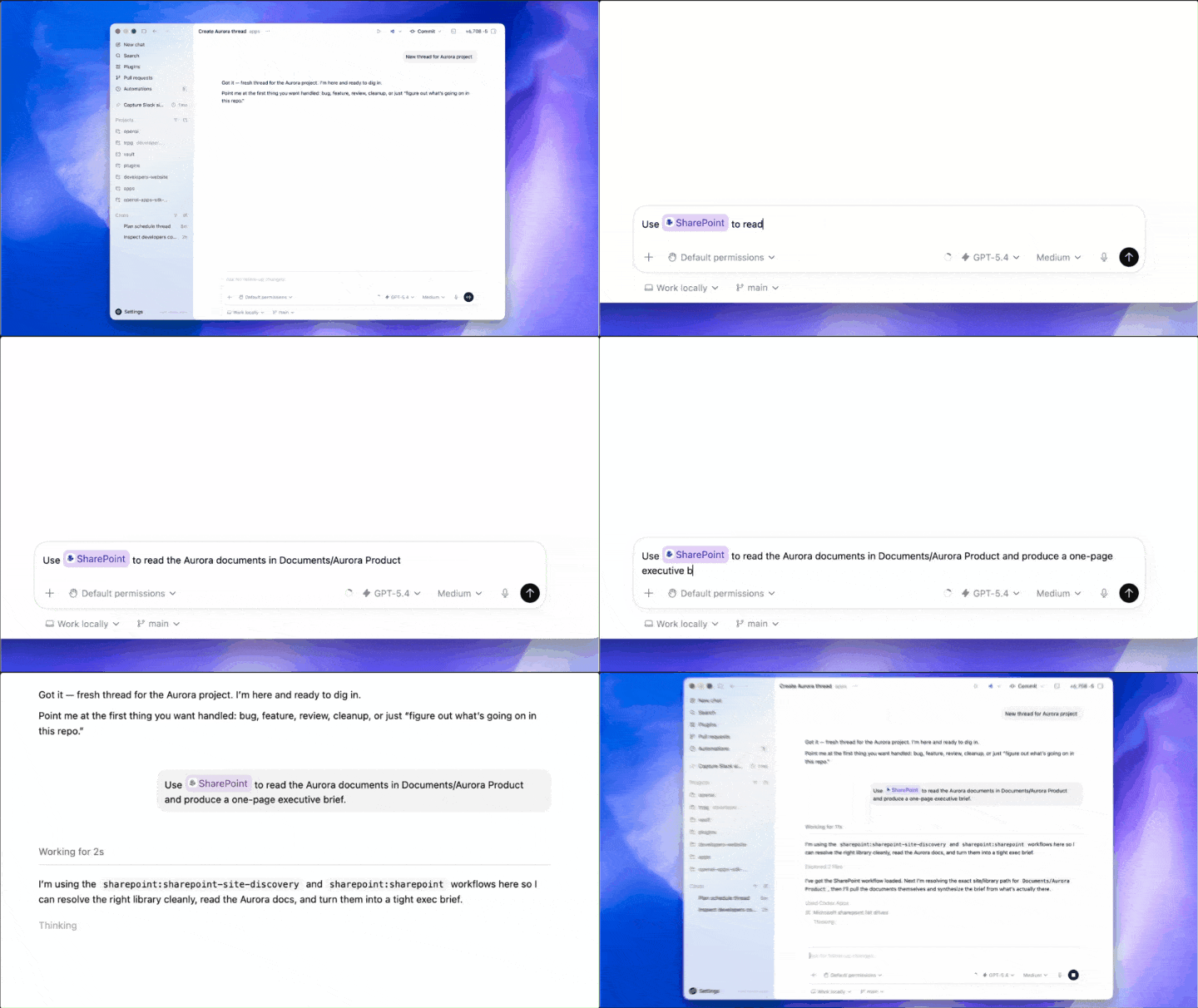
For example, @SharePoint, ask Codex to read documents in the product catalog and generate an executive brief. It automatically searches the file tree, parses documents, and extracts core information, saving you from searching through various cloud drives.
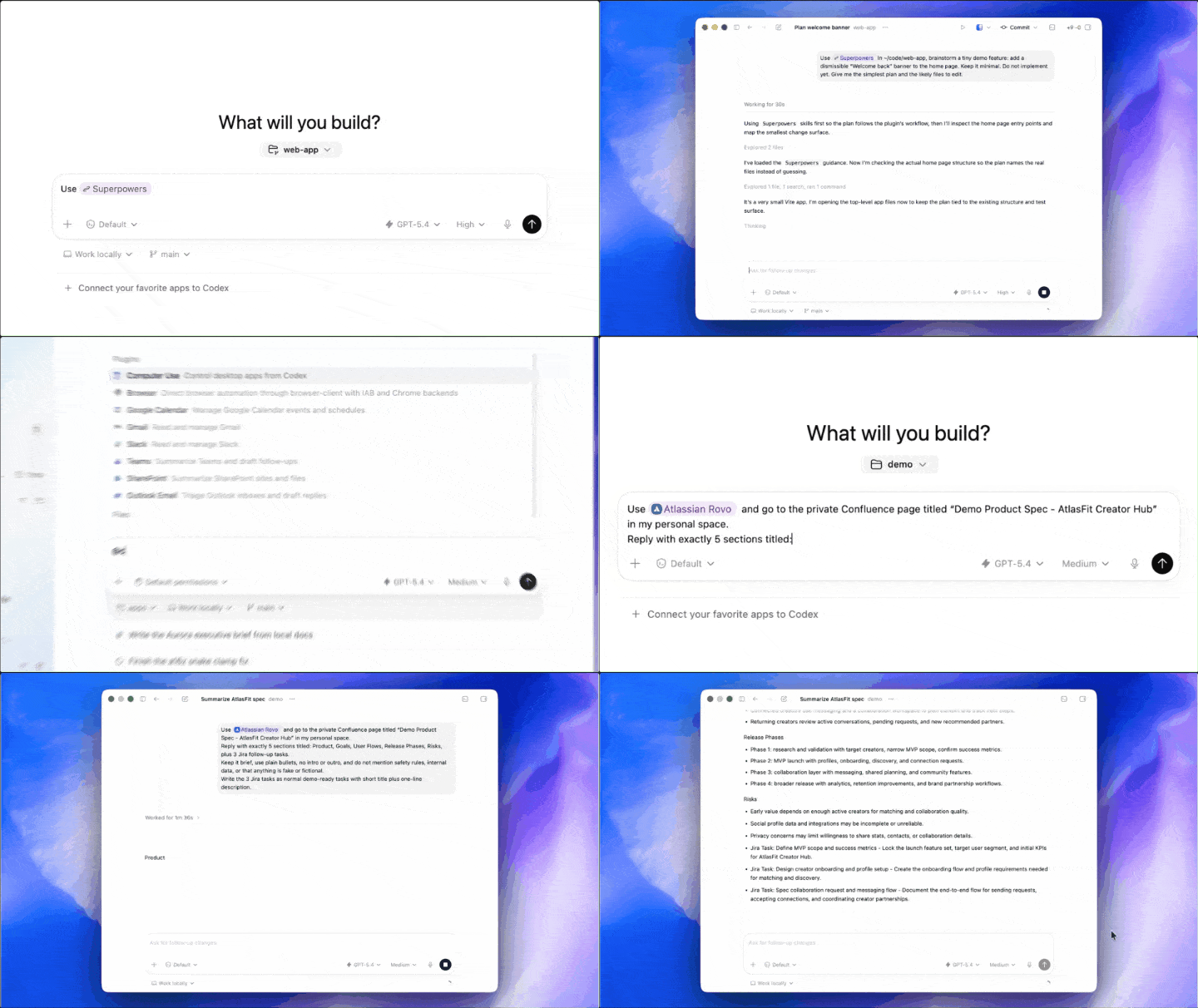
Another example: @Superpowers, ask Codex to conceptualize a feature plan within the local code directory. It will traverse your file structure, read code and CSS, and provide a set of implementation suggestions that fit the current project architecture.

@CircleCI can help diagnose branch build failures; @Atlassian Rovo can read product specifications on Confluence, output summaries in format, and even convert feature points into standard JIRA tasks.
From upstream requirements to local coding, to CI/CD and task management, plugins串起来了 the entire chain.

AI Starts Scheduling Itself

Even more noteworthy is the new "Heartbeat" mechanism.

Now Codex can schedule future work for itself, automatically waking up at the set time to continue working, even across days or weeks. Moreover, it can reuse previous conversation threads, so the context accumulated last time is not lost.

For example, a user can ask Codex to check Slack, Gmail, Google Calendar, and Notion. It pulls relevant information from these four channels and throws out a prioritized to-do list.

The user adds, "Can you keep an eye on this for me?"

Codex immediately sets itself an hourly automatic patrol schedule, proactively reports on key points requiring decisions, and even asks, "Do you need me to draft a reply for you?"

This is no longer just a tool; it's a junior employee who doesn't sleep.

Coupled with the natively built-in image generation capability of gpt-image-1.5, product concept maps, front-end designs, and visual prototypes can all be completed in one go within the same workflow.

Daily Needs Filled in One Go

Besides these major features, there are also a batch of experience-level upgrades.

First, the memory function is available in preview; Codex can remember your preferences and corrected points, so you don't have to explain from scratch the next time you start a chat.

Second, GitHub code review comments can now also be processed in Codex.

Support for opening multiple terminal tabs simultaneously is here, and the ability to connect to remote development machines via SSH is also in internal testing. There's also a new summary panel to help you keep an eye on the Agent's work plans, information sources, and output files at any time.

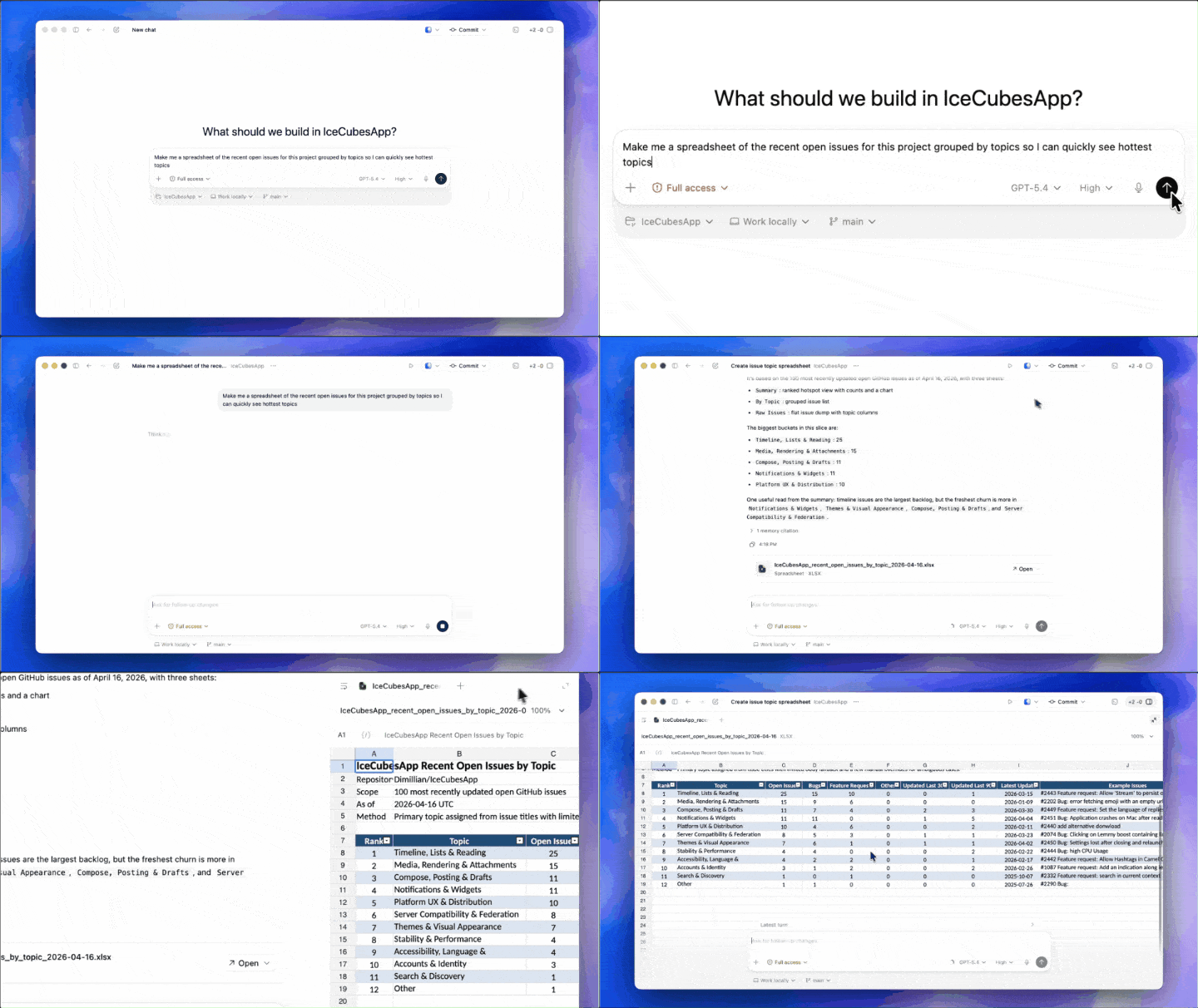
In the demo, the user asked Codex to organize the recent open issues of the current project and generate a table grouped by theme.

Codex then pulled the code repository context in the background and, after a few minutes, threw out a core summary listing the project's current biggest pain points.

Click to generate an Excel file—no need to switch to external software; a complete spreadsheet preview can be opened right in the sidebar.

The same goes for PDFs and PPTs, all handled within the Codex window.
The First Piece of the Super App Puzzle

Looking back at the timeline, you can feel OpenAI's pace.

March 19: Foreign media reported that OpenAI plans to merge ChatGPT, Codex, and the Atlas browser into a desktop "Super App".

March 31: OpenAI secured $122 billion in funding, with a valuation of $852 billion, led by Amazon, NVIDIA, and SoftBank. The funding documents clearly stated that the capital would be used for the development and deployment of the Super App.

April 16: This wave of Codex updates landed.

Another telling data point: over 80% of OpenAI's internal employees are already using Codex, and not just engineers.

Writing weekly reports, organizing feedback, drafting product requirement documents, reviewing contracts, sending security training reminders—they use it for everything.

50% of Codex users are already using it for non-coding tasks.

This isn't a programming tool adding features. This is a Super App using the shell of a programming tool for a cold start.

If You Can't Beat Them, Infiltrate: Made an Official Plugin for Anthropic

Even more interestingly, OpenAI also made an official plugin for Claude Code, actively embedding Codex into the competitor's ecosystem.

It somewhat has the vibe of, rather than waiting for developers to switch camps, better to infiltrate their workflow first.

Currently, Codex emphasizes background execution, multi-Agent parallelism, and unattended operation; Claude Code's advantages lie in long-context reasoning and deep code understanding. More and more teams are choosing to use both.

However, what OpenAI wants is clearly not just a share of the pie.

$122 billion is bet on something far greater than a programming tool.

Reference: https://openai.com/index/codex-for-almost-everything/

This article is from the WeChat public account "新智元" (New Wisdom Yuan), edited: Hao Kun (Very Sleepy)


Pertanyaan Terkait

QWhat is the key new feature of OpenAI's Codex that allows it to operate in the background without taking over the user's entire computer?

AThe key new feature is called 'Computer Use', which gives Codex its own independent cursor, allowing it to operate applications in the background (like running Xcode) while the user continues their work uninterrupted with their own mouse and keyboard.

QWhich operating system currently has the most comprehensive support for Codex's new background control capabilities, and which regions are temporarily excluded?

AmacOS currently has the most comprehensive support for the new background cursor-level control. Users in the European Union and the United Kingdom are temporarily unable to use this feature.

QHow does the new 'heartbeat' mechanism in Codex function?

AThe 'heartbeat' mechanism allows Codex to schedule future work for itself. It can wake up automatically at a set time (even across days or weeks) to continue tasks and can reuse previous conversation threads, maintaining all accumulated context from earlier interactions.

QWhat was the significant business move mentioned in the article that suggests OpenAI is building a 'super app'?

AThe significant business move was OpenAI securing $122 billion in funding at an $852 billion valuation, with investors including Amazon, Nvidia, and SoftBank. The funding documents explicitly stated the capital would be used for the development and deployment of a desktop 'super app' that merges ChatGPT, Codex, and the Atlas browser.

QWhat surprising strategic move did OpenAI make regarding its competitor Anthropic's Claude Code?

AOpenAI created and released an official plugin for Anthropic's Claude Code, effectively embedding its own Codex tool into the ecosystem of its direct competitor. This is a strategic move to integrate into developers' workflows rather than waiting for them to switch platforms entirely.

Bacaan Terkait

Tren Saham AS: Satu Kalimat Jensen Huang Tembuskan $470 Miliar, Google Pertama Kali 'Jual Diri' untuk Cari Dana dalam 20 Tahun

**AI Perang Senjata: Dari Perkataan ke Uang Tunai** Pada tanggal 2 Juni, pasar saham AS menampilkan dua sisi dari perlombaan AI: hype yang mendorong valuasi dan kebutuhan dana yang sangat besar. Pasar saham ditutup lebih tinggi, dengan S&P 500 mencapai rekor di atas 7.600 poin. Namun, sorotan utama adalah sektor semikonduktor yang melonjak karena **Computex Taipei**. * **Marvell Technology (MRVL)** melonjak **32,52%**, menambah kapitalisasi pasar sebesar $470 miliar, setelah CEO Nvidia Jensen Huang menyebutnya sebagai "perusahaan triliunan dolar berikutnya". Ini menunjukkan pergeseran minat investor dari inti AI ke ekosistem pendukungnya. * **Hewlett Packard Enterprise (HPE)** naik **~25%** setelah laporan laba yang sangat kuat, menunjukkan bahwa pemain infrastruktur "tradisional" juga mendapat manfaat dari ledakan AI. Di sisi lain, **Alphabet (GOOGL)** mengumumkan rencana penggalangan dana ekuitas senilai **$80 miliar**, yang pertama kalinya dalam 20 tahun. Ini menekankan betapa hausnya modal untuk infrastruktur AI, sehingga bahkan raksasa seperti Google perlu mencari tambahan dana meski memiliki arus kas yang besar. Sahamnya turun ~4%. Sektor teknologi dan utilitas memimpin kenaikan, sementara komunikasi jatuh karena tekanan dari Alphabet. Meskipun indeks ketakutan (VIX) rendah, para analis memperingatkan bahwa kekuatan pasar saat ini sangat terkonsentrasi pada beberapa saham AI, menutupi tantangan latar belakang yang lebih luas. Fokus selanjutnya adalah pada laporan kuartalan Broadcom dan yang terpenting, data **pekerjaan non-pertanian AS hari Jumat**, yang akan memandu ekspektasi suku bunga dan menguji ketahanan rally pasar.

marsbit16m yang lalu

Tren Saham AS: Satu Kalimat Jensen Huang Tembuskan $470 Miliar, Google Pertama Kali 'Jual Diri' untuk Cari Dana dalam 20 Tahun

marsbit16m yang lalu

Mampukah DeepSeek Menghemat 1 Triliun Dolar untuk China?

**Ringkasan Artikel: Apakah DeepSeek Dapat Menghemat 1 Triliun Dolar AS untuk China?** Artikel ini membahas bagaimana DeepSeek, melalui serangkaian inovasi teknologinya, berpotensi secara drastis menekan biaya infrastruktur AI China dan berpotensi menghemat investasi hingga triliunan dolar AS. **Tantangan: Biaya AI yang Melonjak** Biaya perangkat keras AI, terutama memori berbandwidth tinggi (HBM), sedang meroket. Misalnya, pada sistem AI canggih NVIDIA Vera Rubin, biaya komponen memori saja mencapai sekitar $2 juta dan telah naik 435% dalam setahun. **Solusi DeepSeek: Tiga Inovasi Utama** DeepSeek mendekati masalah ini dengan tiga terobosan teknis utama untuk meningkatkan efisiensi token perangkat keras hingga 4 kali lipat: 1. **Kompresi Memori (KV Cache):** Melalui **Multi-head Latent Attention (MLA)**, DeepSeek mengompres "memori" konteks panjang model secara signifikan (hingga 90%+ pengurangan) tanpa mengorbankan kualitas, mengurangi ketergantungan pada HBM yang mahal. 2. **Aktivasi "Tubuh" Model Sesuai Kebutuhan:** Menggunakan arsitektur **Mixture of Experts (MoE)**, model hanya mengaktifkan sebagian kecil dari total parameternya untuk setiap tugas. Ini seperti hanya memanggil dokter spesialis yang relevan, bukan seluruh rumah sakit. 3. **Cache dan Penggunaan Ulang:** Hasil komputasi yang sudah dihitung disimpan dan digunakan kembali (cache hit), menghindari perhitungan berulang yang mahal. DeepSeek menerapkan ini bahkan dalam struktur harga layanannya. **Dampak dan Potensi Penghematan** Efisiensi ini mengubah ekonomi infrastruktur AI: * **Pengurangan Biaya Operasional:** Untuk tugas tertentu (misalnya, membaca ulang kode panjang), biaya menggunakan DeepSeek V4-Pro bisa **100 kali lebih murah** dibandingkan model seperti GPT-5.5 atau Claude Opus. * **Penghematan Infrastruktur Berskala Besar:** Artikel memperkirakan, dengan peningkatan efisiensi 4x, untuk memenuhi permintaan token harian masa depan China yang mencapai ribuan triliun, pendekatan DeepSeek berpotensi menghemat investasi setara dengan **puluhan ribu pusat komputasi cerdas**, yang nilainya bisa mendekati **$1 triliun**. * **Pergeseran Strategis:** Alih-alih hanya bergantung pada chip komputasi canggih (di mana China tertinggal), DeepSeek mengalihkan beban ke manajemen memori, cache, dan rekayasa sistem — area di mana industri China seperti produsen memori DRAM (contoh: CXMT) semakin kompetitif. Ini meningkatkan keamanan rantai pasokan. **Kesimpulan** DeepSeek tidak menghilangkan kebutuhan akan perangkat keras canggih, tetapi secara radikal mengurangi ketergantungan marjinal padanya. Dengan membuat AI lebih terjangkau melalui efisiensi teknis mendalam, DeepSeek berpotensi membentuk ulang buku besar infrastruktur AI China, menghemat investasi besar, dan yang terpenting, membuat daya AI dapat diakses oleh industri luas di China. *(Catatan: Artikel ini didasarkan pada analisis industri dan proyeksi, bukan fakta yang sudah pasti.)*

marsbit57m yang lalu

Mampukah DeepSeek Menghemat 1 Triliun Dolar untuk China?

marsbit57m yang lalu

Menggugat Gagasan Utama Menangani Halusinasi: Metakognisi, Solusi Baru untuk Menghancurkan Halusinasi Model Besar

Peneliti Google mengusulkan pendekatan baru untuk mengatasi "halusinasi" AI dalam makalahnya, **"Hallucinations Undermine Trust; Metacognition is a Way Forward."** Alih-alih berusaha membuat AI mengetahui segalanya atau menolak menjawab banyak pertanyaan (yang menimbulkan "pajak utilitas"), makalah ini mendefinisikan ulang halusinasi sebagai **AI memberikan informasi yang salah dengan keyakinan tinggi padahal ia tidak yakin.** Solusi intinya adalah **"ketidakpastian yang setia" (faithful uncertainty)** atau **metakognisi** – kemampuan AI untuk merasakan tingkat keyakinan internalnya dan mengekspresikannya dengan jujur dalam bahasa. Misalnya, jika AI ragu, ia harus mengatakan "Saya tidak terlalu yakin." Pendekatan ini lebih realistis karena hanya mengharuskan keselarasan antara sinyal internal dan output AI, bukan kebenaran mutlak yang mustahil. Metakognisi menjadi sangat penting di era **Agent AI** yang menggunakan alat eksternal seperti mesin pencari. Tanpanya, Agent tidak dapat memutuskan kapan harus mencari, kapan harus berhenti, atau bagaimana mengevaluasi informasi yang ditemukan. Namun, implementasinya menghadapi tantangan seperti **"paradoks bootstrap"** (data pelatihan yang statis untuk kemampuan dinamis), **"sinyak perusak keselarasan"** dari pelatihan RLHF yang mendorong AI selalu tampak yakin, dan kesulitan menilai apakah AI benar-benar memiliki metakognisi atau hanya berpura-pura. Makalah ini menyerukan perubahan paradigma: fokus pada pengembangan AI yang jujur tentang batas pengetahuannya, bukan AI yang sempurna tanpa kesalahan. Kepercayaan datang dari kejujuran tentang ketidakpastian, bukan dari klaim kepastian yang salah.

marsbit1j yang lalu

Menggugat Gagasan Utama Menangani Halusinasi: Metakognisi, Solusi Baru untuk Menghancurkan Halusinasi Model Besar

marsbit1j yang lalu

Belilah Emas dan Minyak untuk Hedging, AI untuk Pertumbuhan Cepat, Bitcoin yang 'Ketinggalan Zaman' Masuki Pasar Beruang

Bitcoin terus mengalami penurunan, mencapai level terendah dalam dua bulan di sekitar $66.123. Menurut analis, alasan di balik penurunan ini lebih dalam daripada sekadar aliran keluar dana ETF atau penjualan oleh Strategy. Inti masalahnya adalah Bitcoin kini kalah bersaing di tiga bidang utama. Pertama, sebagai lindung nilai inflasi, emas dan saham energi kini lebih disukai karena memiliki dukungan fisik dan logika yang lebih langsung. Kedua, untuk pertumbuhan tinggi, investor beralih ke perusahaan AI yang memiliki pendapatan dan laba nyata, di mana Bitcoin tidak menghasilkan arus kas. Ketiga, bahkan di dalam ekosistem kripto, eksposur kini dapat diperoleh melalui stablecoin, pertukaran, atau infrastruktur yang terkait dengan adopsi nyata, bukan hanya Bitcoin. Narasi "emas digital" Bitcoin tidak lagi mendapatkan reaksi positif otomatis terhadap kekhawatiran inflasi. Aliran keluar ETF dan penjualan oleh institusi mencerminkan gejala dari realitas baru: investor kini lebih selektif. Mereka memiliki lebih banyak pilihan dan mempertanyakan nilai tambah Bitcoin. Logika bearish baru untuk Bitcoin bukan lagi tentang penipuan atau kegagalan teknologi, melainkan bahwa kelangkaan saja tidak lagi cukup untuk menarik modal. Bitcoin terjepit di zona tengah yang canggung, bukan sebagai aset lindung nilai terbaik, aset pertumbuhan terbaik, atau satu-satunya pilihan kripto.

华尔街日报1j yang lalu

Belilah Emas dan Minyak untuk Hedging, AI untuk Pertumbuhan Cepat, Bitcoin yang 'Ketinggalan Zaman' Masuki Pasar Beruang

华尔街日报1j yang lalu

Trading

Spot
Futures
活动图片




