Memory Module Prices Plummet, Memory Stocks Fall Collectively, Has the Memory Super Cycle Peaked?

marsbitDipublikasikan tanggal 2026-03-30Terakhir diperbarui pada 2026-03-30

Abstrak

Memory module prices have plummeted recently, with DDR5 kits in the U.S. seeing discounts of up to $110 and wholesale prices in China dropping sharply. This has triggered a significant sell-off in memory stocks, wiping nearly $100 billion from the sector's market value last week. Analysts are divided on whether this signals the end of the memory "super cycle." Some, like Dan Nystedt, argue that buyer resistance to high prices, especially for DDR4 in smartphones, indicates a classic cyclical peak. However, others, including independent analyst Jukan, contend that the current cycle is structurally different, driven by essential, inelastic demand for high-end DDR5 in AI and premium devices, with manufacturers now operating models that prevent reckless overcapacity expansion. Investment bank HSBC remains bullish, calling the recent sell-off an overreaction and stating that the AI-driven super cycle is only at its midpoint. It argues that efficiency technologies like Google's TurboQuant will accelerate, not hinder, AI adoption and demand, and it forecasts strong growth in AI server shipments and enterprise SSD demand through 2027. It views any price pullback as a buying opportunity.

Author: Long Yue

Recently, memory prices, which had been rising for several months, suddenly reversed course, sparking market concerns that the memory cycle has peaked.

According to market tracking data, DDR5 memory from multiple US retailers has seen widespread price cuts, with single-kit reductions reaching up to $100. Taking Corsair's VENGEANCE series as an example, its 32GB capacity, 6400MHz maximum frequency model is currently priced at approximately $379.99, a significant drop from the recent peak of $490, representing a single-kit reduction of over $110.

The domestic market in China is also facing impact. A wholesaler told the "China Business Journal" that the price of mainstream 16G memory modules "dropped over one hundred RMB in a single day," and major players who had stockpiled goods earlier are now frantically selling off their inventory.

"Starting last Saturday, the prices just crashed," said Boss Wang, a wholesaler with years of experience in the storage equipment business at Bainaohui, candidly telling the media. He showed an extreme price curve for a mainstream 16G 3200MHz memory module: it was only a little over 130 RMB in May last year, then skyrocketed to a peak of 980 RMB in December. However, after fluctuating at high levels for months, the current spot price has fallen back to around 700 RMB.

Boss Wang expressed helplessness, stating that because the price increase had overdrawn consumer expectations, "those who aren't in urgent need won't buy. Compared to before November last year, our sales have dropped by more than 60%."

At the same time, Google published a paper on a new compression algorithm named "TurboQuant." The research indicates that this technology can reduce the Key-Value cache (KV Cache) memory usage during large language model runtime by at least 60%. Investors quickly priced this in as: the AI hardware shortage issue will be fundamentally alleviated, and memory demand will be significantly reduced.

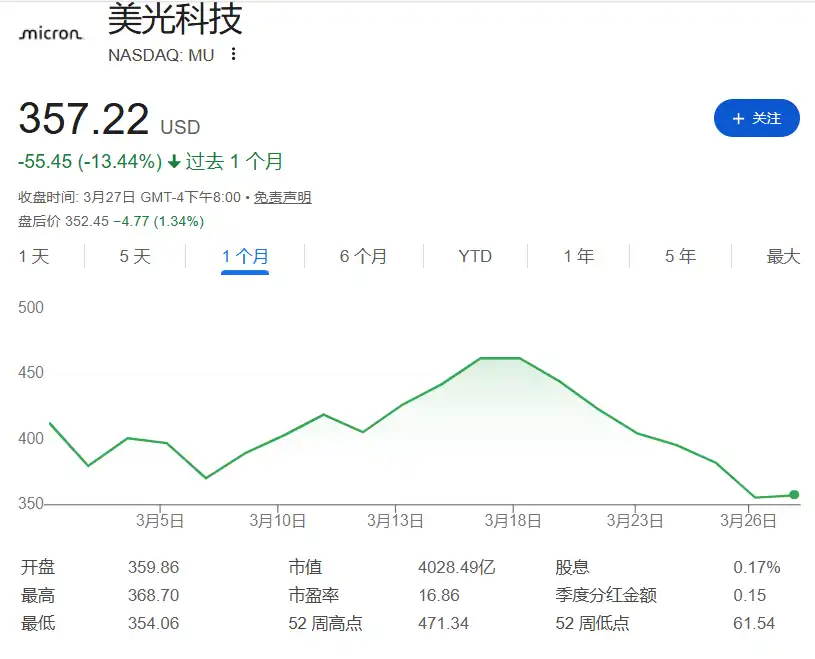
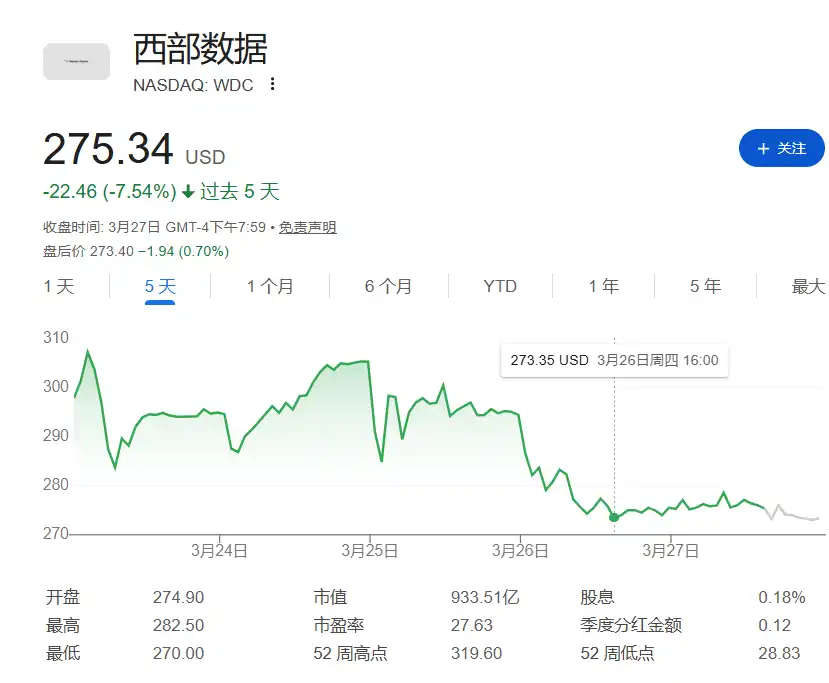
The chill from the spot market quickly spread to the capital markets. Micron Technology's stock price has retreated over 24% from its recent high, and Western Digital has also fallen nearly 21% from its high of $777.60. Simultaneously, the US memory chip sector lost nearly $100 billion in market value last week.

Faced with the price plunge and stock crash, market participants are severely divided on the prospects of the memory industry. Some investors believe the traditional memory "hog cycle" has peaked, while HSBC's institutional research believes the market is overly worried, and the current situation is the mid-point of an AI-driven memory super cycle, with strong demand for high-end products like HBM, and the memory shortage may persist for one to two years.
The Buyer Says 'No': A Repeat of the Traditional "Hog Cycle"?

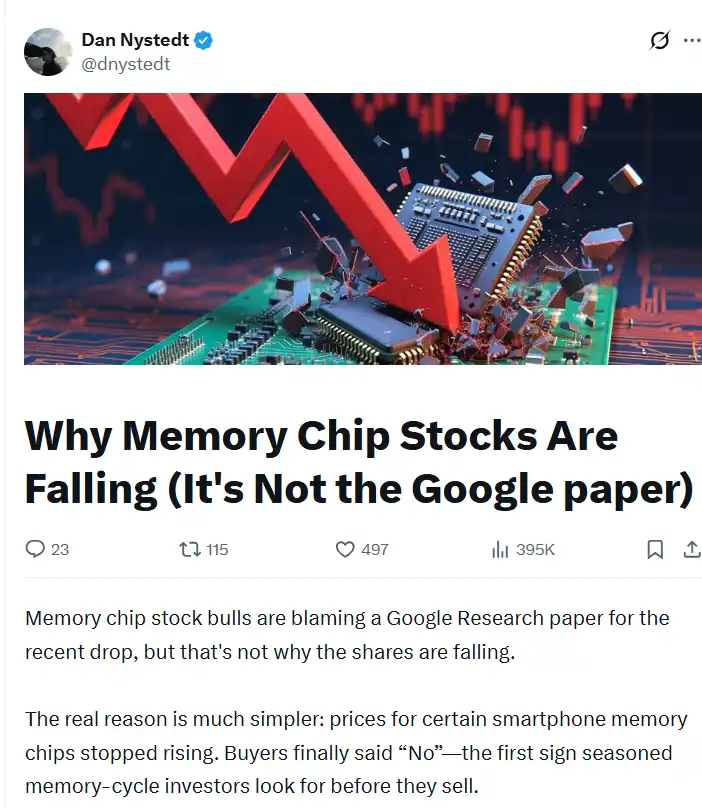
For traders following the traditional cycle, the market crash is not that simple. Former journalist and renowned Taiwan-based semiconductor analyst Dan Nystedt pointed out that many bulls blame the recent plunge on the Google paper, but this is just the surface. Dan believes the real reason is that prices for some smartphone memory chips have stopped rising.

"The real reason is much simpler: prices for some smartphone memory chips stopped rising. Buyers finally said 'no'—this is the first peak signal experienced memory cycle investors look for before selling," said Dan Nystedt. Due to excessively high DRAM and NAND prices, some smartphone manufacturers plan to reduce or even cancel the production of low to mid-range phones in 2026. He revealed that buyers rejected higher DDR4 prices two weeks ago.

Dan Nystedt compared the memory industry to the "hog cycle" in agriculture: high prices prompt companies to expand production, but building factories takes time, and when new capacity is released simultaneously, prices plummet. He believes investors following this script have quickly withdrawn, leading to significant corrections in the stock prices of Micron and SanDisk (Note: likely refers to Western Digital which acquired SanDisk).

Over the past 50 years, memory chips have experienced over a dozen major boom/bust cycles. Since 2010 alone, there have been three: the 2012-2015 3G/4G and cloud computing explosion; the 2016-2019 5G and cloud service provider expansion; and the 2020-2023 pandemic-driven PC/server surge. The cycle starting in 2024 is an upcycle driven by AI servers (HBM and SRAM).

"Whenever someone writes 'this time is different,' that is usually a classic sign of bullish sentiment running wild," Nystedt quoted legendary trader Jesse Livermore: "The market is always right, and opinions are often wrong." He reminded investors that when chip buyers stop panic buying, and when rallies repeatedly face sustained selling, seasoned money will quickly retreat according to the script.
Structural Change: Are Memory Companies No Longer "Cyclical Stocks"?

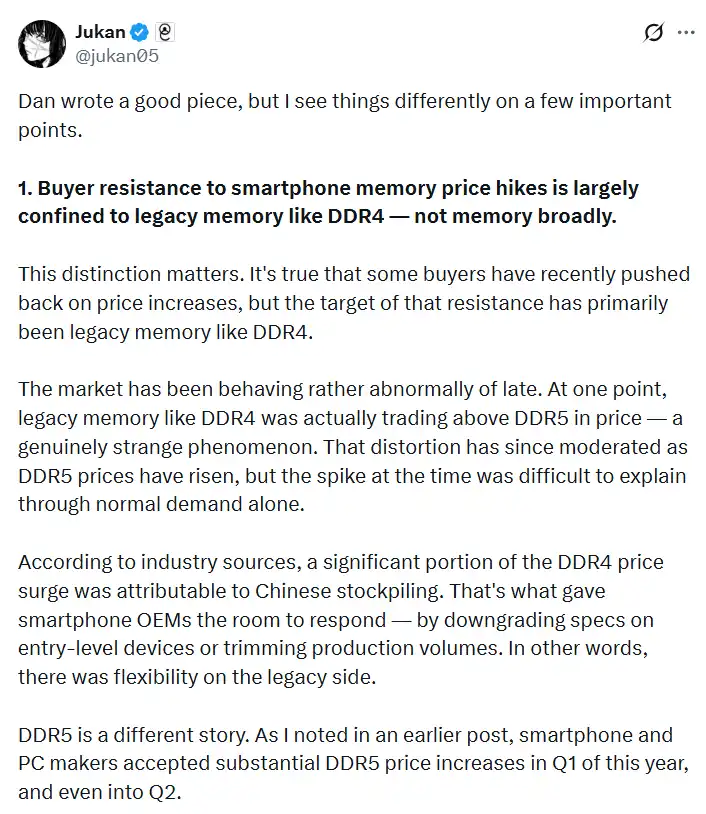
However, independent analyst Jukan offered a different perspective on Dan Nystedt's analysis.

He pointed out that buyer resistance to price increases is mainly concentrated on traditional memory like DDR4, not the entire memory market. The abnormal spike in DDR4 prices was partly attributed to stockpiling in the Chinese market, which gave smartphone manufacturers room to adjust the specifications of low-end devices.

"But DDR5 is a completely different story," Jukan noted. Smartphone and PC manufacturers dutifully accepted the significant price increases for DDR5 in Q1 and even Q2 of this year. In the current AI and high-end device ecosystem, DDR5 is not a negotiable item but a core input that buyers must secure even by paying a premium. Flagship products built around DDR5 simply cannot have their specifications reduced.

Secondly, the market has completely ignored the fundamental transformation in the business models of memory giants. Jukan expressed disdain for so-called "sophisticated investors" who blindly sell based on spot price declines.

"Memory companies are no longer operating in the old mode of blind capacity expansion," Jukan敏锐地 (sharply) pointed out. The three giants—Samsung, SK Hynix, and Micron—are moving closer to TSMC's business model: namely, building capacity only after securing advance payments and long-term demand visibility from core customers.

Recently, Korean media reported that Samsung is discussing prepayment-based cooperation agreements with giants like Microsoft. Memory giants understand the pain of capacity过剩 (excess) destroying cycles better than anyone. Therefore, they are now pursuing extremely restrained capacity expansion, not reflexive overbuilding.
Investment Banks Bullish: Memory Super Cycle Only at Midpoint, Market's Five Major Worries Overblown

In contrast to the panic in the spot market, investment banks remain confident in the long-term prospects of the memory industry. HSBC stated clearly in a research report released on March 30, "In our view, the current concerns are overblown; we are at the midpoint of an AI-driven super cycle."

The report listed five specific current market worries as overreactions:

1) Negative impact of rising raw material and electricity prices due to Middle East conflicts;

2) Slowing memory price growth in the second half of 2026;

3) Industry technologies like Google's "TurboQuant" and NVIDIA's "KVTC" that reduce memory usage in AI systems;

4) Gradually increasing capital expenditure plans by major memory manufacturers;

5) Intensifying competition from Chinese memory manufacturers.

The report pointed out that Middle East conflicts have no substantial impact on memory manufacturers' procurement of raw materials. The absolute growth in profits will have a far greater impact on stock prices than the slowing slope of DRAM price increases. Simultaneously, memory manufacturers remain highly清醒 (clear-headed) and restrained in their execution of capital expenditures.

Regarding the Google TurboQuant technology that triggered the market sell-off, the bank believes it is too early to worry. The commercialization of this technology will take about a year, and its reference parameter scale is smaller than the current AI environment. More importantly, the bank noted that TurboQuant alleviates the memory bandwidth bottleneck, will improve system efficiency, reduce token costs, and thus accelerate the commercialization and popularization of AI. The report wrote:

"The net impact is, we believe efficiency gains will accelerate AI development—a positive event that should trigger a sharp increase in AI adoption rates."

Meanwhile, the bank forecasts that AI server shipments will surge 28% year-on-year in 2026. From 2026 to 2027, the average DRAM content per server will achieve strong growth of 17%. With the explosion of AI inference demand, enterprise Solid State Drives (eSSD) are ushering in a golden age. The report expects the share of eSSD in total NAND demand to soar from 18% in 2023 to 40% by 2027. AI servers will consume 62% of that.

The bank believes the current market is at the midpoint of an AI-driven super cycle, comparable in scale to the six-year DRAM shortage triggered by office automation from 1990-1995. Looking back at history, from 1990 to 1995, alongside the popularization of Windows 3.0 and subsequent operating systems, office automation caused a structural DRAM shortage lasting six years, driving the DRAM market size to soar sixfold from $7 billion in 1990 to $41 billion in 1995.

The bank believes that the infrastructure construction催生 (spawned) by large models, agentic AI, and physical AI (like autonomous driving) will cause memory shortages to persist for at least one to two years.

Based on these assessments, the report is firmly optimistic about their certainty of benefiting from the memory super cycle. Regarding the recent暴跌 (plunge), the report wrote: "We believe any pullback provides an additional buying opportunity."


Pertanyaan Terkait

QWhat caused the recent sharp decline in memory module prices according to the article?

AThe decline was triggered by a combination of factors, including buyers (like smartphone manufacturers) refusing higher prices for certain chips (e.g., DDR4), leading to a market pullback. Additionally, panic selling by large-scale hoarders in the market and a reaction to Google's 'TurboQuant' compression algorithm paper, which investors interpreted as a future reducer of AI hardware memory demand, contributed to the drop.

QHow does analyst Dan Nystedt characterize the memory industry's cycles, and what was the key signal he identified for a market top?

ADan Nystedt characterizes the memory industry's cycles as similar to the agricultural 'hog cycle,' where high prices lead to capacity expansion, and when new capacity is released simultaneously, prices crash. The key signal he identified for a market top was buyers finally saying 'no' to higher prices, which is the first sign experienced memory cycle investors look for before selling.

QWhat contrasting view does analyst Jukan present regarding the current memory market situation?

AJukan argues that the buyer resistance is primarily focused on traditional memory like DDR4, often driven by hoarding in China, and not the entire market. He emphasizes that DDR5 is a core, non-negotiable component for AI and high-end devices, with buyers accepting its price increases. Furthermore, he states that memory giants have fundamentally changed their business models, moving towards a more controlled capacity expansion approach similar to TSMC, using prepayments and long-term contracts to avoid the destructive overcapacity of past cycles.

QAccording to the HSBC report cited, what is the overall perspective on the current memory market downturn and the long-term cycle?

AHSBC's report states that the current market concerns are overblown and that the industry is at the midpoint of an AI-driven super cycle. It argues that the downturn is an overreaction and that any price pullback presents a buying opportunity. The report compares the current AI-driven infrastructure build-out to the six-year DRAM shortage from 1990-1995 caused by office automation and expects the current memory shortage to last at least one to two more years.

QHow does the HSBC report address the market's concerns about new technologies like Google's 'TurboQuant' reducing future memory demand?

AThe HSBC report argues that concern over technologies like Google's 'TurboQuant' is premature, as commercialization is about a year away and its parameters are smaller than current AI setups. Crucially, the report posits that such efficiency improvements will lower the cost per token for AI operations, thereby accelerating the commercialization and adoption of AI. The net effect is seen as positive, likely driving a sharp increase in AI adoption and thus sustaining or even increasing long-term demand for memory.

Bacaan Terkait

Pemain Besar di Pasar Bitcoin yang Tidak Aktif Selama Empat Tahun Mentransfer Bitcoin Senilai Sekitar 46 Juta Dolar! Ini Detailnya

Pemain besar di pasar Bitcoin yang tidak aktif selama empat tahun baru saja mentransfer Bitcoin senilai sekitar $46 juta! Menurut platform analitik Onchain Lens, sebanyak 730 BTC (setara dengan $46,12 juta) telah dipindahkan dari dompet investor besar yang telah lama tidak aktif. Bitcoin tersebut ditransfer ke dompet baru yang baru dibuat. Data blockchain menunjukkan bahwa investor ini mengumpulkan aset tersebut selama tujuh tahun terakhir dan menyimpannya di alamat yang sama tanpa transaksi apa pun. Aktivitas ini diduga terkait dengan kerentanan keamanan yang baru-baru ini ditemukan di dompet perangkat keras Coldcard. Analis menduga investor jangka panjang mungkin mulai memindahkan aset mereka ke dompet baru yang lebih aman karena kekhawatiran keamanan. Namun, belum ada bukti bahwa Bitcoin yang ditransfer dikirim ke pertukaran kripto, sehingga tidak jelas apakah transfer ini untuk dijual atau hanya untuk keamanan. Aktivasi dompet yang lama tidak aktif dianggap sebagai sinyal penting oleh investor. Namun, para ahli menekankan bahwa transfer antar dompet tidak selalu berarti penjualan dan sering dilakukan untuk keamanan, strategi penyimpanan, atau manajemen portofolio institusional. Peristiwa ini mengikuti transfer besar Bitcoin lainnya baru-baru ini, menunjukkan peningkatan aktivitas pergerakan dana, terutama di kalangan investor jangka panjang.

cryptonews.ru6m yang lalu

Pemain Besar di Pasar Bitcoin yang Tidak Aktif Selama Empat Tahun Mentransfer Bitcoin Senilai Sekitar 46 Juta Dolar! Ini Detailnya

cryptonews.ru6m yang lalu

Mendalam: Tamu Asing Genspark

Genspark, sebuah perusahaan AI yang berkantor pusat di Palo Alto, AS, secara aktif membangun narasi sebagai perusahaan "AS asli" di industri AI global. Artikel ini mengungkap strategi Genspark yang kontradiktif: di satu sisi, mereka berusaha keras memamerkan hubungan dengan raksasa teknologi AS seperti OpenAI, Anthropic, dan Microsoft (melalui foto bersama, studi kasus, dan konten sponsor), menandatangani petisi terbuka untuk mendukung model open-weight, dan menghindari keterlibatan publik dengan komunitas atau perusahaan AI Tionghoa. Di sisi lain, operasi inti Genspark diduga sangat bergantung pada sumber daya "tersembunyi" dari Tiongkok, termasuk tim pengembangan di Beijing, penggunaan model open-weight Tiongkok melalui platform pihak ketiga, dan kemungkinan aliran pendapatan dari klien Tiongkok yang mengakses model AS secara tidak langsung. Produk utama Genspark, yang dipasarkan sebagai "AI Costco," adalah ruang kerja AI yang mengintegrasikan puluhan model dan alat. Kekuatan perusahaan ini terletak pada kemampuannya meniru dengan cepat produk AI yang sudah terbukti di pasar (seperti Perplexity, Manus, Plaud Note), menggabungkannya ke dalam satu langganan, dan mendorong pertumbuhan melalui mesin pemasaran agresif (iklan Super Bowl, iklan kereta bawah tanah, konten berbayar di Wall Street Journal). Namun, pertumbuhan pengunjung websitenya dilaporkan menurun tajam. Intinya, Genspark menjalankan tugas agen jangka panjangnya sendiri: memproyeksikan citra sebagai perusahaan AI Silicon Valley yang murni sambil memanfaatkan ekosistem, tenaga kerja, dan kemungkinan pasar Tiongkok di balik layar.

marsbit22m yang lalu

Mendalam: Tamu Asing Genspark

marsbit22m yang lalu

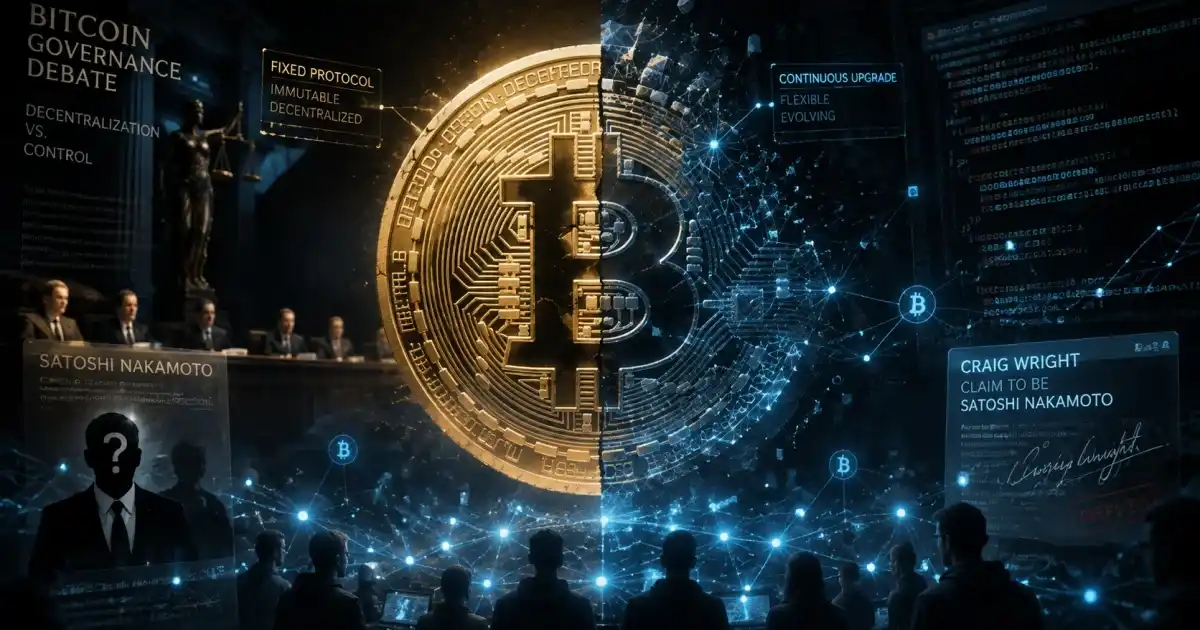
Bitcoin Haruskah "Tidak Berubah"? Craig Wright Kembali Picu Perdebatan Arah Tata Kelola

Bitcoin: Tetap Tidak Berubah atau Terus Berevolusi? Perdebatan Craig Wright tentang Tata Kelola Craig Wright kembali memicu perdebatan mengenai tata kelola Bitcoin dengan berpendapat bahwa protokol Bitcoin harus tetap permanen dan tidak berubah, menjaga aturan moneter yang transparan dan tidak dapat diubah seenaknya sebagai nilai intinya. Ia mengkritik arah perkembangan saat ini yang menurutnya ditentukan oleh segelintir pengembang. Artikel ini membahas dilema inti: apakah Bitcoin harus mempertahankan protokol tetap untuk membangun kepercayaan dan determinisme, atau harus beradaptasi dengan ancaman keamanan dan kebutuhan pengguna yang terus berubah melalui peningkatan? Dua pandangan bertentangan dijelaskan: 1. **Pendukung protokol tetap**: Menekankan bahwa nilai utama Bitcoin terletak pada aturan yang stabil dan tidak dapat diubah, seperti pasokan yang tetap, yang membedakannya dari sistem keuangan tradisional. Perubahan bisa mengurangi kepercayaan. 2. **Pendukung peningkatan berkelanjutan**: Berargumen bahwa sistem teknis harus berevolusi untuk tetap kompetitif, menangani masalah privasi, efisiensi, dan mendukung pengembangan lapisan kedua. Artikel menyoroti bahwa Bitcoin sebenarnya telah mengalami peningkatan signifikan seperti SegWit (2017) dan Taproot (2021), yang disepakati melalui konsensus komunitas, bukan keputusan terpusat. Tantangan sebenarnya bukan pada "berubah atau tidak", tetapi pada **siapa yang memiliki kekuasaan untuk mengubah** dan **proses perubahan yang sesuai dengan prinsip desentralisasi**. Peran pengembang inti juga diperdebatkan: meskipun mereka memiliki pengaruh dalam pemeliharaan kode, mereka tidak dapat memaksa perubahan tanpa penerimaan luas dari penambang, operator node, dan pengguna. Tata kelola Bitcoin lebih mirip **mekanisme konsensus sosial**. Kesimpulannya, perdebatan ini menggarisbawahi tantangan terbesar Bitcoin: bagaimana mengelola jaringan global tanpa otoritas pusat sambil menyeimbangkan **stabilitas aturan inti** dengan **kemampuan beradaptasi**. Masa depan Bitcoin kemungkinan akan mengikuti jalan tengah: mempertahankan stabilitas aturan inti sambil melakukan peningkatan terbatas melalui konsensus komunitas yang hati-hati. Eksperimen tata kelola desentralisasi ini terus berlanjut.

marsbit40m yang lalu

Bitcoin Haruskah "Tidak Berubah"? Craig Wright Kembali Picu Perdebatan Arah Tata Kelola

marsbit40m yang lalu

Diskusi: Pekerja Korea Takut Kehilangan Pekerjaan, Tapi Elon Musk Membayangkan Masyarakat 'Tanpa Pekerjaan'?

200 tahun lalu, buruh tekstil Inggris menghancurkan mesin. Kini, keresahan serupa muncul di pabrik mobil Hyundai Korea Selatan. Meskipun pemogokan Juli lalu terutama terkait tuntutan upah, serikat pekerja juga secara resmi memasukkan jaminan pekerjaan di era robot dan AI ke dalam negosiasi. Kekhawatiran ini dipicu oleh rencana Hyundai mengadopsi robot humanoid seperti Boston Dynamics Atlas. Sementara pekerja Hyundai cemas robot akan merebut pekerjaan mereka, Elon Musk justru membayangkan masa depan di mana AI dan robot melakukan hampir semua pekerjaan, membawa masyarakat ke era "kelimpahan tinggi" di mana bekerja menjadi pilihan, bukan keharusan untuk bertahan hidup. Ia mengusulkan "Universal High Income" agar manfaat produktivitas robot didistribusikan secara luas. Namun, jurang antara visi jauh ke depan dan realitas saat ini sangat lebar. Robot saat ini masih jauh dari kemampuan menggantikan sepenuhnya pengetahuan implisit dan adaptabilitas buruh terampil di lini produksi yang kompleks. Namun, kecemasan sosial telah muncul lebih dini, mencerminkan pertanyaan mendasar yang sama dengan gerakan Luddite dulu: ketika mesin menciptakan efisiensi dan kekayaan lebih besar, siapa yang akan menikmatinya? Tantangan terberat bukan pada titik akhir yang dibayangkan Musk, tetapi pada masa transisi yang panjang. Teknologi berkembang secara bertahap, sementara sistem sosial dan aturan distribusi manfaat sering tertinggal. Jika biaya transformasi—seperti kehilangan pekerjaan dan penurunan nilai keterampilan—hanya ditanggung oleh segelintir orang, konflik bisa terjadi sebelum "kelimpahan" tercapai. Oleh karena itu, diskusi tentang aturan, tanggung jawab, distribusi manfaat, dan jaminan sosial di era robotisasi perlu dimulai lebih awal. Seperti revolusi industri sebelumnya menciptakan standar perburuhan, aturan baru diperlukan untuk memastikan robotisasi berjalan beriringan dengan keadilan dan stabilitas sosial. Keresahan pekerja Hyundai, meski mungkin prematur secara teknologi, adalah pengingat penting untuk mempersiapkan landasan sosial ini sejak dini.

marsbit50m yang lalu

Diskusi: Pekerja Korea Takut Kehilangan Pekerjaan, Tapi Elon Musk Membayangkan Masyarakat 'Tanpa Pekerjaan'?

marsbit50m yang lalu

Trading

Spot
活动图片