Intelligent Computing Convergence: The Deep Integration Architecture, Paradigm Evolution, and Application Landscape of AI and Cryptocurrency Industries

marsbitDipublikasikan tanggal 2026-03-17Terakhir diperbarui pada 2026-03-17

Abstrak

The deep integration of AI and cryptocurrency represents a fundamental paradigm shift, moving beyond mere technological convergence to reshape economic and computational infrastructures. By 2025, the crypto market cap surpassed $4 trillion, signaling its maturation, while AI evolved from centralized models toward decentralized, transparent “open intelligence.” Key architectural innovations include decentralized physical infrastructure networks (DePINs) like Render and Akash, which aggregate global idle GPU resources, and platforms like Ritual that embed AI models into blockchain execution environments. Verification mechanisms such as ZKML and TEE ensure computational integrity and privacy. Bittensor introduces a token-incentivized marketplace for machine intelligence, using its Yuma consensus to reward high-performing models dynamically. AI agents have transitioned from tools to autonomous on-chain entities, capable of managing finances and executing DeFi strategies via protocols like x402 and Olas. Privacy advancements through FHE (e.g., Zama), ZKML, and TEE enable confidential on-chain computations, critical for high-stakes applications. AI also enhances security via automated smart contract auditing and real-time threat prevention systems. This fusion drives enterprise efficiency through cost reduction and secure data processing, while empowering individuals via intent-based agents and data monetization. The future points to “intelligent ledgers” where AI and block...

Authored by: GO2MARS WEB3 Research

Symbiosis of Algorithm and Ledger: A Major Shift in Global Technological Paradigm

In the third decade of the 21st century, the convergence of artificial intelligence (AI) and cryptocurrency (Crypto) is no longer merely the combination of two buzzwords, but a profound revolution in technological paradigms. As the global cryptocurrency market capitalization officially surpassed the $4 trillion mark in 2025, the industry has completed its transition from an experimental niche market to an essential component of the modern economy.

One of the core drivers of this transformation is the deep convergence between AI as an extremely powerful decision-making and processing layer, and blockchain as a transparent, immutable execution and settlement layer. This combination is addressing the respective pain points of both: AI is at a critical juncture of transitioning from monopolization by centralized giants to a decentralized, transparent era of "Open Intelligence"; meanwhile, the crypto industry, after the gradual maturation of its infrastructure, urgently needs AI to solve problems such as complex on-chain interactions, fragile security, and insufficient application utility.
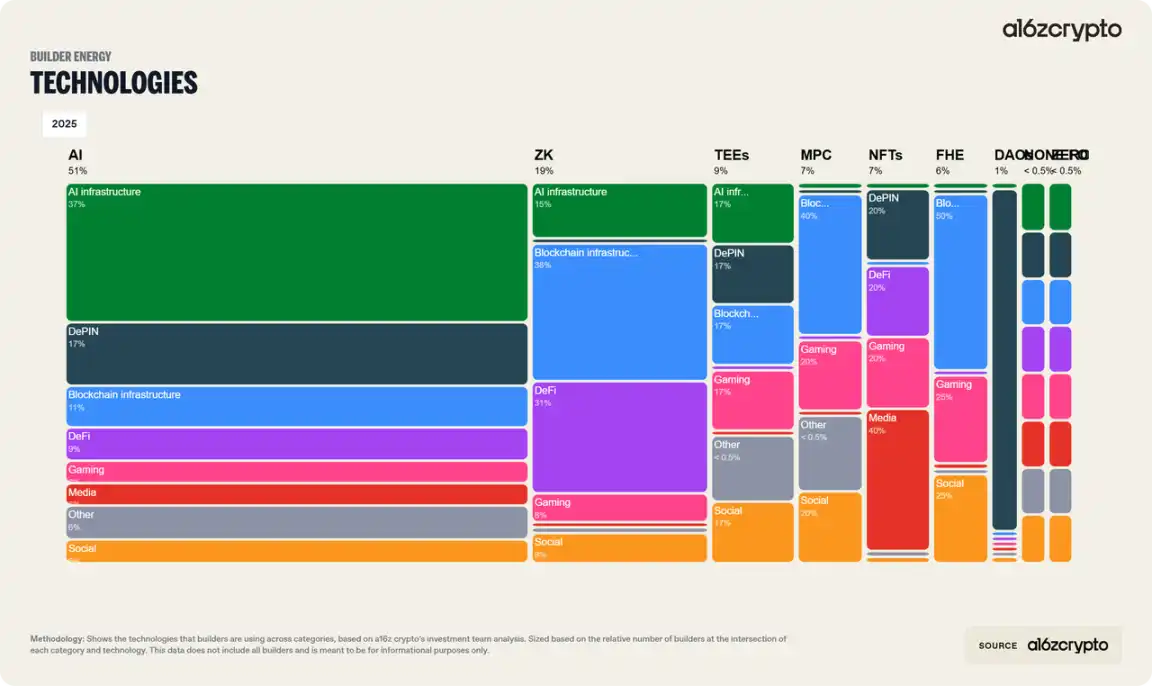
From the perspective of capital flow, the strategic divergence among top-tier venture capital firms also confirms this trend. a16z Crypto completed its fifth fundraising round of $2 billion in 2025, firmly positioning the intersection of AI and Crypto as its long-term strategic core, believing blockchain is the necessary infrastructure to prevent AI censorship and control.

Meanwhile, institutions like Paradigm are attempting to capture cross-industry dividends from technological convergence by expanding their investment boundaries to robotics and generalized AI. According to OECD data, by 2025, venture capital in the global AI sector accounted for 51% of total global investments, while within the Web3 space, the proportion of funding for AI-related projects is also steadily rising, reflecting the market's high recognition of the "decentralized intelligence" narrative.

1. Infrastructure Restructuring: Decentralized Computing Power and Computational Integrity

There is a natural contradiction between AI's insatiable appetite for Graphics Processing Units (GPUs) and the fragility of the current global supply chain. Between 2024 and 2025, GPU shortages became the norm, providing fertile ground for the explosion of Decentralized Physical Infrastructure Networks (DePIN).

1.1 Dual Evolution of Decentralized Computing Markets

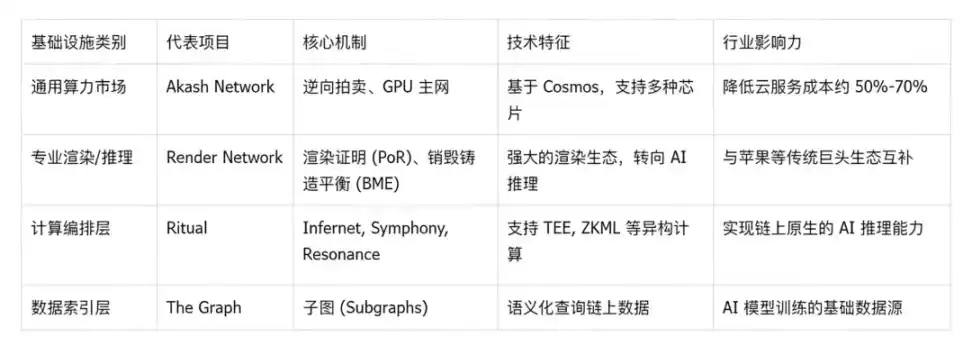
Current decentralized computing platforms are mainly divided into two camps. The first is represented by Render Network (RNDR) and Akash Network (AKT), which aggregate idle GPU computing power from around the world by building decentralized two-sided markets. Render Network has become a benchmark for distributed GPU rendering, not only reducing the cost of 3D creation but also supporting AI inference tasks through blockchain coordination functions, enabling creators to access high-performance computing power at lower prices. Akash, after 2023, achieved a leap forward with its GPU mainnet (Akash ML), allowing developers to rent high-spec chips for large-scale model training and inference.

The second category is represented by new computational orchestration layers like Ritual. Ritual's uniqueness lies in not trying to directly replace existing cloud services, but rather acting as an open, modular sovereign execution layer that embeds AI models directly into the blockchain's execution environment. Its Infernet product allows smart contracts to seamlessly call AI inference results, solving the long-standing technical bottleneck that "on-chain applications cannot natively run AI".
1.2 Computational Integrity and Breakthroughs in Verification Technology

In decentralized networks, verifying "whether computation has been executed correctly" is a core challenge. The technological progress in 2025 has mainly focused on the integrated application of Zero-Knowledge Machine Learning (ZKML) and Trusted Execution Environments (TEE).

The Ritual architecture, through its proof-system agnostic design, allows nodes to choose between TEE code execution or ZK proofs based on task requirements. This flexibility ensures that every inference result generated by an AI model is traceable, auditable, and guaranteed integrity, even in highly decentralized environments.

2. Democratization of Intelligence: The Rise of Bittensor and Commoditized Markets

The emergence of Bittensor (TAO) marks the entry of the AI and Crypto combination into a new stage of "marketization of machine intelligence." Unlike traditional single computing power platforms, Bittensor aims to create an incentive mechanism that allows various machine learning models worldwide to connect, learn from each other, and compete for rewards.

2.1 Yuma Consensus: From Linguistics to Consensus Algorithm

The core of Bittensor is the Yuma Consensus (YC), a subjective utility consensus mechanism inspired by Gricean pragmatics.

YC's operational logic assumes: an efficient cooperator tends to output true, relevant, and information-rich answers, as this is the optimal strategy for obtaining the highest reward in the incentive landscape. Technically, YC calculates token emissions through validators' weighted evaluation of miners' performance. Its core logic for allocating emission shares can be represented by the following LaTeX formula:
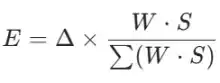
Where E is the emission reward, Δ is the daily total supply increment, W is the matrix of validator evaluation weights, and S is the corresponding staking weight. To prevent malicious collusion or bias, YC introduces a Clipping mechanism, which cuts weight settings that exceed the consensus baseline, ensuring the system's robustness.

2.2 Subnet Economy and the Dynamic TAO Paradigm

By 2025, Bittensor has evolved into a multi-layered architecture. The underlying layer is the Subtensor ledger managed by the Opentensor Foundation, while the upper layer consists of dozens of vertically specialized subnets (Subnets), focusing on specific tasks such as text generation, audio prediction, image recognition, etc.
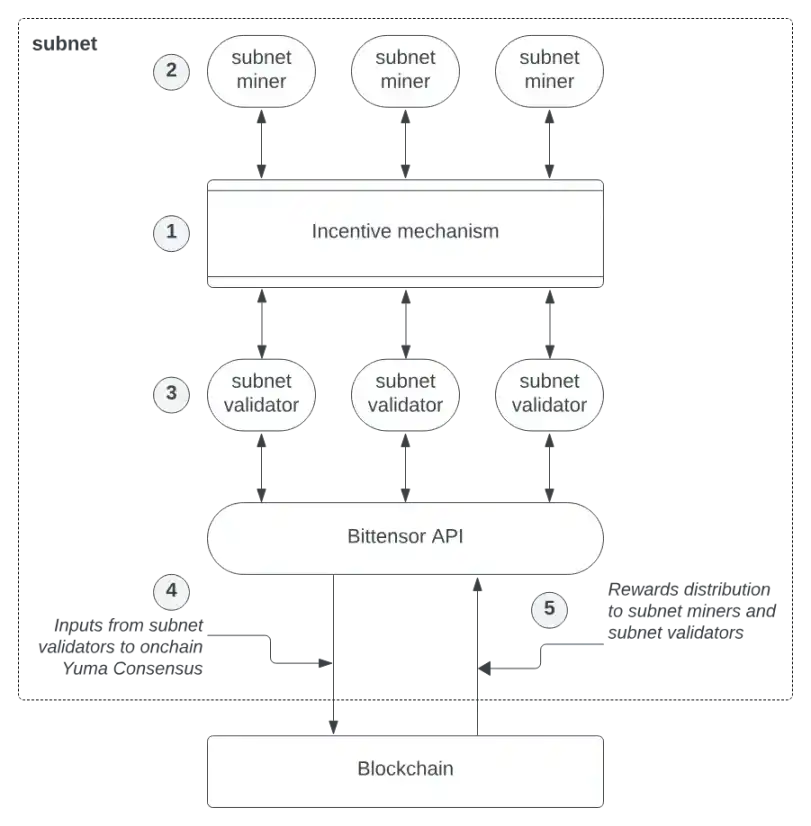
The introduced "Dynamic TAO" mechanism creates independent value reserve pools for each subnet through an Automated Market Maker (AMM), with its price determined by the ratio of TAO to Alpha tokens:
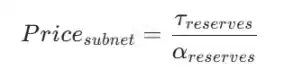
This mechanism enables automatic resource allocation: subnets with high demand and high-quality output will attract more staking, thereby receiving a higher proportion of daily TAO emissions. This competitive market structure is aptly compared to an "Olympic Games of Intelligence," naturally selecting out inefficient models.

3. The Rise of the Agent Economy: AI Agents as First-Class Citizens in Web3

In the 2024-2025 cycle, AI Agents are undergoing a fundamental transformation from "auxiliary tools" to "native on-chain entities." This evolution is reflected not only in the increasing complexity of the technical architecture but also in the fundamental expansion of their roles and permissions within the decentralized finance (DeFi) ecosystem.

Below is an in-depth analysis of this trend:

3.1 Agent Architecture: Closed Loop from Data to Execution

Current on-chain AI agents are no longer simple scripts but mature systems built on three complex logical layers:

Data Input Layer: Agents fetch real-time on-chain data such as liquidity pools, trading volume through blockchain nodes or APIs (like Ethers.js), and incorporate off-chain information like social media sentiment and centralized exchange prices through oracles (like Chainlink).

AI/ML Decision Layer (AI/ML Layer): Agents utilize Long Short-Term Memory networks (LSTM) to analyze price trends, or use Reinforcement Learning to continuously iterate optimal strategies in complex market games. The integration of Large Language Models (LLMs) also empowers agents to understand vague human intentions.

Blockchain Interaction Layer: This is the key to achieving "financial autonomy." Agents can now manage non-custodial wallets, automatically calculate optimal Gas fees, handle nonces, and even integrate MEV protection tools (e.g., Jito Labs) to prevent front-running in transactions.

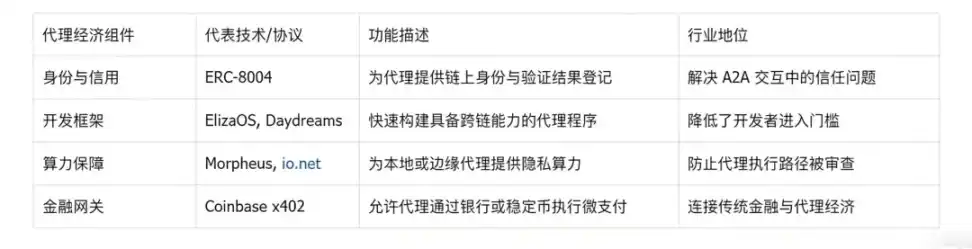
3.2 Financial Rails and Agent-to-Agent Transactions

a16z's 2025 report particularly emphasized the financial backbone of AI agents—protocols like x402 and similar micro-payment standards. These standards allow agents to pay API fees or purchase services from other agents without human intervention. For example, the Olas (formerly Autonolas) ecosystem already processes over 2 million automated transactions between agents monthly, covering tasks from DeFi swaps to content creation.
This trend is tangibly reflected in market data. In terms of growth rate, the AI agent market is on the verge of an explosion. According to research data from MarketsandMarkets, the global AI agent market is expected to grow from $7.84 billion in 2025 to $52.62 billion in 2030, with a compound annual growth rate (CAGR) of 46.3%. Furthermore, Grand View Research provides a similar long-term forecast, estimating the market size to reach $50.31 billion by 2030.

Meanwhile, standard tools at the development layer are also taking shape. The ElizaOS framework, strongly promoted by a16z, has become the infrastructure for the AI agent space, comparable to "Next.js" in front-end development. It allows developers to easily deploy AI agents with full financial capabilities on mainstream social platforms like X, Discord, and Telegram. As of early 2025, the total market capitalization of Web3 projects built on this framework has exceeded $20 billion.

4. Privacy Computing and Confidentiality: The Game of FHE, TEE, and ZKML

Privacy is one of the most challenging issues in the convergence of AI and Crypto. When enterprises run AI strategies on public chains, they neither want to leak private data nor disclose their core model parameters. Currently, the industry has formed three main technical paths: Fully Homomorphic Encryption (FHE), Trusted Execution Environment (TEE), and Zero-Knowledge Machine Learning (ZKML).

4.1 Zama and the Industrialization Journey of FHE

Zama, as a leading unicorn in this field, has made its fhEVM the standard for achieving "full-process encrypted computation." FHE allows computers to perform mathematical operations on data without decrypting it, and the results after decryption are identical to those from plaintext operations.

By 2025, Zama's technology stack has achieved significant performance leaps: for a 20-layer Convolutional Neural Network (CNN), computation speed increased by 21 times, and for a 50-layer CNN, it increased by 14 times. This progress makes "privacy stablecoins" (where transaction amounts are encrypted externally but the protocol can still verify legitimacy) and "sealed-bid auctions" possible on mainstream chains like Ethereum.

4.2 Verification Efficiency of ZKML and Integration with LLM

Zero-Knowledge Machine Learning (ZKML) focuses on "verification" rather than "computation." It allows one party to prove that it correctly ran a complex neural network model without exposing the input data or model weights. The latest zkLLM protocol can already perform end-to-end inference verification for a 13 billion parameter model, reducing proof generation time to within 15 minutes, with a proof size of only 200 KB. This technology is crucial for high-value financial audits and medical diagnostics.

4.3 Synergy between TEE and GPU: The Power of Hopper H100

Compared to FHE and ZKML, TEE (Trusted Execution Environment) offers execution speeds close to native performance. NVIDIA's H100 GPU introduces confidential computing capabilities, isolating memory through hardware-level firewalls, with inference overhead typically below 7%. Protocols like Ritual are heavily adopting GPU-based TEE to support AI agent applications requiring low latency and high throughput.

Privacy computing technology has officially moved from the idealistic conception of the laboratory into a new era of "production-level industrialization." Fully Homomorphic Encryption (FHE), Zero-Knowledge Machine Learning (ZKML), and Trusted Execution Environment (TEE) are no longer isolated technical tracks but together constitute a "modular confidentiality stack" for decentralized artificial intelligence.

This fusion is completely rewriting the underlying logic of Web3 and leads to the following three core conclusions:

FHE is the "HTTPS" underlying standard for Web3: As unicorns like Zama improve computational performance dozens of times, FHE is achieving a qualitative change from "everything public" to "encrypted by default." It solves the privacy challenge of on-chain state processing, enabling privacy stablecoins and fully MEV-resistant trading systems to move from theory to large-scale compliant applications.

ZKML is the mathematical endpoint for algorithmic accountability: The "ZKML singularity" arriving in the second half of 2025 marks a dramatic decrease in verification costs. By compressing the inference proof of a 13 billion parameter (13B) model to within 15 minutes, ZKML provides "mathematical-level consistency" guarantees for high-value financial audits and credit ratings, ensuring AI is no longer an untrustworthy black box.

TEE is the performance foundation of the agent economy: Compared to software solutions, TEE based on hardware like NVIDIA H100 offers near-native execution speeds with overhead below 7%. It is currently the only economically viable solution to support hundreds of millions of AI Agents making 24/7 real-time decisions, ensuring that agents securely hold private keys and execute complex strategies within hardware-level firewalls.
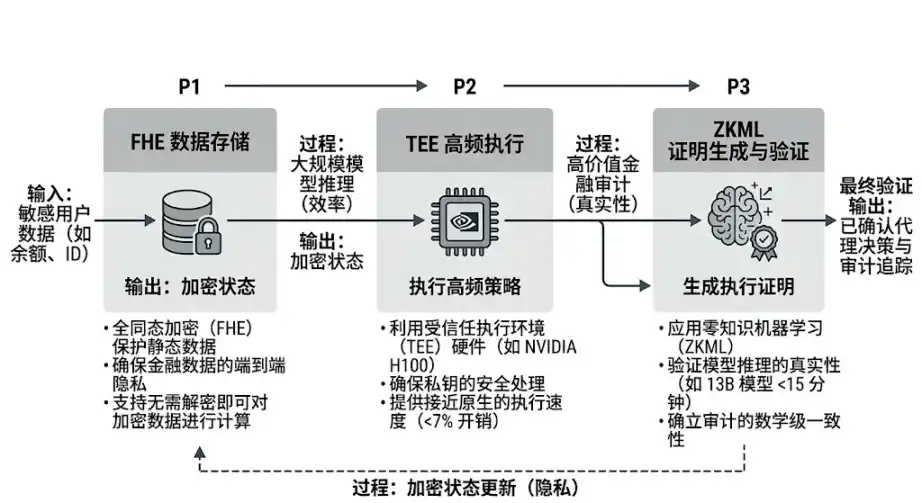
The future technological trend is not the victory of a single path, but the comprehensive popularization of "Hybrid Confidential Computing." In a complete AI business flow: use TEE for large-scale, high-frequency model inference to ensure efficiency; use ZKML at key nodes to generate execution proofs to ensure authenticity; and let FHE handle the encryption of sensitive financial states (such as account balances and private IDs).

This "trinity" fusion is reshaping the crypto industry from a "public transparent ledger" to a "sovereign privacy-enabled intelligent system," truly ushering in the era of an automated agent economy worth trillions of dollars.

5. Industry Security and Automated Auditing: AI as Web3's "Immune System"

The cryptocurrency industry has long been plagued by huge losses caused by smart contract vulnerabilities. The introduction of AI is changing this passive defense situation, shifting it from expensive manual audits to real-time AI monitoring.

5.1 Innovation in Static and Dynamic Audit Tools

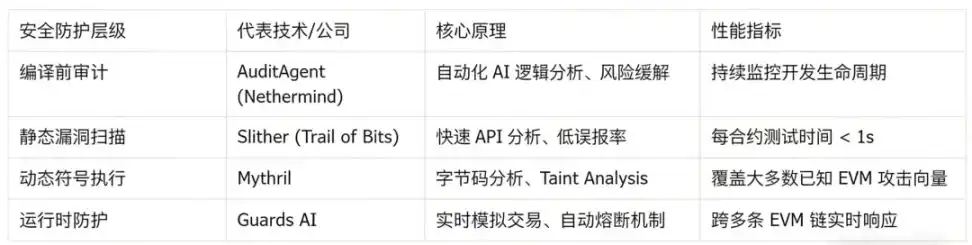
Tools like Slither and Mythril have deeply integrated machine learning models by 2025, capable of scanning Solidity contracts for reentrancy attacks, suicidal functions, or Gas consumption abnormalities in sub-second speeds. Furthermore, fuzzing tools like Foundry and Echidna use AI to generate extreme input data to probe deeply hidden logical vulnerabilities.

5.2 Real-time Threat Prevention Systems

In addition to pre-deployment audits, real-time defense has also made significant progress. Systems like Guardrail's Guards AI and CUBE3.AI can monitor all pending transactions (Mempool) across chains. Upon detecting malicious attack signals (such as governance attacks or oracle manipulation), they can automatically trigger contract pauses or intercept malicious transactions. This "active immunity" significantly reduces the risk of DeFi protocol hacks.
Practical Roadmap for Leveraging AI to Develop Crypto

In the future digital landscape, the convergence of AI and Crypto is no longer a technological experiment but a deep revolution concerning "productivity efficiency" and "wealth distribution rights." This combination not only gives AI an independently controlled "wallet" but also gives Crypto an autonomously thinking "brain," jointly opening the era of an autonomous agent economy worth trillions of dollars.

The following is the core benefits and practical map of this convergence at the enterprise and individual levels:

1. Enterprise Level: From "Cost Reduction and Efficiency Increase" to "Business Boundary Expansion"

For enterprises, the combination of AI and Crypto primarily solves the structural contradiction between high computing power costs, fragile system security, and data privacy protection.

Drastic reduction in infrastructure costs (DePIN effect): Leveraging distributed computing power networks (like Akash or Render), enterprises are no longer trapped by expensive NVIDIA H100 cluster procurement. Actual measurement data shows that renting global idle GPUs can reduce costs by 39% to 86% compared to traditional cloud service providers. This "computing freedom" allows startups to afford fine-tuning and training of ultra-large-scale models.

Automation and cost reduction of security barriers: Traditional contract audit cycles are long and expensive. Now, by deploying AI security agents like AuditAgent, driven by neural networks, enterprises can achieve "sentry monitoring" throughout the entire development lifecycle. They can identify logical vulnerabilities like reentrancy attacks the moment code is submitted and can automatically trigger contract circuit breakers at the mempool level the instant a hacker's command is issued, protecting protocol assets from loss.

"Encrypted Computing" for core business secrets: With Fully Homomorphic Encryption (FHE) and networks like Nillion's "Blind Compute," enterprises can run AI strategies on public chains without disclosing core model parameters and private customer data. This not only establishes data sovereignty but also allows financial and medical data, previously restricted by compliance risks, to enter the decentralized collaboration network.

2. Individual Level: From "Financial Blind Spots" to "Intelligent Sovereign Economy"

For individual users, the fusion of AI and Crypto means the complete disappearance of technical barriers and the opening of new income channels.

Intent-oriented "Private Banker": Future users will no longer need to understand what Gas fees or cross-chain bridges are. AI agents built on frameworks like ElizaOS will achieve "radical abstraction"—you just need to say: "Help me deposit this $1000 in the place with the highest interest and safest," and the AI will autonomously monitor APY across the network and automatically close positions during risk fluctuations. Ordinary people can thus enjoy asset management at the level of top hedge funds.

Assetization of personal data (Data Yield Farming): Your digital footprint is no longer taken for free by giants. Through platforms like Synesis One, users can participate in "Train2Earn," providing labeled data for AI training and directly obtaining token rewards. You can even earn passive dividends every time an AI calls a specific knowledge entry by holding a Kanon NFT, truly realizing "data as an asset."

Ultimate protection of privacy and identity: Using Worldcoin or cryptographic identity protocols, you can prove you are human and not an AI, while using privacy computing networks to protect sensitive information like your personal schedule and home address from being leaked to AI service providers. This "blind interaction" mode ensures that while you benefit from AI convenience, you still hold the highest right of interpretation over your digital sovereignty.

This two-way architectural evolution is handing "trust" to the blockchain and "efficiency" to AI. It is not only reconstructing the moats of enterprises but also building a ladder for every ordinary person to access the intelligent sovereign economy.

Evolution Prediction: Towards a New Era of "Intelligent Ledger"

In summary, how can AI and Crypto combine better? The answer lies in shifting from "simple tool stacking" to "deep architectural coupling."

First, blockchain must evolve into a platform capable of supporting large-scale computation. Efforts by protocols like Ritual and Starknet are making ZKML as simple as calling a standard library. Second, AI agents must become legitimate entities in economic life. With the proliferation of identity standards like ERC-8004, we will see an "intelligent network" composed of hundreds of millions of agents, engaging in 24/7 resource gaming and value exchange on-chain.

Finally, this fusion will reshape human financial sovereignty. Privacy payments realized through FHE, fair creator distribution achieved through provenance protocols, and algorithmic democratization realized through markets like Bittensor, together constitute a blueprint for a fairer, more efficient, and decentralized future digital economy.

In this technological marathon, the crypto industry provides not just capital, but a philosophical framework about "transparency" and "trust"; while AI provides the "brain" that makes these frameworks operate. As 2026 approaches, this convergence will not be limited to technical circles but will reach billions of ordinary users globally through more intuitive AI interaction interfaces.


Pertanyaan Terkait

QWhat are the two main types of decentralized computing platforms mentioned in the article, and what are their key characteristics?

AThe two main types are: 1) Decentralized bilateral markets like Render Network (RNDR) and Akash Network (AKT), which aggregate idle global GPU power to provide cost-effective computing for tasks like rendering and AI inference. 2) New computational orchestration layers like Ritual, which act as an open, modular sovereign execution layer that embeds AI models directly into a blockchain's execution environment, allowing smart contracts to natively call AI inference results.

QHow does Bittensor's Yuma consensus mechanism work to incentivize and validate machine learning models?

ABittensor's Yuma consensus (YC) is a subjective utility consensus mechanism inspired by Gricean pragmatics. It operates on the logic that an efficient collaborator is incentivized to output truthful, relevant, and informative answers to gain the highest rewards. Validators evaluate the performance of miners (ML models), and token emissions are calculated based on a matrix of these validator-assigned weights and corresponding staking weights. A clipping mechanism is used to cut weights that exceed a consensus benchmark, ensuring system robustness against collusion or bias.

QWhat are the three primary technical paths for ensuring privacy in AI and Crypto applications, as discussed in the article?

AThe three primary technical paths for privacy are: 1) Fully Homomorphic Encryption (FHE), exemplified by Zama's fhEVM, which allows computation on encrypted data. 2) Zero-Knowledge Machine Learning (ZKML), which focuses on verifying that a complex neural network model was run correctly without revealing input data or model weights. 3) Trusted Execution Environments (TEE), such as those utilizing NVIDIA's H100 GPU, which provide hardware-level memory isolation for high-speed, confidential computation with low overhead.

QAccording to the article, how is AI transforming security and auditing in the Web3 space?

AAI is transforming Web3 security by moving from expensive manual audits to real-time AI monitoring. Tools like Slither and Mythril now integrate machine learning models to scan smart contracts for vulnerabilities at sub-second speeds. Furthermore, real-time threat prevention systems like Guardrail's Guards AI and CUBE3.AI monitor the mempool across chains, automatically intercepting malicious transactions or triggering contract pauses upon detecting attack signals, such as governance attacks or oracle manipulation, thus providing a proactive 'immune system' for DeFi protocols.

QWhat is the predicted future trend for the architecture of decentralized AI, particularly concerning privacy technologies?

AThe predicted future trend is not the victory of a single path but the comprehensive adoption of 'Hybrid Confidential Computing.' In a complete AI workflow, TEE would be used for large-scale, high-frequency model inference to ensure efficiency; critical nodes would use ZKML to generate execution proofs for verifiability; and sensitive financial states (like account balances) would be handled by FHE for encrypted storage. This 'trinity' fusion is reshaping the crypto industry from a 'transparent ledger' into a 'sovereign privacy intelligent system' capable of powering a multi-trillion-dollar automated agent economy.

Bacaan Terkait

Trading

Spot
Futures

Artikel Populer

Apa Itu GROK AI

Grok AI: Merevolusi Teknologi Percakapan di Era Web3 Pendahuluan Dalam lanskap kecerdasan buatan yang terus berkembang dengan cepat, Grok AI menonjol sebagai proyek yang patut diperhatikan yang menjembatani domain teknologi canggih dan interaksi pengguna. Dikembangkan oleh xAI, sebuah perusahaan yang dipimpin oleh pengusaha terkenal Elon Musk, Grok AI berupaya untuk mendefinisikan ulang cara kita berinteraksi dengan kecerdasan buatan. Seiring dengan berkembangnya gerakan Web3, Grok AI bertujuan untuk memanfaatkan kekuatan AI percakapan untuk menjawab pertanyaan kompleks, memberikan pengguna pengalaman yang tidak hanya informatif tetapi juga menghibur. Apa itu Grok AI? Grok AI adalah chatbot AI percakapan yang canggih yang dirancang untuk berinteraksi dengan pengguna secara dinamis. Berbeda dengan banyak sistem AI tradisional, Grok AI menerima berbagai pertanyaan yang lebih luas, termasuk yang biasanya dianggap tidak pantas atau di luar respons standar. Tujuan inti proyek ini meliputi: Penalaran yang Andal: Grok AI menekankan penalaran akal sehat untuk memberikan jawaban logis berdasarkan pemahaman kontekstual. Pengawasan yang Dapat Diskalakan: Integrasi bantuan alat memastikan bahwa interaksi pengguna dipantau dan dioptimalkan untuk kualitas. Verifikasi Formal: Keamanan adalah hal yang utama; Grok AI menggabungkan metode verifikasi formal untuk meningkatkan keandalan output-nya. Pemahaman Konteks Panjang: Model AI unggul dalam mempertahankan dan mengingat riwayat percakapan yang luas, memfasilitasi diskusi yang bermakna dan sadar konteks. Ketahanan Adversarial: Dengan fokus pada peningkatan pertahanannya terhadap input yang dimanipulasi atau berbahaya, Grok AI bertujuan untuk mempertahankan integritas interaksi pengguna. Intinya, Grok AI bukan hanya perangkat pengambilan informasi; ini adalah mitra percakapan yang imersif yang mendorong dialog yang dinamis. Pencipta Grok AI Otak di balik Grok AI tidak lain adalah Elon Musk, seorang individu yang identik dengan inovasi di berbagai bidang, termasuk otomotif, perjalanan luar angkasa, dan teknologi. Di bawah naungan xAI, sebuah perusahaan yang fokus pada kemajuan teknologi AI dengan cara yang bermanfaat, visi Musk bertujuan untuk membentuk kembali pemahaman tentang interaksi AI. Kepemimpinan dan etos dasar sangat dipengaruhi oleh komitmen Musk untuk mendorong batasan teknologi. Investor Grok AI Meskipun rincian spesifik mengenai investor yang mendukung Grok AI masih terbatas, secara publik diakui bahwa xAI, inkubator proyek ini, didirikan dan didukung terutama oleh Elon Musk sendiri. Usaha dan kepemilikan Musk sebelumnya memberikan dukungan yang kuat, lebih lanjut memperkuat kredibilitas dan potensi pertumbuhan Grok AI. Namun, hingga saat ini, informasi mengenai yayasan investasi tambahan atau organisasi yang mendukung Grok AI tidak tersedia secara mudah, menandai area untuk eksplorasi potensial di masa depan. Bagaimana Grok AI Bekerja? Mekanisme operasional Grok AI sama inovatifnya dengan kerangka konseptualnya. Proyek ini mengintegrasikan beberapa teknologi mutakhir yang memfasilitasi fungsionalitas uniknya: Infrastruktur yang Kuat: Grok AI dibangun menggunakan Kubernetes untuk orkestrasi kontainer, Rust untuk kinerja dan keamanan, dan JAX untuk komputasi numerik berkinerja tinggi. Ketiga elemen ini memastikan bahwa chatbot beroperasi secara efisien, dapat diskalakan dengan efektif, dan melayani pengguna dengan cepat. Akses Pengetahuan Real-Time: Salah satu fitur pembeda Grok AI adalah kemampuannya untuk mengakses data real-time melalui platform X—sebelumnya dikenal sebagai Twitter. Kemampuan ini memberikan AI akses ke informasi terbaru, memungkinkannya untuk memberikan jawaban dan rekomendasi yang tepat waktu yang mungkin terlewat oleh model AI lainnya. Dua Mode Interaksi: Grok AI menawarkan pengguna pilihan antara “Mode Menyenangkan” dan “Mode Reguler.” Mode Menyenangkan memungkinkan gaya interaksi yang lebih bermain dan humoris, sementara Mode Reguler fokus pada memberikan respons yang tepat dan akurat. Fleksibilitas ini memastikan pengalaman yang disesuaikan yang memenuhi berbagai preferensi pengguna. Intinya, Grok AI menggabungkan kinerja dengan keterlibatan, menciptakan pengalaman yang kaya dan menghibur. Garis Waktu Grok AI Perjalanan Grok AI ditandai oleh tonggak penting yang mencerminkan tahap pengembangan dan penerapannya: Pengembangan Awal: Fase dasar Grok AI berlangsung selama sekitar dua bulan, di mana pelatihan awal dan penyempurnaan model dilakukan. Rilis Beta Grok-2: Dalam kemajuan signifikan, beta Grok-2 diumumkan. Rilis ini memperkenalkan dua versi chatbot—Grok-2 dan Grok-2 mini—masing-masing dilengkapi dengan kemampuan untuk chatting, coding, dan penalaran. Akses Publik: Setelah pengembangan beta, Grok AI menjadi tersedia untuk pengguna platform X. Mereka yang memiliki akun yang diverifikasi dengan nomor telepon dan aktif selama setidaknya tujuh hari dapat mengakses versi terbatas, membuat teknologi ini tersedia untuk audiens yang lebih luas. Garis waktu ini mencakup pertumbuhan sistematis Grok AI dari awal hingga keterlibatan publik, menekankan komitmennya untuk perbaikan berkelanjutan dan interaksi pengguna. Fitur Utama Grok AI Grok AI mencakup beberapa fitur kunci yang berkontribusi pada identitas inovatifnya: Integrasi Pengetahuan Real-Time: Akses ke informasi terkini dan relevan membedakan Grok AI dari banyak model statis, memungkinkan pengalaman pengguna yang menarik dan akurat. Gaya Interaksi yang Beragam: Dengan menawarkan mode interaksi yang berbeda, Grok AI memenuhi berbagai preferensi pengguna, mengundang kreativitas dan personalisasi dalam berkomunikasi dengan AI. Dasar Teknologi yang Canggih: Pemanfaatan Kubernetes, Rust, dan JAX memberikan proyek ini kerangka kerja yang solid untuk memastikan keandalan dan kinerja optimal. Pertimbangan Diskursus Etis: Penyertaan fungsi penghasil gambar menunjukkan semangat inovatif proyek ini. Namun, hal ini juga menimbulkan pertimbangan etis seputar hak cipta dan penggambaran yang menghormati tokoh-tokoh yang dikenali—diskusi yang sedang berlangsung dalam komunitas AI. Kesimpulan Sebagai entitas perintis di bidang AI percakapan, Grok AI mencakup potensi untuk pengalaman pengguna yang transformatif di era digital. Dikembangkan oleh xAI dan didorong oleh pendekatan visioner Elon Musk, Grok AI mengintegrasikan pengetahuan real-time dengan kemampuan interaksi yang canggih. Ini berupaya untuk mendorong batasan apa yang dapat dicapai oleh kecerdasan buatan sambil tetap fokus pada pertimbangan etis dan keselamatan pengguna. Grok AI tidak hanya mewujudkan kemajuan teknologi tetapi juga mewakili paradigma percakapan baru di lanskap Web3, menjanjikan untuk melibatkan pengguna dengan pengetahuan yang mahir dan interaksi yang menyenangkan. Seiring proyek ini terus berkembang, ia berdiri sebagai bukti apa yang dapat dicapai di persimpangan teknologi, kreativitas, dan interaksi yang mirip manusia.

427 Total TayanganDipublikasikan pada 2024.12.26Diperbarui pada 2024.12.26

Apa Itu GROK AI

Apa Itu ERC AI

Euruka Tech: Gambaran Umum tentang $erc ai dan Ambisinya di Web3 Pendahuluan Dalam lanskap teknologi blockchain dan aplikasi terdesentralisasi yang berkembang pesat, proyek-proyek baru muncul dengan frekuensi tinggi, masing-masing dengan tujuan dan metodologi yang unik. Salah satu proyek tersebut adalah Euruka Tech, yang beroperasi di domain cryptocurrency dan Web3 yang luas. Fokus utama Euruka Tech, khususnya tokennya $erc ai, adalah untuk menghadirkan solusi inovatif yang dirancang untuk memanfaatkan kemampuan teknologi terdesentralisasi yang terus berkembang. Artikel ini bertujuan untuk memberikan gambaran komprehensif tentang Euruka Tech, eksplorasi tujuannya, fungsionalitas, identitas penciptanya, calon investor, dan signifikansinya dalam konteks yang lebih luas dari Web3. Apa itu Euruka Tech, $erc ai? Euruka Tech dicirikan sebagai proyek yang memanfaatkan alat dan fungsionalitas yang ditawarkan oleh lingkungan Web3, dengan fokus pada integrasi kecerdasan buatan dalam operasinya. Meskipun rincian spesifik tentang kerangka proyek ini agak samar, proyek ini dirancang untuk meningkatkan keterlibatan pengguna dan mengotomatiskan proses di ruang crypto. Proyek ini bertujuan untuk menciptakan ekosistem terdesentralisasi yang tidak hanya memfasilitasi transaksi tetapi juga menggabungkan fungsionalitas prediktif melalui kecerdasan buatan, sehingga penamaan tokennya, $erc ai. Tujuannya adalah untuk menyediakan platform intuitif yang memfasilitasi interaksi yang lebih cerdas dan pemrosesan transaksi yang efisien dalam lingkup Web3 yang terus berkembang. Siapa Pencipta Euruka Tech, $erc ai? Saat ini, informasi mengenai pencipta atau tim pendiri di balik Euruka Tech masih tidak ditentukan dan agak tidak jelas. Ketidakhadiran data ini menimbulkan kekhawatiran, karena pengetahuan tentang latar belakang tim sering kali penting untuk membangun kredibilitas dalam sektor blockchain. Oleh karena itu, kami telah mengkategorikan informasi ini sebagai tidak diketahui sampai rincian konkret tersedia di domain publik. Siapa Investor Euruka Tech, $erc ai? Demikian pula, identifikasi investor atau organisasi pendukung untuk proyek Euruka Tech tidak disediakan dengan mudah melalui penelitian yang tersedia. Aspek yang sangat penting bagi pemangku kepentingan atau pengguna potensial yang mempertimbangkan keterlibatan dengan Euruka Tech adalah jaminan yang datang dari kemitraan keuangan yang mapan atau dukungan dari perusahaan investasi yang terkemuka. Tanpa pengungkapan tentang afiliasi investasi, sulit untuk menarik kesimpulan komprehensif tentang keamanan finansial atau keberlangsungan proyek. Sesuai dengan informasi yang ditemukan, bagian ini juga berada pada status tidak diketahui. Bagaimana Euruka Tech, $erc ai Bekerja? Meskipun kurangnya spesifikasi teknis yang mendetail untuk Euruka Tech, penting untuk mempertimbangkan ambisi inovatifnya. Proyek ini berusaha memanfaatkan kemampuan komputasi kecerdasan buatan untuk mengotomatiskan dan meningkatkan pengalaman pengguna dalam lingkungan cryptocurrency. Dengan mengintegrasikan AI dengan teknologi blockchain, Euruka Tech bertujuan untuk menyediakan fitur seperti perdagangan otomatis, penilaian risiko, dan antarmuka pengguna yang dipersonalisasi. Esensi inovatif dari Euruka Tech terletak pada tujuannya untuk menciptakan koneksi yang mulus antara pengguna dan kemungkinan luas yang ditawarkan oleh jaringan terdesentralisasi. Melalui pemanfaatan algoritma pembelajaran mesin dan AI, proyek ini bertujuan untuk meminimalkan tantangan bagi pengguna baru dan menyederhanakan pengalaman transaksional dalam kerangka Web3. Simbiosis antara AI dan blockchain ini menggarisbawahi signifikansi token $erc ai, yang berdiri sebagai jembatan antara antarmuka pengguna tradisional dan kemampuan canggih dari teknologi terdesentralisasi. Garis Waktu Euruka Tech, $erc ai Sayangnya, sebagai akibat dari informasi yang terbatas mengenai Euruka Tech, kami tidak dapat menyajikan garis waktu yang mendetail tentang perkembangan utama atau tonggak dalam perjalanan proyek ini. Garis waktu ini, yang biasanya sangat berharga dalam memetakan evolusi suatu proyek dan memahami trajektori pertumbuhannya, saat ini tidak tersedia. Ketika informasi tentang peristiwa penting, kemitraan, atau penambahan fungsional menjadi jelas, pembaruan pasti akan meningkatkan visibilitas Euruka Tech di dunia crypto. Klarifikasi tentang Proyek “Eureka” Lainnya Penting untuk dicatat bahwa banyak proyek dan perusahaan berbagi nomenklatur serupa dengan “Eureka.” Penelitian telah mengidentifikasi inisiatif seperti agen AI dari NVIDIA Research, yang fokus pada pengajaran robot tugas kompleks menggunakan metode generatif, serta Eureka Labs dan Eureka AI, yang meningkatkan pengalaman pengguna dalam analitik pendidikan dan layanan pelanggan, masing-masing. Namun, proyek-proyek ini berbeda dari Euruka Tech dan tidak boleh disamakan dengan tujuan atau fungsionalitasnya. Kesimpulan Euruka Tech, bersama dengan token $erc ai-nya, mewakili pemain yang menjanjikan namun saat ini masih samar dalam lanskap Web3. Meskipun rincian tentang pencipta dan investor masih belum diungkapkan, ambisi inti untuk menggabungkan kecerdasan buatan dengan teknologi blockchain tetap menjadi titik fokus yang menarik. Pendekatan unik proyek ini dalam mendorong keterlibatan pengguna melalui otomatisasi canggih dapat membedakannya seiring dengan kemajuan ekosistem Web3. Seiring dengan terus berkembangnya pasar crypto, pemangku kepentingan harus memperhatikan kemajuan seputar Euruka Tech, karena pengembangan inovasi yang terdokumentasi, kemitraan, atau peta jalan yang terdefinisi dapat menghadirkan peluang signifikan di masa depan. Saat ini, kami menunggu wawasan yang lebih substansial yang dapat mengungkap potensi Euruka Tech dan posisinya dalam lanskap crypto yang kompetitif.

382 Total TayanganDipublikasikan pada 2025.01.02Diperbarui pada 2025.01.02

Apa Itu ERC AI

Apa Itu DUOLINGO AI

DUOLINGO AI: Mengintegrasikan Pembelajaran Bahasa dengan Inovasi Web3 dan AI Dalam era di mana teknologi membentuk kembali pendidikan, integrasi kecerdasan buatan (AI) dan jaringan blockchain menandai batasan baru untuk pembelajaran bahasa. Masuklah DUOLINGO AI dan cryptocurrency terkaitnya, $DUOLINGO AI. Proyek ini bercita-cita untuk menggabungkan kekuatan pendidikan dari platform pembelajaran bahasa terkemuka dengan manfaat teknologi Web3 yang terdesentralisasi. Artikel ini menggali aspek-aspek kunci dari DUOLINGO AI, menjelajahi tujuannya, kerangka teknologi, perkembangan sejarah, dan potensi masa depan sambil mempertahankan kejelasan antara sumber daya pendidikan asli dan inisiatif cryptocurrency independen ini. Gambaran Umum DUOLINGO AI Pada intinya, DUOLINGO AI berusaha untuk membangun lingkungan terdesentralisasi di mana pelajar dapat memperoleh imbalan kriptografi untuk mencapai tonggak pendidikan dalam kemahiran bahasa. Dengan menerapkan kontrak pintar, proyek ini bertujuan untuk mengotomatiskan proses verifikasi keterampilan dan alokasi token, sesuai dengan prinsip Web3 yang menekankan transparansi dan kepemilikan pengguna. Model ini menyimpang dari pendekatan tradisional dalam akuisisi bahasa dengan sangat bergantung pada struktur tata kelola yang dipimpin oleh komunitas, memungkinkan pemegang token untuk menyarankan perbaikan pada konten kursus dan distribusi imbalan. Beberapa tujuan notable dari DUOLINGO AI meliputi: Pembelajaran Gamified: Proyek ini mengintegrasikan pencapaian blockchain dan token non-fungible (NFT) untuk mewakili tingkat kemahiran bahasa, mendorong motivasi melalui imbalan digital yang menarik. Penciptaan Konten Terdesentralisasi: Ini membuka jalan bagi pendidik dan penggemar bahasa untuk berkontribusi pada kursus mereka, memfasilitasi model pembagian pendapatan yang menguntungkan semua kontributor. Personalisasi Berbasis AI: Dengan menggunakan model pembelajaran mesin yang canggih, DUOLINGO AI mempersonalisasi pelajaran untuk beradaptasi dengan kemajuan belajar individu, mirip dengan fitur adaptif yang ditemukan di platform yang sudah mapan. Pencipta Proyek dan Tata Kelola Hingga April 2025, tim di balik $DUOLINGO AI tetap anonim, praktik yang umum dalam lanskap cryptocurrency terdesentralisasi. Anonimitas ini dimaksudkan untuk mempromosikan pertumbuhan kolektif dan keterlibatan pemangku kepentingan daripada fokus pada pengembang individu. Kontrak pintar yang diterapkan di blockchain Solana mencatat alamat dompet pengembang, yang menandakan komitmen terhadap transparansi terkait transaksi meskipun identitas penciptanya tidak diketahui. Menurut peta jalannya, DUOLINGO AI bertujuan untuk berkembang menjadi Organisasi Otonom Terdesentralisasi (DAO). Struktur tata kelola ini memungkinkan pemegang token untuk memberikan suara pada isu-isu penting seperti implementasi fitur dan alokasi kas. Model ini sejalan dengan etos pemberdayaan komunitas yang ditemukan dalam berbagai aplikasi terdesentralisasi, menekankan pentingnya pengambilan keputusan kolektif. Investor dan Kemitraan Strategis Saat ini, tidak ada investor institusi atau modal ventura yang dapat diidentifikasi secara publik yang terkait dengan $DUOLINGO AI. Sebaliknya, likuiditas proyek ini terutama berasal dari bursa terdesentralisasi (DEX), menandai kontras yang tajam dengan strategi pendanaan perusahaan teknologi pendidikan tradisional. Model akar rumput ini menunjukkan pendekatan yang dipimpin oleh komunitas, mencerminkan komitmen proyek terhadap desentralisasi. Dalam whitepapernya, DUOLINGO AI menyebutkan pembentukan kolaborasi dengan “platform pendidikan blockchain” yang tidak ditentukan yang bertujuan untuk memperkaya penawaran kursusnya. Meskipun kemitraan spesifik belum diungkapkan, upaya kolaboratif ini menunjukkan strategi untuk menggabungkan inovasi blockchain dengan inisiatif pendidikan, memperluas akses dan keterlibatan pengguna di berbagai jalur pembelajaran. Arsitektur Teknologi Integrasi AI DUOLINGO AI menggabungkan dua komponen utama yang didorong oleh AI untuk meningkatkan penawaran pendidikannya: Mesin Pembelajaran Adaptif: Mesin canggih ini belajar dari interaksi pengguna, mirip dengan model kepemilikan dari platform pendidikan besar. Ia secara dinamis menyesuaikan kesulitan pelajaran untuk mengatasi tantangan spesifik pelajar, memperkuat area yang lemah melalui latihan yang ditargetkan. Agen Percakapan: Dengan menggunakan chatbot bertenaga GPT-4, DUOLINGO AI menyediakan platform bagi pengguna untuk terlibat dalam percakapan yang disimulasikan, mendorong pengalaman pembelajaran bahasa yang lebih interaktif dan praktis. Infrastruktur Blockchain Dibangun di atas blockchain Solana, $DUOLINGO AI memanfaatkan kerangka teknologi yang komprehensif yang mencakup: Kontrak Pintar Verifikasi Keterampilan: Fitur ini secara otomatis memberikan token kepada pengguna yang berhasil melewati tes kemahiran, memperkuat struktur insentif untuk hasil pembelajaran yang nyata. Lencana NFT: Token digital ini menandakan berbagai tonggak yang dicapai pelajar, seperti menyelesaikan bagian dari kursus mereka atau menguasai keterampilan tertentu, memungkinkan mereka untuk memperdagangkan atau memamerkan pencapaian mereka secara digital. Tata Kelola DAO: Anggota komunitas yang memiliki token dapat terlibat dalam tata kelola dengan memberikan suara pada proposal kunci, memfasilitasi budaya partisipatif yang mendorong inovasi dalam penawaran kursus dan fitur platform. Garis Waktu Sejarah 2022–2023: Konseptualisasi Landasan untuk DUOLINGO AI dimulai dengan pembuatan whitepaper, menyoroti sinergi antara kemajuan AI dalam pembelajaran bahasa dan potensi terdesentralisasi dari teknologi blockchain. 2024: Peluncuran Beta Peluncuran beta terbatas memperkenalkan penawaran dalam bahasa-bahasa populer, memberikan imbalan kepada pengguna awal dengan insentif token sebagai bagian dari strategi keterlibatan komunitas proyek. 2025: Transisi DAO Pada bulan April, peluncuran mainnet penuh terjadi dengan peredaran token, mendorong diskusi komunitas mengenai kemungkinan ekspansi ke bahasa Asia dan pengembangan kursus lainnya. Tantangan dan Arah Masa Depan Hambatan Teknis Meskipun memiliki tujuan ambisius, DUOLINGO AI menghadapi tantangan signifikan. Skalabilitas tetap menjadi perhatian yang berkelanjutan, terutama dalam menyeimbangkan biaya yang terkait dengan pemrosesan AI dan mempertahankan jaringan terdesentralisasi yang responsif. Selain itu, memastikan penciptaan konten berkualitas dan moderasi di tengah penawaran terdesentralisasi menimbulkan kompleksitas dalam mempertahankan standar pendidikan. Peluang Strategis Melihat ke depan, DUOLINGO AI memiliki potensi untuk memanfaatkan kemitraan mikro-credentialing dengan institusi akademis, menyediakan validasi keterampilan bahasa yang diverifikasi oleh blockchain. Selain itu, ekspansi lintas rantai dapat memungkinkan proyek ini untuk menjangkau basis pengguna yang lebih luas dan ekosistem blockchain tambahan, meningkatkan interoperabilitas dan jangkauannya. Kesimpulan DUOLINGO AI mewakili perpaduan inovatif antara kecerdasan buatan dan teknologi blockchain, menghadirkan alternatif yang berfokus pada komunitas untuk sistem pembelajaran bahasa tradisional. Meskipun pengembangannya yang anonim dan model ekonomi yang muncul membawa risiko tertentu, komitmen proyek terhadap pembelajaran gamified, pendidikan yang dipersonalisasi, dan tata kelola terdesentralisasi menerangi jalan ke depan untuk teknologi pendidikan di ranah Web3. Seiring kemajuan AI dan evolusi ekosistem blockchain, inisiatif seperti DUOLINGO AI dapat mendefinisikan ulang bagaimana pengguna terlibat dengan pendidikan bahasa, memberdayakan komunitas dan memberikan imbalan atas keterlibatan melalui mekanisme pembelajaran yang inovatif.

430 Total TayanganDipublikasikan pada 2025.04.11Diperbarui pada 2025.04.11

Apa Itu DUOLINGO AI

Diskusi

Selamat datang di Komunitas HTX. Di sini, Anda bisa terus mendapatkan informasi terbaru tentang perkembangan platform terkini dan mendapatkan akses ke wawasan pasar profesional. Pendapat pengguna mengenai harga AI (AI) disajikan di bawah ini.

活动图片