Illustrating Meta's Layoffs: Firing 700 Employees on the Same Day, Offering Executives a $9 Trillion Bet-Based Incentive

marsbitDipublikasikan tanggal 2026-03-26Terakhir diperbarui pada 2026-03-26

Abstrak

On March 25, Meta laid off approximately 700 employees across departments including Reality Labs, Facebook, recruiting, and sales. On the same day, the SEC disclosed an executive stock option plan for six top executives, tied to a $9 trillion market cap target—the first such grant since Meta’s 2012 IPO. This reflects Meta’s strategic shift: fewer but higher-value talent and massive AI investment. Since its 2022 peak of 86,482 employees, Meta has cut nearly 8,000 roles. Meanwhile, annual revenue grew 72% to $201 billion by Q4 2025, and revenue per employee surged 89% to $2.55 million. Meta’s 2026 capital expenditure is projected to reach $115–135 billion, part of a collective $650 billion AI infrastructure push by Amazon, Google, Microsoft, and Meta. This spending is prioritized over short-term cash flow, with free cash flow expected to drop nearly 90% in 2026. The executive options are structured with tiered targets: the highest requires Meta’s market cap to reach $9 trillion—six times its current $1.5 trillion—by 2031. If achieved, top executives could gain up to $2.7 billion each. The underlying formula is clear: reallocating resources from broad headcount to elite talent and AI infrastructure, with leadership incentives aligned to extreme growth.

On March 25, Meta notified approximately 700 employees to leave, affecting five departments including Reality Labs, Facebook social media, recruitment, and sales. On the same day, the SEC disclosed an executive stock option plan, where six core executives will receive stock options tied to a $9 trillion market cap. This is the first time Meta has issued options to executives since its IPO in 2012.

Laying off employees while rolling out the most aggressive executive incentive plan in Silicon Valley history. These two actions taken by Meta on the same day are not contradictory; they are two sides of the same strategy. The AI race doesn't need more people; it needs more expensive people and more machines.

Fewer People, Each More "Valuable"

2022 was Meta's peak year for employees, with 86,482 people company-wide. That year, Zuckerberg bet heavily on the metaverse, hiring frantically, only to see annual revenue drop from the previous year's $117.9 billion to $116.6 billion. Revenue per employee fell to a trough of $1.35 million.

What happened next is known to all. In November 2022, 11,000 people were laid off, followed by another 21,000 in 2023, cutting a quarter of the company's workforce. Zuckerberg named 2023 the "Year of Efficiency".

The results of efficiency are written in the numbers. According to Meta's Q4 2025 earnings report, by the end of 2025, the company had 78,865 employees, nearly 8,000 fewer than the peak. However, annual revenue grew from $116.6 billion to $201 billion during the same period, an increase of 72%. Revenue per employee soared from $1.35 million to $2.55 million, an 89% increase.
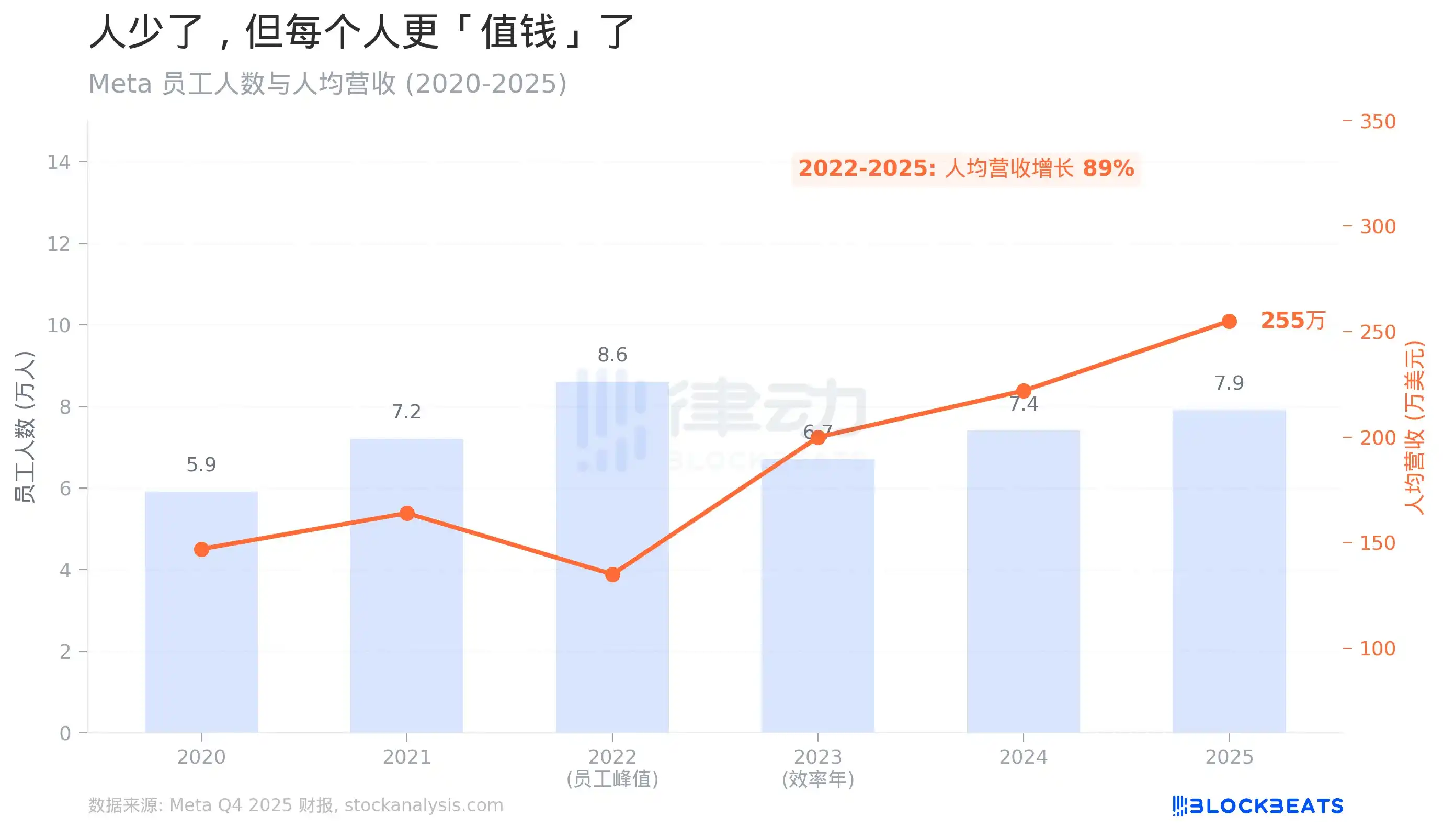
The meaning of these numbers is straightforward. Meta is making more money with fewer people. In 2022, the marginal revenue brought by each additional employee was declining. By 2024 and 2025, the revenue increase corresponding to each employee reduction was expanding. This is the typical scale effect of a technology company, but Meta accelerated this process through layoffs.

This is the background for this round of 700 layoffs in March 2026. According to The Register, this is already Meta's second round of layoffs this year, with about 1,000 people cut from Reality Labs in January. NBC News, citing informed sources, reported that there may be larger cuts later, potentially involving up to 20% of the total workforce, or about 15,000 people, which would bring Meta's total employee count back to 2021 levels.

Zuckerberg's exact words in the January earnings call were plans to "flatten teams," allowing excellent individual contributors to complete projects that previously required large teams. Meta's spokesperson's response was also templated, saying "teams periodically undergo restructuring or adjustments to ensure they are in the best position to achieve their goals."

Continuing to Bet on the AI Arms Race

Where did the money saved from the laid-off employees go? A look at capital expenditures makes it clear.

According to Q4 2025 earnings reports and public guidance from various companies, the combined capital expenditures of Amazon, Google, Microsoft, and Meta in 2026 will reach approximately $650 billion, a year-on-year increase of about 130%. This includes Amazon at about $200 billion (up 167%), Google at about $175 to $185 billion (up 140%), Microsoft annualized at about $145 billion (up 127%), and Meta at $115 to $135 billion (up 73%).

According to CNBC, this is the largest single-year capital expenditure in the history of the tech industry. The four companies' investment in AI infrastructure in one year exceeds Sweden's annual GDP.
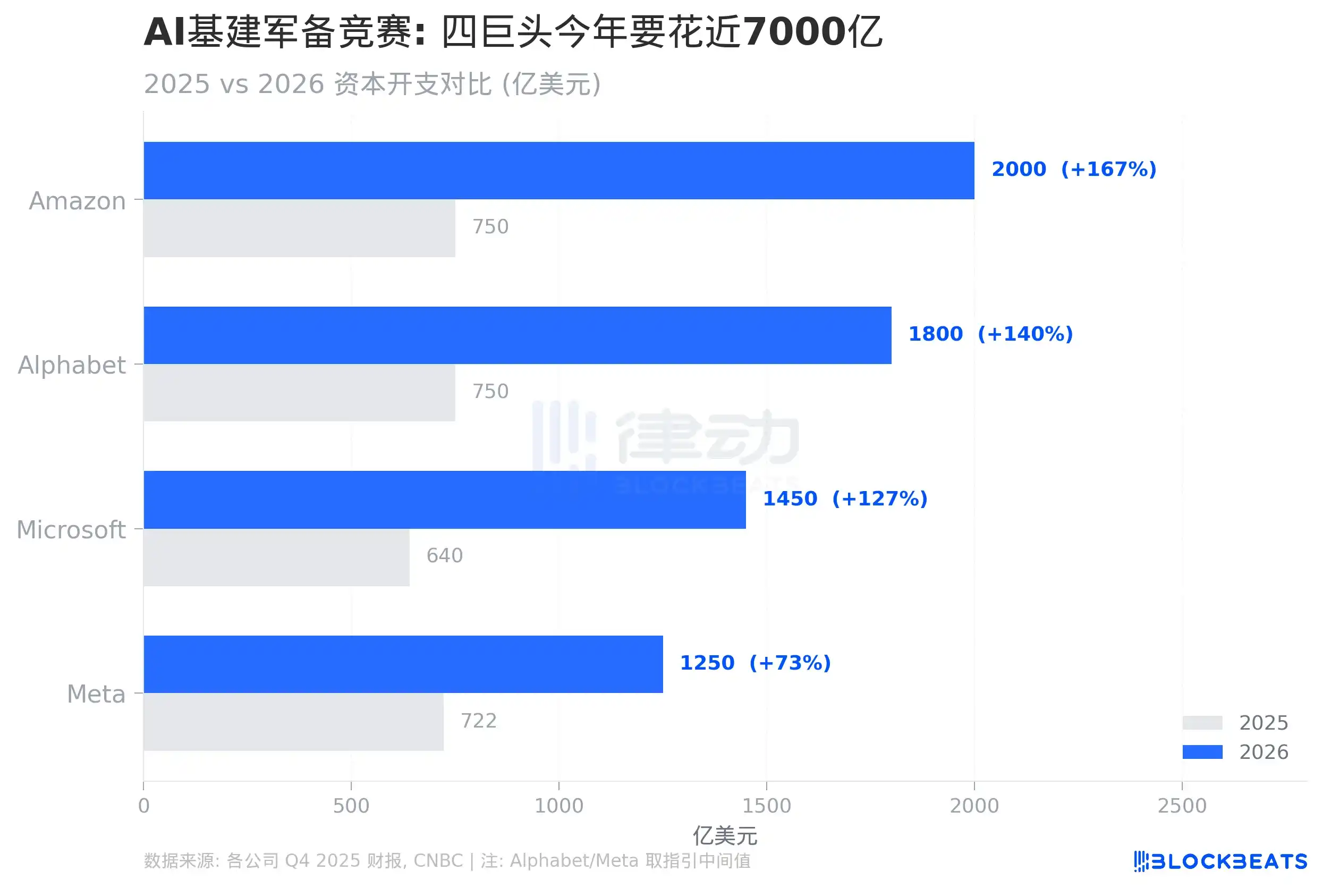
Meta's absolute value ranks fourth, but relative to its own size, the density of this investment is staggering. Calculated at the midpoint of $125 billion, Meta's AI infrastructure investment per employee is about $1.59 million, close to 62% of the revenue per employee ($2.55 million). Put another way, for every $100 Meta earns, it invests $62 into data centers.

The cost of this money is also direct. According to CNBC, citing Barclays analysts' estimates, Meta's free cash flow in 2026 will decline by nearly 90%. Amazon is even more aggressive; Morgan Stanley expects Amazon to have approximately negative $17 billion in free cash flow in 2026. All four giants are doing the same thing: trading today's cash flow for tomorrow's AI infrastructure.

The $9 Trillion Bet

Now look at the option plan. According to the SEC disclosure documents and analysis by Motley Fool, this plan covers 6 executives, including CTO Bosworth, CPO Cox, COO Olivan, CFO Susan Li, CLO Mahoney, and Vice Chairman McCormick. Zuckerberg is not on the list; his super-voting shares already make additional incentives unnecessary.

The option's exercise conditions are designed with tiered price thresholds. According to Motley Fool, the lowest exercise price is $1,116 per share, requiring the stock price to rise 88% from the current ~$615. The highest tier is $3,727 per share, corresponding to a market cap of about $9 trillion, six times the current $1.5 trillion. There is a five-year window for vesting before 2031. If Meta actually reaches a $9 trillion market cap, according to Motley Fool's calculations, the top four executives (Bosworth, Cox, Olivan, Susan Li) could each see potential gains of approximately $2.7 billion.

The signal of this plan is clear. Meta is not giving executives a bonus; it is using options to tie the core team to an extremely aggressive growth target. The current market cap is $1.5 trillion, the goal is $9 trillion. The difference of $7.5 trillion – Meta is betting that AI can create this value.
For a sense of scale: $9 trillion is roughly equivalent to the combined current market capitalization of Apple and Nvidia. No company in the world has ever reached this market cap. Meta has given its core executives five years to try and reach a number that doesn't exist in human commercial history.

One Formula

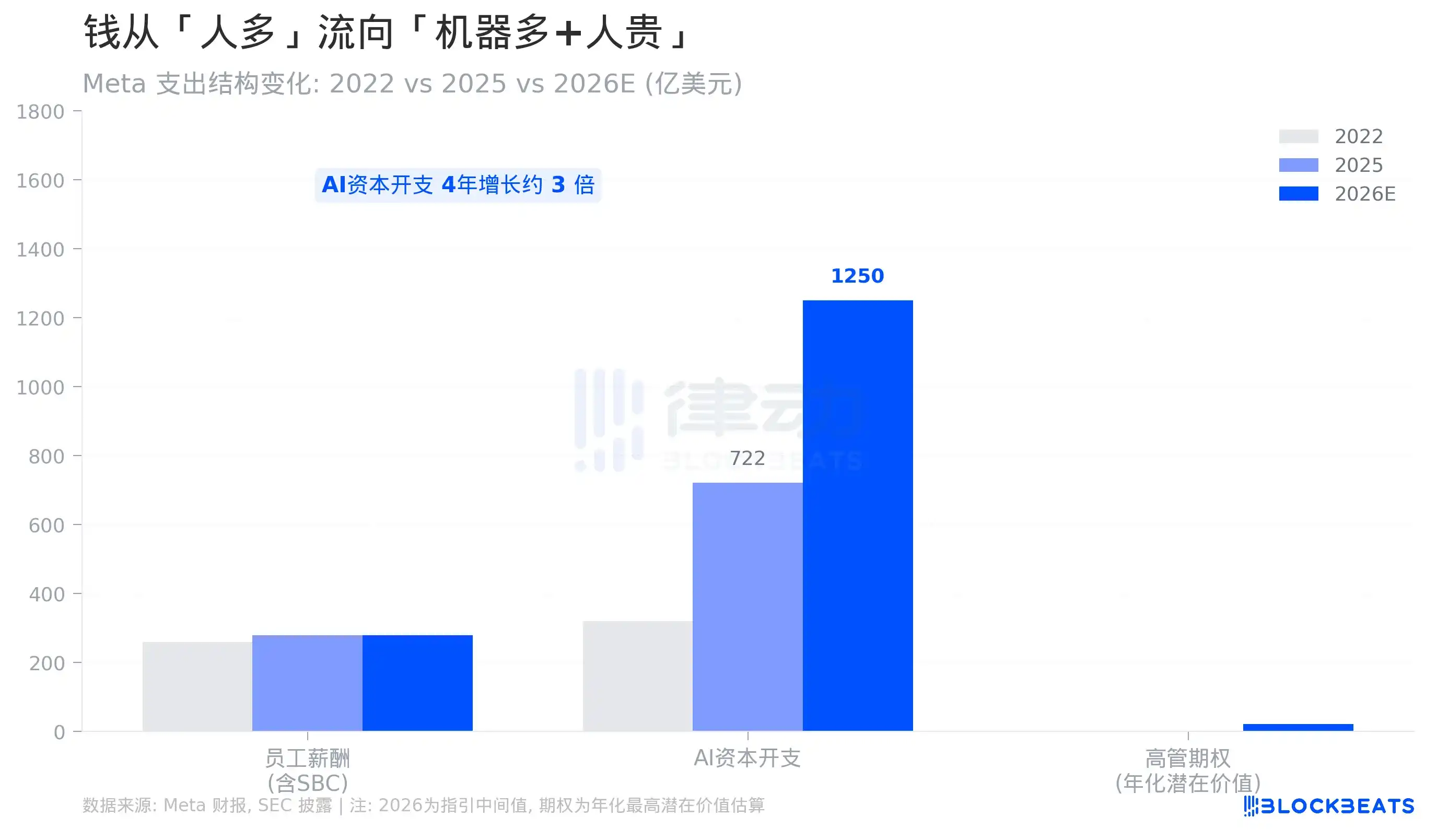
Looking at these three things together, Meta's logic is a simple resource allocation formula. Total employee compensation (including equity incentives) remained largely flat between 2022 and 2026, around $26 to $28 billion. But AI capital expenditures soared from $32 billion to $125 billion, a roughly 3-fold increase in four years. At the same time, a brand new executive option pool has appeared, locking the six most core people into the next five years.

According to Benzinga, Meta's stock-based compensation expense in 2025 was approximately $42 billion, already consuming most of its free cash flow. Signing bonuses for AI researchers have reached nine figures, with reports of researchers poached from OpenAI receiving packages in the $100 million range. The contrast between these numbers and the 700 laid-off employees makes Meta's pricing logic for "people" clear without any need for commentary.

The money saved from laying off 700 people is roughly equivalent to a day and a half of Meta's AI infrastructure spending.

Pertanyaan Terkait

QWhat is the significance of Meta's dual actions on March 25th: laying off 700 employees while announcing a $9 trillion stock option plan for executives?

AThese actions represent two sides of the same strategic shift. Meta is reallocating resources from a larger, less focused workforce to massive AI infrastructure investments and highly compensated, elite talent. The layoffs improve efficiency (as seen in rising revenue per employee), while the unprecedented executive期权 plan aligns top leadership with an extremely aggressive growth target tied to AI's potential value creation.

QHow did Meta's employee count and financial performance change between its 2022 peak and the end of 2025?

AMeta's employee count decreased from a peak of 86,482 in 2022 to 78,865 by the end of 2025, a reduction of nearly 8,000 people. However, its annual revenue grew 72%, from $116.6 billion to $201.0 billion. Consequently, revenue per employee surged 89%, from $1.35 million to $2.55 million, demonstrating significantly improved efficiency.

QWhat are the scale and implications of the capital expenditure plans by major tech companies like Meta for 2026?

AAmazon, Google, Microsoft, and Meta plan a combined capital expenditure of approximately $650 billion in 2026, a 130% year-over-year increase. This represents the largest single-year capex in tech industry history, exceeding Sweden's GDP. For Meta specifically, its planned $115-135 billion capex translates to about $1.59 million in AI infrastructure investment per employee, which is roughly 62% of its revenue per employee.

QWhat are the specific terms and potential payouts of the new executive stock option plan at Meta?

AThe plan covers 6 core executives (excluding Zuckerberg). It features tiered exercise prices. The lowest tier requires the stock price to rise 88% from ~$615 to $1,116 per share. The highest tier is set at $3,727 per share, which would give Meta a market capitalization of approximately $9 trillion—six times its current $1.5 trillion value. If this top target is met within the 5-year window (by 2031), the top four executives could each see potential gains of around $2.7 billion.

QHow does Meta's resource allocation formula illustrate its new strategic priority towards AI?

AMeta's resource allocation has fundamentally shifted. Total employee compensation (including stock awards) remained flat at around $26-28 billion between 2022 and 2026. Meanwhile, AI capital expenditure skyrocketed nearly 3x, from $32 billion to $125 billion. This shows a massive reallocation of cash flow from human resources to AI infrastructure. Furthermore, the new executive期权 pool and reports of nine-figure signing bonuses for top AI researchers highlight a focus on investing in a smaller number of 'more expensive' people critical to AI development.

Bacaan Terkait

Inti dari PHK AI: Mengapa Semakin AI Menyebar, Perusahaan Semakin Cemas?

Dalam artikel ini, penulis, seorang karyawan yang menunggu keputusan PHK, menganalisis gelombang PHK terkait AI di perusahaan-perusahaan teknologi. Meskipun penggunaan AI (seperti Claude) telah meledak dan produktivitas teknis (seperti jumlah kode) meningkat 2-5 kali lipat, hasil bisnis (pendapatan) tidak mengikuti. Ini karena kode hanyalah "input", bukan "output" (fitur) apalagi "outcome" (nilai yang dibayar pengguna). AI membuat produksi kode murah dan cepat, tetapi justru memperburuk dua masalah mendasar: 1. **Kualitas Ide**: Banyak ide dari manajemen sebenarnya buruk. Dulu, keterbatasan sumber daya memaksa seleksi ketat. Kini, semua ide mudah diwujudkan, termasuk yang tidak bernilai. 2. **"Pajak Penyelarasan" (Alignment Tax)**: Menyelaraskan banyak tim dalam organisasi besar itu lambat dan sulit. Dengan AI, tiap tim bisa cepat membuat produk versi sendiri berdasarkan asumsi berbeda, menciptakan duplikasi dan konflik. PHK terjadi bukan karena AI secara langsung menggantikan manusia, tetapi untuk: 1. **Mengimbangi Biaya AI**: Pengeluaran besar untuk token AI harus diimbangi dengan memotong biaya gaji agar keuangan perusahaan stabil. 2. **Mengurangi Kompleksitas Organisasi**: Memotong karyawan mengurangi jumlah tim yang perlu diselaraskan, menghilangkan "penyumbatan" dan membuat keputusan lebih cepat dalam jangka pendek. Penulis menyimpulkan bahwa PHK ini adalah akibat dari kegagalan mengubah "input" AI yang melimpah menjadi "outcome" bisnis yang nyata, dan ketidakmampuan organisasi beradaptasi dengan kecepatan baru. Siklus ini akan terus berlanjut sampai perusahaan belajar memanfaatkan AI secara efektif untuk pertumbuhan, bukan hanya efisiensi semu.

marsbit14m yang lalu

Inti dari PHK AI: Mengapa Semakin AI Menyebar, Perusahaan Semakin Cemas?

marsbit14m yang lalu

Solana Foundation Bermitra dengan Google Luncurkan Pay.sh, Dapatkah Membuka Jalan Pembayaran antara Web2 dan Web3 dalam Ekonomi Agen Cerdas?

Solana Foundation bermitra dengan Google Cloud meluncurkan Pay.sh, sebuah "gerbang pembayaran antara agen AI dan layanan perusahaan," yang bertujuan menghubungkan sistem pembayaran Web2 dan Web3 untuk ekonomi agen. Pay.sh memungkinkan agen AI menggunakan dompet Solana (yang dapat diisi dengan kartu kredit atau stablecoin) sebagai identitas dan agen pembayaran tunggal untuk mengakses layanan API seperti Google Cloud tanpa perlu pendaftaran akun manual. Ini bekerja dengan memanfaatkan kode status HTTP 402 dan kompatibel dengan protokol pembayaran x402 dan MPP, secara otomatis memilih metode pembayaran satu kali atau berbasis sesi yang sesuai. Layanan ini juga memudahkan penyedia layanan dengan menyediakan gateway yang mudah diintegrasikan, mendukung skema pembayaran bertingkat dan pembagian pembayaran otomatis ke beberapa alamat. Dengan memanfaatkan infrastruktur Google Cloud untuk kepatuhan dan log, Pay.sh bertujuan menciptakan lingkungan yang lebih aman dan terpercaya bagi agen untuk menemukan dan menggunakan layanan, sekaligus melengkapi protokol komunikasi agen lainnya dari Google. Inisiatif ini berpotensi membawa lebih banyak arus pembayaran Web2 ke ekosistem Solana dan meningkatkan utilitas dompetnya. Namun, tantangan tetap ada, termasuk risiko layanan tiruan di direktori penyedia, ketergantungan pada keamanan protokol pembayaran dasar, dan persyaratan kepatuhan regional yang berpotensi menghambat adopsi oleh penyedia layanan. Meski demikian, Pay.sh menandai langkah signifikan menuju integrasi infrastruktur pembayaran untuk ekonomi agen yang menghubungkan dunia Web2 dan Web3.

marsbit25m yang lalu

Solana Foundation Bermitra dengan Google Luncurkan Pay.sh, Dapatkah Membuka Jalan Pembayaran antara Web2 dan Web3 dalam Ekonomi Agen Cerdas?

marsbit25m yang lalu

Indikator Siklus Bull-Bear Bitcoin Berbalik Positif untuk Pertama Kalinya dalam 7 Bulan, Apakah Bear Market Sudah Berakhir atau Hanya False Breakout?

**Indikator Siklus Bull-Bear Bitcoin Tembus Positif untuk Pertama Kalinya dalam 7 Bulan: Akhir Bear Market atau False Breakout?** Analisis CryptoQuant menunjukkan indikator siklus pasar bull-bear Bitcoin (Bull-Bear Market Cycle Indicator) telah berubah menjadi positif untuk pertama kalinya sejak Oktober 2025. Indikator ini, yang menganalisis jarak antara Indeks P&L (yang menggabungkan MVRV, NUPL, dan SOPR) dengan rata-ratanya selama 365 hari, merupakan sinyal awal pemulihan dari fase bearish. Perbaikan ini terjadi setelah indikator tersebut menyentuh level terendah yang setara dengan masa pandemi Maret 2020 pada Februari lalu. Sinyal ini didukung oleh indikator inti lainnya, Bull Score Index, yang naik ke level netral 50 pada akhir April—juga yang pertama kalinya sejak puncak Desember 2025. Peningkatan ini didukung oleh rebound harga Bitcoin sebesar lebih dari 35% dari titik terendah sekitar $60.000 pada Februari ke level sekitar $81.000, dengan catatan tiga bulan berturut-turut menghasilkan return positif. Namun, kehati-hatian tetap diperlukan. Sejarah mencatat pada Maret 2022, Bull Score Index juga sempat mencapai level 50 tetapi hanya bertahan seminggu sebelum harga melanjutkan penurunan yang dalam akibat krisis Terra/LUNA dan FTX. Perbedaan utama siklus saat ini adalah adanya permintaan institusional melalui ETF spot Bitcoin, yang mencatat arus masuk bersih kuat pada April. Selain itu, data menunjukkan peningkatan akumulasi oleh alamat "paus". Beberapa analis mengingatkan bahwa jika pola siklus empat tahun (halving) tetap berlaku, dasar pasar yang berkelanjutan mungkin baru terbentuk sekitar kuartal keempat 2026. Oleh karena itu, meskipun fase kepanikan terburuk mungkin telah berlalu, pasar membutuhkan konfirmasi lebih lanjut, seperti penembusan berkelanjutan di atas resistance rata-rata bergerak 200-hari di sekitar $82.000, untuk secara meyakinkan menyatakan awal tren bull baru.

marsbit38m yang lalu

Indikator Siklus Bull-Bear Bitcoin Berbalik Positif untuk Pertama Kalinya dalam 7 Bulan, Apakah Bear Market Sudah Berakhir atau Hanya False Breakout?

marsbit38m yang lalu

Bagaimana Mengotomatiskan Setiap Alur Kerja dengan Claude Skills (Tutorial Lengkap)

**Panduan Lengkap: Mengotomatiskan Alur Kerja dengan Claude Skills** Claude Skills adalah file instruksi permanen yang disimpan di komputer Anda, dirancang untuk memberi tahu Claude cara menyelesaikan tugas tertentu secara konsisten dan berkualitas tinggi. Berbeda dengan prompt biasa yang hanya menjadi awal percakapan, Skills bertindak seperti karyawan terlatih yang mengikuti proses, standar, dan format output yang sama setiap kali. **Mengapa Skills Sangat Berharga?** Skills menawarkan kualitas yang terstandarisasi dan dapat diandalkan. Dengan lebih dari 80.000 Skills komunitas dan Skills resmi dari Anthropic, alat ini masih sering kurang dimanfaatkan karena kurangnya panduan yang jelas. **Tahap 1: Instalasi Cepat (5 Menit)** Skills adalah folder di komputer Anda yang berisi file `SKILL.md`. Untuk menginstal: - Kunjungi skillsmp.com atau github.com/anthropics/skills. - Pilih Skill yang relevan, ikuti petunjuk instalasi. - Terapkan pada tugas nyata dan bandingkan hasilnya dengan metode prompt biasa. **Tahap 2: Membuat Skill Kustom dari Awal** Sebelum mulai, jawab tiga pertanyaan: 1. **Apa tujuan Skill ini?** (Contoh: "Menulis email tindak lanjut untuk calon klien yang menghadiri webinar, menyebutkan sesi spesifik, menyertakan studi kasus, dan mengajak menjadwalkan demo 15 menit."). 2. **Kapan Skill ini diaktifkan?** (Daftar 5 frasa pemicu seperti "tulis email tindak lanjut"). 3. **Seperti apa output yang sempurna?** (Berikan contoh nyata). **Struktur File SKILL.md:** - **Bagian 1:** YAML frontmatter (nama dan deskripsi spesifik). - **Bagian 2:** Instruksi alur kerja langkah demi langkah, contoh, dan penanganan kasus khusus. **Tahap 3: Uji dan Optimalkan ke Level Produksi** Uji Skill dengan tiga skenario: 1. **Jalur reguler** (80% kasus penggunaan). 2. **Kasus batas** (input tidak biasa atau tidak lengkap). 3. **Uji tekanan** (tugas paling kompleks dan berantakan). Lakukan pengoptimalan mingguan berdasarkan kegagalan. Dalam satu bulan, Skill akan menghasilkan output setara profesional manusia. **Tahap 4: Bangun Perpustakaan Skills untuk Industri Anda** Buat satu Skill untuk setiap tugas berulang dalam alur kerja Anda. Contoh per bidang: - **Pemasaran:** Pembuat brief acara, penulis iklan, perencana kalender konten. - **Keuangan:** Pemroses laporan pengeluaran, analis faktur, penjelas perbedaan anggaran. - **Konsultasi:** Penyusun proposal, alat persiapan wawancara kebutuhan. Dengan 10 Skills yang menghemat 30 menit per minggu, Anda dapat menghemat 260 jam per tahun. Skills mengubah cara kerja: dari mengulang instruksi manual menjadi memiliki sistem otomatis yang efisien. Mulailah membangun perpustakaan Skills Anda sekarang.

marsbit54m yang lalu

Bagaimana Mengotomatiskan Setiap Alur Kerja dengan Claude Skills (Tutorial Lengkap)

marsbit54m yang lalu

Trading

Spot
Futures
活动图片




