Could This Be BTC's 2028 Diamond Bottom?

marsbitDipublikasikan tanggal 2026-02-27Terakhir diperbarui pada 2026-02-27

Abstrak

The article "Is This the 2028 Diamond Bottom for BTC?" analyzes Bitcoin's sharp and unexplained price decline in early 2026, describing it as the worst start to a year since 2016. Unlike previous major crashes—such as the 2018 ICO bust or the 2022 collapse triggered by Luna and FTX—this downturn lacks a clear catalyst, deepening market fear and uncertainty. Quantitative indicators suggest the market is in a state of extreme panic, with a "fear and greed index" of 11, levels historically seen only during major bottoms like the 2018 $3K low or the 2022 $16K FTX crisis. Other metrics, however—such as MVRV, price relative to the 200-week moving average, and miner shutdown proximity—have not yet reached typical bottom signals. Despite the bearish sentiment, some positive signs exist: significant USDT outflows indicate reduced leverage, and large short-term whales are facing substantial losses, which may limit further selling pressure. The author does not definitively call a bottom but argues that extreme fear often precedes strong rebounds and that $65K may offer a relatively high margin of safety. Historically, periods of irrational pessimism have often later been viewed as diamond-bottom opportunities.

Author: Chain Research Society

Could This Be BTC's 2028 Diamond Bottom?

2026 has undoubtedly been Bitcoin's worst start to a year in the past decade.

From the opening drop on January 1st to now, BTC has fallen from $109K to $65K, a year-to-date decline of 24%. ETH has fared even worse, dropping 34%. This is BTC's worst start to a year since 2016.

But this time is different. This crash seems to have no reason.

I. An Unexplained Drop is the Deepest Fear

In 2018, it fell 73% because the ICO bubble burst, with countless shitcoins going to zero. In 2022, it fell 77% due to the Luna collapse, Three Arrows Capital, and the FTX implosion. Every crash had a clear reason.

Every time, you knew where the enemy was and how long it would take to rebuild trust. So what about 2026?

• No exchange blow-ups

• No algorithmic stablecoin collapses

• No major hacks

• No country banning BTC

It just fell. Fortune magazine said: The worst start ever, but without a clear crash catalyst.

A crash with a reason often leads to a vengeful rebound once the negative news is exhausted; but an unexplained drop is like a slow bleed. When everyone asks why it's falling but gets no answer, panic escalates exponentially.

II. Have the Bottom-Fishing Indicators Bottomed Out?

Current quantitative indicators show the market has entered an irrational selling vacuum zone.

According to the latest data on February 25th, our bottom-fishing model currently shows a signal of only 1/5, indicating it's still early for a true bottom (Data source: fuckbtc).

❌ MVRV < 1.0

❌ Price ≤ 200-week moving average

❌ Price < P25

✅ Fear & Greed Index ≤ 25 (Extreme Fear: 11)

❌ Approaching miner shutdown price (Nearly half the machines are close to shutting down)
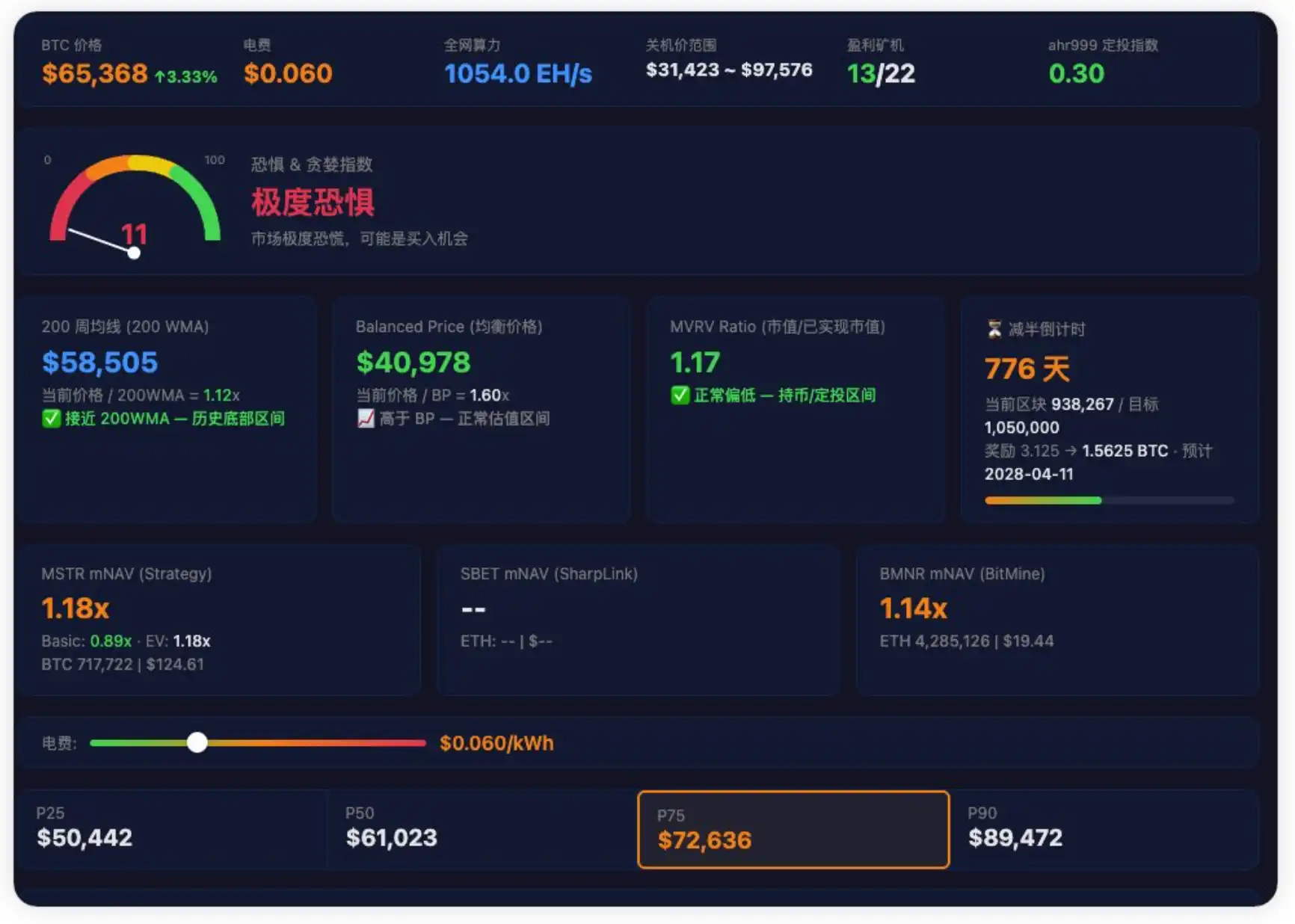
This level of extreme fear has only appeared historically at the end of 2018 at $3,000 and during the FTX crisis at $16,000. Although the price is still at $65,000, the market's psychological defense line has retreated to doomsday mode.

III. Positive Signals Under the Ice: Who's Exiting? Who's Bagholding?

Despite the freezing sentiment, there are also some positive signals:

1. USDT has seen a net outflow of $3B over 60 days. A similar scale of contraction last occurred at the end of 2022 during the FTX crash, when BTC was at $16K. BTC is now at $64K, four times higher than then.

The intensity of capital withdrawal is similar, indicating that场内杠杆 (on-exchange leverage) and weak hands have been cleaned out quite thoroughly.

2. Short-term whales have unrealized losses of $26B. Most of these players built positions between $90K-$120K and are now down 40%. The selling pressure for further significant declines should be less substantial.

Historical experience suggests that when large funds are bagholding at this depth, active selling pressure tends to dry up—because selling at a loss loses its logical meaning.

➤ My View

I am not predicting this is the bottom (it likely isn't).

But I know:

• Extreme Fear (11) has appeared.

• Historically, unexplained drops often fall deeper but also rebound more fiercely.

• At the $65K level, the margin of safety is already relatively high.

Those who called $3K the bottom in 2018 were right. Those who called $16K the bottom in 2022 were right. Those calling $64K the bottom in 2026—might be right, might be wrong.

I don't know.

But what I do know is: Panic always passes. Once trust is rebuilt, the price returns.

If you are still holding cash at this level, at least you have avoided the most violent drawdown phase. Historically, sentiment often bottoms before the price.

History repeats: After the Mt.Gox hack in 2015, people also thought trust could not be rebuilt; but looking back, every unexplained darkest hour eventually became the diamond bottom leading to the next cycle. The $64,000 of 2026 might just be the number you look back on in 2028, regretting not having bought more.


Pertanyaan Terkait

QWhat is the current market sentiment for Bitcoin according to the Fear and Greed Index mentioned in the article?

AThe Fear and Greed Index is at 11, indicating extreme fear'.

QWhat is the author's view on whether $64,000 is the bottom price for Bitcoin in 2026?

AThe author does not predict that $64,000 is definitely the bottom, stating it 'might be right, might be wrong,' but highlights that it offers a relatively high margin of safety and could be seen as a 'diamond bottom' in hindsight by 2028.

QWhat positive signals does the article mention that are happening beneath the surface of the market panic?

AThe positive signals mentioned are: 1) USDT has seen a net outflow of $3B over 60 days, indicating leveraged and floating筹码 have been cleaned out. 2) Short-term whales are facing $26B in unrealized losses, which suggests selling pressure may be exhausted as cutting losses lacks logical sense at this depth.

QHow does the article characterize the current Bitcoin price drop compared to the crashes of 2018 and 2022?

AThe article states that unlike the 2018 crash (caused by ICO bubble burst) and the 2022 crash (caused by Luna collapse, Three Arrows Capital, and FTX implosion), the 2026 drop has no clear catalyst or reason, which creates a deeper fear as it is a form of chronic blood loss rather than a sharp event with a known enemy.

QAccording to the 'buy the dip' model cited (fuckbtc), how many of its 5 signals were triggered as of February 25th?

AOnly 1 out of the 5 signals from the 'buy the dip' model was triggered as of February 25th. The Fear and Greed index was ≤25 (it was 11), but the other four conditions (MVRV

Bacaan Terkait

Goldman Sachs: Juli Menghancurkan Perdagangan Padat, Pasar Bull AS Tak Terputus Tapi Lebih Sulit

Menurut analisis Goldman Sachs, pasar saham AS pada Juli mengalami koreksi yang lebih didorong oleh penyesuaian posisi (deleveraging) ketimbang keruntuhan indeks utama. Meskipun S&P 500 relatif stabil (hanya turun <2% dari puncak), terjadi gejolak besar di bawah permukaan. Transaksi yang sebelumnya padat dan digerakkan momentum—seperti saham AI, teknologi berkecepatan tinggi, dan strategi Asia—mengalami tekanan likuiditas dan penjualan besar-besaran. Leverage pada sektor teknologi global turun ke level terendah dalam lima tahun terakhir, dan eksposur terhadap momentum berada pada persentil ke-28 dalam satu tahun terakhir. Perdebatan utama pada saham AI bergeser dari narasi menuju keberlanjutan profitabilitas, dengan kinerja perusahaan cloud seperti Microsoft dan Amazon yang lebih baik meredam kekhawatiran. Komunikasi Federal Reserve yang lebih hati-hati dan tekanan pada imbal hasil obligasi jangka panjang menambah ketidakpastian. Secara keseluruhan, dasar fundamental pasar saham AS masih solid didukung ekonomi dan pengeluaran modal AI, namun elastisitas kenaikan telah melemah. Tren bull market belum berakhir, tetapi periode ke depan akan lebih fluktuatif dan menuntut selektivitas yang lebih tinggi, bukan sekadar "beli dan tahan". Juli menjadi pengingat bahwa pasar tidak memberi imbalan untuk posisi yang terlalu padat dan leverage berlebihan.

marsbit1j yang lalu

Goldman Sachs: Juli Menghancurkan Perdagangan Padat, Pasar Bull AS Tak Terputus Tapi Lebih Sulit

marsbit1j yang lalu

RUU Kripto yang Ditunggu-tunggu, Dikenal sebagai 'RUU Kejelasan', Berada di Tahap Kritis: Gedung Putih Akan Membahasnya Akhir Pekan Ini

Masa depan U.S. Crypto-Asset Regulatory Clarity Act atau "CLARITY Act" berada di titik kritis, dengan keputusan Gedung Putih Trump diharapkan pada akhir pekan ini terkait proposal etika baru dari kedua partai. Proposal alternatif oleh Senator Republik Tom Tillis dan Senator Demokrat Ruben Gallego ini bertujuan mengatasi kekhawatiran Demokrat dengan memberi wewenang kepada jaksa agung negara bagian untuk menuntut pejabat federal jika Departemen Kehakiman gagal menegakkan aturan etika. Versi sebelumnya didukung Gedung Putih namun dikritik karena penegakan tetap di Departemen Kehakiman dan batas waktu yang berakhir Januari 2029. Jika kesepakatan etika tercapai, Senat dapat melakukan pemungutan suara untuk CLARITY Act, meski memerlukan dukungan 60 senator. RUU yang telah disetujui Komite Perbankan Senat ini bertujuan memperjelas yurisdiksi SEC dan CFTC atas aset kripto, menciptakan kerangka pasar, mengatur imbal hasil stablecoin, dan memberikan perlindungan hukum tertentu bagi pengembang perangkat lunak. Kompromi pada aturan stablecoin membatasi pembayaran mirip bunga yang hanya berdasarkan kepemilikan token, tetapi mengizinkan imbalan terkait transaksi, pembayaran, program loyalitas, atau penggunaan platform. Kegagalan mencapai kesepakatan etika dapat kembali menghalangi kemajuan RUU ini di Senat, memperpanjang ketidakpastian regulasi untuk imbal hasil stablecoin dan implementasi ketentuan terkait dalam GENIUS Act.

cryptonews.ru2j yang lalu

RUU Kripto yang Ditunggu-tunggu, Dikenal sebagai 'RUU Kejelasan', Berada di Tahap Kritis: Gedung Putih Akan Membahasnya Akhir Pekan Ini

cryptonews.ru2j yang lalu

Wawancara dengan Eksekutif Robinhood: Strategi Akusisi 'Barbel' dengan Meme + Tokenisasi Saham AS, Semua Lini Bisnis Capai Pendapatan Ratusan Juta Dolar

Wawancara dengan Johann Kerbrat, Wakil Presiden Senior Robinhood, mengungkap strategi mereka untuk mendorong adopsi crypto melalui "strategi barbell": memadukan meme coin untuk menarik pengguna DeFi dengan tokenisasi saham AS (RWA) untuk menjangkau pengguna global yang kesulitan mengakses pasar modal tradisional. Robinhood Chain, yang baru diluncurkan tiga minggu, telah mencatat volume perdagangan mingguan lebih dari $30 miliar dan lebih dari 1,05 miliar transaksi. Strategi intinya adalah memindahkan 27 juta akun berdananya ke ekosistem blockchain dengan menyederhanakan pengalaman DeFi. Produk seperti Robinhood Earn memungkinkan pengguna mendapatkan yield aset kripto tanpa harus mengelola dompet atau private key. Tokenisasi saham, yang kini mencakup 90+ saham di 120+ negara, menawarkan solusi seperti perdagangan 24/7 dan akses internasional. Kerbrat menekankan bahwa mereka memilih stack teknologi Arbitrum daripada membangun L1 sendiri untuk memanfaatkan keamanan Ethereum dan likuiditas EVM. Fokus mereka adalah memperluas pasar secara keseluruhan, bukan bersaing langsung dengan platform seperti Base. Kemitraan dengan proyek DeFi dipilih berdasarkan kesesuaian regulasi, kemampuan membangun pengalaman unik, dan diferensiasi. Visi jangka panjang Robinhood adalah menjadi "aplikasi super" yang memenuhi semua kebutuhan keuangan pengguna, dengan semua lini bisnisnya telah menghasilkan pendapatan miliaran dolar.

marsbit3j yang lalu

Wawancara dengan Eksekutif Robinhood: Strategi Akusisi 'Barbel' dengan Meme + Tokenisasi Saham AS, Semua Lini Bisnis Capai Pendapatan Ratusan Juta Dolar

marsbit3j yang lalu

Trading

Spot
活动图片




