As Circle, the First Stablecoin Stock, Resolves to Shed Its Label

链捕手Dipublikasikan tanggal 2026-05-12Terakhir diperbarui pada 2026-05-12

Abstrak

Circle, the "stablecoin stock," reported its Q1 2026 results, showing a 20% YoY revenue increase to $694M despite a 15% drop in net profit due to post-IPO stock-based compensation and operational investments. The company's USDC stablecoin hit a record $770B in circulation with on-chain transaction volume soaring 263% YoY. However, market share slightly declined amid competition. The key market catalyst was the announcement of a $222M pre-sale for the ARC token of Circle's new institutional-focused Layer 1 blockchain, Arc, valuing the network at $30B. Led by a16z, the round included major investors like BlackRock and Apollo. CEO Jeremy Allaire positioned this as a strategic pivot from a stablecoin issuer to a broader internet platform and "financial OS" company. Circle also launched "Agent Stack" products for AI agent payments using USDC. While reaffirming its full-year 2026 guidance, the company noted the financial impact of Arc is not yet included, leaving room for future upside. Following the report, CRCL's stock surged nearly 16%. Wall Street analysts remain largely bullish on the long-term narrative, though some caution about near-term execution risks and the current immaterial contribution of new initiatives like Arc. The focus is now on Arc's mainnet launch, ARC token adoption, and evolving U.S. crypto regulation.

Author: Chloe, ChainCatcher

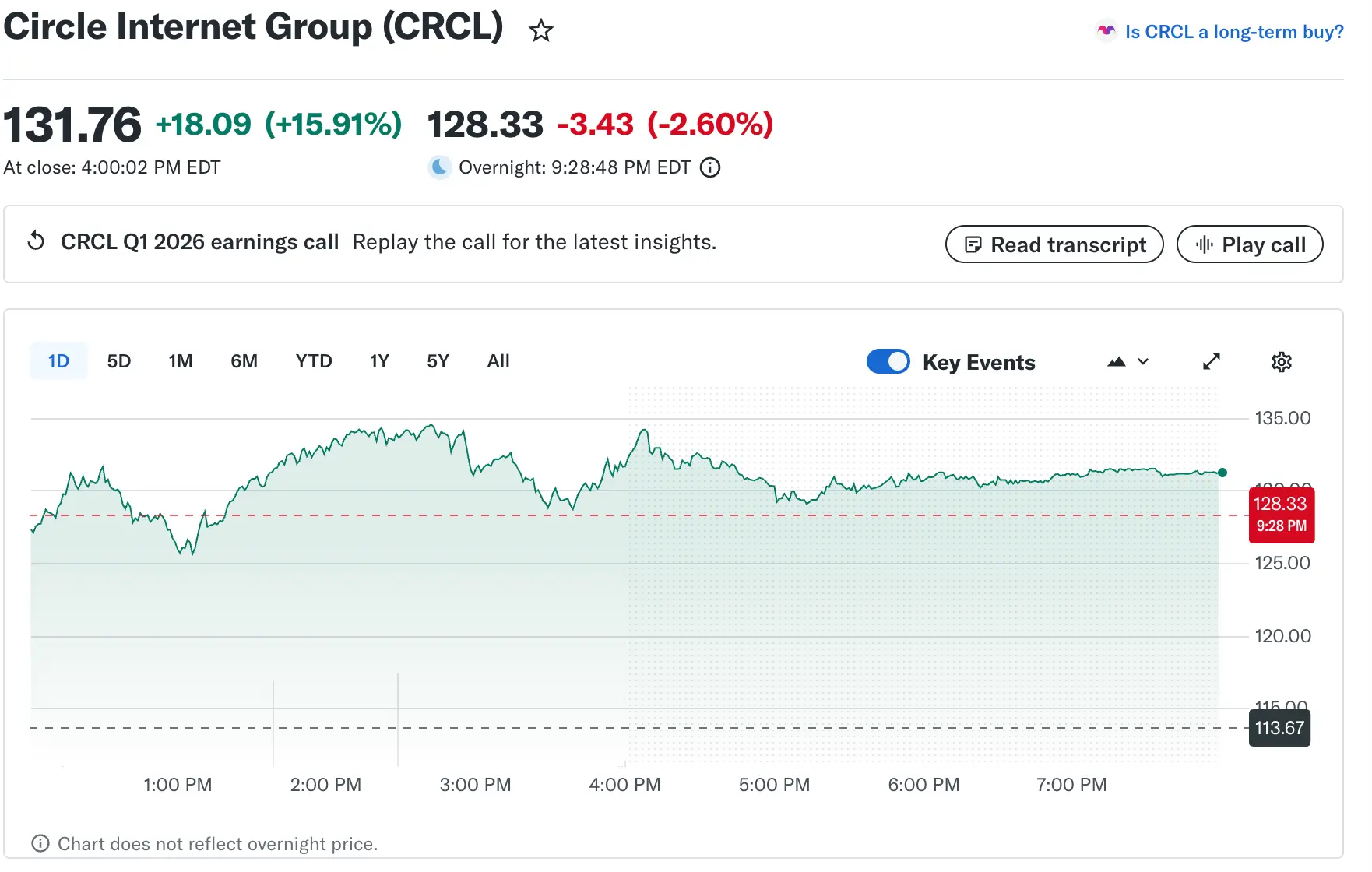
Circle released its first-quarter earnings for 2026 before the market opened yesterday, posting double-digit year-over-year revenue growth and simultaneously disclosing that its new public chain Arc's native token completed a pre-sale of $222 million at a $3 billion valuation. Although net profit declined 15% year-over-year due to increased stock-based compensation and operational investments, market focus remained centered on the long-term narrative of Arc and AI agent payments. CRCL's stock price surged nearly 16% that day, closing at $131.76, hitting a new high since mid-March.
USDC Scale Hits New Record, On-chain Transaction Volume Up 263% YoY

Circle's first-quarter total revenue and reserve income reached $694 million, a 20% increase year-over-year. Breakdown:

  • Reserve Income: $653 million, up 17% YoY, primarily benefiting from a 39% YoY increase in average USDC circulation, partially offset by a 66 basis point decrease in reserve yield (down to 3.5%).

  • Other Revenue: $42 million, roughly doubling YoY, reflecting strong growth in subscription, service, and transaction revenues.

  • Net Income from Continuing Operations: $55 million, down 15% YoY, mainly due to stock-based compensation and related payroll taxes post-IPO, as well as increased investment in products, distribution, and operational infrastructure.

  • Adjusted EBITDA: $151 million, up 24% YoY; Adjusted EBITDA margin was 53%.

Notably, both revenue and net income fell short of Wall Street analysts' expectations prior to the earnings release. According to Bloomberg, sell-side analysts had forecast revenue around $720.8 million and a reserve yield of 3.56%, neither of which were met. However, the adjusted EBITDA of $151 million exceeded the market expectation of $137.9 million, providing some support. This also indicates that the interest rate environment will be one of the most critical external variables for Circle moving forward.

On the operational front, USDC circulation reached $77 billion, up 28% YoY. First-quarter USDC on-chain transaction volume reached $21.5 trillion, a 263% YoY increase, reflecting a significant rise in stablecoin usage density as a payment and settlement medium.

According to Visa Onchain Analytics data, USDC accounted for 63% of stablecoin transaction volume in Q1. Meanwhile, Circle's USYC has become the world's largest tokenized money market fund as of May 7. Other key operational metrics include a USDC "platform retention" balance of $13.7 billion at quarter-end, up 254% YoY; 7.2 million "active wallets" holding over $10 in USDC, up 47% YoY; and a stablecoin market share of 28%, down 62 basis points YoY, directly reflecting competitive pressure from Tether and other rivals.

Public Chain Arc Completes $222 Million Token Financing with Star-Studded Investor Lineup

Circle also announced that the native token ARC for Arc, its institutionally-focused Layer 1 public chain, has completed a $222 million pre-sale, with a fully diluted network valuation of $3 billion. According to crypto asset data platform RootData, the financing was led by a16z with a $75 million investment. Other participating investors include BlackRock, Apollo Funds, Intercontinental Exchange (ICE), Standard Chartered Ventures, ARK Invest, Bullish, and over ten other institutions.
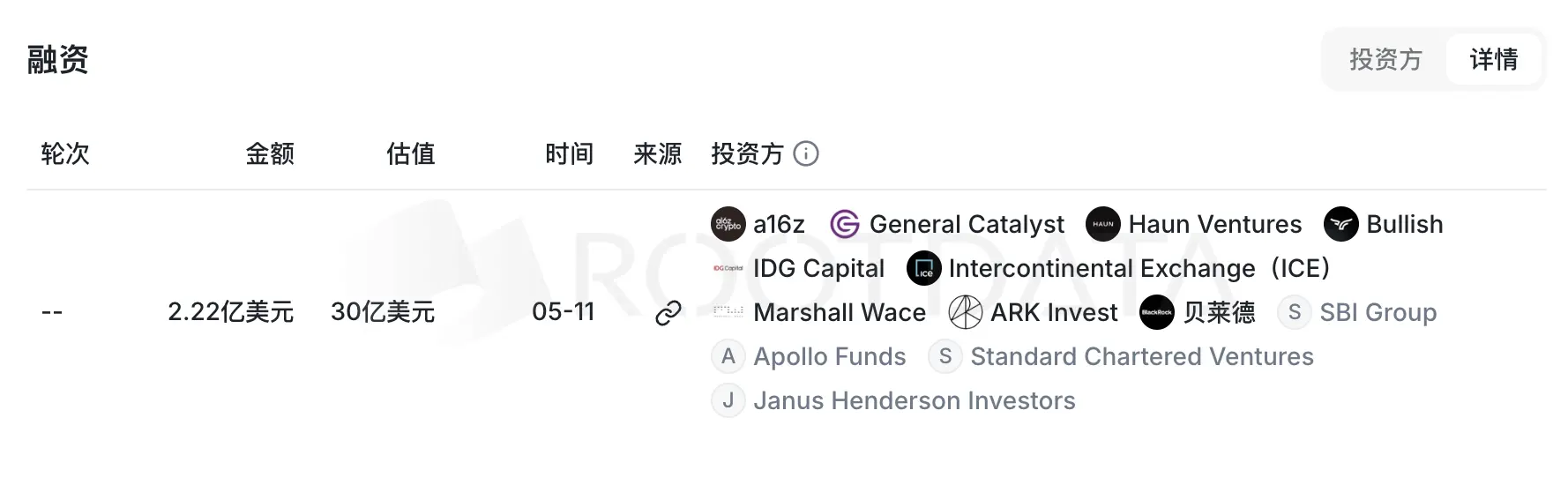
Circle CEO Jeremy Allaire stated that the company is transitioning from a stablecoin issuer to a broader internet platform company, entering the operating system and application business. Regarding token distribution, Circle holds 25% of the initial 10 billion token supply, 60% is allocated to network builders and participants, and 15% is reserved as long-term reserves.

Notably, Circle stated that this financial forecast does not incorporate the financial impact of the ARC token pre-sale, Arc incentive programs, or future Arc-related revenues.

Reaffirms Previously Announced Full-Year Guidance, No Adjustments

Additionally, Circle simultaneously launched a series of "Agent Stack" products, including Circle CLI (Command Line Tool), Agent Wallets, and Agent Marketplace, enabling developers and merchants to create, fund, and monetize AI agent-driven activities using USDC across multiple public chains and payment protocols.

The earnings report also revealed that, in terms of payment business, the Circle Payments Network (CPN) processed an annualized transaction volume of $8.3 billion as of March 31, based on the past 30 days of activity. Managed Payments, launched in April, allows financial institutions to offer stablecoin payment services without managing digital assets themselves.

New enterprise use cases for USDC include: Kyriba embedding USDC into its corporate treasury system, and Polymarket expanding its use of USDC as a core collateral and settlement asset.

Finally, regarding the outlook for the full year 2026, Circle chose to reiterate its previously announced performance guidance without any upward or downward revisions. Specifically, USDC circulation is still expected to maintain a 40% compound annual growth rate (CAGR) over multi-year cycles. FY2026 other revenue is projected between $150 million and $170 million; RLDC margin is expected between 38% and 40%; and adjusted operating expenses are forecast at $570 million to $585 million.

Similarly, this set of guidance does not incorporate the financial impact of the ARC token pre-sale, Arc incentive programs, or future Arc-related revenues, meaning there is room for upward revision once the Arc ecosystem successfully launches.

Majority of Wall Street Analysts Issue Bullish Ratings

Following the earnings release, CRCL surged approximately 16% that day, closing at $131.76, reaching its highest level since March 18. The stock has gained 66% year-to-date, with market capitalization rebounding to around $35 billion.

Wall Street analysts are generally optimistic about Circle's stock price performance over the next 12 months and beyond. According to TipRanks statistics, the consensus target price is $138.50. Among them, Peter Christiansen of Citi gave a 12-month target of $243, while Gautam Chhugani of Bernstein set a target of $190. Along with ten other analysts, all issued "Buy" ratings.

However, analysts still retain some reservations about short-term execution risks. Clear Street analyst Owen Lau pointed out that while the narratives of Arc and Agent Stack are eye-catching, they are "not yet a material business." John Todaro of Needham & Co. noted that recent DeFi protocol hacks could indirectly affect USDC use cases: "If capital leaves DeFi, how does that impact Circle's business?" Andrew Jeffrey of William Blair believes that CRCL stock price volatility will remain high in the short term, but Circle holds a significant advantage in "stablecoin commerce" with multiple catalysts progressing simultaneously.

It can be seen that Circle's earnings report presents a dual structure: the stablecoin business is still scaling rapidly, but unit economics are being compressed by interest rates and distribution costs. The market's willingness to award a 16% single-day gain is more of a bet that the Arc public chain, ARC tokenomics, and AI agent payments can reposition Circle from a stablecoin issuer to a "network financial operating system" in the medium to long term, opening up second and third growth curves beyond the existing USDC spread model.

Perhaps the market's focus going forward will be on the Arc mainnet launch timeline, market acceptance of the ARC token after public circulation, and the impact of subsequent U.S. GENIUS Act and Clarity Act implementations on the overall stablecoin competitive landscape.


Pertanyaan Terkait

QWhat was Circle's stock price performance after the release of its Q1 2026 earnings report?

AFollowing the release of its Q1 2026 earnings report, Circle's stock (CRCL) rose nearly 16% on the day, closing at $131.76, which was a new high since mid-March.

QWhat major development did Circle announce alongside its earnings?

AAlongside its earnings, Circle announced that the native token ARC of its new institutional finance-focused Layer 1 blockchain, Arc, completed a pre-sale of $222 million at a fully diluted network valuation of $30 billion.

QWhat were the key financial results for Circle in Q1 2026?

AIn Q1 2026, Circle's total revenue and reserve income was $694 million, a 20% year-over-year increase. However, net income from continuing operations was $55 million, down 15% YoY. Adjusted EBITDA was $151 million, a 24% YoY increase.

QWho led the funding round for the ARC token?

AThe funding round for the ARC token was led by the venture capital firm Andreessen Horowitz (a16z), which invested $75 million.

QAccording to the article, what is the main transformation that Circle's CEO Jeremy Allaire described for the company?

ACircle's CEO Jeremy Allaire stated that the company is transforming from a stablecoin issuer into a broader internet platform company, entering the operating system and application businesses.

Bacaan Terkait

GitHub, Ditembus oleh AI

Tanggal 9 Februari pukul 12 malam WIB, GitHub mengalami gangguan global yang parah. Situs web, API, GitHub Actions, hingga Copilot semuanya down. Penyebabnya adalah perubahan sederhana: memperpendek waktu refresh cache dari 12 jam menjadi 2 jam, yang memicu badai penulisan ulang cache dan menyebabkan kegagalan berantai. Ini bukan insiden tunggal. Pada kuartal pertama 2026, GitHub mengalami setidaknya 8 gangguan besar. Polanya aneh: setiap kali penyebabnya berbeda, tetapi akar masalahnya sama: infrastruktur yang mulai retak di bawah beban baru yang sangat masif. Beban baru itu datang dari AI Agent. Pada 2026, jumlah commit mingguan mencapai 275 juta. Jika berlanjut, total tahunan bisa 14 miliar, atau 14 kali lipat dari tahun 2025. AI Agent seperti Claude Code sekarang menyumbang 4,5% dari semua commit publik. Mereka bekerja tanpa henti, menghasilkan PR dalam jumlah besar, dan memperlakukan repository sebagai "output" alih-alih "ruang kerja" manusia. Pola lalu lintas yang bisa diprediksi telah berubah total. Masalah lainnya adalah model bisnis. Harga flat Copilot tidak lagi sesuai karena sesi Agentic AI menghabiskan sumber daya yang sangat besar, jauh melebihi biaya langganan. Sejak 1 Juni, GitHub beralih ke model pembayaran berdasarkan penggunaan (AI Credits). Untuk mengatasinya, GitHub tidak sekadar menambah kapasitas, tetapi merancang ulang arsitektur untuk menanggung beban 30 kali dari skala saat ini. Mereka berencana memisahkan layanan penting, memperkenalkan mekanisme kontrol lalu lintas, dan menghilangkan titik kegagalan tunggal. Intinya, GitHub sedang berubah dari "alat kolaborasi manusia" menjadi "pipa pembuangan AI". Gangguan pada 9 Februari bukan sekadar kecelakaan, melainkan pertanda era baru di mana AI mengubah fundamental alur kerja pengembangan perangkat lunak.

marsbit25m yang lalu

GitHub, Ditembus oleh AI

marsbit25m yang lalu

Di Mana Sebenarnya Gelembung AI: Lapisan Mana yang Berenang Tanpa Pakaian?

**Gelembung AI Sebenarnya di Mana: Lapisan Mana yang Berenang Tanpa Pakaian** Pertanyaan yang tepat bukan "apakah ada gelembung AI?", tetapi "di lapisan mana gelembung AI itu?". Analisis mendetail terhadap rantai pasokan AI menunjukkan pola: **semakin dekat dengan kendala fisik, semakin kecil gelembungnya.** * **Lapisan Terbawah (L0) Aman:** **TSMC** bertindak sebagai "bank sentral" AI, mengontrol suplai chip dengan ketat. Ekspansi mereka konservatif, dibatasi oleh siklus pembangunan pabrik 3-5 tahun dan investasi miliaran dolar. **Kendala listrik** untuk data center juga membatasi ekspansi tanpa terkendali. Lapisan ini tidak mendukung gelembung. * **Lapisan Inti (Large Cap) Mahal, Tapi Kokoh:** Raksasa seperti Microsoft, Google, Meta, Amazon, dan NVIDIA memiliki **pendapatan nyata, kontrak nyata, dan utilisasi penuh**. Pertumbuhan pendapatan yang eksplosif (contoh: satu perusahaan dari $1B ke $450B dalam 18 bulan) mendukung valuasi, meski mahal. * **Area Pertarungan (L1 - Memori):** Profitabilitas HBM yang melonjak (hingga 70%) bisa menjadi awal siklus baru atau puncak "siklus babi" lama. Struktur oligopoli (hanya 3 pemain) mencegah ekspansi berlebihan, tetapi kenaikan harga yang didorong oleh spekulasi tetap menjadi risiko. * **Lapisan dengan Bau Gelembung:** * **L2 - Modul Optik (Fotonik):** Harga saham naik 4-10x, jauh melampaui pertumbuhan pendapatan (~60%). Ini adalah satu-satunya segmen hardware di mana suplai dapat merespons dengan cepat, menciptakan ruang bagi spekulasi. Teknologi seperti *co-packaged optics* juga mengancam model bisnis lama. * **L3 - Penyedia Cloud GPU "Tuan Tanah Kedua":** Mereka hidup dari **kelangkaan sementara** di antara raksasa cloud. Begitu kendala listrik dan ekspansi cloud besar mereda, atau teknologi seperti *data center luar angkasa* muncul, model bisnis mereka terancam. * **L4 - Ekor Panjang Aplikasi & Ekosistem VC:** Konsentrasi modal ventura di AI (>80% pada Q1) dua kali lipat lebih tinggi daripada puncak gelembung dotcom 1999. Banyak startup tanpa pendapatan yang solid meminjam logika valuasi perusahaan besar, menciptakan risiko **valuasi terbalik** saat pendanaan berikutnya turun. * **Risiko Sistemik Potensial:** 1. **Revolusi Efisiensi Algoritma:** Jika algoritma baru secara drastis mengurangi kebutuhan komputasi. 2. **Kredit GPU yang Dileverage:** Munculnya struktur pembiayaan di luar neraca (SPV) yang membungkus GPU sebagai agunan dapat menciptakan leverage tersembunyi, mengingatkan pada krisis 2008. 3. **TSMC Menjadi Kurang Konservatif:** Jika monopoli suplai chip canggih pecah dan ekspansi menjadi tidak terkendali. **Kesimpulan:** AI memiliki fondasi yang kuat di lapisan inti dengan permintaan nyata, tetapi terdapat tanda-tanda kepanikan dan valuasi berlebihan di lapisan yang lebih dekat ke aplikasi dan memiliki kendala suplai yang lebih longgar. **Gelembung tidak merata.** Kunci untuk menilai adalah dengan menanyakan: (1) Di lapisan mana sebuah entitas berada? (2) Apakah pendapatannya nyata atau dipinjam dari valuasi orang lain? (3) Apakah ia menghasilkan uang dari struktur yang berkelanjutan atau hanya dari kelangkaan sementara? Selama TSMC dan kendala fisik lainnya tetap menjadi "penjaga", gelembung sistemik dapat dihindari.

marsbit31m yang lalu

Di Mana Sebenarnya Gelembung AI: Lapisan Mana yang Berenang Tanpa Pakaian?

marsbit31m yang lalu

Keduanya Menderita Kerugian Lebih dari 90 Miliar Dolar, Mana yang Lebih Berbahaya, Strategy atau Bitmine?

**Bitmine dan Strategy Rugi Miliaran Dolar, Siapa Lebih Berisiko?** Dalam pasar yang terus turun, dua raksasa perusahaan aset kripto berbasis perbendaharaan (DAT), Strategy dan Bitmine, menghadapi kerugian mengambang yang sangat besar. Saat ini, Strategy dilaporkan rugi sekitar 100 miliar dolar AS, sementara Bitmine sekitar 90 miliar dolar AS. Meski sama-sama rugi, tekanan keuangan keduanya berbeda. Bitmine terutama mendanai pembelian ETH melalui penerbitan saham, tanpa utang besar. Perusahaan ini masih memiliki cadangan tunai sekitar 446 juta dolar AS dan pendapatan dari staking ETH. Mereka juga berencana mengumpulkan 300 juta dolar AS lagi melalui penerbitan saham prioritas. Sebaliknya, Strategy membeli BTC dengan menggunakan utang besar, termasuk sekitar 6,7 miliar dolar AS dalam obligasi konversi. Perusahaan ini juga memiliki kewajiban membayar dividen saham prioritas (STRC) yang besar, sekitar 1,7 miliar dolar AS per tahun. Dengan cadangan tunai yang terbatas, Strategy menghadapi tekanan likuiditas yang signifikan jika harga BTC terus turun, berpotensi memaksa mereka menjual BTC untuk memenuhi kewajiban. Kesimpulannya, meski kedua perusahaan menghadapi tekanan pasar, **Strategy dianggap lebih berisiko karena struktur pendanaan berbasis utang dan kewajiban dividen yang memberatkan,** sementara Bitmine memiliki posisi keuangan yang lebih fleksibel.

marsbit33m yang lalu

Keduanya Menderita Kerugian Lebih dari 90 Miliar Dolar, Mana yang Lebih Berbahaya, Strategy atau Bitmine?

marsbit33m yang lalu

Trading

Spot
Futures
活动图片