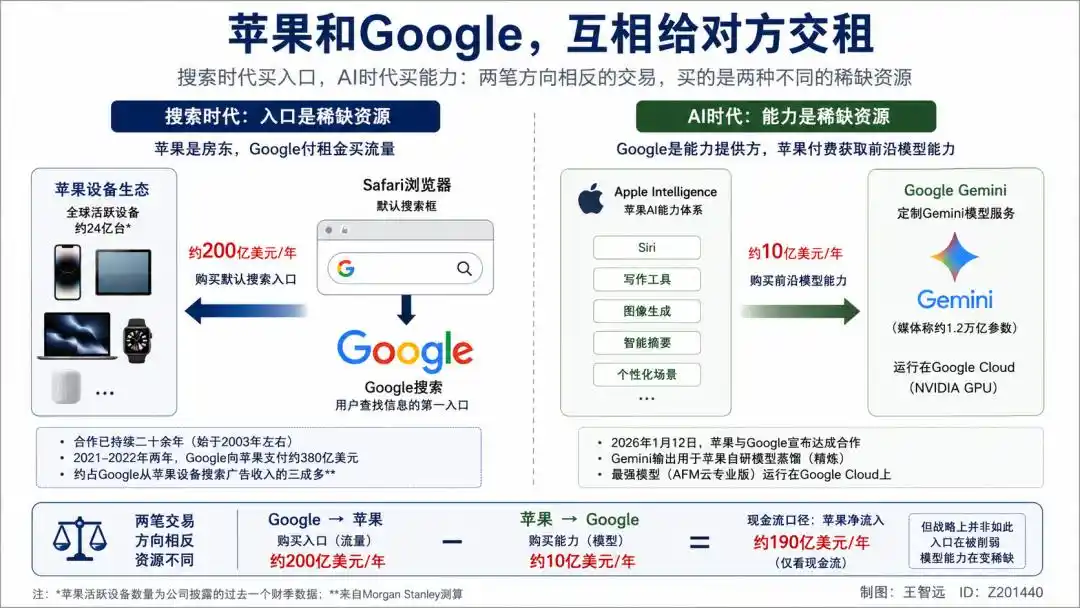
Google pays Apple $20 billion a year. For just one thing:
The default search position on the Safari browser—the first search box users see when they open the browser is Google. This deal started around 2003 and has been running for over twenty years.
01
Trial materials from the U.S. Department of Justice's antitrust case against Google reveal a number. Just for 2021 and 2022, Google shelled out about $38 billion for this; Morgan Stanley calculated that this amount is roughly over 30% of Google's share from search ads on Apple devices.
In short, this is a traffic tax business.
Another flow of money goes in the opposite direction, from Cupertino to Mountain View.
On January 12, 2026, Apple and Google issued a joint statement announcing that Apple's next-generation foundation models will be built using Google's Gemini.
Bloomberg's Gurman reported that Apple will pay Google about $1 billion annually for this; Google is providing Apple with a custom 1.2-trillion-parameter model, eight times the size of Apple's own original cloud model. CNBC, CNN, and TechCrunch all confirmed the deal the same day.
Two cash flows, opposite directions, buying things that seem completely unrelated.
The first buys an entrance; hundreds of millions of devices, the first gate users pass through to find information, is Google. The second buys capability; Apple itself can't catch up on the frontier of models, so it spends money to bridge the gap.
Looking just at net cash flow, Apple still wins; $20 billion in, $1 billion out, net profit $19 billion. But ARK Invest's Chief Futurist, Winton, calculated a more startling figure this January.
Looking at both deals together, Apple has a net loss of $21 billion on "users finding information through its devices." The problem with this calculation, however, is that it lumps two completely different types of transactions onto one P&L statement.
Two rents buying two different scarce resources, and the prices of these two things are moving in opposite directions.
First, why is the search money still flowing? The answer is simple. The entrance is still scarce.
Apple has roughly 2.4 billion active devices. The attention of some of the world's most affluent consumers flows through here. To intercept this river, Google has to pay a sky-high price.
For twenty years, no other search engine has come close to offering this price.
Cook said a blunt truth in 2018: Google's search engine is the best. Eddy Cue was even more direct in court testimony: even if Microsoft gave Bing away for free, it wouldn't be enough.
But. The foundation of this rent has developed its first crack.
In May 2025, Cue testified in court; in April 2025, Safari search volume saw its first decline in 22 years. He attributed the cause to the diversion by AI search tools.
ChatGPT, Perplexity, and similar tools are changing the way some people find information. The day the news broke, Alphabet's stock fell 7%, wiping out $155 billion in market cap in a day. Wall Street voted with its feet.
Now, why is the model money starting to flow? The answer is equally simple. Frontier model capability is scarce.
The number of organizations globally that can consistently train truly frontier large models doesn't exceed five or six. Apple isn't among them. Multiple media outlets cited insiders saying Apple's in-house models had a failure rate of about one-third on complex tasks in 2025.
Instead of pushing through alone, it spent $1 billion to buy Google's capability to fill this gap.
Thus, a rather interesting picture emerges:
In the old battlefield of search, Apple is the landlord, Google pays rent for traffic. In the new battlefield of AI models, Google becomes the landlord, Apple pays rent for technology.
Think about this picture: Apple and Google, collecting $20 billion in rent on the left, paying $1 billion in tuition on the right. The same company, acting as landlord in one place, tenant in another.
Honestly, this kind of thing is rare in business history.
Two lines moving in different directions. The old business of the search entrance is being slowly eroded by AI, while the barrier to entry on the model capability side keeps rising.
Net cash flow is today's snapshot; the direction of rent tells you about tomorrow. Whoever can provide something others don't have, gets to keep collecting rent.
02
Apple's speed of response this time was unusually fast for itself.
The day after WWDC ended, software VP Federighi and AI VP Subramanya sat down with a group of media for a technical Q&A.
Federighi's first move on stage was to distance themselves.
His exact words: "The amount of Google Assistant we use is zero." In plain English: We didn't use a single bit of Google Assistant's stuff.
Then he listed item by item: not using any Gemini model Google deploys for its own customers, not using Google's client-side code, not using Google Search as a knowledge base.
They didn't even put the Gemini app into iOS. Several Apple-focused news sites were present, each independently reporting the same statement.
Subramanya followed up with another point.
Apple's foundation models are customized for its own chips, trained on its own data, and finally refined using the output of Gemini's frontier models.
The most critical four words in this sentence are "输出来精炼" (output to refine), technically called distillation.
What does it mean? Have Gemini act as the teacher, do the task first, then have Apple's own smaller model learn from the teacher's answers. After learning, after graduation, not a single piece of the teacher's chalkboard remains in the classroom. The shipped model is Apple's own.
One of those Apple sites had a headline that hit the nail on the head: "Not a single drop of Gemini in Apple's new models."
If the story ended here, it would be great. Apple borrowed Google's strength, but the product is clean, under its own control.
But if you really lay out everything Apple took from Google, piece by piece, the picture isn't so pretty.
First item: Knowledge dependency.
Apple's five foundation models, the first four were all distilled using Gemini's output. Without that output as a target, the quality of Apple's own models wouldn't improve.
Subramanya himself said the refinement uses "Gemini frontier models," the latest batch. What does this mean? Every model iteration cycle, Apple has to go back to Google for the latest output. Graduating doesn't mean you don't have to retrain next year.
Second item: Compute dependency.
Apple's strongest model is called AFM Cloud Pro, specialized for complex reasoning and agent-level tool use. Where does this model run? On Google Cloud, on Nvidia GPUs.
Apple's own private cloud infrastructure simply can't handle the heaviest inference loads, so this layer has to extend into Google's data centers.
Apple emphasized that these machines can be audited by third parties, and user data won't be stored. The privacy agreement is indeed tight. But the hardware isn't in their own hands; that's the fact.
Simultaneously, Apple is developing its own AI chip called Baltra. In collaboration with Broadcom, using TSMC's 3nm process, expected to be usable by 2027. But Baltra's design direction is inference-specific, not for training.
Bloomberg reported that Apple has already cut much of its investment in large model training.
In other words, the bridge Apple is building leads to "running inference itself," not "training models itself." The other end of the bridge solves the compute power problem, not the knowledge problem.
So, Federighi's statement "not a single drop" is completely valid at the product level. But at the capability level, Apple's dependency on Google hasn't disappeared at all. It's just changed its form: knowledge binding plus compute binding.
You don't live in the landlord's house, but you have to go back to his school every semester for classes. Your hardest training sets have to use his gym.
Apple, of course, knows this.
It has done a series of hedges in the contract structure. The deal is non-exclusive. The Foundation Models framework was designed with a backdoor from the start—vendors can be switched.
Developers using the same set of APIs can call Apple's own on-device models, or cloud-based Gemini, switching to whomever they want in the future.
Xcode 27 simultaneously installed coding agents from Anthropic, Google, and OpenAI. At Siri's entry layer, Google can't touch it; scheduling logic, default backend, user interaction are all firmly in Apple's hands. But at the developer tools layer, all three are let in.
Entry exclusive, backend multi-choice. This hedging strategy itself is the best evidence.
If there really was no dependency, why buy insurance? The act of buying insurance precisely shows you are clearly aware of where the risks lie.
Apple spent so much effort shouting "not a single drop" precisely because it knows better than anyone: no drop of code doesn't mean not a shred of dependency.
It needs the market, developers, and users to believe the story: Apple is still in complete control. But every hedging move it simultaneously makes is preparation for the day that story might become untenable.
To see a company's real situation, look at how it hedges. The statement tells you what it wants you to believe; the hedging tells you what it itself believes.
03
Whether hedging works this time is truly not up to Apple.
The key is one thing: Are frontier models getting cheaper or more expensive?
If they are getting cheaper, industry jargon calls it model commoditization. Simply put, more players can make frontier models, prices keep dropping, and the gap between models keeps shrinking.
In this script, Apple is the biggest winner.
Holding the world's largest installed base of devices, the most powerful distribution channel, it can rent from whoever's model works best, switch to whoever's cheaper. No one can choke its neck.
Rent will only get cheaper; Apple won't bat an eye at the cost. Its moat lies in distribution and trust, not in the models themselves. The entrance is still scarce; models become something anyone can supply. Apple remains the landlord.
If they are getting more expensive? Or rather, frontier capabilities remain concentrated in the hands of just a few? That's another story.
The number of institutions capable of training truly frontier models is shrinking. Rent will rise, options will shrink. Apple's situation three to five years from now will gradually shift from "I choose you" to "I can't do without you."
At that point, non-exclusive contracts, switchable frameworks—all become useless. You can indeed switch suppliers, but if there are only two or three in the world that can give you what you want, your bargaining power is paper-thin.
Currently, evidence exists on both sides, and it's solid.
For commoditization, the reasoning is direct. Prices are collapsing. Anthropic cut API prices by 67% over the past year, Google by 70-80%, OpenAI also keeps lowering prices. Open-source model capabilities are catching up.
The logic is simple: If frontier capability were truly so scarce that only a few could provide it, they wouldn't need to cut prices. Price cuts themselves are evidence competition exists.
But for concentration, the evidence is equally striking.
Four U.S. tech giants—Google, Amazon, Microsoft, Meta—have combined capital expenditure on AI infrastructure in 2026 estimated at around $700 billion.
This figure was calculated by the Financial Times based on Q1 earnings reports and cited by many media outlets.
What does $700 billion mean? It's higher than Sweden's entire GDP. And this money is highly concentrated on one purpose: building data centers, buying chips, training models.
This is the largest single-year corporate investment concentration in human history. And this barrier is still rising.
Meta's situation is even more interesting.
Meta is the most vigorous promoter of open-source AI; its Llama series models are free for global developers. But its own latest closed-source model, codenamed Avocado, in internal testing, couldn't beat Google's Gemini 3.0.
The New York Times and Reuters both reported that Avocado's capability is stuck between Gemini 2.5 and 3.0, not reaching the frontier.
Its release date was pushed from late 2025 to March 2026, then to May, then to June. Meta management even discussed an option internally: Temporarily rent Gemini from Google to prop up its own AI products.
Think about it. A company spending $115-135 billion annually, holding the world's largest social dataset, is considering renting models from a competitor.
The threshold for training frontier models is rising, rising so high that even a company of Meta's size isn't sure it can keep up every round.
Apple is facing essentially the same problem.
It's just that Apple chose to rent from the start, while Meta realized while running: Damn, it seems we have to rent too. Two forces are pulling on this rope simultaneously.
The first force is pushing models towards becoming utilities like water and electricity—accessible and affordable for everyone. The second force is pushing models towards becoming like uranium mines—barriers so high only a few hold licenses.
Apple is betting on the former direction.
Its entire hand—renting models, making its own inference chips, keeping the entry point locked down, opening the backend—all bets on one premise: models will get cheaper and cheaper; I'll always have choices.
But what if this premise doesn't hold?
If frontier capabilities continue concentrating in the hands of a few, Apple will eventually find that the future it so carefully hedged against is one that never arrives.
Whether scarce things are getting cheaper or more expensive, which way this line turns, determines who remains the landlord and who becomes the long-term tenant three to five years from now.
04
At this point, some might ask: What does all this have to do with me?
Put it this way: Apple, Google, and WeChat are all doing the same thing to developers on their respective platforms right now.
This June, Apple issued a death notice for SiriKit at WWDC. This framework, which allowed apps to integrate with Siri since 2016, was officially scrapped.
Starting this fall with iOS 27, there's only one way for an app to appear in the new Siri's world: Break its functionality into standardized actions, register them as App Intents. Let Siri call them directly. Don't register? Then disappear from the entry point.
The same month, Google introduced AppFunctions at I/O. It calls this the "device-local MCP."
Apps register their functions, and Gemini can call them directly in the background. If you don't register, that's okay too; Google has a second path: Gemini directly operates your screen for you. If you don't open the front door, it will come in through the back.
WeChat was even earlier.
The developer guidelines from June 8th begin with "fully respect developers' rights and autonomous choice"; scroll down a few lines, and the conclusion is: Mini-programs not integrated will be unable to be called by WeChat AI.
Three platforms, three accents, one action.
Turning apps from "user-opened" to "AI-called." The calling logic, ranking rules, who gets prioritized—all in the platform's hands. You can't see it, you can't touch it.
Think back.
Over the past fifteen years, apps paid a 30% cut to app stores, buying distribution and exposure. The download charts were the scarce resource, controlled by the platform, so the platform collected rent. Now the scarce resource has changed. Download volume is already worthless; "being selected by AI" is what's valuable now.
But this time, what you pay isn't 30% in cash; you have to break your functionality into atomic capabilities the platform can call, surrendering control over user interaction. The currency of rent has changed, but the structure of rent collection hasn't changed at all.
Apple, facing its own landlord, at least has a hand of hedging cards; most people making a living on platforms have none.
References:
[1]. U.S. Department of Justice v. Google antitrust case trial documents;
[2]. Bloomberg (Mark Gurman): Report on Apple-Google AI partnership deal;
[3]. Apple WWDC 2026 official releases;
[4]. Financial Times: Compilation of four giants' 2026 AI capital expenditures;
[5]. New York Times / Reuters: Reports on Meta's Avocado model;
[6]. WeChat Open Platform Developer Guidelines, 2026.6.8
This article is from the WeChat public account "Wang Zhiyuan" (ID: Z201440), author: Wang Zhiyuan



















