Anthropic Just Released an "AI Job Disruption Report": The Higher the Education, the More "Disrupted"

marsbitDipublikasikan tanggal 2026-01-16Terakhir diperbarui pada 2026-01-16

Abstrak

Anthropic's latest "Economic Index Report" reveals a counterintuitive finding: AI accelerates work most dramatically in complex, high-skill tasks. While AI boosts speed by 9x for high-school-level tasks, this jumps to 12x for college-level work, indicating that knowledge-intensive roles are most impacted. The report highlights a critical shift towards "deskilling," where AI handles the analytical core of jobs, potentially leaving humans with diminished, routine tasks. However, effective human-AI collaboration extends AI's effective task horizon from 2 hours to 19 hours, showcasing a 10x improvement in handling complex projects. Globally, a divide exists: wealthier nations use AI for productivity enhancement, while poorer regions primarily use it for education. Anthropic forecasts AI could drive 1.0-1.2% annual US productivity growth, echoing 1990s tech boom levels. The key takeaway is that the future belongs not to those replaced by AI, but to those who master defining problems and collaborating with it.

Original Author: Xinzhiyuan

The "gold content" of your job is being hollowed out by AI. Anthropic's latest report reveals a counterintuitive truth: the more complex a task is as measured by years of education required, the more dramatically AI accelerates it. More frightening than direct replacement is "deskilling"—AI takes away the joy of thinking, leaving you with only mundane chores. But the data also points to the only way out: mastering human-AI collaboration can increase your odds of success tenfold. In this era of computational surplus, this is a survival guide you must understand.

Anthropic just released its "Economic Index Report" on its official website yesterday.

The report not only focuses on what people are using AI for but also on the extent to which AI is truly replacing human thinking.
This time, they introduced a new dimension called "Economic Primitives" to quantify task complexity, required education level, and the degree of AI autonomy.

The future of the workplace reflected in the data is far more complex than simple "unemployment" or "utopian" theories.

The Harder the Task, the Faster AI Does It

In our traditional understanding, machines are usually good at repetitive, simple labor but appear clumsy in areas involving profound knowledge.

But Anthropic's data presents a completely opposite conclusion: the more complex the task, the more惊人 (stunning) the "acceleration" brought by AI.

The report shows that for tasks understandable with just a high school education, Claude can increase work speed by 9 times;

once the task difficulty rises to a level requiring a college degree, this acceleration multiplier soars to 12 times.

This means that the white-collar elite work that originally required humans to ponder for hours is currently the area where AI "harvests" most efficiently.

Even when considering the failure rate of AI occasionally producing hallucinations, the conclusion remains unchanged: the efficiency surge AI brings to complex tasks is enough to offset the cost of fixing its errors.

This explains why programmers and financial analysts are now more reliant on Claude than data entry clerks—because in these high-intelligence-density fields, the leverage effect demonstrated by AI is the strongest.

19 Hours: The "New Moore's Law" of Human-AI Collaboration

The most shocking data in this report comes from the test of AI's "endurance" (task horizons, measured by 50% success rate).

Standard benchmark tests like METR (Model Evaluation & Threat Research) suggest that current top models (like Claude Sonnet 4.5) see their success rate drop below 50% when handling tasks that would take a human 2 hours.
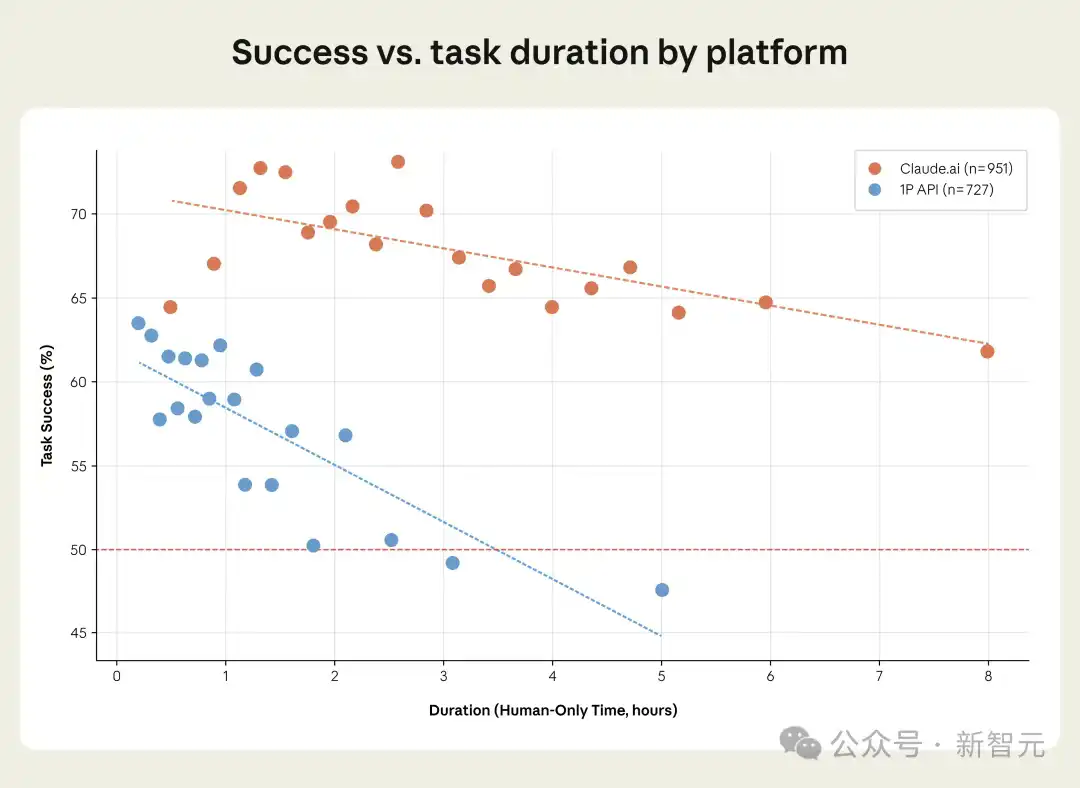
But in Anthropic's actual user data, this time limit is significantly extended.

In commercial scenarios using API calls, Claude can maintain a success rate of over 50% for tasks involving 3.5 hours of work.

And in the Claude.ai chat interface, this number is astonishingly pushed to 19 hours.

Why such a huge gap? The secret lies in human intervention.

Benchmark tests are AI facing the test alone, while real-world users break down a massive complex project into countless small steps, constantly correcting AI's course through feedback loops.

This human-AI collaborative workflow pushes the (50% success rate measured) task duration上限 (upper limit) from 2 hours to about 19 hours, nearly a 10-fold increase.

This might be the true shape of future work: not AI doing everything independently, but humans learning how to steer it through a marathon.

The Folded World Map: The Poor Learn Knowledge, the Rich Engage in Production

If we zoom out to a global perspective, we see a clear and slightly ironic "adoption curve".

In high per capita GDP developed countries, AI is already deeply embedded in productivity and personal life.

People use it to write code, create reports, and even plan travel itineraries.

But in countries with lower per capita GDP, Claude's primary role is "teacher," with大量 (a large number of) uses concentrated on coursework and educational tutoring.
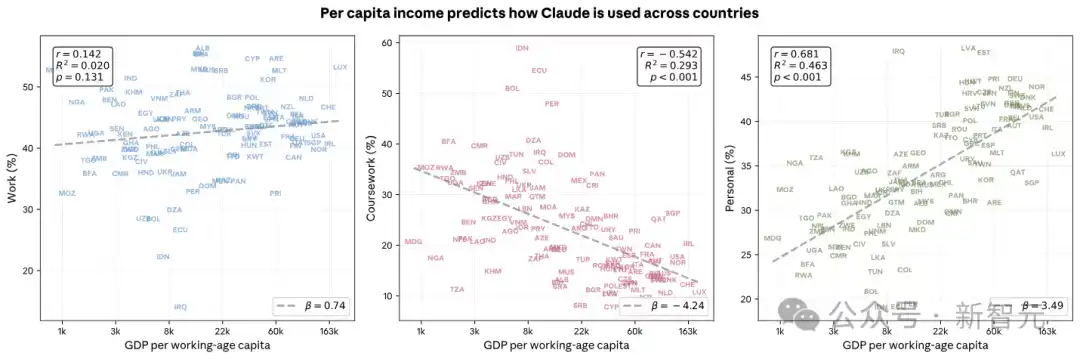
Beyond wealth disparity, this is also a manifestation of a technological gap.

Anthropic mentioned they are collaborating with the Rwandan government, trying to help people there leapfrog the mere "learning" phase and enter broader application layers.

Because without intervention, AI is likely to become a new barrier: people in wealthy regions use it to exponentially amplify output, while people in less developed regions are still using it to补习 (remedially learn) basic knowledge.

Workplace Concerns: The Specter of "Deskilling"

The most controversial and警惕 (warranting caution) part of the report is the discussion on "Deskilling".

Data indicates that the tasks currently covered by Claude require, on average, 14.4 years of educational background (equivalent to an associate degree), significantly higher than the 13.2 years required on average for overall economic activity.
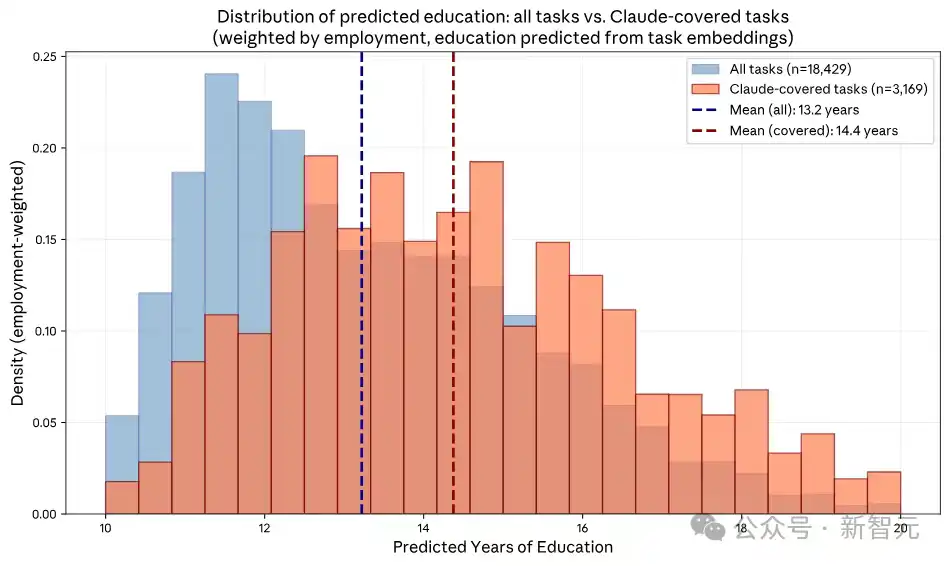
AI is systematically剔除 (removing) the "high-intelligence" parts of work.

For technical writers or travel agency agents, this could be disastrous.

AI takes over分析行业动态 (analyzing industry trends),规划复杂行程 (planning complex itineraries) — the tasks that require "brains" — leaving humans with only琐碎工作 (trivial tasks) like sketching or collecting invoices.

Your job remains, but the "gold content" of the job is hollowed out.

Of course, there are beneficiaries.

For example, real estate managers, when AI handles枯燥的行政工作 (tedious administrative work) like bookkeeping and contract comparison, can focus their energy on client negotiation and stakeholder management requiring high emotional intelligence—this is反而 (instead) a form of "Upskilling".

Anthropic cautiously states this is only an extrapolation based on the current situation, not an inevitable prophecy.

But the alarm it sounds is real.

If your core competitiveness is merely processing complex information, then you are at the eye of the storm.

A Return to the "Golden Age" of Productivity?

Finally, let's return to the macro perspective.

Anthropic revised its forecast for US labor productivity.

After剔除 (removing) possible AI errors and failures, they predict AI will drive productivity growth by 1.0% to 1.2% annually over the next decade.

This seems like a reduction of one-third compared to the previous optimistic estimate of 1.8%, but don't underestimate this 1 percentage point.

It is enough to bring US productivity growth back to the levels of the late 1990s internet boom.

Moreover, this is based solely on the model capabilities as of November 2025. With the entry of Claude Opus 4.5, and the gradual dominance of "augmented mode" (where people no longer try to dump all work on AI but collaborate with it more intelligently) in user behavior, this number has significant upside potential.

Conclusion

Reading through the entire report, what is most感慨 (striking) is not just how strong AI has become, but more how quickly humans are adapting.

We are undergoing a migration from "passive automation" to "active enhancement".

In this transformation, AI acts like a mirror; it takes over those tasks that require high education but can be completed through logical deduction, thereby forcing us to seek out value that cannot be quantified by algorithms.

In this era of computational surplus, humanity's scarcest ability is no longer finding answers, but defining problems.

References:

https://www.anthropic.com/research/economic-index-primitives

https://www.anthropic.com/research/anthropic-economic-index-january-2026-report

Pertanyaan Terkait

QAccording to Anthropic's report, which type of tasks does AI accelerate the most?

AAI accelerates complex tasks that require a higher level of education the most. Tasks requiring a college degree see a 12x speedup, compared to a 9x speedup for tasks requiring only a high school education.

QWhat is the key finding regarding human-AI collaboration in terms of task duration?

AThe key finding is that human-AI collaboration dramatically extends the viable task duration. While benchmarks suggest AI's 50% success rate drops at 2-hour tasks, real-world collaborative workflows push this limit to approximately 19 hours.

QHow does the primary use of AI differ between high-GDP and low-GDP countries, as per the report?

AIn high-GDP countries, AI is primarily used for productivity and personal life enhancement (e.g., coding, reports). In low-GDP countries, its main role is as an educational tool for coursework and tutoring.

QWhat is 'deskilling' and which professionals are most at risk from it?

A'Deskilling' is the process where AI systematically removes the high-intellect, analytical parts of a job, leaving humans with more mundane tasks. Professionals like technical writers and travel agents, whose core value is processing complex information, are most at risk.

QWhat is Anthropic's revised forecast for AI's annual impact on US productivity growth over the next decade?

AAnthropic's revised forecast estimates that AI will boost US labor productivity growth by 1.0% to 1.2% annually over the next decade, a figure comparable to the growth rates seen during the late 1990s internet boom.

Bacaan Terkait

"Gergaji Musim Panas" Berlanjut: Breakout $67.000 Akan Menjadi Awal Kenaikan Bitcoin

Harga Bitcoin terus terkonsolidasi dalam kisaran $58.000–$67.000 sejak awal Juni, dengan harga terkini di sekitar $62.217 pada 1 Agustus. Para analis pasar mempertimbangkan beberapa skenario kunci. Secara teknis, pergerakan di atas $66.000 dianggap penting untuk mengubah momentum. Beberapa trader seperti Crypto Candy memprediksi kemungkinan penurunan menuju $60.000 jika level $66.000 tidak tertembus. Trader lain, Jelle, menggambarkan situasi ini sebagai "gergaji musim panas" yang berkepanjangan dan mempertahankan strategi rata-rata biaya dengan pembelian berkala. Di sisi lain, skenario breakout ke atas tetap ada. Daan Crypto Trades menekankan bahwa keberhasilan menembus $67.000 sangat penting untuk menghindari fase konsolidasi yang berlarut-larut. Roman bahkan memperkirakan bahwa breakout dengan volume yang kuat dapat mendorong harga dengan cepat ke zona $70.000–$80.000. Dari perspektif jangka panjang, analis Gert van Lagen melihat fase ini sebagai periode akumulasi, dengan Bitcoin menguji pola grafik besar "cangkir dengan pegangan". Dia mencatat bahwa pemegang jangka panjang masih enggan menjual, yang ditunjukkan oleh metrik NUPL mereka yang masih jauh dari zona kapitulasi. Kesimpulannya, pasar Bitcoin saat ini berada dalam fase akumulasi yang menentukan. Level $60.000 dan $67.000 menjadi kunci, dan breakout dari level mana pun kemungkinan akan menentukan arah tren berikutnya. Skenario AI dalam artikel juga mempertanyakan apakah konsolidasi saat ini dapat membentuk fondasi yang lebih kuat, atau apakah setiap ujian di level $67.000 akan terus menghadapi hambatan psikologis yang sama dari pemegang aset jangka pendek.

cryptonews.ru22m yang lalu

"Gergaji Musim Panas" Berlanjut: Breakout $67.000 Akan Menjadi Awal Kenaikan Bitcoin

cryptonews.ru22m yang lalu

Perhatian Wajib Pekan Depan|Undang-Undang CLARITY Diperkirakan Akan Masuk ke Pemungutan Suara Senat; SpaceX dan Circle Umumkan Laporan Keuangan (3-9 Agustus)

**Ringkasan Acara Penting Pekan Depan (3-9 Agustus)** Pekan depan diwarnai sejumlah pengumuman keuangan penting dan perkembangan regulasi kripto di AS. **Laporan Keuangan & Acara Perusahaan:** * **SpaceX** akan merilis laporan keuangan Q2 2026 pada 4 Agustus, diikuti gelombang pencairan saham internal pertama (hingga 12%) pada 6 Agustus. * **Circle** (penerbit USDC) dan **Hut 8** (penambang Bitcoin) masing-masing akan mengumumkan laporan kuartalan pada 5 Agustus dan 4 Agustus. * **American Bitcoin (ABTC)**, perusahaan tambang kripto yang dikaitkan dengan keluarga Trump, merilis laporan Q2 pada 3 Agustus. * Perusahaan robotika **宇树科技 (Unitree Robotics)** akan melakukan penawaran saham perdana (IPO) di pasar STAR China, dengan hari penentuan harga awal pada 5 Agustus. **Regulasi Kripto AS:** * **CLARITY Act**, undang-undang kerangka kerja federal untuk aset kripto, berpeluang dilakukan pemungutan suara penuh di Senat AS minggu ini. Para negosiator harus merampungkan aturan tentang konflik kepentingan sebelum masa reses 7 Agustus. RUU ini memerlukan 60 suara untuk disetujui. **Pengumuman Data & Teknologi:** * **Laporan Non-Farm AS** untuk Juli akan dirilis pada 7 Agustus, menjadi fokus pasar. * **Grok AI** versi 4.6 (dengan 1,5 triliun parameter) diperkirakan diluncurkan sekitar 7 Agustus, diikuti versi 4.7 yang lebih kuat beberapa minggu setelahnya. * **XRP Ledger** versi 3.3.0 dengan lima fitur baru, termasuk transaksi batch, dijadwalkan rilis minggu depan. **Penutupan & Perubahan Layanan:** * Beberapa layanan kripto akan berhenti beroperasi: **Zapper** (pelacak portofolio DeFi) dan **Ctrl Wallet** pada 3 Agustus, serta **LayerZero** akan menghentikan relayernya untuk v1 pada tanggal yang sama. Bursa Korea **Upbit** akan menghapus perdagangan pasangan **AQT** dan **AERGO** pada 3 Agustus. **Acara Lainnya:** * **BIP-110**, sebuah proposal peningkatan jaringan Bitcoin, akan memulai fase pengiriman sinyal wajib sekitar 8 Agustus.

marsbit1j yang lalu

Perhatian Wajib Pekan Depan|Undang-Undang CLARITY Diperkirakan Akan Masuk ke Pemungutan Suara Senat; SpaceX dan Circle Umumkan Laporan Keuangan (3-9 Agustus)

marsbit1j yang lalu

Saham Jatuh Lebih Parah daripada Kripto, Ke Mana Uangnya Pergi?

Penulis: Cathy,白话区块链 Pada 28 dan 29 Juli di Seoul, indeks Kospi memicu *circuit breaker* dua hari berturut-turut, suatu peristiwa yang belum pernah terjadi dalam sejarah pasar saham Korea. Saham-saham semikonduktor global, termasuk SK Hynix yang turun sekitar 23% dalam dua hari, mengalami penurunan drastis. Penarikan dana (pullback) Kospi pada Juli mencapai 40% dari titik tertinggi Juni, menjadikannya bulan terburuk yang tercatat. Produk leverage seperti ETF 2x Long SK Hynix bahkan anjlok hingga 83%, menghapus lebih dari 1 triliun HKD dalam nilai pasar. Ironisnya, Bitcoin justru naik hampir 15% dari titik terendah Juli, menunjukkan perilaku yang tidak biasa: **saham yang jatuh seperti aset kripto, sementara Bitcoin relatif stabil.** Penurunan ini bukan kepanikan pasar luas, melainkan "peledakan tertarget" terhadap perdagangan yang paling ramai (*crowded trades*), dipicu oleh laporan keuangan SK Hynix yang meski mencetak rekor laba tetapi di bawah perkiraan, serta IPO besar-besaran ChangXin Memory (CXMT) dari China. Ditambah dengan potensi likuidasi posisi *carry trade* Yen Jepang yang masif, pasar mengalami de-leverage paksa. Lalu, apakah uang yang keluar dari saham mengalir ke Bitcoin? Jawabannya tidak. Bitcoin tampak "tahan jatuh" karena sudah mengalami koreksi lebih dulu—jatuh sekitar 21% selama periode arus keluar ETF berkelanjutan pada Mei-Juni. Uang yang mencari perlindungan justru mengalir ke emas, yang harganya naik lebih dari 20% secara tahunan. Koefisien korelasi Bitcoin dengan emas mencapai -0.88, mengindikasikan bahwa institusi kini memandangnya sebagai aset yang berbeda: **emas untuk perlindungan, Bitcoin untuk potensi pertumbuhan.** Agar aliran dana besar-besaran benar-benar masuk ke Bitcoin, diperlukan tiga kondisi: tekanan likuidasi global mereda, The Fed menurunkan suku bunga tanpa memicu resesi, dan disahkannya RUU CLARITY di AS untuk memberikan kejelasan regulasi. Meski RUU tersebut tertunda di Senat, arahnya sudah jelas. **Harga saham teknologi ditentukan oleh pengeluaran modal AI dan laba perusahaan, sedangkan harga Bitcoin ditentukan oleh likuiditas global.** Ketidakselarasan ini justru menciptakan daya tarik bagi institusi yang ingin mendiversifikasi portofolio mereka. Kesimpulannya, Bitcoin saat ini bukan tempat perlindungan (*safe haven*), melainkan aset yang sudah terkoreksi lebih dulu dan sudah berada di posisi yang siap. **Dana belum datang, tetapi posisinya sudah dipersiapkan.** Ketika badai berlalu dan modal global mencari tempat baru untuk dialokasikan, Bitcoin berada di urutan terdepan dalam antrian.

marsbit1j yang lalu

Saham Jatuh Lebih Parah daripada Kripto, Ke Mana Uangnya Pergi?

marsbit1j yang lalu

Dialog dengan Ray Dalio: Saat Ini Berada dalam Gelembung AI, 1% Portofolio Investasi Adalah Bitcoin

Sumber: The Diary Of A CEO Ray Dalio, pendiri Bridgewater Associates yang meramalkan krisis keuangan 2008, memperingatkan bahwa ledakan AI saat ini menunjukkan tanda-tanda klasik gelembung ekonomi yang dapat pecah dan memicu resesi. Dalam wawancara podcast, dia menjelaskan dinamika "siklus besar" yang didorong oleh ketimpangan kekayaan, defisit pemerintah, dan perubahan geopolitik. Dalio mengidentifikasi pola di mana antusiasme berlebihan terhadap teknologi revolusioner baru, seperti AI, menyebabkan harga aset melambung dan pinjaman berlebihan. Ketika kondisi berubah (seperti kenaikan suku bunga atau kebutuhan tunai), gelembung ini dapat pecah, menyebabkan penurunan harga aset, kerugian luas, dan kontraksi ekonomi. Untuk melindungi kekayaan di masa ketidakpastian, Dalio sangat menekankan pentingnya **diversifikasi portofolio**—termasuk saham, obligasi, emas, dan real estat—daripada mengandalkan uang tunai saja. Dia mengungkapkan bahwa sekitar **1% portofolionya adalah Bitcoin**, yang diakuinya sebagai aset keras, tetapi dia lebih menyukai **emas fisik** karena sejarahnya sebagai penyimpan nilai dan aset bebas liabilitas. Mengenai dampak AI, Dalio percaya bahwa teknologi ini akan menggantikan tidak hanya tenaga fisik tetapi juga kemampuan kognitif manusia, berpotensi memperlebar kesenjangan antara pemilik modal dan pekerja. Masa depan akan menguntungkan mereka yang dapat memadukan kecerdasan manusia (seperti emosi dan intuisi) dengan kemitraan AI. Secara geopolitik, Dalio menggambarkan dunia yang memasuki fase "penurunan" dalam tatanan global, dengan Amerika Serikat menghadapi tantangan internal dan eksternal, termasuk konflik seperti di Iran yang mengungkap kelemahannya. Dia memprediksi dunia mungkin menjadi lebih terregionalisasi di masa depan. Secara keseluruhan, kunci untuk navigasi melalui periode kompleks ini adalah pemahaman akan pola sejarah, adaptasi, dan diversifikasi yang cermat.

marsbit4j yang lalu

Dialog dengan Ray Dalio: Saat Ini Berada dalam Gelembung AI, 1% Portofolio Investasi Adalah Bitcoin

marsbit4j yang lalu

Trading

Spot
活动图片





