Airdrop of $675 Million Sparks Distribution Controversy, Lighter Faces User Retention Post-Token Launch

marsbitDipublikasikan tanggal 2025-12-31Terakhir diperbarui pada 2025-12-31

Abstrak

Lighter, a zk-rollup-based perpetual DEX, airdropped $675 million worth of LIT tokens to early users on December 30, sparking mixed reactions. While the airdrop was generous—25% of total supply with no lock-up—some users felt rewards were only on par with fees paid. Tokenomics drew criticism, with 50% allocated to the team and investors (3-year linear unlock), raising concerns over community dilution and sell pressure. Founded by ex-Citadel quant Vladimir Novakovski, Lighter raised $68 million at a $1.5 billion valuation, backed by investors like Founders Fund and Robinhood. Its tech stack features a high-performance CLOB model with custom ZK circuits, enabling 15,000+ TPS, sub-10ms latency, and verifiable trustlessness. Key innovations include zero trading fees for retail users, universal cross-margin support using L1 yield-bearing assets as collateral, and isolated risk pools. However, Lighter faces challenges: an unusually high OI/volume ratio (~0.2) suggests wash trading, and system outages have raised stability concerns. Post-airdrop, retaining organic users and sustaining revenue—currently ~$200k daily—will be critical as it competes in the crowded Perp DEX space.

Author: Jae, PANews

The final airdrop suspense of the year concluded last night (December 30). Perp DEX (decentralized perpetual contract exchange) Lighter announced the completion of its airdrop distribution, granting early participants a total of $675 million, bringing a glimmer of warmth to the chilly market at the end of 2025.

Although the winter market is somewhat bleak, competition in the Perp DEX arena for liquidity and trading experience is intensifying. The industry is witnessing the gradual replacement of early automated market makers (AMMs) by high-performance central limit order books (CLOBs). Lighter, built on zk-rollup, quickly stands out with its zero-fee strategy and customized ZK circuit technical approach, attempting to redefine the standard for on-chain derivatives trading.

Airdrops have always been hard to please everyone, and Lighter undoubtedly faces the same issues encountered by other airdrop projects: dissatisfaction with the airdrop and user retention in the post-airdrop era.

Polarized Reactions to Airdrop, Token Distribution Sparks Controversy

Lighter completed its TGE yesterday, and the protocol token LIT showed significant volatility in its early listing. In pre-market trading on several centralized exchanges, LIT once reached a high of $3.9. After the TGE officially began, the price briefly surged to $7.8 before falling back and stabilizing in the range of $2.6 to $3.

According to Bubblemaps monitoring, the total airdrop amount distributed to early participants on the first day of LIT's listing reached $675 million. Since the airdrop distribution began, approximately $30 million has flowed out of Lighter.

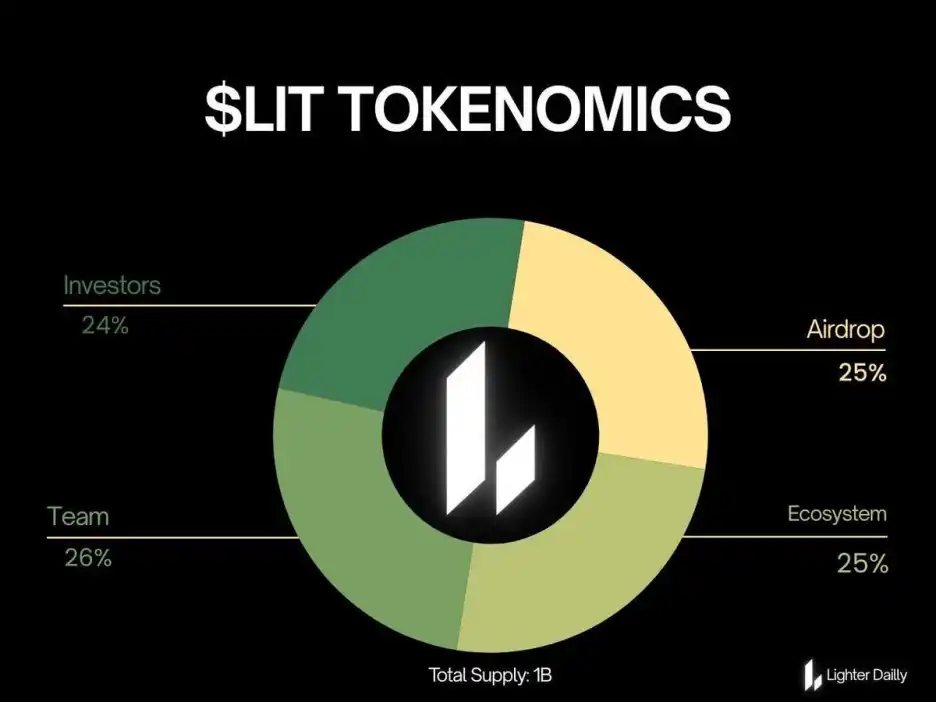
While Lighter's airdrop was relatively generous, community evaluations are polarized. Supporters believe that the initial airdrop accounted for 25% of the total supply, equivalent to approximately $690 million directly distributed to Season 1 and Season 2 points holders, with no lock-up restrictions, contrasting sharply with the lower token allocations at TGE for many other projects; opponents argue that the points conversion rate for Season 1 and Season 2 was about 20 to 28 LIT tokens per point. For some users with higher trading frequency, this is roughly equivalent to the fees they paid, failing to deliver the expected "big win"回报.

The biggest controversy surrounding this TGE lies in Lighter's tokenomics. The total token supply is 1 billion, with 50% allocated to the ecosystem and the other 50% to the team and investors, subject to a 3-year linear unlock. This plan has been criticized by the community as "team-dominated": although investor lock-ups are strict, the overall proportion is too high, potentially diluting community interests. The 25% unlocked airdrop tokens might create short-term selling pressure, while the 50% locked portion could lead to long-term potential selling pressure,不利于 the steady growth of LIT's market capitalization.
From a valuation perspective, Lighter's pricing directly benchmarks Hyperliquid and Aster. Although its trading volume once surpassed these two major rivals, the market still has doubts about the rationality of its valuation.

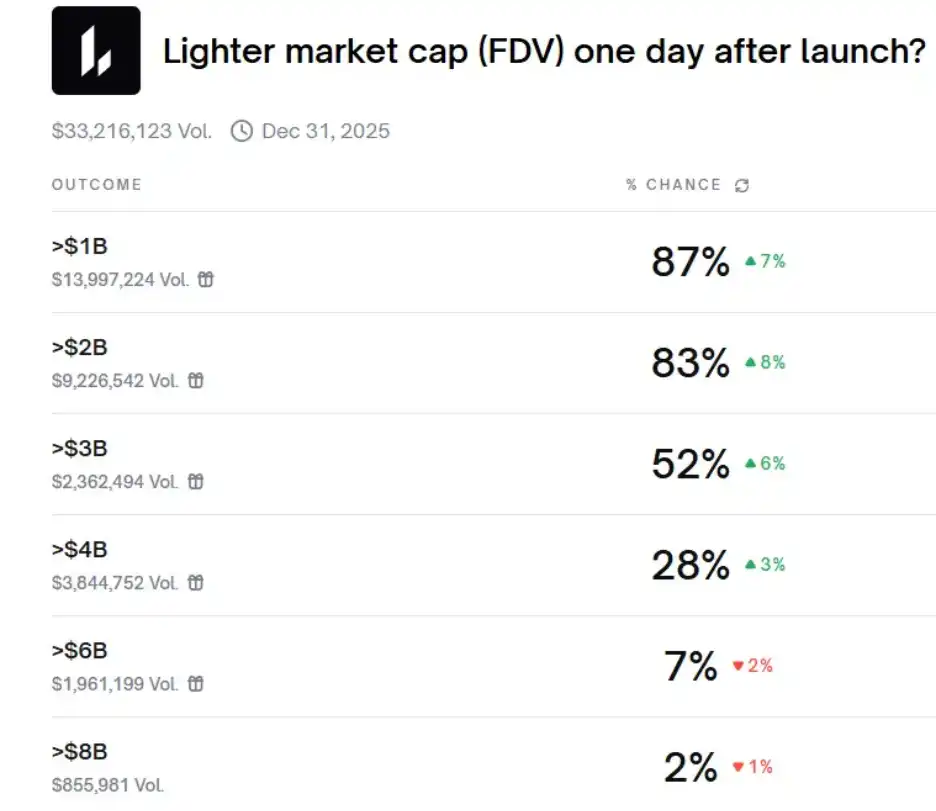
CoinGecko data shows that LIT's current market capitalization is approximately $680 million, with an FDV (fully diluted valuation) exceeding $2.7 billion. A week ago, Polymarket's prediction market showed an 83% probability that "Lighter's market cap will exceed $2 billion the day after listing".

Lighter CEO Vladimir Novakovski stated in a podcast interview: the token won't skyrocket immediately upon listing, realistic expectations are to start from a relatively healthy position. Andy, founder of The Rollup, also tweeted: if LIT's FDV is around $2 billion, he would choose to buy.

Overall, Lighter's TGE performance was largely in line with expectations but lacked surprises. Coupled with the overall market downturn, the community's overall response to the protocol has been muted.
Top-Tier Capital Bets on Harvard Prodigy Building Lighter

Lighter's story begins with its founder, Vladimir Novakovski, a mix of the typical "overachiever next door" and Wall Street elite. He entered Harvard at 16 and graduated early, later personally recruited by Ken Griffin, founder of the global market-making giant Citadel Securities. This experience in a top quantitative fund gave him deep insights into the microstructure of traditional financial markets and the essence of liquidity management.

However, this prodigy's ambition did not stop at Wall Street. He previously successfully founded Lunchclub, an AI social platform valued at over $100 million in Web2. In 2023, he敏锐地捕捉到 the gap in on-chain financial infrastructure, leading 80% of his team members to transition and All in Crypto, fully dedicating themselves to Lighter's development.

"We invested in Lighter, mostly because of Vladimir and his team's engineering capabilities." This statement by Joey Krug, partner at top Wall Street VC Founders Fund, reveals the underlying logic of the capital bet: on extremely complex technical tracks, top talent density is the main moat.

In November 2025, Lighter announced the completion of a $68 million funding round, with a post-money valuation reaching $1.5 billion.
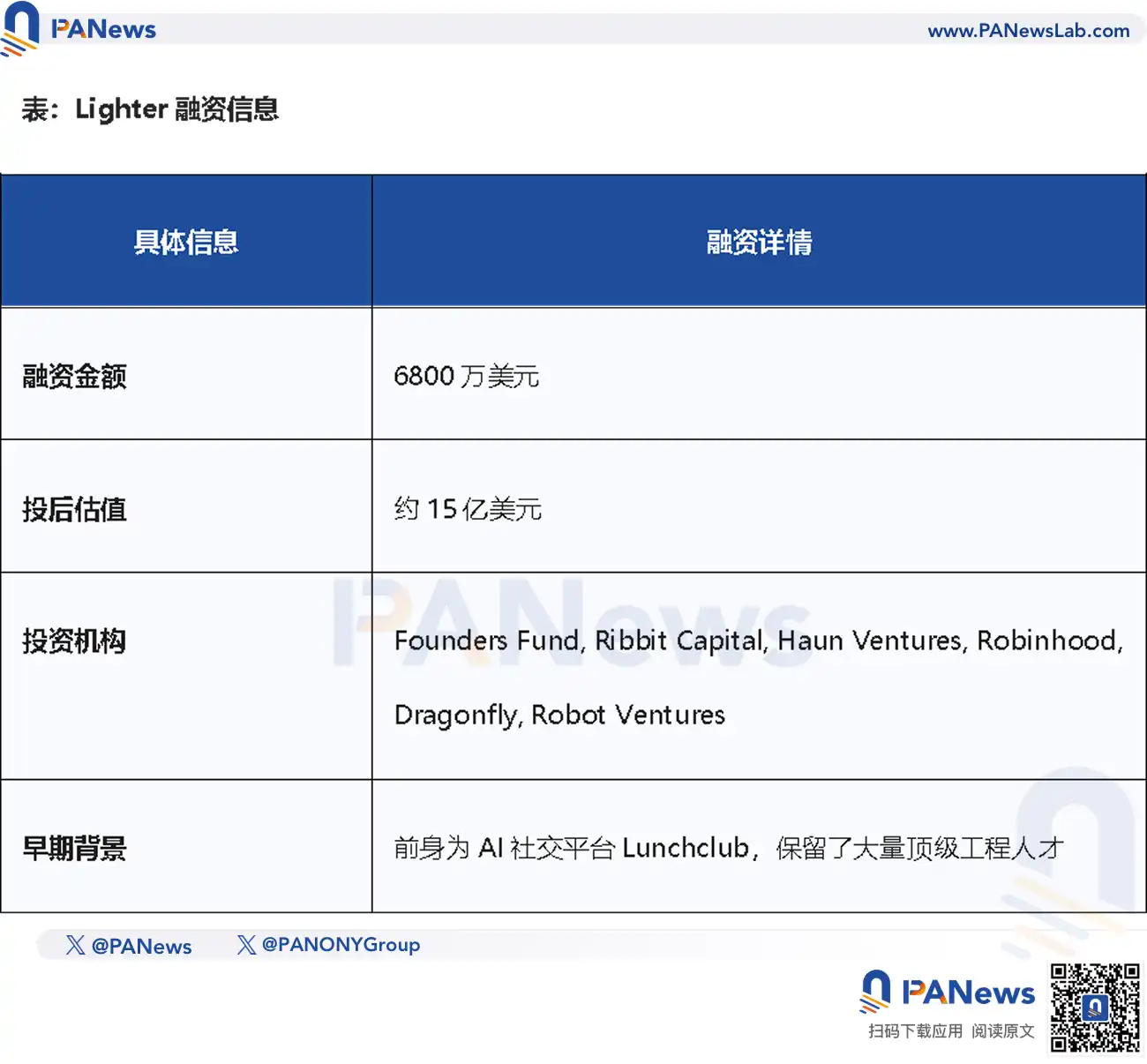
The participation of知名券商 Robinhood in this round perhaps signals an important trend: traditional financial giants are seeking Perp DEX infrastructure capable of truly handling institutional-grade trading volumes. This will not only bring funds to Lighter but also potentially导入 traditional financial institution user bases.

ZK Empowers Lighter to Achieve 15K+ TPS While Ensuring Verifiability

2025 is a watershed year for the Perp DEX赛道. Although early protocols like dYdX and GMX validated the feasibility of on-chain derivatives trading, they始终无法 match CEXs (centralized exchanges) in execution speed, slippage control, oracle latency, and liquidity depth. Lighter, however, achieves sub-second execution and higher capital efficiency by adopting a CLOB model and a high-performance Layer 2 architecture.

The core logic behind this evolution is verification equals trust. Lighter does not require users to trust the matching engine; instead, it uses customized ZK circuits to generate verifiable cryptographic proofs for every order match, every risk check, and every liquidation event. This architecture ensures that even if the sequencer attempts to act maliciously or is attacked, the underlying Ethereum mainnet contract can safeguard assets.

Lighter's technical moat is built on a seemingly contradictory combination: decentralized trust (ZK) and centralized efficiency (CLOB). Its architectural design pursues not only high performance but also transparency and non-custodianship, giving it a strong "Ethereum-native" attribute in its technical narrative.

Unlike many general-purpose ZK virtual machine protocols, Lighter chose a harder path: tailoring ZK circuits (zkLighter) specifically for trading logic. This allows the protocol to generate proofs with extremely high efficiency, achieving throughput of over 15,000 TPS (transactions per second) and soft finality below 10 milliseconds, sufficient to meet the demanding requirements of high-frequency traders.

It is worth mentioning that Lighter's underlying data structure uses a "hyper-tree" architecture to ensure that even under extremely high concurrency, the execution price of every order is the optimal available at that time.

To prevent extreme risks like sequencer offline or denial-of-service, Lighter also designed an "escape hatch" mode. Since all account balances and position data are published as Blob data on Ethereum, users can generate their own account value proofs based on the public data history and directly withdraw funds on the mainnet, without authorization from the sequencer. This mechanism also makes Lighter superior in terms of censorship resistance and asset sovereignty compared to Perp DEX protocols that build their own L1 consensus.

Zero-Fee Model Reshapes Protocol User Acquisition Logic

The reason Lighter has attracted such dense capital and user attention lies not only in its high performance and verifiability but also in its triple innovation in fee structure, capital efficiency, and liquidation logic.

In the context of Perp DEXs普遍 relying on trading fees for profit, Lighter dropped a bombshell on the market: "zero trading fees".

The protocol designed a clever dual-account model to balance商业可持续性.

  • Retail Account (Standard): No maker or taker fees for ordinary users. Although this introduces a slight delay of around 300ms, this cost saving is highly attractive for most non-high-frequency users.

  • Premium Account (Premium): Offers a zero-delay channel for institutions and high-frequency traders but charges very low fees (Maker 0.002%, Taker 0.02%).

Currently, Lighter's revenue mainly comes from premium account fees and liquidation fees, with daily revenue around $200,000,初步验证了其获客模式的可行性.
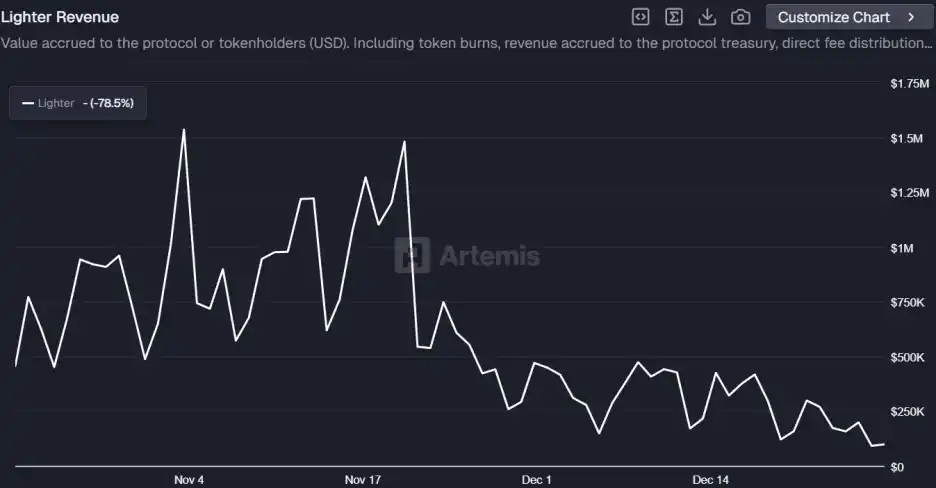
However, possibly due to the market downturn, Lighter's revenue level has declined slightly in the past week. With the airdrop expectation realized, the protocol's true revenue generation capability remains to be observed.

If the zero-fee is the hook for user acquisition, then the Universal Cross Margin (UCM) is the killer feature for retaining professional capital.

Traditional Perp DEXs typically require users to deposit stablecoins like USDC as margin, resulting in lower capital efficiency. Addressing this, Lighter introduced the UCM system, which allows traders to directly use yield-bearing assets stored on Ethereum L1 (such as stETH, LP tokens, or even Aave deposit positions) as collateral for L2 leveraged trading.

The cleverness of this design is that users' collateral assets do not need to be moved cross-chain; instead, they are mapped to L2 via ZK proofs. This means users can earn L1 staking yields while opening positions on L2.

If liquidation occurs, the system generates a cryptographic proof submitted to the L1 contract, automatically deducting the corresponding assets. This model of "assets stay put, credit extends" significantly improves capital efficiency, eliminating the difficult trade-off for users between yield assets and trading capital.

The liquidation mechanism has always been the most dispute-prone环节 in Perp DEXs. Lighter ensures liquidation behavior is fully verifiable through ZK circuits, reducing the probability of platform price manipulation (malicious wicking) or forced liquidation.

Additionally, Lighter has launched risk-tiered liquidity pools:

  • LLP (Lighter Liquidity Provider): This is the main protocol pool, acting as the counterparty and liquidation executor. It not only profits from losing traders but also captures funding rates and liquidation fees. Currently, LLP's annualized yield remains around 30%.
  • XLP (Experimental Liquidity Provider): An isolated pool specifically designed for experimental assets (like pre-listing tokens, RWA, and low-liquidity altcoins). XLP does not participate in forced liquidations, and its risk exposure is isolated from the main protocol, suitable for liquidity providers with higher risk appetite.

OI/Vol Ratio Lingers Around 0.2 Long-Term, Post-Airdrop Data May See Significant "Dehydration"

The rapidly advancing Lighter is not without its shadows.

The protocol's exaggerated OI/Vol (Open Interest/Volume) ratio has sparked widespread market skepticism. Although the ratio has recovered somewhat recently, Lighter maintained a ratio around 0.2 for a long time, meaning that on average, every $1 of open interest was traded back and forth about 5 times within 24 hours. This significantly deviates from a healthy organic holding pattern (OI/Vol < 0.33), showing明显的刷量特征 (obvious wash trading characteristics).
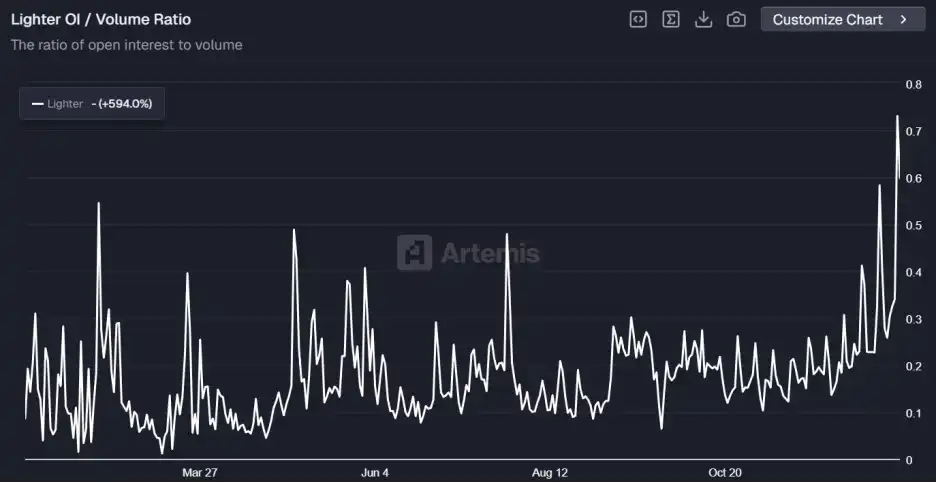
This phenomenon mainly stems from Lighter's aggressive points incentive program. Although the protocol defended against this by making invitation codes scarce and weighting holding duration, the TGE has concluded. The retention or departure of these high-frequency flows will also affect Lighter's true market share.

Frequent outages at Lighter also expose its insufficient system stability. On October 9, the protocol experienced a宕机事故 (downtime incident) lasting 4.5 hours. On December 30, Lighter again encountered issues with prover stagnation preventing users from正常提现 (withdrawing normally). For a derivatives platform handling billions of dollars, stability is the lifeline.

Lighter's emergence represents a new stage in the evolution of Perp DEXs: from decentralization to verifiable high performance. The protocol addresses the trust challenge through Ethereum mainnet security and ZK technology, and enters the Perp DEX battlefield with a zero-fee strategy.

However, competition in the Perp DEX赛道 is no longer just a technical contest but a comprehensive game of liquidity, community ecology, and product quality. Whether Lighter can grow from a technical dark horse into a top player in the赛道 depends on its ability to continuously attract and retain genuine trading demand in the post-airdrop era.


Kripto yang Sedang Tren

Pertanyaan Terkait

QWhat was the total value of the airdrop distributed by Lighter and why did it cause controversy?

ALighter distributed an airdrop with a total value of $675 million. The controversy stemmed from the tokenomics, where 50% of the total supply was allocated to the team and investors with a 3-year linear unlock, which the community criticized as being 'team-dominated'. This structure, combined with a 25% unlocked airdrop, was seen as potentially creating both short-term and long-term selling pressure, diluting community interests.

QWhat is the core technological innovation that enables Lighter to achieve high performance and verifiability?

ALighter's core technological innovation is its use of a customized ZK circuit (zkLighter) on a zk-rollup. This allows the protocol to generate verifiable cryptographic proofs for every order matching, risk check, and liquidation event. This architecture combines the efficiency of a centralized limit order book (CLOB) with the trustlessness of zero-knowledge proofs, enabling high throughput (15,000+ TPS) and sub-second finality while ensuring security backed by the Ethereum mainnet.

QHow does Lighter's 'zero-fee' business model work and what are its two account types?

ALighter employs a dual-account model to offer zero fees while maintaining sustainability. The 'Standard' account offers zero maker and taker fees for retail users but introduces a slight delay (~300ms). The 'Premium' account provides zero-latency trading for institutions and high-frequency traders but charges very low fees (Maker 0.002%, Taker 0.02%). Protocol revenue is generated from these premium fees and liquidation penalties.

QWhat is the Universal Cross-Margin (UCM) system and how does it improve capital efficiency for traders?

AThe Universal Cross-Margin (UCM) system allows traders to use yield-bearing assets stored on Ethereum L1 (such as stETH, LP tokens, or Aave deposit positions) as collateral for leveraged trading on Lighter's L2. The collateral does not need to be moved cross-chain; instead, it is mapped to L2 via ZK proof. This lets users earn yield on their L1 assets while simultaneously using them as margin for trading on L2, significantly improving capital efficiency.

QWhat major operational challenges has Lighter faced, as mentioned in the article?

ALighter has faced two major operational challenges: a high OI/Vol (Open Interest to Volume) ratio, which suggested significant wash trading was occurring to farm airdrop points, and system stability issues. The protocol experienced a 4.5-hour outage in October and another incident on December 30th where the prover stalled, preventing users from withdrawing funds, highlighting concerns about the reliability of its infrastructure.

Bacaan Terkait

Dialog dengan Ray Dalio: Saat Ini Berada dalam Gelembung AI, 1% Portofolio Investasi Adalah Bitcoin

Sumber: The Diary Of A CEO Ray Dalio, pendiri Bridgewater Associates yang meramalkan krisis keuangan 2008, memperingatkan bahwa ledakan AI saat ini menunjukkan tanda-tanda klasik gelembung ekonomi yang dapat pecah dan memicu resesi. Dalam wawancara podcast, dia menjelaskan dinamika "siklus besar" yang didorong oleh ketimpangan kekayaan, defisit pemerintah, dan perubahan geopolitik. Dalio mengidentifikasi pola di mana antusiasme berlebihan terhadap teknologi revolusioner baru, seperti AI, menyebabkan harga aset melambung dan pinjaman berlebihan. Ketika kondisi berubah (seperti kenaikan suku bunga atau kebutuhan tunai), gelembung ini dapat pecah, menyebabkan penurunan harga aset, kerugian luas, dan kontraksi ekonomi. Untuk melindungi kekayaan di masa ketidakpastian, Dalio sangat menekankan pentingnya **diversifikasi portofolio**—termasuk saham, obligasi, emas, dan real estat—daripada mengandalkan uang tunai saja. Dia mengungkapkan bahwa sekitar **1% portofolionya adalah Bitcoin**, yang diakuinya sebagai aset keras, tetapi dia lebih menyukai **emas fisik** karena sejarahnya sebagai penyimpan nilai dan aset bebas liabilitas. Mengenai dampak AI, Dalio percaya bahwa teknologi ini akan menggantikan tidak hanya tenaga fisik tetapi juga kemampuan kognitif manusia, berpotensi memperlebar kesenjangan antara pemilik modal dan pekerja. Masa depan akan menguntungkan mereka yang dapat memadukan kecerdasan manusia (seperti emosi dan intuisi) dengan kemitraan AI. Secara geopolitik, Dalio menggambarkan dunia yang memasuki fase "penurunan" dalam tatanan global, dengan Amerika Serikat menghadapi tantangan internal dan eksternal, termasuk konflik seperti di Iran yang mengungkap kelemahannya. Dia memprediksi dunia mungkin menjadi lebih terregionalisasi di masa depan. Secara keseluruhan, kunci untuk navigasi melalui periode kompleks ini adalah pemahaman akan pola sejarah, adaptasi, dan diversifikasi yang cermat.

marsbit16m yang lalu

Dialog dengan Ray Dalio: Saat Ini Berada dalam Gelembung AI, 1% Portofolio Investasi Adalah Bitcoin

marsbit16m yang lalu

Rekor! Beli Bersih Asing 7,2 Triliun Won dalam Sehari, Wall Street: Tekanan Likuiditas di Pasar Saham Korea Telah Mereda

**Ringkasan: Rekor Pembelian Asing dan Peningkatan Likuiditas di Pasar Saham Korea** Aliran modal asing menunjukkan perubahan signifikan di pasar saham Korea (KOSPI). Pada 31 Juli, investor asing melakukan pembelian bersih rekor sebesar 7,2 triliun Won Korea dalam sehari, menandai pembalikan dari tren penjualan bersih besar-besaran dalam beberapa bulan terakhir. Secara bulanan, penjualan bersih asing menyusut drastis menjadi 9,8 triliun Won di Juli, turun dari 48,4 triliun dan 44,5 triliun Won pada Juni dan Mei. Tekanan penjualan dari lembaga domestik juga mereda. Dana pensiun dan reksa dana domestik justru menjadi pembeli bersih 1,0 triliun Won di Juli, setelah dua bulan sebelumnya menjadi penjual bersih. Faktor pendukung lainnya adalah peraturan baru dari Komisi Jasa Keuangan (FSC) yang memberlakukan syarat lebih ketat bagi investor ritel untuk masuk ke ETF leverage saham tunggal, yang langsung mengurangi volume perdagangan instrumen tersebut hingga sekitar 50%. Kebijakan ini diperkirakan dapat menekan volatilitas pasar. Citigroup mempertahankan target indeks KOSPI di level 10.000 poin, menyoroti memudarnya angin penentu likuiditas. Analis mereka menilai faktor fundamental seperti industri chip memori yang solid, valuasi historis yang rendah, fundamental ekonomi Korea yang kuat, dan dukungan kebijakan berpotensi menjadi pendorong bagi pasar.

marsbit16m yang lalu

Rekor! Beli Bersih Asing 7,2 Triliun Won dalam Sehari, Wall Street: Tekanan Likuiditas di Pasar Saham Korea Telah Mereda

marsbit16m yang lalu

Pembaruan! AI Generasi Berikut OpenAI Pecahkan 10 Masalah Kelas Medali Fields

**OpenAI Model Astra Pecahkan 10 Masalah Matematika Kelas Fields Medal!** OpenAI mengumumkan terobosan besar dari model internal terbarunya, Astra. Model ini dilaporkan telah membuat kemajuan signifikan dalam **10 masalah matematika yang belum terpecahkan**, dengan biaya komputasi hanya sekitar **$2000**. Hasilnya dipublikasikan dalam makalah setebal 249 halaman. Beberapa pencapaian utama meliputi: 1. **Menyelesaikan masalah "non-sofic group"** yang diajukan Mikhail Gromov tahun 1999, dengan membangun contoh kelompok yang tak hingga dan finitely presented yang bukan sofic. Ini dianggap sebagai kemajuan bersejarah. 2. **Memecahkan batas lama dalam masalah pengepakan bola berdimensi tinggi** (sphere packing), meningkatkan batas yang telah bertahan sejak 1978 untuk dimensi tak hingga. 3. **Menyangkal dugaan "Connes Rigidity"** dengan membangun keluarga tak terhitung dari kelompok berbeda yang menghasilkan aljabar von Neumann yang sama persis. Semua bukti telah diverifikasi menggunakan asisten pembuktian formal Lean 4, memastikan ketepatannya. Para ahli matematika menyebut temuan ini sebagai **momen bersejarah**, setara dengan prestasi penghargaan Fields Medal, dan menandai kemampuan AI untuk melakukan penalaran matematika mendalam di berbagai bidang. OpenAI juga membagikan proses penalaran model, menunjukkan langkah maju yang besar menuju AGI (Artificial General Intelligence).

marsbit1j yang lalu

Pembaruan! AI Generasi Berikut OpenAI Pecahkan 10 Masalah Kelas Medali Fields

marsbit1j yang lalu

Bagaimana Membuat Diri Sendiri Tak Tergantikan oleh Kecerdasan Buatan

**Ringkasan: Bagaimana Membuat Diri Anda Tak Tergantikan oleh AI** Artikel ini membahas ancaman nyata dalam era AI: bukan kehilangan pekerjaan, tetapi "perbudakan gaji"—ketergantungan pada sistem dan orang lain untuk bertahan hidup. Solusinya adalah menjadi "individu super" yang "tak bisa dipekerjakan" dengan membangun bisnis atau karya sendiri. Kunci untuk bertahan dan berkembang di masa depan bukan sekadar keterampilan teknis, tetapi menguasai lima elemen yang sulit digantikan AI: 1. **Otonomi (Agency):** Kemampuan bertindak tanpa menunggu perintah. 2. **Rasa (Taste):** Pengalaman untuk mengetahui apa yang bernilai untuk ditawarkan. 3. **Kemampuan Persuasi (Persuasion):** Keterampilan menarik perhatian dan pengakuan. 4. **Ketekunan (Persistence):** Memahami bahwa kegagalan adalah bagian dari proses. 5. **Iterasi (Iteration):** Kemampuan memperbaiki kesalahan berdasarkan umpan balik. Lima elemen ini dapat dikembangkan dengan **membuat konten** (media). Dibandingkan pemrograman (code), konten lebih unggul karena nilainya subjektif, membutuhkan penilaian manusia, dan merupakan alat distribusi yang ampuh untuk membangun koneksi dan otoritas. Untuk memulai transformasi: 1. **Ubah lingkungan** Anda secara drastis untuk memicu perubahan identitas. 2. **Gali "bahan mentah"** Anda: Identifikasi pengetahuan mendalam, masalah yang pernah Anda selesaikan, dan minat unik masa kecil Anda. 3. **Temukan "poros pemikiran balik"**: Tentukan pendapat kontra-intuitif atau keyakinan Anda yang bertentangan dengan arus utama dalam bidang Anda. 4. **Luncurkan ide pertama** Anda besok. Gabungkan jawaban dari langkah 2 dan 3, lalu publikasikan. Umpan balik nyata dari dunia adalah guru terbaik. Intinya, bangunlah *karier seumur hidup* yang autentik berdasarkan pengalaman dan sudut pandang unik Anda. Dengan memanfaatkan AI sebagai alat dan fokus pada pengembangan diri yang tak tergantikan, Anda dapat mengambil kendali atas hidup dan masa depan Anda.

marsbit2j yang lalu

Bagaimana Membuat Diri Sendiri Tak Tergantikan oleh Kecerdasan Buatan

marsbit2j yang lalu

Kunci Bitcoin Disimpan Offline Berkat Lemparan Dadu, Tetapi Tidak Semua Orang Akan Melakukannya

Berdasarkan insiden kerentanan generator angka acak pada perangkat hardware wallet Coldcard, artikel ini membahas metode pembuatan kunci Bitcoin menggunakan dadu untuk menghasilkan entropi mandiri. Claude Shannon mengukur ketidakpastian dengan konsep entropi, di mana satu lemparan dadu enam sisi setara dengan sekitar 2,585 bit. Praktik melempar dadu 50 hingga 99 kali dapat menghasilkan frasa pemulihan 12 kata yang aman (128 bit entropi), melampaui ketergantungan pada generator perangkat. Namun, insiden Coldcard mengungkap bahwa meskipun seed utama dibuat dari dadu aman, fungsi lain seperti dompet kertas, kunci kloning, dan password masih berpotensi menggunakan generator cacat. Peneliti keamanan Kevin Loaec menekankan bahwa perlindungan hanya berlaku untuk seed utama, bukan keseluruhan sistem. Proses manual ini membutuhkan ketelitian tinggi, rentan kesalahan, dan tidak praktis bagi kebanyakan pengguna baru. Oleh karena itu, meski kuat secara matematis, metode ini lebih cocok untuk pengguna berpengalaman. Artikel menyarankan pemilik Coldcard untuk memperbarui firmware, memeriksa fungsi yang pernah digunakan, dan mempertimbangkan skema multisignature dengan perangkat dari produsen berbeda untuk mitigasi risiko. Tujuan jangka panjang adalah perangkat yang dapat menghasilkan keacakan kuat secara mandiri, tanpa memerlukan prosedur rumit dari pengguna.

cryptonews.ru5j yang lalu

Kunci Bitcoin Disimpan Offline Berkat Lemparan Dadu, Tetapi Tidak Semua Orang Akan Melakukannya

cryptonews.ru5j yang lalu

Trading

Spot

Artikel Populer

Cara Membeli NIGHT

Selamat datang di HTX.com! Kami telah membuat pembelian Midnight (NIGHT) menjadi mudah dan nyaman. Ikuti panduan langkah demi langkah kami untuk memulai perjalanan kripto Anda.Langkah 1: Buat Akun HTX AndaGunakan alamat email atau nomor ponsel Anda untuk mendaftar akun gratis di HTX. Rasakan perjalanan pendaftaran yang mudah dan buka semua fitur.Dapatkan Akun SayaLangkah 2: Buka Beli Kripto, lalu Pilih Metode Pembayaran AndaKartu Kredit/Debit: Gunakan Visa atau Mastercard Anda untuk membeli Midnight (NIGHT) secara instan.Saldo: Gunakan dana dari saldo akun HTX Anda untuk melakukan trading dengan lancar.Pihak Ketiga: Kami telah menambahkan metode pembayaran populer seperti Google Pay dan Apple Pay untuk meningkatkan kenyamanan.P2P: Lakukan trading langsung dengan pengguna lain di HTX.Over-the-Counter (OTC): Kami menawarkan layanan yang dibuat khusus dan kurs yang kompetitif bagi para trader.Langkah 3: Simpan Midnight (NIGHT) AndaSetelah melakukan pembelian, simpan Midnight (NIGHT) di akun HTX Anda. Selain itu, Anda dapat mengirimkannya ke tempat lain melalui transfer blockchain atau menggunakannya untuk memperdagangkan mata uang kripto lainnya.Langkah 4: Lakukan trading Midnight (NIGHT)Lakukan trading Midnight (NIGHT) dengan mudah di pasar spot HTX. Cukup akses akun Anda, pilih pasangan perdagangan, jalankan trading, lalu pantau secara real-time. Kami menawarkan pengalaman yang ramah pengguna baik untuk pemula maupun trader berpengalaman.

711 Total TayanganDipublikasikan pada 2025.12.08Diperbarui pada 2026.06.02

Cara Membeli NIGHT

Diskusi

Selamat datang di Komunitas HTX. Di sini, Anda bisa terus mendapatkan informasi terbaru tentang perkembangan platform terkini dan mendapatkan akses ke wawasan pasar profesional. Pendapat pengguna mengenai harga NIGHT (NIGHT) disajikan di bawah ini.

活动图片












