Abandon Illusions, Prepare for the Most Grueling Time in the Crypto Market

marsbitDipublikasikan tanggal 2025-12-20Terakhir diperbarui pada 2025-12-20

Abstrak

The article argues that while cryptocurrency adoption will continue to accelerate, market valuations may remain depressed or decline further for a prolonged period. This decoupling between real-world usage and price action is presented not as a flaw, but as a necessary and healthy feature of the market's maturation. The author draws a parallel to the dot-com bubble, where internet user growth exploded even as the Nasdaq crashed. The core thesis is that the market is undergoing a painful but essential recalibration. Many assets were fundamentally overvalued, and the current phase will pressure-test business models, eliminating flawed projects and forcing rational valuations. Cryptocurrency is transitioning from a speculative asset to a core, "boring" infrastructure technology, much like the internet did. This shift creates discomfort. Builders, early investors, and retail token holders may see value captured by traditional companies and VCs that leverage the open infrastructure. The article posits that the biggest beneficiaries might be traditional and hybrid businesses that use crypto to improve efficiency, rather than the underlying protocols themselves. The author's outlook for near-term prices is not optimistic, warning that the process could be a prolonged test of patience. They advocate for a long-term perspective, capital preservation, and a focus on businesses with sound unit economics, while cautioning against over-financialized models and excessive infrastructure ...

Author: Santiago Roel Santos

Compiled by: Tim, PANews

The Price and Adoption Paradox

Crypto adoption will continue, but market prices may not recover for a long time.

This contradiction between accelerating real-world adoption and lagging market prices is not a flaw, but a necessary feature of the current stage of crypto market evolution.

If you look at the crypto market from a ten-year perspective, its prospects are very attractive. However, maintaining this long-term perspective is psychologically challenging. You should be prepared to watch adoption rates expand while prices stagnate or slowly decline; you must also be prepared to watch others profit in other areas (AI, stocks, or the next hot trend the market hypes) while the crypto space seems forgotten.

It will feel unfair, and the process will be grueling. But the price lag is inevitable. Fundamentally, many of these crypto assets never deserved the valuations they once had.

The market doesn't care about actual adoption until the price crashes and it starts to care again.

Application Proliferation Fuels Bubbles

Initial application proliferation can actually fuel bubble problems. This is the painful process of value discovery. When real usage demand cannot support inflated valuations, the market will recalibrate, and this is precisely the necessary path to long-term healthy development.

When crypto infrastructure achieves scaled application, it becomes clear that the capital invested far exceeds its actual needs. Application proliferation will bring pressure tests for business models rather than value verification. Some projects will die off quietly, and while others may survive, their valuations will be far lower than the visions painted at their peak.

Cryptocurrency is moving from the spotlight, the main character, to gradually fading from view, becoming ordinary. From exciting to mundane, and this is the necessary path from noise to maturity.

This is a good thing.

This script isn't new. During the dot-com bubble burst, the NASDAQ index plummeted by about 78%, while the number of internet users tripled and broadband infrastructure was fully deployed. The market took years to recover, and now the internet has quietly reshaped the world. While investors were still licking their wounds, software was "eating" the whole world.
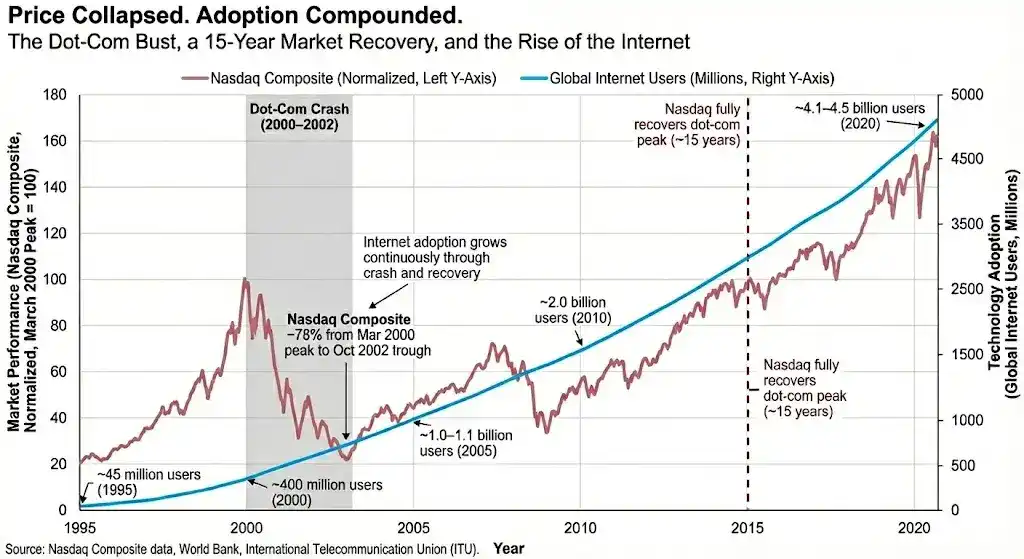
Infrastructure technology does not reward impatient investors.

When Infrastructure Wins, Who Will Be the Real Winners?

The shift in market phases will make many participants uncomfortable. Builders who have spent years maintaining open-source codebases will watch other companies copy their work and reap most of the economic benefits; early native crypto VCs who invested in infrastructure will see traditional VCs capture more value; retail investors who bought tokens instead of equity may feel marginalized, as enterprises benefit from the ecosystem network without returning corresponding value to token holders.

Some are structural problems, some are self-inflicted dilemmas.

The market is adjusting itself. Open networks will develop rapidly, system incentives will change, value capture mechanisms will improve, but not all models will survive long enough to benefit.

Crypto adoption is quietly advancing, it's just that the market hasn't truly valued it yet. It may take years for the market to re-establish the value connection and recognize that crypto technology is a core operating system, not just a speculative asset.

Price Cycles and Application Cycles Are Two Different Things

Price cycles are driven by market psychology and liquidity.

Application cycles are driven by utility value and infrastructure.

The two are related, but not synchronized. Historically, prices often led adoption, which is common in early technological revolutions. Now, adoption is starting to lead, and prices are instead lagging.

Right now, the marginal buyers of crypto assets are elsewhere, they are chasing the AI wave. This phenomenon may continue, or it may reverse, regardless of our will.

But what we can see is that a world without stablecoins, without transparent capital channels, without global 24/7 real-time settlement is becoming increasingly difficult to imagine.

The most profound lesson cycles teach us is: we must accept that the disconnect between application and price may last much longer than expected, and if you want sustained compound interest, you need to remain rational when you lose patience.

This is not a HODL manifesto.

Many crypto projects will never recover. Some were flawed by design, some lack moats, and others have been completely abandoned. New winners will inevitably be born, there will be fallen stars, and a few true dark horses.

Pullbacks Are Healthy

We are entering a different regulatory and economic environment. This creates an opportunity to solve long-standing problems: weak product revenue, insufficient asset disclosure, mismatched equity and token structures, and opaque team incentives.

If the crypto industry really wants to become what it aspires to be, it must first act the part.

I believe anything is possible. My most confident view is that most businesses will adopt crypto technology to remain competitive within the next 15 years. By then, the total market capitalization of cryptocurrency will exceed ten trillion dollars. Stablecoins, tokenization, user scale, and on-chain activity will grow exponentially. Meanwhile, valuation standards will be redefined, existing giants may decline, and unreasonable business models will eventually be eliminated.

This is healthy, and necessary.

Cryptocurrency will eventually become invisible. The more a company makes crypto the core of its product, the more fragile its business model often is. The truly lasting winners will embed it deeply in business processes, payment systems, and balance sheets. Users should not be aware of the crypto technology's existence, but should feel its benefits: faster settlement, lower costs, and reduced intermediaries.

Cryptocurrency should be pure and "boring".

As capital tightens, the era of airdrop proliferation, subsidy-driven demand, unreasonable incentives, and over-financialization is coming to an end. This is just another inevitable historical cycle.

My basic judgment is simple: crypto adoption will accelerate, prices will readjust, and valuations will return to rationality. Crypto is a long-term trend, but this absolutely does not mean the tokens you hold will necessarily rise.

Who Actually Captures the Value of Crypto Technology?

Basic technology primarily benefits consumers by lowering prices and improving experience. The secondary beneficiaries are those enterprises that upgrade their own systems to leverage cheaper, faster, more programmable infrastructure.

This theoretical framework raises some uncomfortable but necessary questions:

  • Visa or Circle?
  • Stripe or Ethereum?
  • Robinhood or Coinbase?
  • A basket of Layer 1 protocols or user aggregators?
  • A basket of Layer 1 protocols or DeFi?
  • A basket of Layer 1 protocols or DePIN?
  • DeFi or traditional finance stocks?
  • DePIN or infrastructure stocks?

This isn't an absolute either/or; diversified investment strategies are also feasible. The question is about relative value and relative performance. Who will capture the surplus value created by blockchain?

I lean towards traditional and hybrid enterprises that connect to open settlement channels to reduce costs and increase profit margins. History suggests they often benefit more than the infrastructure itself.

But it must be emphasized that there are exceptions to every theoretical framework.

What I Believe, and What I Don't

I do believe that networks with real demand will eventually monetize, the internet has proven this. Facebook also went through many years before commercialization.

I am confident that the value of some Layer 1s will be validated as they develop, eventually matching their valuation. But I also believe most will struggle to attract users and find sufficient value support.

I believe the gap between winners and losers will widen further. Distribution, market entry strategy, user relationships, and unit economics will be far more important than first-mover advantage.

A common misconception in crypto is overestimating the early advantage of technological leadership while underestimating other elements required for subsequent development.

Back to Reality

My view on price movements in the coming years is not particularly optimistic. Adoption will continue to rise, but prices may fall further, potentially exacerbated by broader stock market mean reversion and a cooling AI hype cycle.

But, patience is a great advantage.

  • I am bullish on Crypto-as-a-Service models
  • I am bullish on crypto-enabled enterprises
  • I am bearish on over-financialization
  • I am bearish on failed unit economics
  • I am bearish on overbuilding infrastructure

Protecting capital becomes crucial. Cash is undervalued: not for its yield, but for the psychological immunity it grants. It allows you to act decisively when others cannot.

The market has entered a fast-paced and increasingly impatient era. Nowadays, having a longer time horizon than most participants is itself a substantial advantage. Professional managers must frequently adjust positions to prove their value. Faced with increasing life pressures, retail investors are increasingly chasing short-term trends. And institutional investors will inevitably once again declare cryptocurrency dead.

Slowly, more traditional companies will adopt crypto technology, more balance sheets will connect to the blockchain.

One day, when we look back on this period in hindsight, everything will seem so clear. The signals were everywhere, it's just that firm conviction often seems easy only after prices rise.

Until then: wait for the pain to arrive.

Wait for sellers to capitulate, wait for faith to collapse, but we are not there yet.

No need to rush into action, the market will continue to fluctuate, life goes on, spend more time with the people you care about. Don't let your investment portfolio become your whole life.

The crypto world will operate silently, whether the market is in the shadows or under bright lights.

Good luck to all.

Pertanyaan Terkait

QAccording to the article, what is the paradox between price and adoption in the current crypto market?

AThe paradox is that crypto adoption continues to accelerate, but market prices may stagnate or decline for a long time. This is a necessary feature of the current stage of market evolution, not a flaw.

QWhat historical event does the author compare the current crypto market phase to, and what was the outcome of that event?

AThe author compares it to the dot-com bubble burst, where the NASDAQ index fell about 78% while internet user numbers tripled and broadband infrastructure was widely deployed. The market took years to recover, but the internet ultimately reshaped the world.

QWho does the author suggest will be the ultimate beneficiaries as crypto infrastructure matures and becomes widely adopted?

AThe author suggests that the primary beneficiaries will be consumers through lower prices and better experiences, and the secondary beneficiaries will be traditional and hybrid enterprises that upgrade their systems to use the cheaper, faster, and more programmable infrastructure.

QWhat is the author's view on the future price trend of crypto assets in the coming years?

AThe author is not particularly optimistic about price movements in the coming years. They believe adoption will continue to rise, but prices may fall further, potentially exacerbated by a broader stock market mean reversion and a cooling AI hype cycle.

QWhat key piece of caution does the author give to investors regarding their investment strategy and mindset?

AThe author cautions that protecting capital is crucial and emphasizes the underestimated value of cash, not for its yield, but for the psychological immunity it provides, allowing one to act decisively when others cannot. They advise having a longer time horizon and not letting one's portfolio become their entire life.

Bacaan Terkait

Kirim Pesan Bisa Transfer Koin? Telegram Akan 'Suntik' Dompet Kripto untuk 1 Miliar Pengguna Musim Panas Ini

Pendiri Telegram, Pavel Durov, mengumumkan bahwa musim panas ini dompet kripto non-penampung (non-custodial) asli, "Gram wallet", akan dibangun ke dalam semua aplikasi Telegram. Langkah ini menargetkan lebih dari 1 miliar pengguna bulanan, menawarkan transfer aset kripto instan dan tanpa biaya. Dompet baru ini berbeda dari bot @wallet pihak ketiga yang sudah ada, karena dikembangkan langsung oleh Telegram dan pengguna mengontrol kunci pribadi mereka sendiri. Pengumuman tersebut mendorong harga GRAM (sebelumnya Toncoin) naik sekitar 8%. Namun, harga saat ini masih jauh dari titik tertinggi sebelumnya. Keputusan Durov ini adalah bagian dari roadmap "Make TON Great Again" (MTONGA), menandai kembalinya Telegram ke proyek blockchain TON setelah sebelumnya berkonflik dengan SEC pada 2018-2020. Langkah Telegram terjadi di tengah persaingan ketat fitur pembayaran di aplikasi super. X Money pimpinan Elon Musk fokus pada rute fiat yang sesuai regulasi, sementara Meta mengeksplorasi pembayaran stablecoin. Telegram memilih jalur asli kripto dengan dompet non-penampung, memanfaatkan basis pengguna besar dan kedekatan alami dengan komunitas kripto. Namun, janji "tanpa biaya" dan detail teknis lainnya, seperti dukungan aset selain GRAM serta strategi edukasi pengguna baru, masih belum diungkap. Jadwal peluncuran yang tepat juga hanya disebut "musim panas ini".

marsbit19m yang lalu

Kirim Pesan Bisa Transfer Koin? Telegram Akan 'Suntik' Dompet Kripto untuk 1 Miliar Pengguna Musim Panas Ini

marsbit19m yang lalu

7 Bulan Setelah Runtuhnya Huiwang, Lanskap Platform Jaminan Asia Tenggara Menghadapi Reshuffle Besar

Setelah platform garansi terkenal Asia Tenggara, "Huiwang Pay", runtuh pada Desember tahun lalu, pasar menyaksikan perubahan besar dan kemunculan platform-platform baru yang mengisi kekosongan. Platform-platform seperti XinBi, JinBei/JinBo, DaLi/TianCheng, Fulilai, dan LingHang kini beroperasi di wilayah gelap, terutama melayani industri abu-abu dan ilegal. Data dari Bitrace menunjukkan bahwa pendapatan platform XinBi telah melebihi 1,6 miliar USDT. Sementara itu, platform LingHang secara terbuka menyediakan layanan garansi untuk transaksi yang terkait dengan perdagangan manusia. JinBei, yang terkait erat dengan bisnis kasino, telah berganti nama menjadi JinBo. DaLi mewarisi banyak bisnis dari platform "Tudou" yang sebelumnya terkait dengan Huiwang. Adapun Fulilai terkait dengan kelompok kriminal keluarga Liu di Myanmar Utara. Meskipun platform-platform ini sering dijuluki "Alipay Asia Tenggara", fungsi sebenarnya jauh dari itu. Seperti yang ditunjukkan dalam laporan Elliptic, pasar garansi Huiwang telah menangani lebih dari 310 miliar dolar AS, menjadikannya pasar ilegal online terbesar yang pernah ada, yang terutama melayani pencucian uang, penipuan, perjudian, dan perdagangan manusia. Kebangkitan platform-platform baru ini mencerminkan ekosistem keuangan bawah tanah yang terus beradaptasi dan berkembang di Asia Tenggara, menunggu tindakan penegakan hukum lebih lanjut.

Odaily星球日报31m yang lalu

7 Bulan Setelah Runtuhnya Huiwang, Lanskap Platform Jaminan Asia Tenggara Menghadapi Reshuffle Besar

Odaily星球日报31m yang lalu

Cahaya Tak Semenarik Dulu: Apa yang Sedang Dialami oleh VC Kripto?

Krisis Dana Ventura Kripto Khusus: Pergeseran Menuju Infrastruktur dan Masa Depan yang Terpolarisasi Dana ventura khusus kripto, seperti Paradigm yang baru saja mengalihkan fokus ke AI dan robotika, sedang menghadapi tantangan eksistensial. Artikel ini membahas apakah dana semacam ini sedang menuju kepunahan, dengan menarik paralel dari siklus hidup dana khusus sebelumnya di sektor energi bersih dan SPAC. Inti masalahnya adalah runtuhnya *information advantage* (keunggulan informasi) yang dulunya dimiliki dana khusus. Saat teknologi kripto matang dan diadopsi raksasa tradisional seperti Stripe dan BlackRock, pengetahuan mendalam tentang MEV atau ekonomi validator tidak lagi menjadi penghalang masuk. Dana generalis besar (seperti a16z, Sequoia) kini dapat menilai proyek kripto dengan logika yang sama seperti fintech biasa. Industri ventura mengalami polarisasi "barbell": di satu ujung, platform besar multifokus; di ujung lain, dana kecil niche yang bisa bertahan dengan satu "home run". Dana khusus kripto ukuran menengah terjepit di "zona kematian", karena ukurannya terlalu besar untuk bergantung pada investasi seed kecil, namun terlalu kecil untuk bersaing di putaran growth. Ini memaksa banyak dana, seperti Framework Ventures, untuk melebarkan mandat investasi. Bahkan dana yang tetap berlabel "kripto" seperti Dragonfly dan a16z kini mendefinisikan ulang fokus mereka terutama pada infrastruktur keuangan berbasis blockchain (stablecoin, pasar prediksi), yang juga diminati dana generalis. Perubahan ini didorong oleh tekanan dari Limited Partner (LP) yang haus akan hasil di tengah kinerja buruk portofolio kripto mereka, dan teralihkan oleh daya tarik AI yang menyedot 70% modal ventura. Implikasi bagi startup kripto adalah tantangan baru: bersaing dengan proyek AI untuk mendapatkan perhatian di dana generalis, dan kehilangan sponsor jangka panjang untuk riset infrastruktur dasar yang kurang komersial (seperti yang pernah didanai Paradigm). Kesimpulannya, "dana ventura kripto" sebagai kategori mandiri mungkin akan usang, mirip dengan "dana internet". Kripto berevolusi menjadi infrastruktur dasar. Masa depan akan mengikuti pola barbell: dana besar multifokus mendanai pertumbuhan, sementara dana kecil khusus akan muncul untuk niche eksperimental baru (seperti tokenisasi). Dana ukuran menengah yang hanya fokus pada kripto akan menghadapi kesulitan bertahan.

Foresight News51m yang lalu

Cahaya Tak Semenarik Dulu: Apa yang Sedang Dialami oleh VC Kripto?

Foresight News51m yang lalu

Ketika Konsensus Semakin Cepat, Apa yang Ditaruhkan oleh Investor Muda?

Dengan kemajuan teknologi yang semakin cepat, terutama di bidang AI, robotika, dirgantara, dan komputasi kuantum, para investor muda berhadapan dengan perubahan logika investasi. Mereka tidak lagi cukup mengandalkan model keuangan dan pengalaman industri lama, tetapi juga harus memahami bahasa teknologi, menerima rute yang belum konvergen, dan membuat keputusan sebelum konsensus terbentuk. WAIC merilis daftar "Alpha Youth Investment Leaders," yang mencerminkan beberapa tren utama dalam investasi teknologi saat ini. Tren pertama adalah pergeseran AI dari layar ke dunia fisik. Perhatian kini beralih ke perangkat ujung, robot, mobil, sistem industri, dan infrastruktur luar angkasa. Meskipun robot humanoid dan kecerdasan emboddied menarik perhatian, fokus utama adalah kemampuan pengiriman dan ROI yang nyata, bukan hanya demonstrasi yang mengesankan. Kecerdasan ujung menjadi kunci, dengan perangkat keras AI yang membangun hubungan data dan layanan berkelanjutan dengan pengguna. Tren kedua adalah beralihnya fokus kompetisi dari model dasar ke "roda terbang cerdas." Manfaat model besar belum sepenuhnya terealisasi dalam merekonstruksi produktivitas. Nilai jangka panjang terletak pada perusahaan yang dapat mengintegrasikan kemampuan model ke dalam alur kerja nyata, membentuk siklus tertutup data, pelatihan, dan umpan balik pengguna yang saling memperkuat (roda terbang cerdas). Ini menciptakan nilai yang bertahan melampaui sekadar pembaruan model. Tren ketiga adalah munculnya teknologi dasar baru untuk mengatasi hambatan data. Ketika data manusia yang berkualitas tinggi menjadi langka, pembelajaran penguatan, permainan mandiri, dan model dasar ilmiah menjadi arah yang diperhatikan. Model-model ini bertujuan untuk membangun kemampuan yang lebih mendasar dan universal dalam bidang seperti ilmu kehidupan dan material, menggunakan data dan umpan balik eksperimen khusus untuk mendorong pertumbuhan kemampuan AI selanjutnya. Tren keempat adalah perlunya modal yang sabar untuk teknologi keras. Di bidang seperti dirgantara komersial, komputasi kuantum, dan energi canggih, siklus validasi lebih panjang dan penuh ketidakpastian teknis. Investasi di bidang ini memerlukan pemahaman awal tentang kemampuan teknik dan ketahanan tim, dengan harapan pengembalian dalam skala waktu yang lebih panjang, sambil mendorong perkembangan industri dan akumulasi kemampuan dasar. Peran investor muda adalah memahami teknologi lebih awal, masuk lebih dalam ke industri, dan membuat pilihan jangka panjang di tengah ketidakpastian.

marsbit1j yang lalu

Ketika Konsensus Semakin Cepat, Apa yang Ditaruhkan oleh Investor Muda?

marsbit1j yang lalu

Trading

Spot
活动图片