55 Billion Dollars: Musk's 'Chip Factory' Becomes a Reality

marsbitDipublikasikan tanggal 2026-05-08Terakhir diperbarui pada 2026-05-08

Abstrak

Elon Musk's "Terafab" Chip Factory Vision Begins with a $55 Billion Bet SpaceX has formally proposed investing $55 billion to initiate construction of a "Terafab" chip manufacturing facility in Grimes County, Texas, with the total cost potentially reaching $119 billion in later phases. This massive project, a joint initiative by SpaceX and Tesla, marks a pivotal step in Elon Musk's strategy of vertical integration for his company ecosystem. The core logic is that Musk's ventures—SpaceX, Tesla, xAI, and future projects like the Optimus robot—consume enormous amounts of AI computing power. Terafab is envisioned not merely as a factory but as a "full-stack AI infrastructure strategy," aiming to bring chip production, energy sourcing, and compute deployment under one umbrella to secure a self-sufficient supply of this critical resource. Analysts describe this as a bold "15-year strategy" with significant execution risks. Building a leading-edge semiconductor fab requires 3-5 years, specialized equipment like ASML's EUV lithography machines, and a skilled workforce, with the earliest chip output not expected until mid-2028 at best. It mirrors a broader industry trend where giants like Microsoft and Google are also pouring billions into custom AI chips, driven by the belief that in the AI era, controlling computing power means controlling the future. Timed alongside SpaceX's impending IPO, the Terafab announcement also serves as a powerful narrative, linking Tesla to SpaceX's a...

Author: Birch Forest Dance King

In the 1980s, Japan's semiconductor industry was at its peak, once accounting for over 50% of the global chip market share.

Americans became restless—not because they couldn't buy chips, but because they realized that a country that couldn't control its own "silicon" was effectively handing over its strategic lifeline to others. This led to the *Semiconductor Agreement*, the subsequent resurgence of Intel, and today's *CHIPS Act*.

Four decades later, a similar anxiety has manifested in a more personal way with Elon Musk.

Except this time, the entity seeking to control "silicon" is not a country, but an individual—and the cluster of companies under his control.

On May 6th, Bloomberg disclosed a document: SpaceX has formally proposed a $55 billion investment in Grimes County, Texas, to initiate the construction plan for the "Terafab" chip manufacturing facility. If all subsequent phases proceed, the total capital expenditure could surge to $119 billion.

First, let's translate these numbers to grasp the scale.

$55 billion is more than double TSMC's total revenue in 2023. $119 billion is close to NVIDIA's peak revenue for its entire 2024 fiscal year. This isn't an "investment"; it's a high-stakes gamble—or perhaps, a strategic declaration.

This project is a joint initiative by SpaceX and Tesla. Musk's logic is clear: His group of companies—SpaceX, Tesla, xAI—consumes a massive amount of GPU computing power annually. Training Grok requires chips, the Starlink ground station network requires chips, Tesla's Autopilot requires chips, and the future humanoid robot Optimus will also require chips.

Rather than paying NVIDIA billions every year, why not invest that money in himself?

From a strategic logic standpoint, this is impeccable.

01 Musk's Ambition for Vertical Integration

To understand Terafab, you first need to understand what Musk has been doing over the past two years.

In 2025, xAI acquired the social media platform X. Earlier this year, SpaceX absorbed xAI in an all-stock deal. Meanwhile, SpaceX's IPO plan is advancing, with the roadshow window reportedly opening around June 8th, and the S-1 registration document expected to be submitted later this month.

This is an increasingly dense web: rockets, satellite broadband, AI models, social platforms, electric vehicles, humanoid robots... And now, chip manufacturing is to be added to the portfolio.

DataCenter Knowledge's analysis hit the nail on the head: Terafab should best not be understood as a "factory," but as *a "full-stack AI infrastructure strategy"* —an attempt to unify compute production, energy procurement, and compute deployment under the same roof.

This is like Amazon not just wanting to sell books, but also wanting to build its own shipping network, its own data centers, its own logistics satellites—except Musk is adding one more layer on top: building a "factory for producing computation."

Apple's move to design its own A-series chips was considered one of the most successful vertical integration decisions in tech history. But Apple only "designs" the chips; manufacturing is still outsourced to TSMC. What Musk wants to do is take over the manufacturing as well.

That's an ambition even Apple hasn't dared to touch.

02 Behind the "15-Year Strategy"

However, there's always a deep chasm between strategic vision and engineering reality.

Chip analyst Ben Bajarin from Creative Strategies used an interesting phrase, *saying Musk is pursuing a "15-year strategy"* —which sounds like praise, but the implication is: don't expect returns in the short term.

Morgan Stanley's forecast is more direct. They estimate that even under the most optimistic construction assumptions, *the initial chip output from Terafab wouldn't arrive until mid-2028 at the earliest*. That's over two years from now. And where will the technological generation of AI chips be by then? No one knows.

The brutality of semiconductor manufacturing lies in it being one of the world's least forgiving industries for "PPT promises."

Building an advanced-node wafer fab typically takes 3-5 years, requiring extremely precise lithography machines (only ASML can make high-end EUV machines globally), thousands of highly specialized engineers, a stable supply of ultra-pure water and electricity, and an entire suite of sophisticated cleanroom management systems. Intel has spent hundreds of billions of dollars and years of time, yet still struggles to catch up with TSMC in process technology.

Finance Monthly's analysis directly pointed out this risk: chip projects are prone to underestimating execution difficulties—slow, expensive, easily delayed, reliant on specialized machinery, skilled labor, and already highly strained supply chains.

Interestingly, when asked about Terafab, Intel CEO Pat Gelsinger offered a subtly worded response, saying he was *"excited to explore innovative ways to re-architect silicon technology."* This can be interpreted as a signal of willingness to cooperate, or as an indirect acknowledgment of the tight market supply and demand—or perhaps both.

03 More Than Just Business

But viewing Terafab solely through the lens of business investment returns might be applying the wrong analytical framework from the start.

The truly interesting aspect of this project is how it reflects the AI industry's deepening obsession with "compute autonomy."

Over the past three years, the nature of the AI arms race has evolved from "whose model is smarter" to "who can secure more computing power." NVIDIA's H100, H200, GB200 are in critically short supply, and TSMC's advanced node capacity is booked years in advance. Microsoft, Google, Amazon, and Meta have invested tens of billions of dollars in developing their own AI chips.

Musk's logic is fundamentally the same as that of these tech giants: *In the AI era, computing power is the means of production. Whoever controls the chips controls AI.*

And the emergence of Terafab, layered on top of SpaceX's upcoming IPO, adds another dimension of complexity. A tech media editor commented that part of the announcement's design was to *"tie Tesla, which is under pressure, to the narratives of SpaceX's impending IPO and AI supercomputing."*

This assessment may not be entirely fair, but it's not baseless. Just a few months ago, Musk himself admitted that *"xAI was not built correctly,"* forcing SpaceX to step in for the integration. Against this backdrop, Terafab's high-profile unveiling serves as both a strategic maneuver and a capital narrative—two things that are not mutually exclusive.

Musk never does just one thing.

Right now, the launch window for Starship Flight 12 is between May 12th and 18th, and the Dragon cargo spacecraft will fly to the International Space Station on the same day. SpaceX's rocket business continues to operate with great momentum.

And in Grimes County, Texas, a plot of land that could potentially reshape the AI-era chip supply chain remains just coordinates on a document.

No one can guarantee that $119 billion will turn into a fully operational wafer fab. But one thing is already certain—when a company famous for building rockets decides to build chips, the boundaries of this industry are once again being redefined.

Pertanyaan Terkait

QWhat is the estimated initial investment for SpaceX's Terafab chip manufacturing facility, and where is it planned to be built?

AThe estimated initial investment for SpaceX's Terafab chip manufacturing facility is $55 billion, and it is planned to be built in Grimes County, Texas.

QAccording to the article, what is the primary strategic reason for Elon Musk's companies to build their own chip manufacturing plant?

AThe primary strategic reason is to achieve vertical integration and 'compute sovereignty'. Musk's companies (SpaceX, Tesla, xAI) consume vast amounts of GPU compute power, and building their own plant ensures control over this critical AI-era production resource, reducing dependence on suppliers like NVIDIA.

QWhat major challenge or risk does the article associate with the Terafab project, according to analysts and industry examples?

AThe major challenge is the extreme difficulty and long timeline of advanced semiconductor manufacturing. It requires 3-5 years for construction, highly specialized equipment (like EUV lithography machines from ASML), skilled engineers, stable utilities, and a complex supply chain. The article cites Intel's struggles to catch up with TSMC as an example of these execution risks.

QHow does the article interpret the timing of the Terafab announcement in relation to SpaceX's other corporate activities?

AThe article suggests the Terafab announcement serves a dual purpose. It is a strategic move for vertical integration, but its timing also helps craft a compelling capital narrative by linking Tesla (which is under pressure) with the upcoming SpaceX IPO and the powerful 'AI supercomputing' story.

QWhat broader industry trend does the Terafab project represent, as mentioned in the article?

AThe Terafab project represents the broader AI industry's deep-seated drive for 'compute autonomy' or 'compute sovereignty'. Major tech firms (Microsoft, Google, Amazon, Meta) are investing billions in custom AI chips, reflecting the belief that in the AI era, controlling the chip supply is synonymous with controlling AI itself.

Bacaan Terkait

Sinyal Russell Ini Telah Memprediksi Setiap Pasar Bull Bitcoin Dan Baru Saja Terpicu Kembali

Seorang pakar crypto bernama Bull Theory mengklaim bahwa sinyal dari indeks Russell 2000, yang baru saja terpicu lagi, telah meramalkan setiap pasar bull besar Bitcoin di masa lalu. Indeks ini disebut telah keluar dari konsolidasi selama 64 bulan, periode dasarnya terpanjang dalam lebih dari 20 tahun. Pakar tersebut menjelaskan bahwa Russell 2000 adalah indikator utama likuiditas dan selera risiko; ketika saham-saham kecil naik, modal mengalir ke aset berisiko seperti crypto. Ia menunjuk kuartal keempat 2012, 2016, dan 2020 di mana breakout Russell diikuti oleh pasar bull Bitcoin. Bull Theory juga mencatat bahwa ISM Manufacturing PMI mengonfirmasi ekspansi likuiditas, dengan siklus Bitcoin secara historis dimulai 4-5 bulan setelah PMI mencapai titik terendah. Kesimpulannya, sinyal dari saham kecil dan PMI menunjukkan likuiditas meningkat dan selera risiko kembali, menyiapkan panggung untuk pasar bull Bitcoin baru, yang berpotensi lebih kuat karena kedalaman konsolidasi yang lama. Di sisi lain, Tom Lee dari Bitmine menyatakan pasar bear akan benar-benar berakhir jika Bitcoin menutup bulan ini di atas $76.000, karena BTC belum pernah menutup hijau tiga bulan berturut-turut di pasar bear sebelumnya. Namun, beberapa analis seperti Doctor Profit memperingatkan bahwa rally baru-baru ini mungkin hanya bull trap. Saat ini, harga Bitcoin diperdagangkan di sekitar $79.600.

bitcoinist1j yang lalu

Sinyal Russell Ini Telah Memprediksi Setiap Pasar Bull Bitcoin Dan Baru Saja Terpicu Kembali

bitcoinist1j yang lalu

JPMorgan: Strategi Saylor Dapat Membeli Bitcoin Senilai $30 Miliar Tahun Ini

Analis JPMorgan memperkirakan bahwa perusahaan Michael Saylor, MicroStrategy, berpotensi membeli Bitcoin senilai $30 miliar pada tahun 2026 jika kecepatan akuisisinya saat ini bertahan. Estimasi ini muncul setelah perusahaan menambahkan 145.834 BTC (senilai sekitar $11 miliar) sejauh tahun ini, dengan banyak pembelian dilakukan saat harga BTC di bawah perkiraan biaya rata-rata perusahaan sekitar $75.000. JPMorgan mencatat MicroStrategy tampaknya mempercepat pembelian Bitcoin lagi pada April, mengikuti pola yang dipicu peluang pasar. Strategi perusahaan ini didukung oleh premium sahamnya di atas nilai aset bersih (sekitar 26%), yang memudahkan penggalangan modal melalui penerbitan saham atau utang untuk kemudian digunakan membeli lebih banyak Bitcoin. Per 3 Mei, MicroStrategy memegang 818.334 BTC, tumbuh 22% sejak awal tahun. Perusahaan juga telah mengumpulkan $11,68 miliar, sebagian besar melalui produk Digital Credit-nya (STRC). CEO Phong Le menyoroti keberhasilan STRC dan aktivitas Bitcoin yang tumbuh dari bank besar. Namun, strategi agresif ini meningkatkan kewajiban. Perusahaan melaporkan kerugian bersih kuartal pertama $12,54 miliar, didorong kerugian belum terealisasi pada aset digital. Dividen saham preferen yang harus dibayar secara terus-menerus juga dapat memaksa perusahaan untuk menjual saham biasa atau Bitcoin di masa depan, menciptakan ketegangan meskipun filosofi intinya tetap "Beli lebih banyak bitcoin daripada yang Anda jual." Pada saat berita, BTC diperdagangkan di $79.934.

bitcoinist3j yang lalu

JPMorgan: Strategi Saylor Dapat Membeli Bitcoin Senilai $30 Miliar Tahun Ini

bitcoinist3j yang lalu

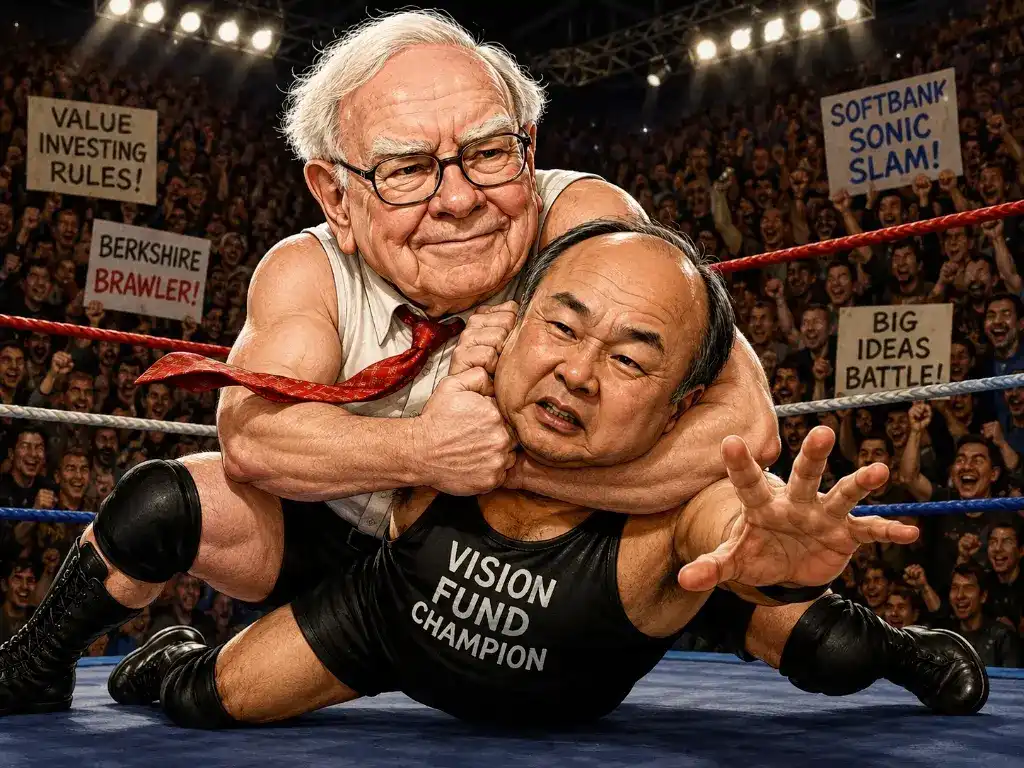
Berkshire dan SoftBank, 'Pasti Mati' Salah Satunya

Berkshire dan SoftBank: Satu Kemungkinan Harus "Mati" Pada Mei 2026, Berkshire Hathaway di bawah CEO baru Greg Abel menghadapi tekanan investor karena memegang kas hampir $400 miliar, sebagian besar dalam obligasi pemerintah AS. Warren Buffett telah mengurangi saham seperti Apple karena pasar dianggap terlalu mahal. Hal ini membuat kinerja saham Berkshire tertinggal jauh dari indeks S&P 500. Tantangan Abel adalah tidak dapat menggunakan uang tunai tersebut di pasar yang mahal, namun juga menghadapi ketidakpuasan investor. Jika pasar terus naik, opsi seperti dividen khusus atau pemecahan perusahaan mungkin harus dipertimbangkan. Meski tidak akan bangkrut, "jiwa" Berkshire sebagai kisah disiplin investasi ala Buffett mungkin telah berakhir. Di sisi lain, SoftBank di bawah Masayoshi Son berada dalam posisi sebaliknya: kekurangan uang tetapi terus berjudi besar. Mereka telah menginvestasikan $64,6 miliar (13% kepemilikan) ke OpenAI, dengan komitmen potensial mendekati $100 miliar. Untuk membiayai ini, SoftBank menjual aset berharga seperti saham Nvidia, T-Mobile, dan Alibaba, serta menanggung utang berbunga lebih dari $100 miliar di tingkat induk perusahaan. Mereka bahkan mengambil pinjaman jembatan $40 miliar yang harus dilunasi pada Maret 2027. Son berharap IPO OpenAI dan perusahaan AI baru mereka, Roze AI, dapat menyelamatkan situasi. Namun, jika IPO tertunda, valuasi Arm (aset utama SoftBank) turun, atau pasar kredit menutup diri, situasi keuangan SoftBank bisa runtuh dengan cepat. Keduanya menghadapi akhir yang berbeda: Berkshire menghadapi kematian secara bertahap sebagai kisah investasi legendaris, sementara SoftBank menghadapi risiko kehancuran finansial yang mendadak jika taruhannya yang sangat besar pada AI gagal. Dalam narasi pasar saat ini, tampaknya hanya satu dari dua pendekatan ekstrem ini yang akan terbukti benar.

marsbit3j yang lalu

Berkshire dan SoftBank, 'Pasti Mati' Salah Satunya

marsbit3j yang lalu

Trading

Spot
Futures

Artikel Populer

Cara Membeli CHIP

Selamat datang di HTX.com! Kami telah membuat pembelian USD.AI (CHIP) menjadi mudah dan nyaman. Ikuti panduan langkah demi langkah kami untuk memulai perjalanan kripto Anda.Langkah 1: Buat Akun HTX AndaGunakan alamat email atau nomor ponsel Anda untuk mendaftar akun gratis di HTX. Rasakan perjalanan pendaftaran yang mudah dan buka semua fitur.Dapatkan Akun SayaLangkah 2: Buka Beli Kripto, lalu Pilih Metode Pembayaran AndaKartu Kredit/Debit: Gunakan Visa atau Mastercard Anda untuk membeli USD.AI (CHIP) secara instan.Saldo: Gunakan dana dari saldo akun HTX Anda untuk melakukan trading dengan lancar.Pihak Ketiga: Kami telah menambahkan metode pembayaran populer seperti Google Pay dan Apple Pay untuk meningkatkan kenyamanan.P2P: Lakukan trading langsung dengan pengguna lain di HTX.Over-the-Counter (OTC): Kami menawarkan layanan yang dibuat khusus dan kurs yang kompetitif bagi para trader.Langkah 3: Simpan USD.AI (CHIP) AndaSetelah melakukan pembelian, simpan USD.AI (CHIP) di akun HTX Anda. Selain itu, Anda dapat mengirimkannya ke tempat lain melalui transfer blockchain atau menggunakannya untuk memperdagangkan mata uang kripto lainnya.Langkah 4: Lakukan trading USD.AI (CHIP)Lakukan trading USD.AI (CHIP) dengan mudah di pasar spot HTX. Cukup akses akun Anda, pilih pasangan perdagangan, jalankan trading, lalu pantau secara real-time. Kami menawarkan pengalaman yang ramah pengguna baik untuk pemula maupun trader berpengalaman.

175 Total TayanganDipublikasikan pada 2026.04.21Diperbarui pada 2026.04.21

Cara Membeli CHIP

Diskusi

Selamat datang di Komunitas HTX. Di sini, Anda bisa terus mendapatkan informasi terbaru tentang perkembangan platform terkini dan mendapatkan akses ke wawasan pasar profesional. Pendapat pengguna mengenai harga CHIP (CHIP) disajikan di bawah ini.

活动图片