North Korea using hackers to raise revenue via crypto heists

cryptoslateDipublikasikan tanggal 2022-03-26Terakhir diperbarui pada 2022-03-26

Abstrak

North Korea has been employing hackers to finance some state operations via “crypto heists”, according to a report by cybersecurity firm Mandiant.

North Korea has been employing hackers to finance some state operations via “crypto heists”, according to a report by cybersecurity firm Mandiant.

“The country’s espionage operations are believed to be reflective of the regime’s immediate concerns and priorities, which is likely currently focused on acquiring financial resources through crypto heists, targeting of media, news, and political entities, information on foreign relations and nuclear information, and a slight decline in the once spiked stealing of COVID-19 vaccine research.”

The report details the country’s cyber operations and how they are structured within the Reconnaissance General Bureau, or RGB — North Korea’s intelligence agency akin to the CIA or MI-6. It also sheds light on the infamous hacker group “Lazarus” which has been operating out of North Korea since 2009.

According to the report, Lazarus is not a single group of hackers, rather an umbrella term reporters use to refer to numerous different state-backed hacker groups operating out of The Democratic Republic of North Korea. However, these different groups operate in different “sectors” and have unique responsibilities. One of the responsibilities is raising funds through the theft of cryptocurrencies.

Assessed Structure of DPRK CYBER PROGRAMS - Mandiant

Assessed cyber structure of DPRK cyber programs

Latest cyber espionage activity

Hacker groups linked to Lazarus have recently been active and were exploiting a google Chrome vulnerability from early January 2022 until mid-February, when the exploit was patched out.

Google’s Threat Analysis Group, or TAG, said in a blog post on March 24th that North Korean state-backed attacker groups — tracked publicly as “Operation Dream Job” and “Operation AppleJeus” — had been exploiting a “remote code execution vulnerability in Chrome” since early January 2022 to conduct various hacks and phishing attacks. TAG’s Adam Weidemann said in the blogpost:

“We observed the campaigns targeting U.S.-based organizations spanning news media, IT, cryptocurrency, and fintech industries. However, other organizations and countries may have been targeted.”

The exploit allowed the hackers to send bogus job offers to people working in the aforementioned industries, which would then lead to spoofed versions of popular job-hunting websites like Indeed.com. The exploit kit and phishing are similar to those tracked in Operation Dream Job. Meanwhile, another hacker group has been targeting crypto firms and exchanges using the same exploit kit.

Google said that roughly 340 people had been targeted by hacker groups. It added that all identified websites and domains were added to its Safe Browsing service to protect users and it is continuing to monitor the situation.

Lazarus targeting financial services, crypto

Lazarus-linked hacker groups have been involved in various hacks on crypto firms and traditional banks for several years now. Some notable hacks include the 2016 Bangladesh Bank cyber heist and various crypto-related attacks in 2017.

The main hacker group focused on financial services attacks is APT38, which was behind the notorious SWIFT hack. It includes a subgroup called CryptoCore or “Open Password.”

Most of these hacks have been successful and it is estimated that hackers have raised over $400 million for North Korea. An investigation by the UN concluded that proceeds from these cyber heists have been used to fund the hermit country’s ballistic missile program.

Bacaan Terkait

Panduan Q3 Broadcom Lebih Rendah 1,2 Miliar Dolar dari Ekspektasi, Saham Anjlok >13% di Pasca-Perdagangan, Narasi AI "Mendingin"?

Penulis: Ada, Deep Wave TechFlow Pada tanggal 3 Juni waktu AS setelah jam pasar, Broadcom merilis kinerja Q2 FY2026. Secara keseluruhan, laporan kuartal ini mencetak rekor dengan pendapatan $22.19 miliar (naik 48% YoY) dan EPS disesuaikan $2.44, melampaui ekspektasi. Pendapatan semikonduktor AI mencapai $10.8 miliar, tumbuh 143% dan terus meningkat selama 13 kuartal berturut-turut. Namun, pedoman untuk Q3 menjadi sorotan utama. Meski total pendapatan diproyeksikan $29.4 miliar (di atas perkiraan analis $28.54 miliar), proyeksi pendapatan semikonduktor AI untuk Q3 hanya $16 miliar, lebih rendah sekitar 7% dari konsensus ekspektasi analis sebesar $17.2 miliar. CEO Hock Tan juga tidak menaikkan panduan pendapatan AI untuk tahun fiskal 2026, yang tetap pada lebih dari $100 miliar. Perbedaan ini memicu reaksi tajam di pasar. Saham AVGO anjlok lebih dari 13% dalam perdagangan setelah jam pasar, menghapus kapitalisasi pasar sekitar $270 miliar. CEO juga mengindikasikan bahwa proporsi pendapatan jaringan AI, yang saat ini mendekati 40% dari pendapatan semikonduktor AI, diperkirakan akan menormalkan menjadi sekitar 30%, bukan tetap di level 40%. Pernyataan ini berpotensi memberi tekanan pada valuasi perusahaan modul optik China yang terkait dengan cerita jaringan AI. Efeknya meluas ke perusahaan lain seperti Marvell yang juga turun setelah jam pasar. Meskipun demikian, manajemen menegaskan permintaan chip AI tetap sangat kuat dan berulang kali menegaskan target pendapatan AI lebih dari $100 miliar untuk FY2027. Koreksi saat ini mungkin merupakan aksi ambil untung karena valuasi yang telah tinggi, bukan perubahan mendasar dalam narasi AI jangka panjang.

marsbit15m yang lalu

Panduan Q3 Broadcom Lebih Rendah 1,2 Miliar Dolar dari Ekspektasi, Saham Anjlok >13% di Pasca-Perdagangan, Narasi AI "Mendingin"?

marsbit15m yang lalu

Taktik Baru Wall Street: Posisi Short Yen Masih Ditambah, Tapi Kenaikan Saham Jepang Bukan Karena Penutupan Carry Trade

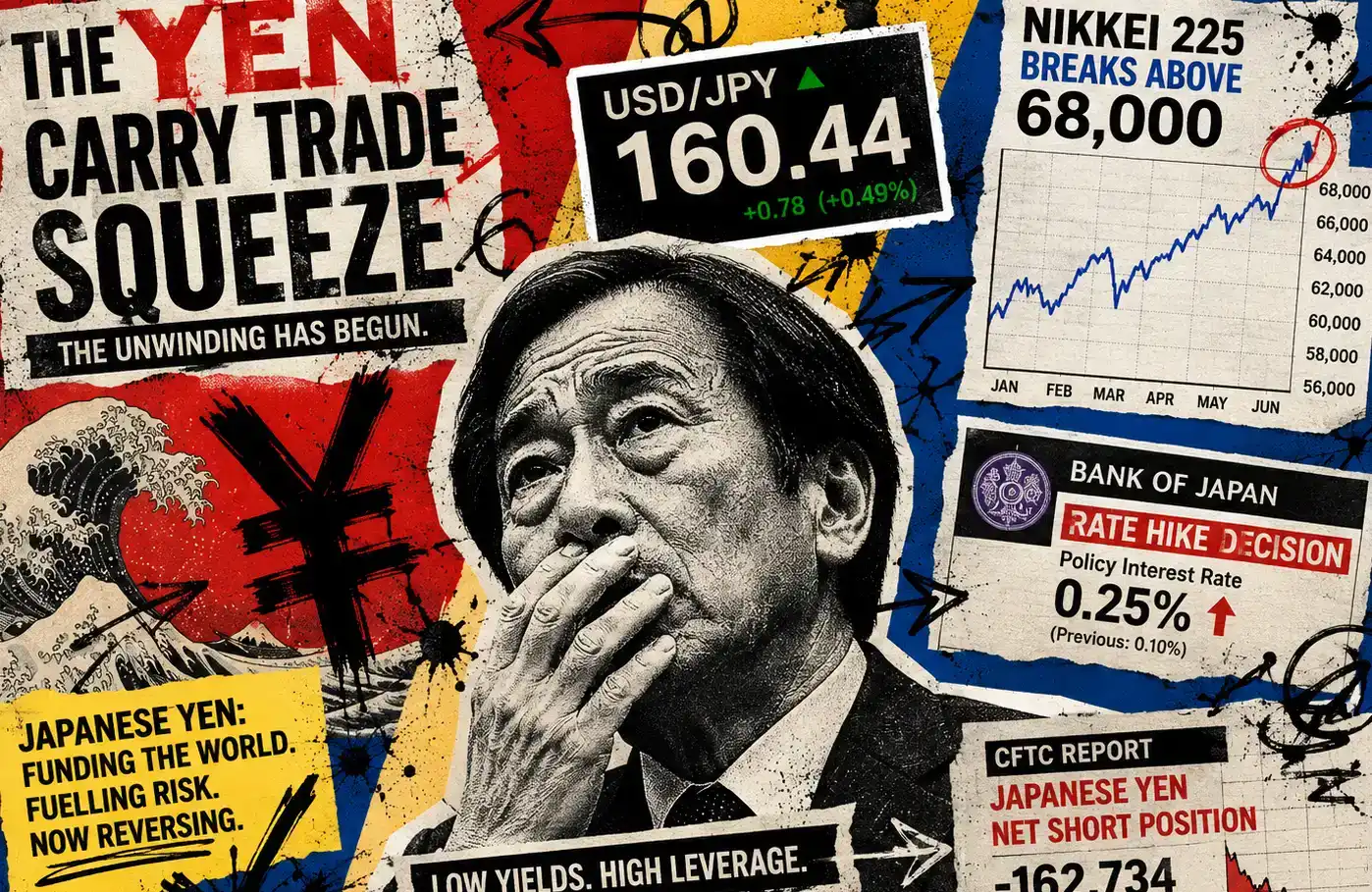
Pada 3 Juni, USD/JPY mencapai 160,44 (tertinggi sejak Juli 2024), sementara Nikkei 225 menembus 68.000 poin. Narasi pasar khawatir "carry trade akan runtuh seperti Agustus 2024". Namun, data menunjukkan cerita berbeda. Posisi bersih short spekulan untuk yen di pasar berjangka AS (CFTC) justru meningkat menjadi -114.667 kontrak per 26 Mei, menunjukkan spekulan masih menambah taruhan pada pelemahan yen, bukan melarikan diri. Jika Bank Jepang (BOJ) bersikap lebih hawkish atau data AS melemah, posisi short besar ini berisiko likuidasi paksa seperti tahun 2024. Meski Kementerian Keuangan Jepang melakukan intervensi terbesar dalam sejarah (11,73 triliun yen) pada April-Mei 2026 untuk mendukung yen, USD/JPY tetap menembus 160. Intervensi gagal sepenuhnya menahan level psikologis tersebut. Kenaikan Nikkei 225 didorong bukan oleh pelarian dana carry trade, melainkan oleh masuknya modal asing yang aktif mengejar tema AI dan semikonduktor. Investor asing telah membeli saham Jepang bersih selama 8 minggu berturut-turut (hingga 23 Mei), dengan pembelian tahunan mendekati 11,7 triliun yen—15,8 kali lipat dari periode sama 2025. Saham seperti SoftBank dan Socionext melonjak. BOJ telah menaikkan suku bunga secara bertahap, dari -0,1% menjadi 0,75% (tertinggi sejak 1995). Namun, berbeda dengan kenaikan Juli 2024 yang memicu crash pasar, kenaikan 2025 justru bertepatan dengan rally saham. Ini karena logika beli asing beralih ke AI, bukan lagi bergantung pada biaya pinjaman yen rendah. Hubungan ini bisa berubah jika BOJ menaikkan suku bunga lebih agresif (misalnya ke 1,0%) bersamaan dengan melemahnya dolar AS. Kesimpulannya, ketiga fakta ini bisa terjadi bersamaan: posisi short yen masih padat, intervensi terbesar gagal tahan level 160, dan rally saham Jepang didorong modal asing yang mengejar AI—tidak saling bertentangan, dan masing-masing tidak bisa secara sendiri memprediksi langkah selanjutnya.

marsbit15m yang lalu

Taktik Baru Wall Street: Posisi Short Yen Masih Ditambah, Tapi Kenaikan Saham Jepang Bukan Karena Penutupan Carry Trade

marsbit15m yang lalu

Trading

Spot
Futures
活动图片