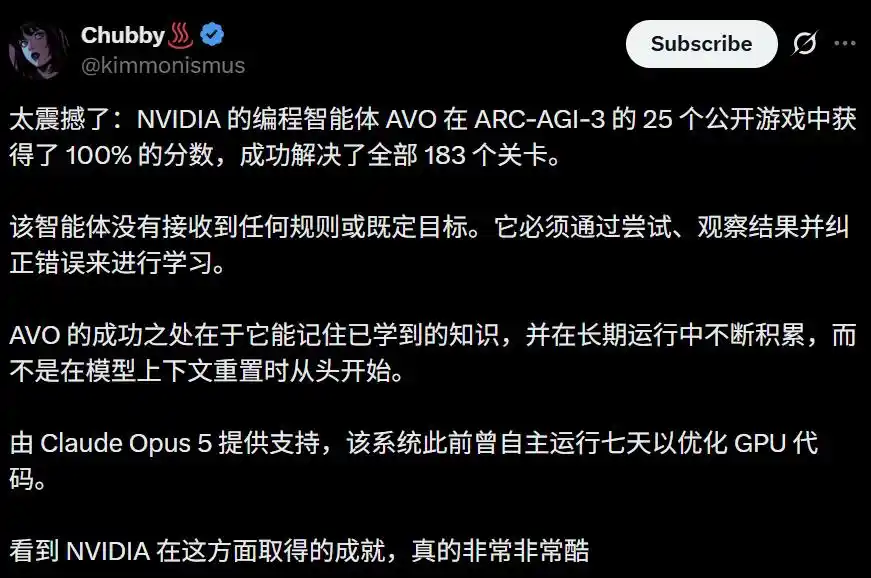
Just moments ago, NVIDIA's general-purpose coding agent AVO achieved a perfect score on ARC-AGI-3!
It cleared all 183 levels across 25 game environments, using only 6624 steps in total, achieving an RHAE score of 100.00.

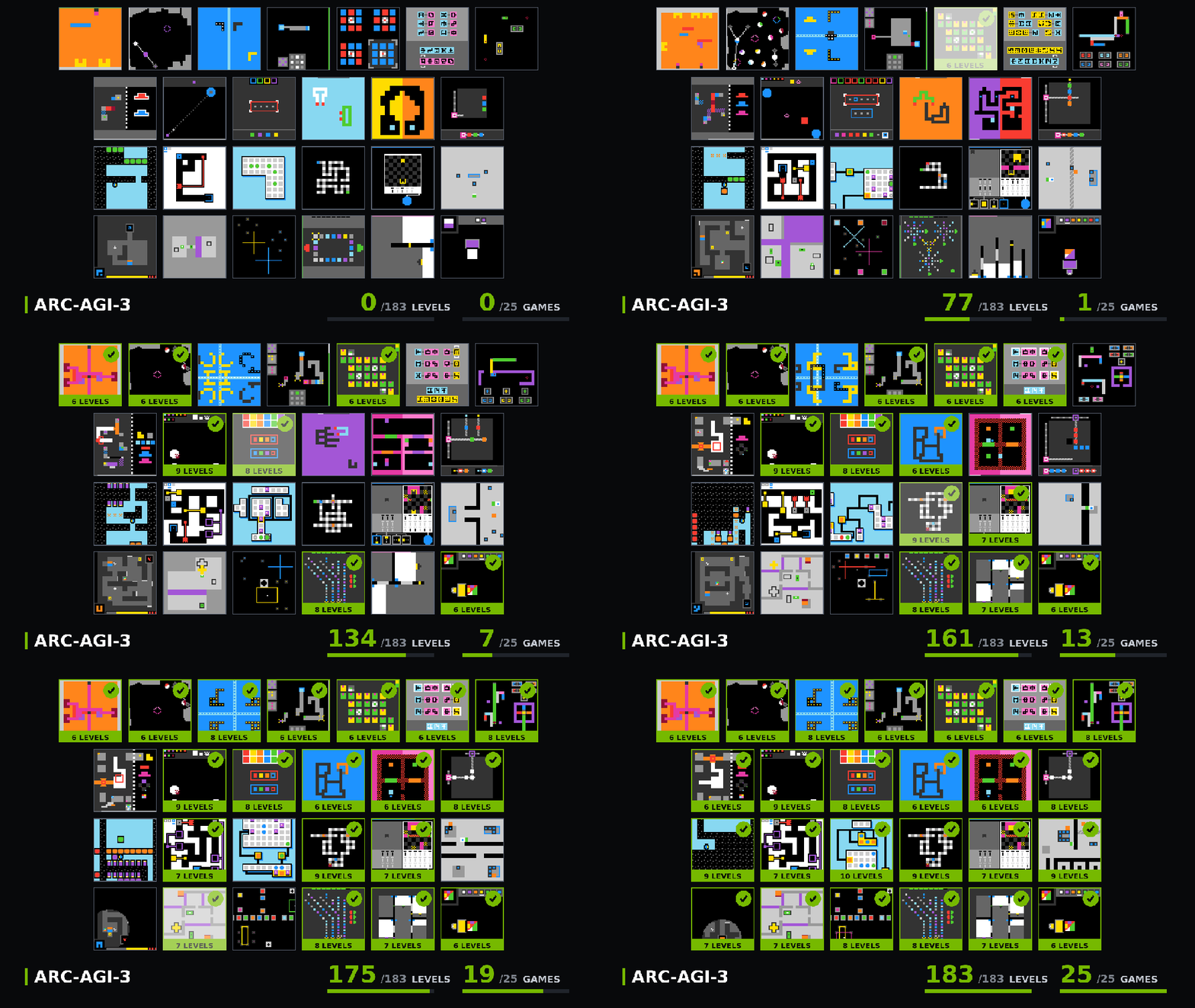
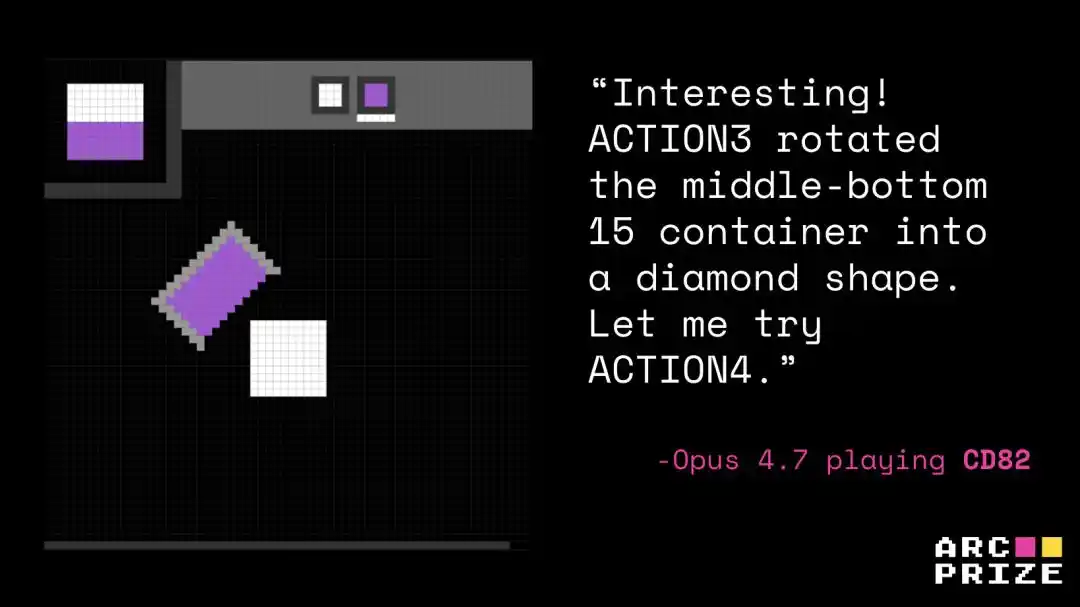
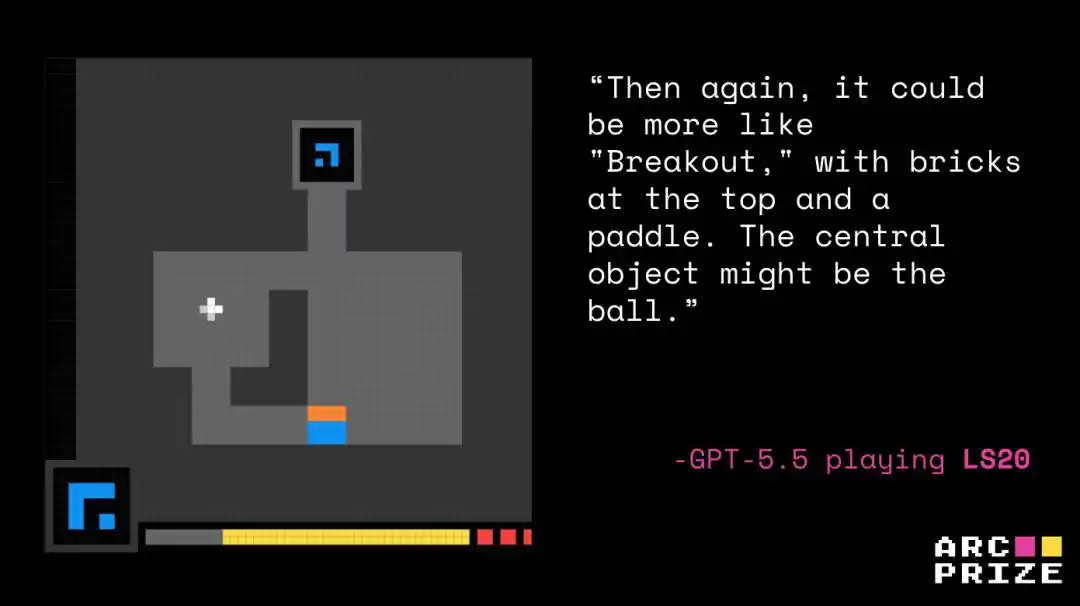
It's important to note that ARC-AGI-3 is notoriously unforgiving. It drops the agent directly into an unfamiliar game, providing no rules or objectives, forcing it to press, observe, and guess on its own.
Some environments allow movement up, down, left, or right, navigating through corridors; hitting a dark blue block rotates the entire screen 90 degrees. Others don't even allow movement, only clicking, relying on clicks to cycle tile colors into the target pattern.


Each environment has at least six levels, getting progressively harder; a level solvable in five steps at the beginning might require fifty steps by the sixth level.
The agent only has access to a 64×64 grid and a few buttons.
Cutting-edge models trying to brute-force their way through simply cannot handle it.
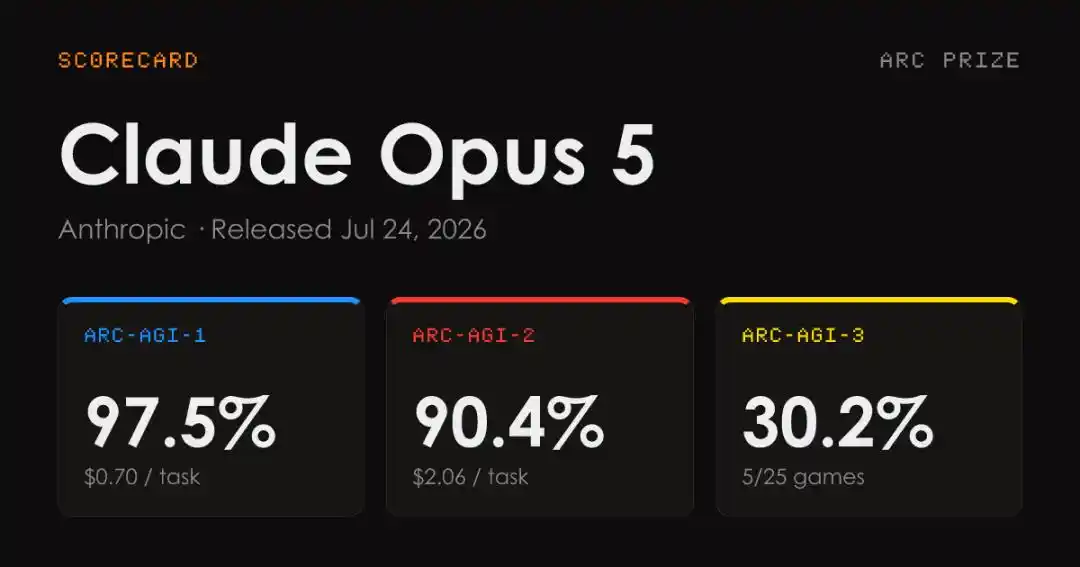
The model used by AVO this time was Claude Opus 5. However, when tested alone, its score was only 30.16%, which still made it the official top-ranking model on the leaderboard.
The ARC Prize team analyzed replays from the previous generation and summarized three typical types of errors.
- First, understanding locally but not globally.
- Second, forcing unfamiliar mechanics to fit familiar game patterns.
- Third, passing a level without actually learning.
The third type is the most critical. Opus once cleared the first level of ka59 in just 37 steps, but its understanding of the click mechanism was fundamentally wrong from the start. When it reached the second level, it stubbornly clung to that incorrect theory and eventually got stuck.
NVIDIA's approach was to leave the model untouched and only add an outer layer.
Thus, the same Claude Opus 5's score jumped directly from 30 points to a perfect score.
This immediately caused an uproar on X. Posts like "ARC-AGI-3 has fallen" and "Time to find a new leaderboard to climb" flooded the feed, while others praised NVIDIA's move as absolutely brilliant.
Given this momentum, the next model-level leap might not come from waiting for a new model, but from an update to the harness.
The 100-Point Leap, Deconstructed into Just Two Components
So what exactly did NVIDIA put around the model to fill these three pitfalls at once?
Similar to the recently trending DeepSeek Harness and Codex Harness, AVO also manages the surrounding layer outside the model.
This includes what context to provide, what tools to give, how to store state, how to handle feedback, what to do when stuck, and how to proceed after the context window is full, among other things.
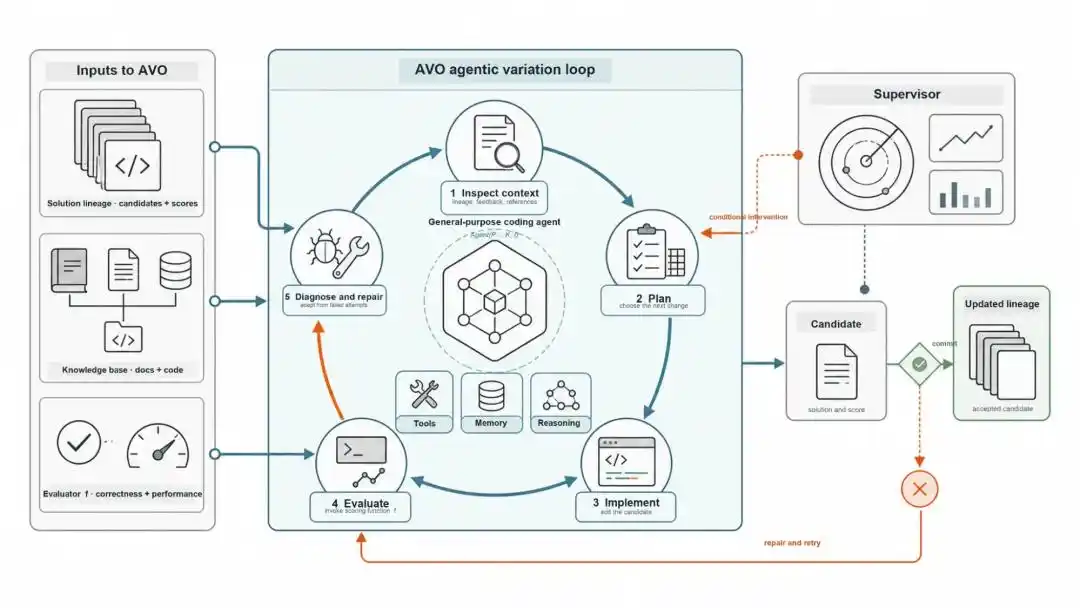
Specifically regarding mechanisms, there are two key components that truly make a difference.
The first is persistent memory.
The biggest challenge in long-horizon tasks is that the context window fills up.
Once full, the model's memory is wiped clean. Everything tried before, which paths were dead ends, what the profiler outputted—all gone.
When the next round begins, it starts from scratch, retracing the same mistakes.
AVO saves all of this: past implementation versions, results from each evaluation, outputs from compilers and analyzers, accumulated reasoning processes—everything is stored.
After a context reset, the agent continues from the current state rather than reconstructing the entire search from zero.
The second is a supervisor.
The main agent focuses on getting the work done, deciding what to look at, what to change, what to test, and what to submit.
The supervisor doesn't do the work; it only monitors the entire search trajectory from the sidelines. Once it detects stalled progress or the agent stuck in loops of unproductive actions, it intervenes to steer the main agent towards different strategies.
There's another detail.
AVO ran the entire ARC-AGI-3 challenge using pure text modality. Each frame observation fed to the model was a precise 64×64 text grid—no images at all, not a single visual token sent.
In other words, in a game filled with pixels, the model never actually "saw" the screen from start to finish.
This mechanism is what yielded the report card of clearing 183 levels in 6624 steps with a perfect RHAE score.

NVIDIA's conclusion from this is that long-horizon capability has never been something a model possesses alone; it's something the entire system assembles.
Memory determines what carries over to the next round, tools determine what actions the agent can perform, and feedback lets it know if it's going astray.
And the ability to get back on track when a hypothesis is disproven determines whether the job can continue.
It's First Revolutionizing NVIDIA's Own Domain
The interesting part is that AVO wasn't built for gaming at all. Its main battleground is GPU kernel optimization.
On March 25th this year, NVIDIA uploaded a paper to arXiv titled "AVO: Agent-based Variational Operators for Autonomous Evolutionary Search."
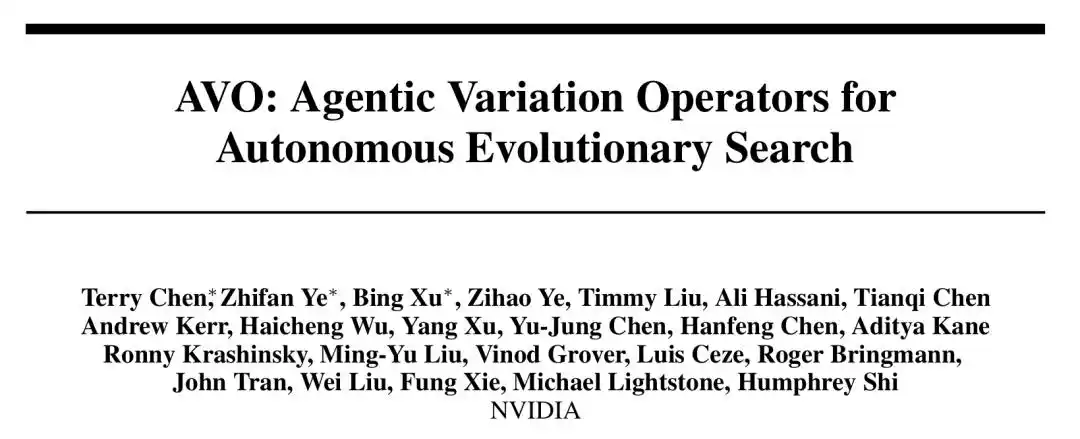
Paper address: https://arxiv.org/abs/2603.24517
Two words in the title are key: evolutionary search and variational operators.
Evolutionary search itself isn't complicated. You hold a batch of candidate code, modify it, run it, keep the fastest version, then continue modifying, pushing forward generation by generation.
The component responsible for the "modify" step is called a variational operator in evolutionary algorithms. In the past, it was hard-coded, with modifications predetermined by humans; later, using LLMs to modify was just generating a piece of code per call.
AVO's approach is to replace the entire variational operator with an autonomous agent.
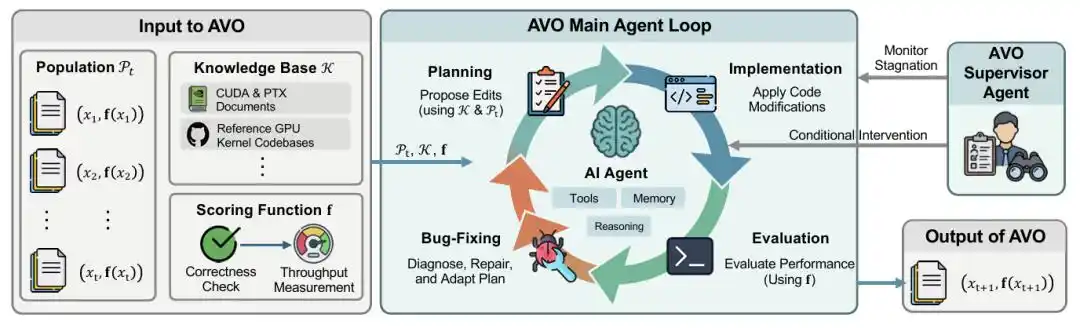
This way, it can not only consult CUDA programming guides and PTX architecture documentation, run tests, read profiler outputs, but also self-diagnose correctness failures, and then decide where to modify next.
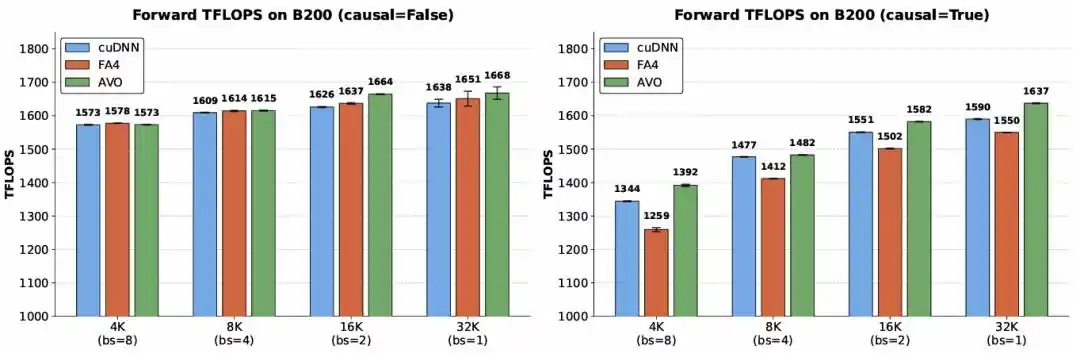
The team deployed it on B200, tasked with optimizing an attention kernel—the most heavily squeezed operator in Transformers. Then they stepped back.
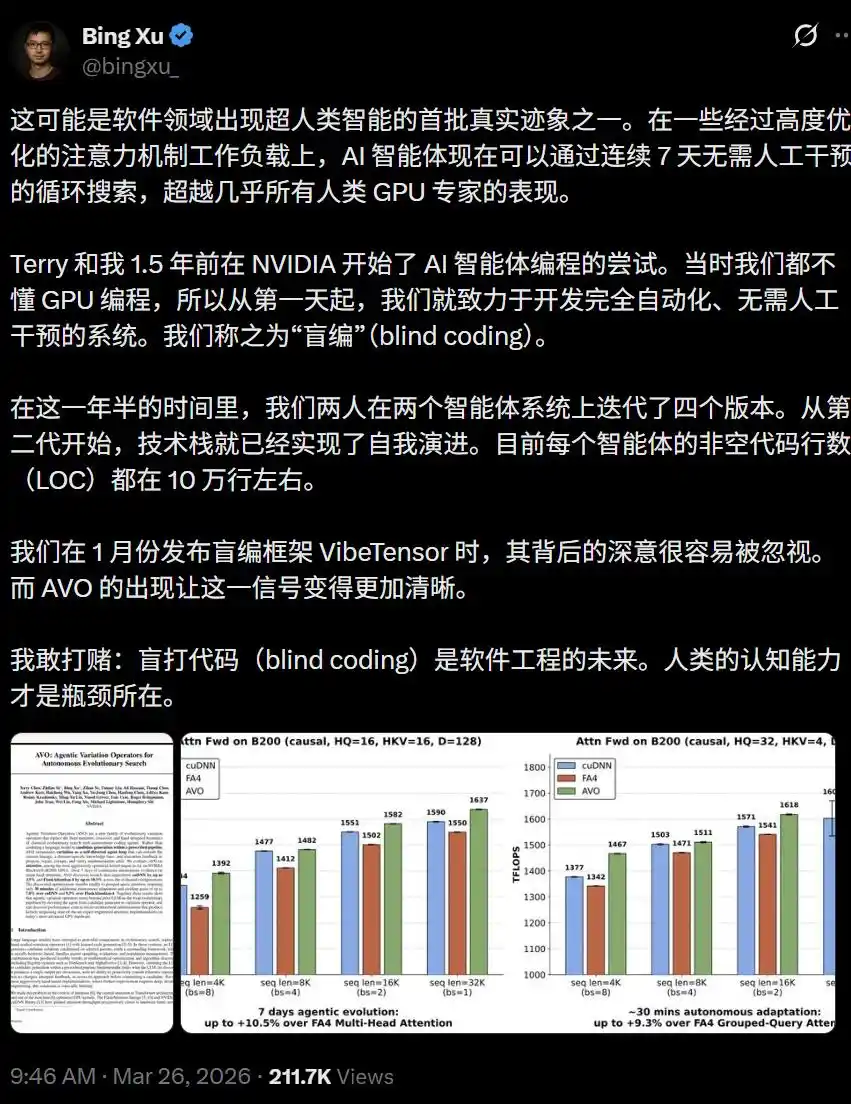
AVO autonomously ran continuously for 7 days, exploring over 500 optimization directions, ultimately submitting 40 valid kernel versions.
The resulting multi-head attention kernel was up to 3.5% faster than NVIDIA's own closed-source cuDNN and up to 10.5% faster than the state-of-the-art open-source implementation FlashAttention-4.
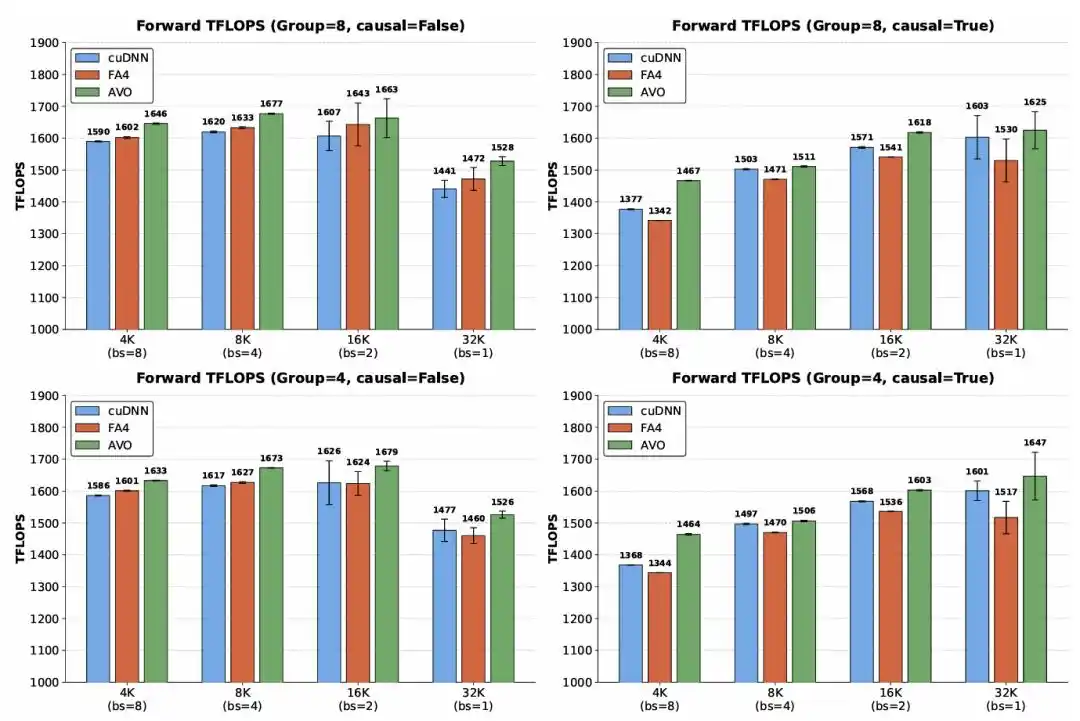
Subsequently, it applied the same optimization to GQA, the mainstream architecture for current large models. This time, after autonomous runs of about 30 minutes, the new kernel was 7.0% faster than cuDNN and 9.3% faster than FlashAttention-4.
Handwriting CUDA kernels has always been one of the highest barriers in this ecosystem, and AVO is the first to surpass it.
And the 25 games in ARC-AGI-3 run on this same system.
Tuning kernels and playing games sound like completely unrelated tasks. But in NVIDIA's view, the same underlying loop powers both.
The agent first forms a hypothesis from incomplete evidence, acts to test it, observes results, stores useful state, and refines its understanding of the problem. If the hypothesis is wrong, it falls back and rethinks, then rolls forward iteration after iteration.
In NVIDIA's own words, what transfers isn't domain knowledge, but the mechanism that sustains long-horizon autonomous advancement.
It Was Built by a Team of Chinese Origin
Looking at the author list of the AVO paper reveals a string of very familiar names.
With 23 authors, it almost assembles key figures from the open-source deep learning infrastructure of the past decade.
One of the co-first authors, Bing Xu, is a Distinguished Engineer at NVIDIA and the creator of MXNet. Earlier, he was also the fourth author of the original 2014 GAN paper, co-authored with Yoshua Bengio under the University of Montreal.
Tianqi Chen, creator of TVM and XGBoost, is also on the list. The TVM connection leads to Luis Ceze; the two co-founded OctoAI, which NVIDIA acquired in September 2024, with Ceze subsequently joining NVIDIA to continue work on machine learning compilers.
Further down are Ye Zihao, creator of FlashInfer, and CUDA compiler veteran Vinod Grover.
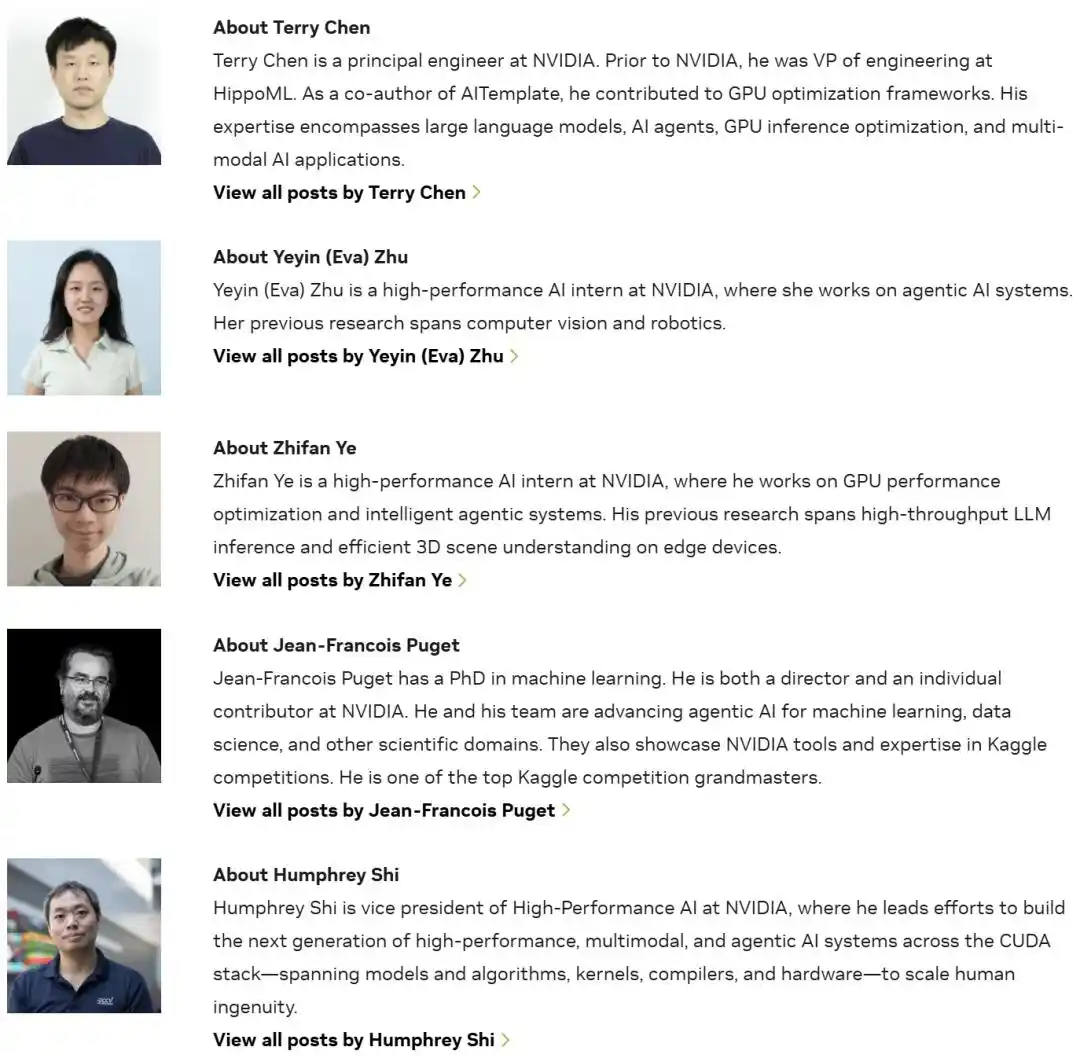
Overseeing the project is Humphrey Shi, NVIDIA's VP of High-Performance AI and also a professor at Georgia Tech. Another co-first author, Zhifan Ye, is a Ph.D. student at Georgia Tech.
The blog post announcing this result bears five names, four of which are of Chinese origin: besides Humphrey Shi, there are Terry Chen, Zhifan Ye, and Yeyin Zhu. The remaining author is Jean-Francois Puget, a two-time Kaggle Grandmaster at NVIDIA.
The most interesting anecdote comes from Bing Xu's earlier self-description on X.
A year and a half ago, when he and Terry Chen first started working on agent programming at NVIDIA, neither of them knew GPU programming.
Precisely because they didn't know, they aimed from day one to build a fully automatic system requiring no human intervention, coining the term "blind programming" for this approach.
A year and a half later, this system, operating without human direction, outperformed kernels that human experts had optimized for months.
The Bill Ultimately Lands on Jensen's GPUs
Why would a company that sells graphics cards spend a year and a half building an agent that requires no human input?
Because this shell layer can work with anyone's model.
AVO has been tested across models. On the same levels, pairing with GPT-5.6 Sol took less time, while pairing with Opus 5 was more step-efficient.
NVIDIA doesn't make money selling models, but it can dominate this layer. This aligns with its overall strategy in recent years.
On the model side, it pursues open source. The Nemotron 4 project, advancing this August, targets trillion-parameter scale, with training expected to finish in the fall. The models will be given away for free, with revenue coming from subsequent GPU and software stack sales.
On the compute side, long-horizon agents are precisely the kind of workload it wants most. Jensen Huang's judgment at GTC this year was that the inference inflection point has arrived. Compute demand has grown about 10,000-fold in the past two years, while usage has only grown about 100-fold—the difference is being consumed by inference.
So whose model is used isn't important. As long as agents take on longer, heavier tasks, the bill will ultimately land on their graphics cards.
As for the term "100 points," it is indeed depreciating rapidly at the moment.
In March, no one could score even 1 point. Tycho was the first to achieve a perfect score at the end of July, VISTA achieved it again on August 5th, and AVO's result is already the third perfect score in six weeks—all three exclusively powered by Claude Opus 5.

But what AVO accomplished won't shrink in value because of this.
An architecture born to squeeze out the last few percentage points of performance from FlashAttention on B200 was almost directly transplanted to a pixel game—and it worked.
The only things changed were the task interface and evaluation method; the core loop remained untouched line by line.
As NVIDIA wrote at the end of its blog post, models are important, but they are not the entirety of an agent.
References:
https://developer.nvidia.com/blog/nvidia-avo-reaches-100-on-arc-agi-3-demonstrating-a-frontier-level-general-purpose-architecture-for-long-horizon-autonomous-agents/
This article is from the WeChat public account "New Zhiyuan," author: ASI Apocalypse, editor: Moses