2026 Mid-Year Report On-Chain RWA: Tokenized Stock Market Cap Doubles in a Year, But 90% of Rights Are Hollow Shells

marsbitDipublikasikan tanggal 2026-08-01Terakhir diperbarui pada 2026-08-01

Abstrak

The 2026 Mid-Year Report on On-Chain RWA highlights a significant growth in tokenized stock market capitalization, which nearly doubled from $951 million in March to $1.89 billion by July. However, the report reveals a fundamental contradiction in this "layer 2.5" ecosystem: products with the strongest legal foundation (like regulated U.S. infrastructure) lack liquidity and distribution, while freely tradable offshored wrapper products often lack substantive ownership rights. The increase is driven largely by a few products (SECZ, FGRS, STRCx) and platforms (Ondo, xStocks, Securitize collectively hold over 85% share). While distributed value across networks like Ethereum, Solana, and BNB Chain has grown, the market remains fragmented. Products referencing the same underlying asset (e.g., Apple stock) are distinct legal liabilities with different intermediaries and jurisdictional rules, offering varying degrees of legal claim. The report cautions that headline numbers are misleading, as they reflect changes in distributed token value—driven by issuance, conversions, and price movements—not pure investor inflows. True "canonical shares" with legal ownership, wide wallet distribution, institutional liquidity, and independent on-chain price discovery do not yet exist at scale. Tokenized treasuries show stronger product-market fit, and ETFs may be easier to scale than single stocks. The core takeaway is a trade-off: legal certainty versus liquidity and composability.

Author: insights4vc

Translation: Deep Chao TechFlow

Deep Chao Introduction: The headline figure for the scale of on-chain tokenized assets looks good, but behind it lies a fundamental contradiction—products that can be freely circulated often lack real ownership rights, while products with genuine legal effect lack liquidity. This report uses specific data to dissect just how much of this "$1.89 billion market" is real money, serving as a necessary dose of sobriety for any investor considering deploying capital in on-chain securities.

The stock market hasn't moved on-chain. What has truly emerged is a set of more credible infrastructure layers—for distributing securities, recording ownership claims, and settling trades through blockchain-based systems.

Data from RWA.xyz shows that the value of distributed tokenized stocks grew from $951 million in March 2026 to $1.89 billion in July, almost doubling. However, this growth primarily came from a handful of products and platforms.

The most significant progress has come from regulated market infrastructure, notably Nasdaq's Same CUSIP Settlement model and the planned commercial rollout by DTC. Liquidity, investor distribution, and independent on-chain price discovery remain very limited. Tokenized treasuries continue to demonstrate stronger product-market fit, and equity ETFs may be easier to scale than single stocks.

Therefore, this market is best understood as a fragmented "Layer 2.5" system: products with the most robust legal foundations often have the weakest liquidity and distribution capabilities; while the most actively traded wrapped products typically have the thinnest ownership rights.

This report is an update to insights4vc's March 2026 analysis "The State of On-Chain Real Assets," focusing on what has substantively changed since its release.

The State of On-Chain Real Assets

What Has Substantively Changed Since March

The March report distinguished between two types of assets: those recorded on a blockchain, and those transferable to external wallets. This distinction remains important today. Under RWA.xyz's framework, a "represented asset" stays within the issuer's or platform's own environment; a "distributed asset" can be transferred externally, though transfers may still be limited to approved or whitelisted wallets.

But transferability alone is no longer sufficient to gauge a product's maturity.

Since March, offshore products have become more accessible for cross-chain movement and use in decentralized markets. Ondo expanded to Ethereum, BNB Chain, and Solana, introduced decentralized routing, and added continuous minting and redemption features for some products. xStocks also broadened its distribution channels and collateral integrations.

Meanwhile, regulated US infrastructure has taken a different path: the focus is not on unrestricted portability, but on legal certainty, controlled wallets, compliant custody, transfer agent records, and integration with DTC.
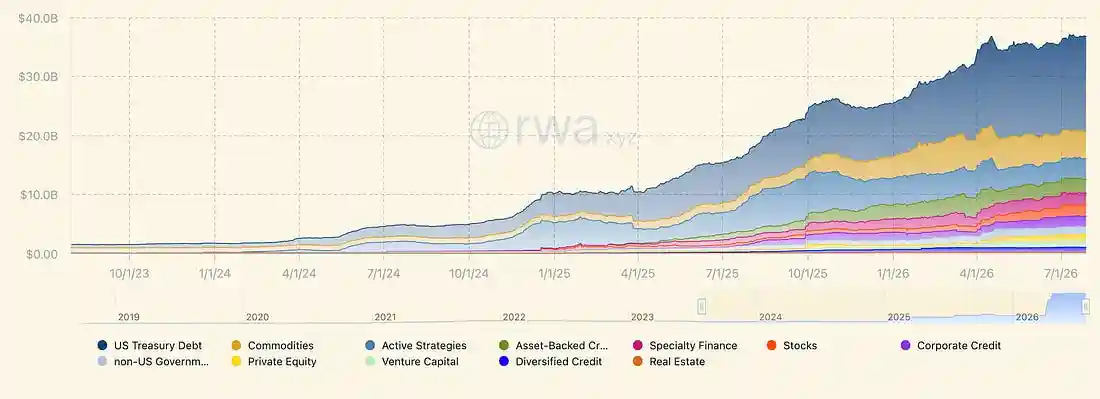
Chart: Market Cap Evolution of Various RWA Asset Types (2019–2026) (Including Tokenized Stocks, Treasuries, etc.)

These two paths solve different problems: offshore wrapped products improve accessibility and composability; regulated infrastructure strengthens the link between the token and the legal ownership claim.

A "canonical share" is the authorized form of the underlying security issued, whose transfer is recognized in the official ownership system. It is fundamentally different from third-party instruments that merely track a stock's price or performance.

Currently, no product achieves all four elements at scale: canonical ownership, broad wallet distribution, institutional liquidity, and independent on-chain price discovery.
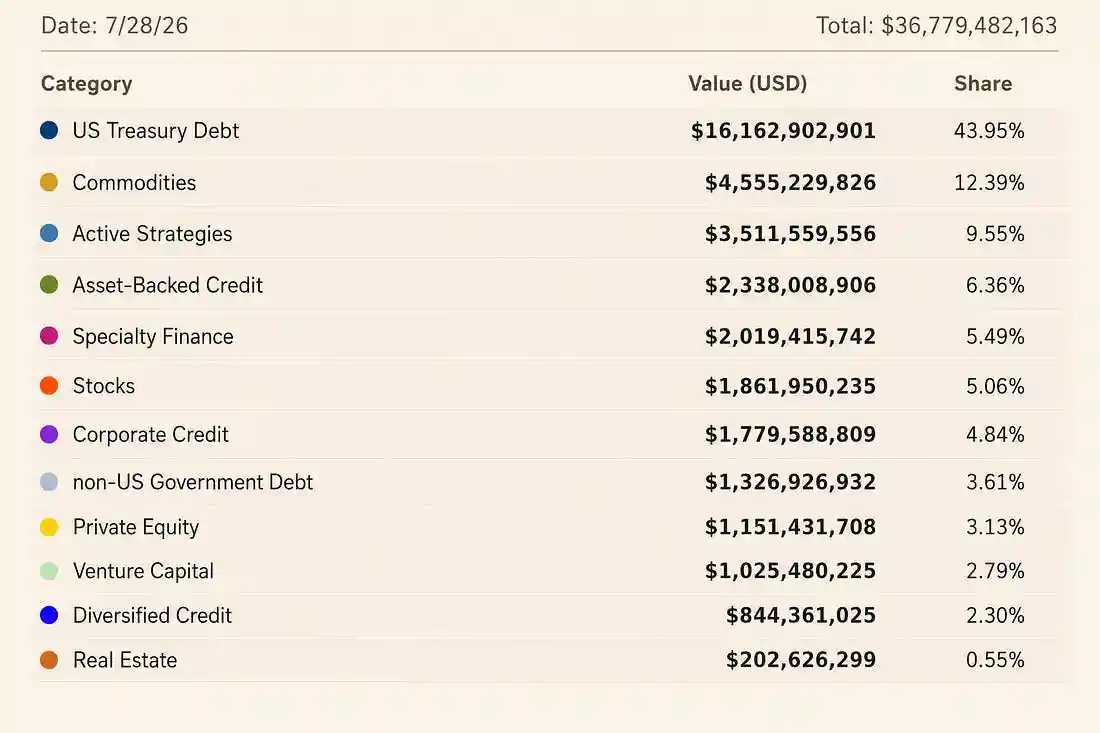
Chart: On-Chain Real Assets Summary Statistics (As of July 28, Total ~$36.78 Billion, US Treasuries Account for 43.95%)

Broader RWA total figures also require careful interpretation. Data reported by RWA.xyz on July 29: distributed value $36.81 billion, represented value $218.27 billion. The apparent $124.33 billion decrease in represented value should not be interpreted as capital outflow or a redemption wave. Between the two observation dates, numerous datasets were added, removed, reclassified, or revalued.

These numbers describe the value of interests covered by the platform's methodology at a specific point in time, not a measure of investor fund flows.

The tokenized stock series is more instructive, as the same "bridged token value" methodology can be applied across both periods. Even so, the reported 98.5% increase cannot be clearly decomposed into new issuance, price appreciation, and classification changes.

FGRS provides a useful example. Figure completed a fundraising offering 4.375 million blockchain shares at $32 per share, but subsequently reported value fluctuates with market prices. Without daily mint, burn, and net asset value data for each product, it's impossible to reliably reconstruct the net market-wide issuance.

Why the $1.888 Billion Headline Number Is Misleading

RWA.xyz uses "Bridged Token Value" to measure tokenized stocks, calculated as: Bridged circulating supply multiplied by Net Asset Value.

Circulating supply excludes balances identified as treasury holdings or pre-minted inventory. The bridged figure also removes tokens locked in known bridge contracts to avoid double-counting when an asset is locked on one network and issued on another.

This is a valid measure of distributed value, but it differs from free float. Free float refers to the portion of securities genuinely available for public trading after excluding restricted, strategic, and concentrated holdings.

The timing of the data also matters. The provided asset-level export shows a distributed total value of $1.8879 billion on July 27, consistent with the ~$1.888 billion shown on the dashboard. A snapshot across platforms and networks on July 29 sums to approximately $1.872 billion.

The difference is $15.8 million, or 0.84%, consistent with price and token supply changes between the two observation dates. Therefore, this report's growth calculations for specific instruments use July 27 data, while platform and network market share uses the July 29 snapshot, and the two datasets are not mixed in the same calculation.
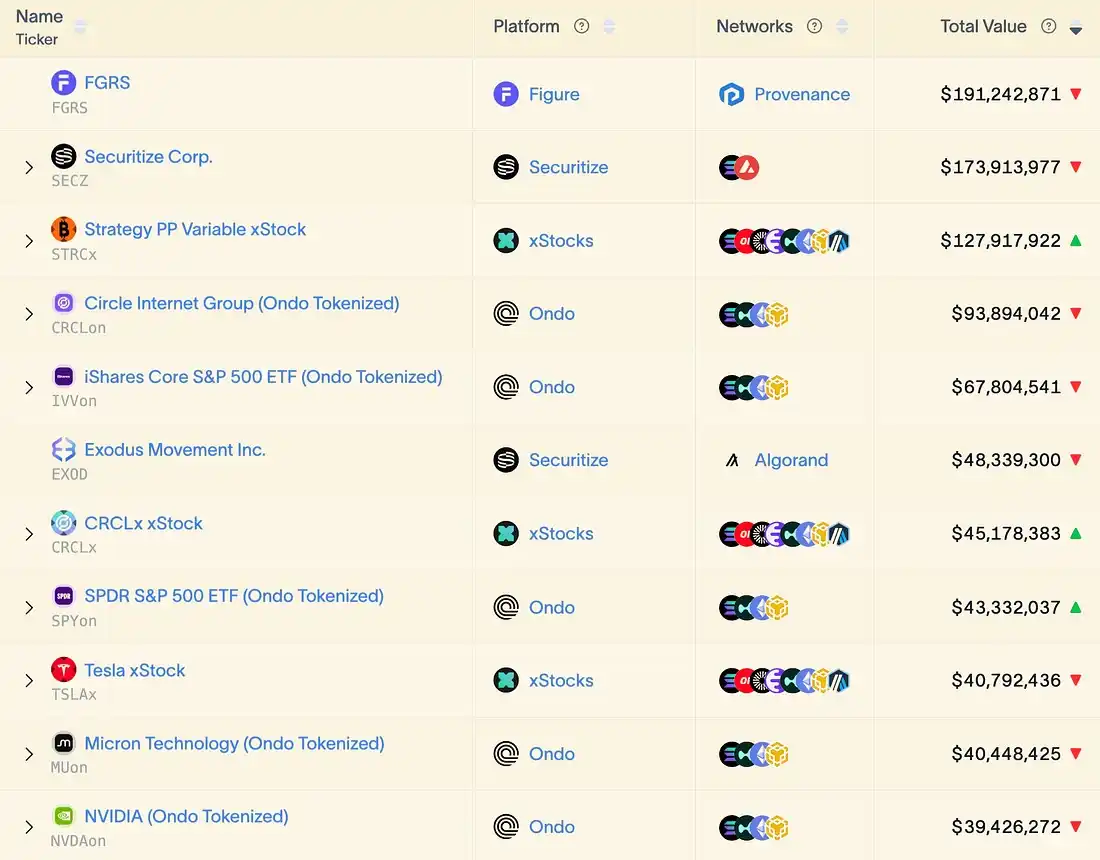
Chart: Tokenized Stock Details (10 Underlyings, Classified by Issuing Platform & Network, FGRS highest at ~$191 million)

Three named instruments contributed roughly half the increment: SECZ added $169 million post-listing, FGRS added $162.9 million, STRCx added $126.6 million. Together they contributed $458.6 million, 49% of the total $936.8 million increase. Long-tail products collectively contributed another $150.5 million, 16.1% of the increment.

These figures reflect changes in distributed value, not investor subscriptions.

SECZ is affected by both the number of represented shares and Securitize's NYSE stock price. FGRS reflects a combination of issuance, conversion activity, and market price changes. STRCx depends on the circulating supply and value of receipts tied to Strategy Floating Rate Preferred Stock.

Calling the above three increases "tokenized stock capital inflows" would merge several economically distinct events into a single, potentially misleading number.

Concentration is more evident at the platform level. In the July 29 snapshot, Ondo and xStocks together accounted for 72.7% of distributed value. Adding Securitize raises the top three platforms' share to 85.1%.
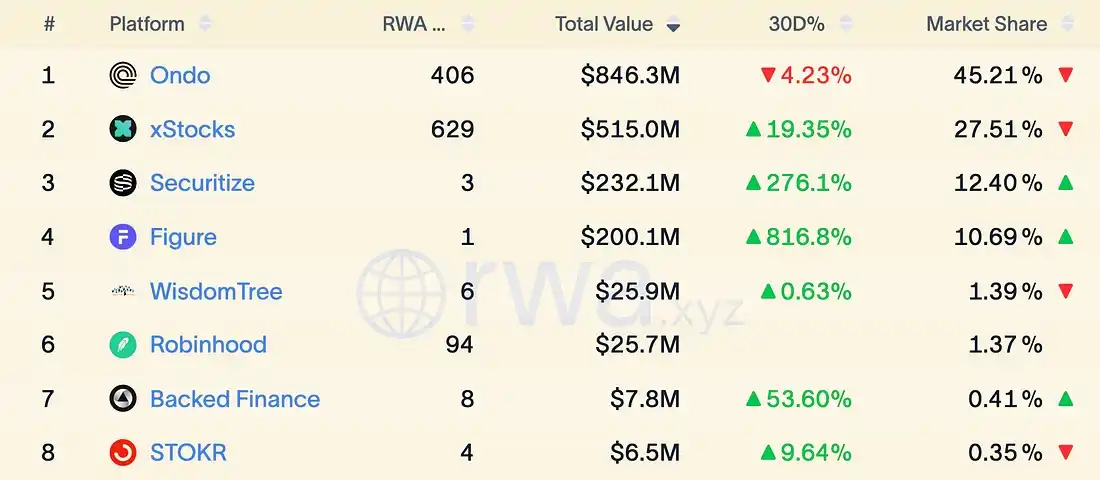
Chart: RWA.xyz Platform Rankings — Ondo (45.21%), xStocks (27.51%), Securitize (12.40%) are Top Three

Distribution across blockchain networks is more decentralized, but this doesn't eliminate underlying common dependencies. Ethereum leads with a 36.2% value share, followed by Solana (19.6%) and BNB Chain (15.8%). Provenance and Avalanche are primarily driven by Figure and Securitize, respectively.

Products issued on different networks may still rely on the same wrapping issuer, broker, custodian, transfer agent, or reference price provider.
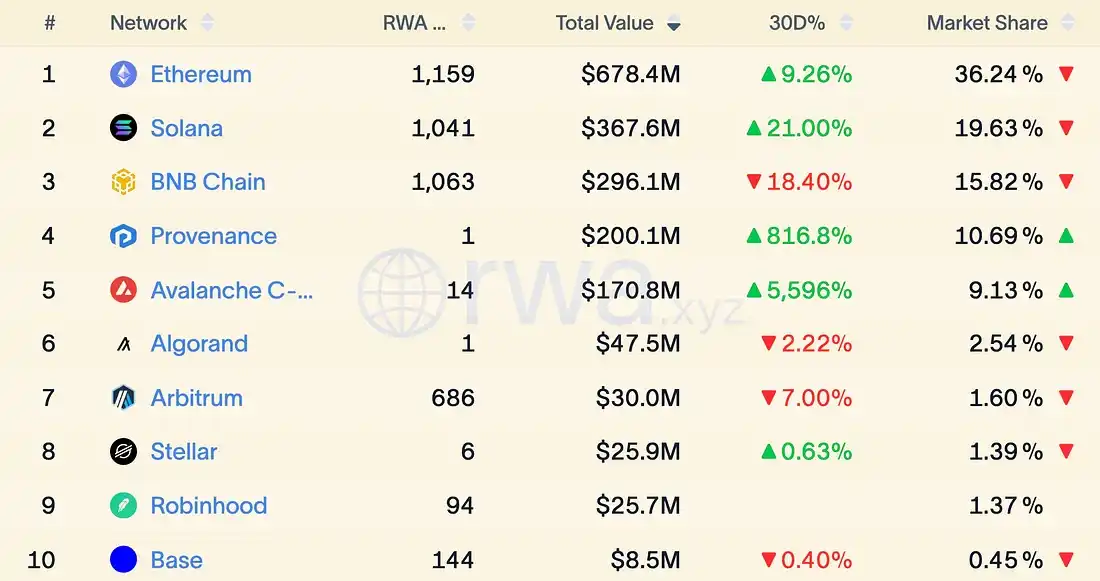
Chart: RWA.xyz Network Rankings — Ethereum (36.24%), Solana (19.63%), BNB Chain (15.82%) are Top Three

This market has broadened in scope but remains legally fragmented. Multiple tokens can simultaneously reference Apple stock or the S&P 500 ETF, but each is a separate legal liability, subject to different jurisdictions, and reliant on different intermediaries.

Bridge adjustments prevent double-counting the same token on different networks, but they cannot—and should not—consolidate products that reference similar assets but offer substantively different legal rights.


Kripto yang Sedang Tren

Pertanyaan Terkait

QAccording to the article, what is the core contradiction within the current tokenized stock market?

AThe core contradiction is that products with free tradability often lack genuine legal ownership rights, while products with solid legal ownership rights suffer from poor liquidity.

QWhat were the two main categories of assets defined in the March 2026 report, and why does the article say transferability alone is no longer sufficient to judge a product's maturity?

AThe two categories were 'represented assets' (recorded but kept within the issuer's environment) and 'distributed assets' (transferable to external wallets). The article states transferability alone is insufficient because the market has evolved into two distinct paths: offshore products focus on accessibility/composability, while regulated US infrastructure focuses on legal certainty, controlled wallets, and integration with traditional systems like the DTC.

QWhich three specific tokenized stock instruments contributed nearly half of the reported growth in distributed value from March to July 2026?

AThe three instruments were SECZ (which added ~$169M), FGRS (~$162.9M), and STRCx (~$126.6M). Together, they contributed about 49% of the total $936.8M increase in distributed value.

QHow concentrated is the tokenized stock market at the platform level as of late July 2026, based on the data presented?

AThe market is highly concentrated. The top three platforms—Ondo, xStocks, and Securitize—collectively accounted for 85.1% of the total distributed value as of July 29th.

QWhat are the four key elements that, according to the article, no tokenized stock product has managed to achieve at scale simultaneously?

AThe four elements are: 1) Canonical ownership (legal recognition), 2) Broad wallet distribution, 3) Institutional liquidity, and 4) Independent on-chain price discovery.

Bacaan Terkait

OpenAI Tidak Lagi Mengandalkan Model Termahal untuk Menghasilkan Uang

OpenAI tidak lagi mengandalkan model termahal untuk menghasilkan uang. Pada 30 Juli, perusahaan mengumumkan penyesuaian harga, menurunkan harga model GPT-5.6 Luna sebesar 80% dan Terra sebesar 20%. Yang lebih penting dari angka penurunan harga adalah pesan intinya: untuk banyak tugas, model terkuat (seperti Sol) tidak selalu diperlukan. OpenAI secara eksplisit merekomendasikan strategi di mana model mahal (Sol) menangani perencanaan dan analisis kompleks, sementara model yang lebih terjangkau (Luna) mengeksekusi tugas, menulis kode, dan menjalankan pengujian. Pergeseran ini mencerminkan perubahan industri AI dari hanya mengejar kecerdasan tertinggi menuju optimisasi biaya dan efisiensi untuk penggunaan skala besar. Anthropic juga mengikuti pola serupa dengan meluncurkan Claude Opus 5 dengan harga setengah dari model andalannya, Fable 5. Kedua raksasa Silicon Valley ini menunjukkan bahwa model flagship kini berfungsi lebih untuk nilai merek dan pembuktian teknologi, sementara model "kendaraan massal" yang lebih murah (seperti Luna, Terra, Opus) yang akan mendorong adopsi komersial luas dan menghasilkan pendapatan utama. OpenAI mengungkapkan bahwa penurunan biaya ini sebagian didorong oleh model AI (Sol) yang mengoptimalkan kode produksi dan alur kerjanya sendiri, menciptakan siklus peningkatan efisiensi yang dapat mempercepat penurunan biaya di masa depan. Intinya, kompetisi AI bergeser dari "siapa yang paling pintar" menjadi "mana yang paling bernilai". Perusahaan tidak lagi membeli satu model tunggal, tetapi merancang sistem dengan beberapa model yang cocok untuk tugas yang berbeda—mirip dengan arsitektur komputasi awan. Tujuan akhir OpenAI adalah membangun ekosistem yang mengunci alur kerja pengembang melalui volume panggilan API yang sangat besar dan biaya yang sangat rendah, sehingga menciptakan daya tarik yang kuat. Ketika AI menjadi murah dan tersebar luas seperti listrik, tertanam dalam setiap proses tanpa diperdebatkan, era sesungguhnya baru dimulai.

marsbit48m yang lalu

OpenAI Tidak Lagi Mengandalkan Model Termahal untuk Menghasilkan Uang

marsbit48m yang lalu

Gaji Puluhan Miliar untuk Rebut Tukang Listrik, Meta Buru-buru Buka Sekolah Kejuruan Sendiri

Perlombaan AI kini menghadapi hambatan baru: **kelangkaan tenaga ahli teknik**, terutama tukang listrik. Proyek data center raksasa seperti "Stargate" OpenAI membutuhkan ratusan pekerja konstruksi yang bekerja hingga 7 hari seminggu. Menurut prediksi, AS membutuhkan **130.000 tukang listrik tambahan** hingga 2030, namun puluhan ribu lowongan per tahun tetap tak terisi. Gaji yang ditawarkan sangat tinggi, mencapai **$240.000-$280.000 per tahun** untuk tukang listrik andal. Namun, kelambatan proyek karena kekurangan tenaga kerja bisa menyebabkan kerugian **$14,2 juta per bulan**. Presiden Microsoft menyebut kelangkaan tukang listrik sebagai **hambatan utama** ekspansi data center. Kompleksitas data center AI sangat tinggi karena kebutuhan daya besar (setara puluhan ribu rumah), sistem distribusi listrik rumit, dan tantangan pendinginan yang membutuhkan ahli pipa dan HVAC. Akibatnya, perusahaan seperti Meta dan Alphabet berinvestasi besar dalam pelatihan. Meta mengalokasikan **$115 juta** untuk mendirikan sekolah pelatihan konstruksi, menawarkan program gratis dengan tunjangan hidup. Upaya ini menarik minat generasi Z, dengan lonjakan pendaftaran sekolah kejuruan. Namun, tantangan berlanjut: konsumsi listrik data center AI melonjak **84,2% per tahun**, mendorong harga listrik naik. Selain itu, pekerjaan konstruksi bersifat proyek - setelah data center selesai, ribuan pekerja terlatih harus mencari pekerjaan baru, berpotensi membanjiri sektor lain dan menekan upah. Masa depan pasar tenaga kerja teknik pasca-boom AI masih belum pasti.

marsbit48m yang lalu

Gaji Puluhan Miliar untuk Rebut Tukang Listrik, Meta Buru-buru Buka Sekolah Kejuruan Sendiri

marsbit48m yang lalu

The Fed Harus Naikkan Suku Bunga di September? Bagaimana Tekanannya pada Crypto dan Saham AS?

Pasar telah meningkatkan perkiraan suku bunga Federal Reserve (The Fed) pada September menjadi lebih dari 73%, meningkat pesat dari kurang dari 53% sepekan sebelumnya. Lonjakan ini dipicu oleh perbedaan suara dalam rapat The Fed Juli (9-3) dan kekhawatiran inflasi akibat kenaikan harga minyak, yang didorong oleh ketegangan geopolitik di dekat Selat Hormuz. Kunci penentu berikutnya adalah data CPI bulan Juli pada 12 Agustus. Jika inflasi menunjukkan kenaikan berlanjut, probabilitas kenaikan suku bunga September akan semakin kuat. Untuk aset kripto seperti Bitcoin, ekspektasi kenaikan suku bunga biasanya menekan harga karena meningkatkan biaya peluang memegang aset tidak menghasilkan dan menarik aliran modal ke aset yang lebih aman. Namun, dampaknya mungkin terbatas jika pasar memandang kenaikan ini sebagai akhir dari siklus pengetatan. Saham AS terkait kripto (seperti Coinbase, MicroStrategy) cenderung bereaksi lebih volatil. Kenaikan suku bunga meningkatkan tingkat diskonto dalam valuasi, memberi tekanan lebih besar pada saham pertumbuhan dan teknologi. Hal ini bertepatan dengan musim laporan keuangan dimana investor kini lebih kritis, menilai apakah pengeluaran modal besar-besaran untuk AI dapat benar-benar menghasilkan pendapatan dan arus kas. Perusahaan dengan cerita pertumbuhan lemah dan arus kas negatif mungkin menghadapi volatilitas lebih tinggi jika The Fed benar-benar menaikkan suku bunga.

marsbit59m yang lalu

The Fed Harus Naikkan Suku Bunga di September? Bagaimana Tekanannya pada Crypto dan Saham AS?

marsbit59m yang lalu

Penambang Bitcoin Mulai Menyerah, Tapi Saham Mereka Malah Meroket

Penambang Bitcoin Menyerah, Namun Saham Mereka Melonjak. Hashrate Bitcoin telah menurun selama berbulan-bulan, dan kesulitan penambangan juga baru saja mencatat salah satu penurunan terbesar. Biasanya, ini adalah cerita sederhana: penambang mematikan mesin karena tidak menguntungkan. Namun, kali ini, saham perusahaan penambang publik justru mengalami salah satu performa terkuat dalam beberapa tahun terakhir, sementara harga BTC sendiri tertekan. Setiap penurunan hashrate yang lebih lama dari ini dalam sejarah Bitcoin dapat dihitung dengan jari. Kesulitan penambangan telah turun 19.9% dari puncaknya, salah satu penurunan terdalam sejak dominasi ASIC. Alasan di balik kenaikan saham perusahaan tambang adalah narasi AI. Aset-aset ini kini lebih banyak bergerak seiring dengan sektor AI daripada dengan Bitcoin itu sendiri. Sementara itu, pendapatan penambang dari blok reward (subsidi) dalam denominasi BTC mencapai rekor terendah baru. Subsidi blok berkurang setengah setiap empat tahun, dan logika bahwa kenaikan harga akan mengimbangi pengurangan ini masih bertahan sejauh ini, dengan metrik Puell Multiple saat ini sekitar 0.75. Jawaban jangka panjang selalu adalah biaya transaksi (fee), yang suatu hari nanti harus sepenuhnya mendanai keamanan jaringan. Namun, realitanya masih sangat jauh. Rata-rata harian fee selama 28 hari terakhir bahkan tidak cukup untuk menutupi subsidi satu blok, sementara jaringan menghasilkan sekitar 144 blok per hari. Bentuk "penyerahan diri" penambang kali ini berbeda dari siklus sebelumnya. Penambang telah menemukan penggunaan perangkat keras yang lebih menguntungkan, sementara harga BTC turun, subsidi menyusut, dan pendapatan dari fee stagnan. Masalah yang perlu diselesaikan seringkali baru ditangani secara serius selama pasar bearish.

marsbit59m yang lalu

Penambang Bitcoin Mulai Menyerah, Tapi Saham Mereka Malah Meroket

marsbit59m yang lalu

Trading

Spot

Artikel Populer

Cara Membeli CAP

Selamat datang di HTX.com! Kami telah membuat pembelian Cap (CAP) menjadi mudah dan nyaman. Ikuti panduan langkah demi langkah kami untuk memulai perjalanan kripto Anda.Langkah 1: Buat Akun HTX AndaGunakan alamat email atau nomor ponsel Anda untuk mendaftar akun gratis di HTX. Rasakan perjalanan pendaftaran yang mudah dan buka semua fitur.Dapatkan Akun SayaLangkah 2: Buka Beli Kripto, lalu Pilih Metode Pembayaran AndaKartu Kredit/Debit: Gunakan Visa atau Mastercard Anda untuk membeli Cap (CAP) secara instan.Saldo: Gunakan dana dari saldo akun HTX Anda untuk melakukan trading dengan lancar.Pihak Ketiga: Kami telah menambahkan metode pembayaran populer seperti Google Pay dan Apple Pay untuk meningkatkan kenyamanan.P2P: Lakukan trading langsung dengan pengguna lain di HTX.Over-the-Counter (OTC): Kami menawarkan layanan yang dibuat khusus dan kurs yang kompetitif bagi para trader.Langkah 3: Simpan Cap (CAP) AndaSetelah melakukan pembelian, simpan Cap (CAP) di akun HTX Anda. Selain itu, Anda dapat mengirimkannya ke tempat lain melalui transfer blockchain atau menggunakannya untuk memperdagangkan mata uang kripto lainnya.Langkah 4: Lakukan trading Cap (CAP)Lakukan trading Cap (CAP) dengan mudah di pasar spot HTX. Cukup akses akun Anda, pilih pasangan perdagangan, jalankan trading, lalu pantau secara real-time. Kami menawarkan pengalaman yang ramah pengguna baik untuk pemula maupun trader berpengalaman.

281 Total TayanganDipublikasikan pada 2026.06.26Diperbarui pada 2026.06.26

Cara Membeli CAP

Diskusi

Selamat datang di Komunitas HTX. Di sini, Anda bisa terus mendapatkan informasi terbaru tentang perkembangan platform terkini dan mendapatkan akses ke wawasan pasar profesional. Pendapat pengguna mengenai harga CAP (CAP) disajikan di bawah ini.

活动图片












