ChatGPT Issues Sudden Ban, Cutting Off Global AI Writers Overnight

marsbitDipublikasikan tanggal 2026-07-31Terakhir diperbarui pada 2026-07-31

Abstrak

The Golden Age of AI writing is showing signs of collapse. While AI models grow more powerful, the quality of their generated text is perceived to be declining. Research notes a divergence: models excel in structured domains like coding and math due to clear feedback signals, but their language expression and reasoning plateau or even regress, as there's no reliable automated metric to score "good writing." Simultaneously, platforms are imposing new restrictions. ChatGPT has reportedly begun refusing prompts that explicitly instruct it to mimic the style of specific famous authors like Stephen King or J.K. Rowling, though requests based on abstract narrative features remain possible. This shift undermines user expectations. AI writing tools are becoming less reliable for end-to-end content creation, as model capabilities may not consistently improve and prompt efficacy can change overnight due to platform policy updates. Consequently, AI is receding to a more auxiliary role—a tool for research, structuring, and editing—while human judgment, experience, and creative intent regain paramount importance.

The golden age of AI writing is collapsing!

Entering it, each generation of models grows stronger, yet the articles become increasingly worse.

It knows when to list several suggestions, where to insert subheadings, and never forgets to add a concluding sentence at the end.

But after reading the entire piece, not a single sentence remains in your mind.

The Stronger the Model, the Less Human the Writing Sounds

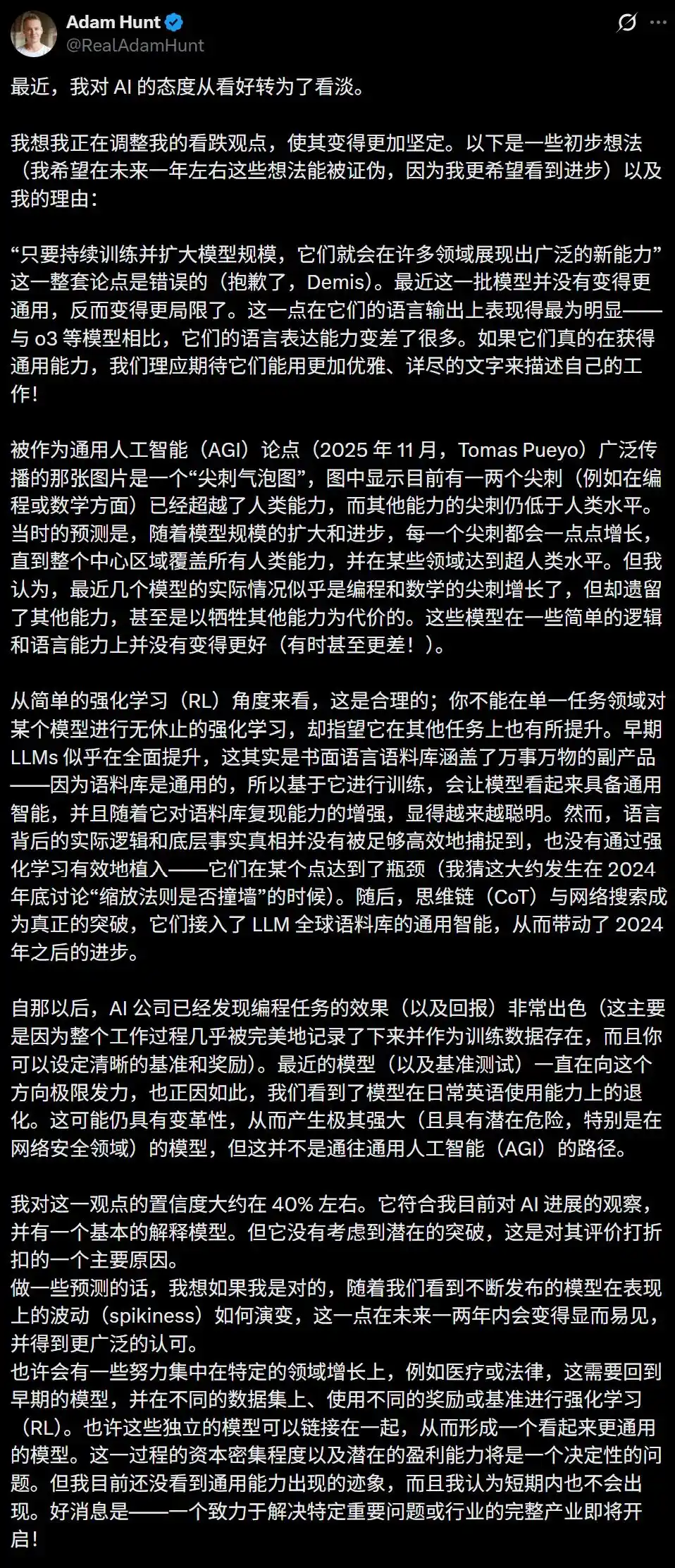
Recently, Cambridge University postdoctoral researcher Adam Hunt also noticed this phenomenon. His research focuses on evolutionary psychiatry and human evolution.

Hunt was previously optimistic about AI. However, on July 28, he frankly admitted in a long post: he is growing increasingly pessimistic now.
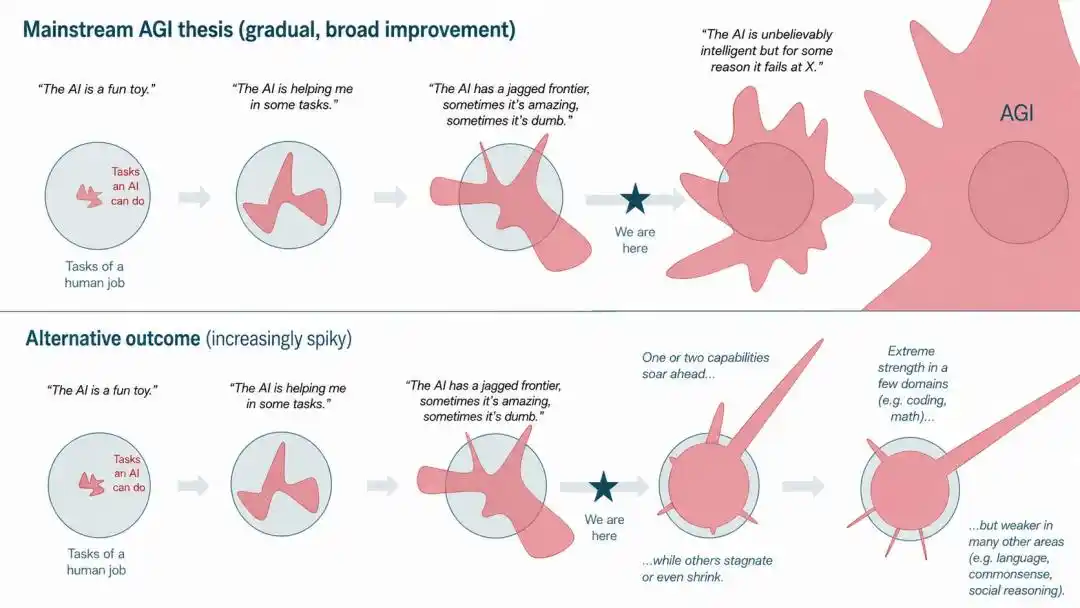
There was a popular metaphor before, depicting model capability as a circle with a sharp spike.

First, code and mathematics surpass humans, then as scale increases, every direction gradually grows, ultimately achieving AGI.

But in reality, the spike for code and mathematics is indeed growing longer, while language expression and simple reasoning have not improved synchronously.
From a reinforcement learning perspective, this outcome is almost inevitable.

Earlier generations of LLMs appeared to become "comprehensively smarter" because the training corpus itself covered all domains, from poetry to theses, encompassing the entire internet.

However, that was a byproduct of the corpus, not the model's genuine "comprehension."

Chain-of-thought and web search were subsequently introduced, giving models a temporary boost. But ultimately, this path hit a wall.

Following that, AI companies eager for a turnaround turned their focus to code.

The reason is simple: there is a constant stream of training data available.

GitHub commits, reviews, and PRs are all readily available. Moreover, similar to mathematics, code provides clear feedback signals: either it runs or it doesn't.

What about writing articles? How do you automatically score "how well a piece of prose is written"? Without a reward, RL won't optimize in that direction.

Thus, all training efforts shifted to code, while language expression had to rely on the foundation laid during the pre-training phase.

This foundational knowledge can only diminish over time. To accommodate improvements in other areas, it might even degrade.

This is precisely where Goodhart's law tends to manifest.

When a metric becomes the training target, it no longer accurately reflects true capability. Labs optimize models using benchmark tests, then prove their improvement with similar tests.

Benchmark accuracy scores will continue to rise. Yet, the actual user experience may stagnate or even decline.

This Time, Imitation Is Also Restricted

While capabilities are degrading, another development is occurring simultaneously.

A Reddit user complained in a post that they had been using ChatGPT to write a book for several months, subscribing to the advanced model. They took a break in between.

When they returned, the prompt that had always worked suddenly returned a refusal.

The prompt itself wasn't complex: specify an author, request to increase dialogue, enrich details, and avoid fragmented sentences.

In the past, simply writing the author's name allowed the model to generate content approximating their style, without needing additional explanations on sentence length, rhythm, or perspective.

Now, this type of prompt no longer works.

Ars Technica tested with Stephen King, J.K. Rowling, Amy Tan, Dickens, Hemingway, and Engadget tested with Agatha Christie. ChatGPT refused to imitate all of them.

If you don't name names and only request abstract features like "suspense intensity," "narrative pacing," or "dialogue density," it can still output. But the flavor is no longer the same.

The Golden Age of AI Writing Has Collapsed

Today, this controversy has shaken users' fundamental expectations regarding AI writing.

Models may not necessarily write better, and prompts are no longer guaranteed to remain effective long-term.

When platforms change their rules, entire writing pipelines built around specific models can collapse overnight.

However, AI writing won't disappear; it has merely retreated to its proper place: as a tool.

It can research information, structure content, and revise sentences, but it cannot replace the author in deciding what to write and why to write it.

In other words, human experience, judgment, and desire to express are becoming increasingly valuable.

Reference: https://arstechnica.com/ai/2026/07/chatgpt-stops-cloning-famous-writers-voices-but-may-capture-a-similar-feeling/

This article is from WeChat public account "New Zhiyuan," author: ASI Apocalypse

Kripto yang Sedang Tren

Pertanyaan Terkait

QAccording to the article, what is the main reason for the decline in the quality of AI-generated writing?

AThe article attributes the decline to reinforcement learning (RL) optimization focusing on domains with clear, automated feedback like code, while creative writing lacks such objective metrics, causing language expression capabilities to stagnate or degrade as models prioritize other benchmarks.

QWhat specific change did ChatGPT make regarding prompts that imitate famous writers?

AChatGPT now refuses to generate content in the style of specific, named famous authors like Stephen King or J.K. Rowling when prompted directly. Prompts using only abstract stylistic features are still allowed, but the output is less authentic.

QWhat is Goodhart's law, as mentioned in the article, and how does it relate to AI model training?

AGoodhart's law states that when a measure becomes a target, it ceases to be a good measure. The article relates this to AI companies optimizing models for specific benchmark tests, which improves scores on those tests but doesn't necessarily translate to better real-world performance, potentially leading to a decline in user experience.

QWhat does the article suggest is the future role of AI in writing?

AThe article suggests AI writing will recede from attempting to replace authors and settle into its proper role as a tool. It will be used for tasks like researching, structuring content, and editing sentences, but the human author's experience, judgment, and desire to express remain central and increasingly valuable.

QWhat analogy does researcher Adam Hunt use to describe the unrealistic expectation of AI model development?

AHe references a popular analogy depicting model capability as a spiky circle, where proficiency in areas like code and math grows into a sharp peak, expecting all other abilities like language to grow uniformly toward AGI. The article argues that in reality, the 'spike' for code has grown while language and simple reasoning have not kept pace.

Bacaan Terkait

Bitcoin di Agustus: Ahli Menantikan Pengujian Rentang, Bukan Pembalikan Cepat

Bitcoin pada Agustus, menurut para analis, kemungkinan akan tetap berada di bawah tekanan. Setelah pemulihan di bulan Juli, pasar tampaknya belum siap untuk pertumbuhan berkelanjutan, dengan risiko penurunan di bawah $60.000 masih ada. Pada akhir Juli, bitcoin diperdagangkan sekitar $63.500, turun sekitar 50% dari rekor tertingginya pada Oktober 2025. Para ahli menyebut kombinasi kondisi makroekonomi yang sulit sebagai faktor penekan, termasuk suku bunga tinggi di AS, inflasi yang tetap tinggi, dan dolar AS yang kuat. Tingkat bunga yang tinggi membuat instrumen pendapatan tetap lebih menarik, sehingga mengalihkan modal dari aset berisiko seperti kripto. Selain itu, aliran keluar bersih dari ETF berbasis bitcoin pada paruh pertama tahun ini menandakan lemahnya permintaan kelembagaan saat ini. Secara historis, Agustus bukanlah bulan yang kuat untuk pasar kripto. Secara teknis, bitcoin terus bergerak dalam kisaran sempit $60.000–$65.000. Para analis memberikan beberapa skenario untuk bulan ini: skenario dasar adalah pergerakan dalam kisaran $58.000–$68.000 (probabilitas 50%), skenario negatif adalah penurunan ke $50.000–$55.000 (probabilitas 30%), dan skenario positif adalah kenaikan ke $71.000–$75.000 (probabilitas 20%). Saran untuk investor adalah fokus pada akumulasi bertahap pada level saat ini untuk jangka panjang, karena harga dianggap menarik. Namun, kewaspadaan diperlukan terhadap potensi penurunan jangka pendek di bawah $60.000. Pergerakan yang lebih signifikan kemungkinan baru akan terjadi pada kuartal IV tahun ini. Faktor kunci yang perlu dipantau meliputi keputusan suku bunga Fed, inflasi, dinamika ETF, dan minat terhadap aset berisiko.

cryptonews.ru2j yang lalu

Bitcoin di Agustus: Ahli Menantikan Pengujian Rentang, Bukan Pembalikan Cepat

cryptonews.ru2j yang lalu

Dompet Perangkat Keras Coldcard Diretas: Peretas Menarik 594 Bitcoin dalam 25 Menit

Dompet perangkat keras Coldcard berhasil diretas: peretas menarik 594 bitcoin dalam 25 menit. Insiden ini merusak reputasi dompet perangkat keras sebagai metode penyimpanan mata uang digital teraman. Pada 30 Juli 2026, penyerang berhasil menarik 594,5 BTC (sekitar $40 juta) dari 500 alamat. Akar masalahnya adalah bug perangkat lunak yang tak terdeteksi selama lima tahun. Kesalahan pengetikan dalam sebuah makro secara tidak sengaja menonaktifkan fungsi chip khusus untuk menghasilkan angka acak yang benar-benar aman di dompet Coldcard sejak Maret 2021. Alih-alih, perangkat menghasilkan kunci berdasarkan data yang dapat diprediksi, seperti nomor seri prosesor dan waktu sistem, sehingga sangat mengurangi keamanan kriptografinya. Peretas tidak memerlukan akses fisik. Mereka hanya perlu memahami parameter generator yang bermasalah ini dan melakukan pencarian brute-force secara offline untuk menghasilkan kemungkinan frasa seed, menemukan alamat dengan saldo di blockchain publik, dan menandatangani transaksi penarikan. Perusahaan di balik Coldcard, Coinkite, awalnya menyatakan versi baru tidak rentan, tetapi kemudian mengakui semua perangkat yang menjalankan firmware yang terpengaruh berisiko. CEO mereka meminta maaf namun mengecualikan kompensasi finansial kepada korban. Pemilik yang terdampak harus segera: 1. Memperbarui firmware ke versi aman (4.2.0 untuk Mk3, 5.6.0 untuk Mk4/Mk5, atau 1.5.0Q untuk model Q). 2. Menghasilkan frasa seed baru yang benar-benar acak pada perangkat yang telah diperbarui. 3. Memindahkan semua dana ke alamat baru yang dibuat dari frasa seed tersebut. Penggunaan frasa sandi BIP-39 dapat membantu, tetapi tidak menggantikan kebutuhan membuat kunci baru. Insiden ini menyoroti bahwa bahkan perangkat keras khusus memerlukan audit kode independen yang berkelanjutan, terutama untuk fungsi kriptografi. Beberapa lanalisis, termasuk dari Galaxy Research, memperkirakan total dana yang dicuri bisa mencapai 1.000 BTC. Kasus ini mengingatkan pada insiden serupa di masa lalu, seperti bug OpenSSL di Debian, dan mempertanyakan apakah audit otomatis oleh AI dapat sepenuhnya menggantikan tinjauan manusia pada kode kritis.

cryptonews.ru2j yang lalu

Dompet Perangkat Keras Coldcard Diretas: Peretas Menarik 594 Bitcoin dalam 25 Menit

cryptonews.ru2j yang lalu

Trading

Spot

Artikel Populer

Cara Membeli BAN

Selamat datang di HTX.com! Kami telah membuat pembelian Comedian (BAN) menjadi mudah dan nyaman. Ikuti panduan langkah demi langkah kami untuk memulai perjalanan kripto Anda.Langkah 1: Buat Akun HTX AndaGunakan alamat email atau nomor ponsel Anda untuk mendaftar akun gratis di HTX. Rasakan perjalanan pendaftaran yang mudah dan buka semua fitur.Dapatkan Akun SayaLangkah 2: Buka Beli Kripto, lalu Pilih Metode Pembayaran AndaKartu Kredit/Debit: Gunakan Visa atau Mastercard Anda untuk membeli Comedian (BAN) secara instan.Saldo: Gunakan dana dari saldo akun HTX Anda untuk melakukan trading dengan lancar.Pihak Ketiga: Kami telah menambahkan metode pembayaran populer seperti Google Pay dan Apple Pay untuk meningkatkan kenyamanan.P2P: Lakukan trading langsung dengan pengguna lain di HTX.Over-the-Counter (OTC): Kami menawarkan layanan yang dibuat khusus dan kurs yang kompetitif bagi para trader.Langkah 3: Simpan Comedian (BAN) AndaSetelah melakukan pembelian, simpan Comedian (BAN) di akun HTX Anda. Selain itu, Anda dapat mengirimkannya ke tempat lain melalui transfer blockchain atau menggunakannya untuk memperdagangkan mata uang kripto lainnya.Langkah 4: Lakukan trading Comedian (BAN)Lakukan trading Comedian (BAN) dengan mudah di pasar spot HTX. Cukup akses akun Anda, pilih pasangan perdagangan, jalankan trading, lalu pantau secara real-time. Kami menawarkan pengalaman yang ramah pengguna baik untuk pemula maupun trader berpengalaman.

908 Total TayanganDipublikasikan pada 2024.12.11Diperbarui pada 2026.06.02

Cara Membeli BAN

Diskusi

Selamat datang di Komunitas HTX. Di sini, Anda bisa terus mendapatkan informasi terbaru tentang perkembangan platform terkini dan mendapatkan akses ke wawasan pasar profesional. Pendapat pengguna mengenai harga BAN (BAN) disajikan di bawah ini.

活动图片













