White House Concession Removes Ethical Hurdle, Clarity Act Races Against Final Window Before Recess?

Odaily星球日报Dipublikasikan tanggal 2026-07-21Terakhir diperbarui pada 2026-07-21

Abstrak

On July 21st, industry sources reported that the Trump administration has agreed to include an ethics provision in the "Clarity Act" (Digital Asset Market Clarity Act of 2025). This concession addresses the long-standing conflict-of-interest concerns regarding government officials and the crypto industry, potentially removing the final major obstacle to the bill's progress. Additionally, Patrick Witt, the executive director of the White House's Digital Asset Advisory Committee, confirmed he will remain in his role to help finalize the bill, alleviating previous concerns about his potential departure. The Clarity Act aims to establish a unified federal regulatory framework for the U.S. digital asset market. Its core objective is to resolve regulatory ambiguity by defining different types of digital assets (digital commodities, investment contract assets, and permitted payment stablecoins) and clarifying the respective oversight roles of the SEC and CFTC. This would end the long-running jurisdictional dispute between the two agencies and provide clearer compliance paths for the industry. With the ethics issue moving toward resolution, the most urgent challenge now is time. The U.S. Congress is set to begin its August recess in mid-August, leaving only a few working weeks to finalize the text and advance the bill through the Senate. Industry advocates, like the Blockchain Association's Kristin Smith, stress that this is a critical moment. If negotiations conclude successfully ...

Original | Odaily Planet Daily (@OdailyChina)

Author | Azuma (@azuma_eth)

Beijing time, July 21st - Multiple industry sources have revealed that the Trump administration has agreed to include an ethics provision in the "Clarity Act" (Digital Asset Market Structure Bill), and the relevant text has been submitted to some Republican senators. Although the specific details of the provision are not yet fully public, industry participants generally believe this progress could clear the way for an updated version of the bill text (expected to be released in the coming days) and subsequent Senate voting.

Over the past year, negotiations surrounding the "Clarity Act" have progressed slowly. After parties gradually reached compromises on earlier disagreements such as stablecoin yields and DeFi regulation, the biggest remaining controversy was how to handle potential conflicts of interest between U.S. government officials and the crypto industry. With the White House expressing willingness to concede on the ethics provision, the last major obstacle that has long hindered the bill's progress is showing signs of possible resolution.

In addition to progress on the ethics provision, another positive signal regarding the "Clarity Act"'s push emerged this morning: Patrick Witt, Executive Director of the White House Digital Asset Advisory Committee responsible for driving the bill's passage, has confirmed he will remain in his position to help the bill through its final sprint. Previous reports suggested Witt might leave his post before the "Clarity Act" entered a critical Senate phase due to training obligations with the U.S. Army National Guard, which had sparked industry concerns about the bill's pace. Witt has now confirmed that his training mission will be postponed, allowing him to continue participating in the bill's passage process.
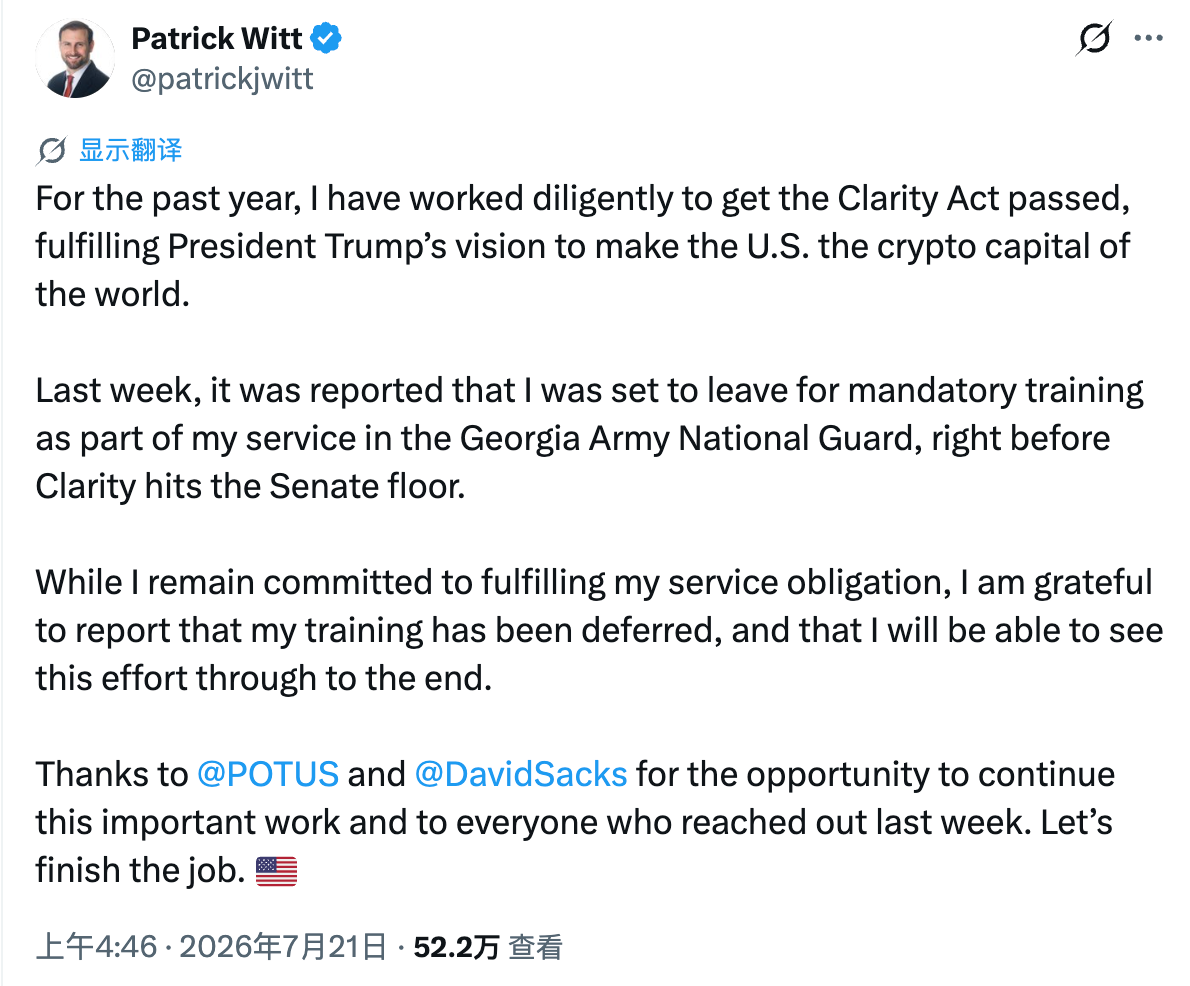
For the entire cryptocurrency industry, the latest developments may indicate that this nearly year-long regulatory standoff has finally reached its most critical turning point.

Content and Significance of the Clarity Act (Skip if Familiar)

As one of the core legislative pieces of the Trump administration's push for the U.S. to become a "global crypto hub," the full name of the "Clarity Act" is the *Digital Asset Market Clarity Act of 2025*. It aims to establish a unified federal regulatory framework for the U.S. digital asset market.

The core objective of this bill is to address the long-standing regulatory ambiguity faced by the U.S. crypto industry in recent years — clarifying the legal attributes of different digital assets and redefining the regulatory responsibilities between the U.S. Securities and Exchange Commission (SEC) and the Commodity Futures Trading Commission (CFTC).

Specifically, the Clarity Act attempts to establish a digital asset classification system, categorizing assets into digital commodities, investment contract assets, and permitted payment stablecoins. Among these, digital commodities with blockchain network functionality would be primarily regulated by the CFTC; investment contract assets involving fundraising and issuance would remain under SEC jurisdiction; stablecoin issuers would mainly be regulated by banking authorities.

The significance of this framework lies in ending the years-long turf war between the SEC and CFTC over digital asset regulatory authority, providing the industry with a clearer compliance path. In the past, under former SEC Chairman Gary Gensler, the SEC tended to classify a large number of digital assets as securities based on the Howey Test, expanding its regulatory scope through enforcement actions; meanwhile, the CFTC argued that some highly decentralized digital assets were closer to commodities and should fall under its purview. This long-standing conflict over regulatory boundaries has kept U.S. crypto businesses, trading platforms, and developers in an uncertain environment.

If the Clarity Act ultimately passes, the U.S. crypto industry may usher in its first comprehensive market structure regulatory framework. For the market, its short-term impact might be boosting sentiment through improved policy expectations, but the longer-term significance lies in reducing regulatory uncertainty and providing a clearer institutional basis for traditional financial institutions and long-term capital to enter the digital asset space.

The Final Disagreement: The Ethics Controversy

The Clarity Act's journey to this point has not been easy. On July 17th last year, the Clarity Act passed the U.S. House of Representatives with a vote of 294 to 134, securing support far exceeding the simple majority requirement. However, unlike the GENIUS Act, which progressed smoothly around the same time and was eventually signed by Trump, the Clarity Act encountered more complex political maneuvering after moving to the Senate.

Compared to the House, while Republicans still hold a majority in the Senate, the Clarity Act, as a major regulatory legislation affecting the entire digital asset market structure, still requires a degree of bipartisan support to proceed to a final vote. This means the bill faces a complex negotiation in the Senate centered on regulatory direction, industry interests, and political demands.

Over the past year, disagreements surrounding the Clarity Act have mainly focused on three areas — stablecoin yield rules, DeFi regulatory boundaries, and potential conflicts of interest between the Trump administration and the crypto industry. Now, the first two major disagreements have gradually cooled as negotiations progressed. Regarding stablecoin yields, once the most contentious issue, parties have reached a compromise solution: "prohibiting yield purely for holding stablecoins, but allowing rewards based on actual activities."

Now, the only issue remaining on the negotiation table is the final disagreement: the ethics issue. Over the past year of negotiations, Congressional members and the White House have spent significant time negotiating ethical clauses aimed at restricting the President, Vice President, members of Congress, and other federal officials from profiting from digital assets during their terms (refer to *Trump's 'Pay Stub' Exposed: Cryptocurrency Generates $1.4 Billion, Stock Trades Exceed 22,000*). With the latest developments this morning, it indicates a potential breakthrough in the last political battle surrounding the "Clarity Act."

More Pressing Than Content Disagreement: Time

However, compared to disputes over the bill's content, an even more pressing problem facing the "Clarity Act" now is time. The U.S. Congress typically enters its August recess in mid-August, leaving only about a dozen working days for both parties to complete text coordination and push for Senate consideration.

Kristin Smith, CEO of the Blockchain Association, which has played a significant lobbying role in the "Clarity Act" process, stated bluntly yesterday: "This is the most critical moment."
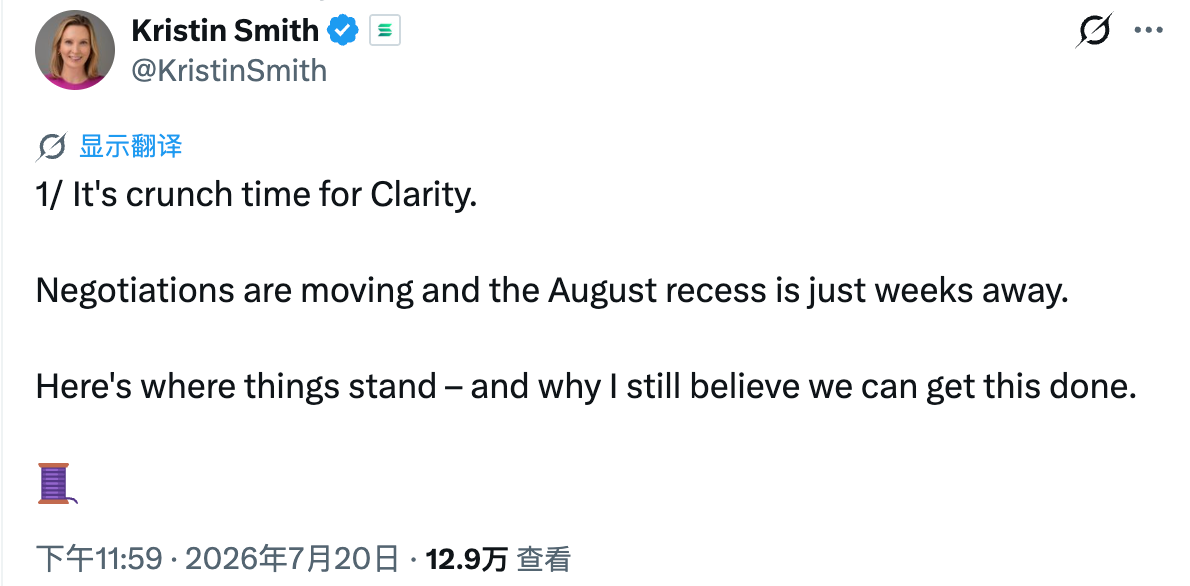
Smith said the "Clarity Act" has gone through a long process, and the current version already includes stronger illegal finance oversight provisions, more comprehensive consumer protection measures, and enhanced regulatory requirements for spot trading platforms. This is one of the most comprehensive digital asset market structure frameworks she has seen. If both sides can resolve the ethics-related disputes in the coming weeks, the "Clarity Act" might have a chance to complete a key breakthrough before the Congressional recess; but if negotiations stall again, this crypto regulatory framework, which has been in the works for over a year, may have to wait for a new political window.

A Historic Turning Point for Crypto Regulation?

Of course, there is still one final step before the "Clarity Act" truly becomes law. Even if the White House has agreed to accept the ethics provision, uncertainties remain regarding the subsequent text release, Senate consideration, and final bipartisan coordination. However, judging from the signals released so far, this digital asset market structure bill, which has undergone over a year of struggle, is getting closer to the finish line.

If the "Clarity Act" can achieve a breakthrough before the August 10th recess, it could become an important turning point in the history of cryptocurrency regulation in the United States and globally. Over the past few years, one of the biggest challenges for the global crypto industry has not been a lack of market demand, but the absence of a sufficiently clear, stable, and predictable regulatory framework. Different jurisdictions have vast differences regarding digital asset attributes, trading platform responsibilities, and issuance rules, forcing businesses and capital to navigate constantly changing regulatory environments.

The significance of the "Clarity Act" lies precisely in its attempt to establish a clearer rule system for digital assets through legislation. Once implemented, this framework could provide an important reference model for global markets. For trading platforms, it means a clearer registration and operation path; for developers, a more predictable innovation environment; and for traditional financial institutions, clearer compliance foundations for entering the digital asset space.

This is not just an upgrade of the U.S. regulatory system itself; it represents the global digital asset market gradually transitioning from the early stage of regulatory exploration to a more mature, institutionalized development phase.

Recommended Reading:

CLARITY Act Countdown: 25 Days Left – How Will the Crypto Market Respond if It Fails Before August Recess?


Kripto yang Sedang Tren

Pertanyaan Terkait

QWhat is the Clarity Act and what is its main purpose?

AThe Clarity Act, short for the Digital Asset Market Clarity Act of 2025, is a piece of legislation aimed at establishing a unified federal regulatory framework for the US digital asset market. Its main purpose is to resolve long-standing regulatory ambiguity by clearly defining the legal status of different digital assets (e.g., digital commodities, investment contract assets, stablecoins) and re-delineating the regulatory jurisdictions between the SEC and the CFTC.

QWhat was the most significant remaining obstacle to the Clarity Act's progress as described in the article?

AThe most significant remaining obstacle was the ethics provision. This involved handling potential conflicts of interest between US government officials and the cryptocurrency industry, specifically aiming to restrict federal officials from profiting from digital assets during their tenure. The article indicates recent progress, with the Trump administration agreeing to include such a provision.

QWhy is time considered a particularly urgent factor for the Clarity Act's passage?

ATime is urgent because the US Congress typically enters its August recess in mid-August. The article states there are only about a dozen working days left for both parties to finalize the bill's text and push it through Senate consideration before this recess. Missing this window could delay the bill until a new political opportunity arises.

QWho is Patrick Witt and what was the significance of him staying in his role?

APatrick Witt is the Executive Director of the White House Digital Asset Advisory Council, responsible for driving the bill's enactment. The significance of him confirming he would stay on is that it removes a potential disruption to the bill's final push. There were concerns he might leave for military training, but his training was postponed, allowing him to continue assisting the bill's passage.

QAccording to the article, what could be the broader global significance if the Clarity Act is passed?

AIf passed, the Clarity Act could represent a major turning point in global crypto regulation. It would provide a clearer, more stable, and predictable regulatory framework. This could serve as a key reference model for other jurisdictions, potentially helping the global digital asset market transition from an early exploratory regulatory phase to a more mature and institutionalized stage of development.

Bacaan Terkait

Setelah Tiga Kuartal Berturut-Turut Turun, Bisakah Pasar Kripto Menyambut Jendela Stabilitas di Kuartal Ketiga?

Pasar kripto mengalami kuartal terburuk sejak 2022, dengan kapitalisasi pasar turun 12.6% menjadi $2.1 triliun, didorong oleh keluarnya modal dan penurunan volume perdagangan. Bitcoin dan Ethereum masing-masing jatuh 14.2% dan 25.4% di kuartal kedua. Aliran keluar bersih dari ETF Bitcoin AS mencapai $4.67 miliar, menandakan tekanan jual yang berkelanjutan. Faktor utama meliputi terputusnya hubungan dengan saham AS, kebijakan moneter Federal Reserve yang ketat, dan pelepasan aset oleh perusahaan seperti Strategy. Proses legislasi UU CLARITY yang akan memberikan kejelasan regulasi terhambat, meningkatkan premi risiko di sektor ini. Namun, ada tanda-tanda potensi stabilisasi. Aliran keluar ETF yang besar secara historis sering terjadi di akhir fase penurunan, dan para pemegang Bitcoin jangka panjang mulai menambah kepemilikan lagi. Sementara sebagian besar sektor menyusut, pasar prediksi dan aset koleksi yang ditokenisasi mencatat pertumbuhan signifikan. Pandangan untuk kuartal ketiga sangat bergantung pada pertemuan Fed akhir Juli. Sinyal kebijakan yang lunak dapat mendukung pemulihan Bitcoin, sementara sikap yang hawkish dapat memicu konsolidasi lebih lanjut. Meskipun tantangan regulasi tetap ada, indikator teknis seperti harga Bitcoin yang mendekati rata-rata bergerak 200-mingguannya menunjukkan dasar jangka panjang belum rusak. Logika pasar telah bergeser dari mengandalkan narasi ke faktor fundamental seperti kebijakan dan ekspektasi suku bunga.

marsbitKemarin 08:40

Setelah Tiga Kuartal Berturut-Turut Turun, Bisakah Pasar Kripto Menyambut Jendela Stabilitas di Kuartal Ketiga?

marsbitKemarin 08:40

The SpaceX Trade, Terbuka: SPCXON Mulai Diperdagangkan di WEEX

SpaceX meluncurkan IPO terbesar dalam sejarah pada Juni 2026, namun akses bagi banyak pedagang terhambat oleh batasan regional dan prosedur broker. WEEX kini menghadirkan SPCXON/USDT di pasar spotnya, sebuah instrumen tokenisasi yang memungkinkan paparan terhadap pergerakan harga SpaceX melalui akun kripto yang diselesaikan dengan USDT, tanpa memerlukan broker AS atau pembiayaan bank. SPCXON adalah produk tokenisasi yang mencerminkan ekonomi kepemilikan SpaceX bagi pedagang yang memenuhi syarat di luar AS, dengan dividen diinvestasikan kembali. Aset ini diperdagangkan di WEEX sebagai pasangan spot dengan USDT, tersedia selama jam pasar, memberikan akses mudah bagi trader kripto. Kasus investasi untuk SpaceX didasarkan pada pertumbuhan pendapatan Starlink dan pencapaian Starship, meskipun valuasinya yang tinggi (sekitar 90-110 kali pendapatan) telah memperhitungkan eksekusi sempurna selama bertahun-tahun. Faktor seperti jumlah saham publik yang terbatas dan masa buka kunci (unlock) insider pertama menjadi pertimbangan penting. Penting untuk diingat bahwa SPCXON memberikan paparan, bukan kepemilikan langsung atas saham atau hak suara. Harganya dapat diperdagangkan pada premium atau diskon terhadap nilai aset bersih. WEEX menawarkan akses ke berbagai aset TradFi yang ditokenisasi seperti ini dalam satu akun terpadu, bersama dengan pasar futures dan kampanye perdagangan dengan pool hadiah.

TheNewsCryptoKemarin 08:33

The SpaceX Trade, Terbuka: SPCXON Mulai Diperdagangkan di WEEX

TheNewsCryptoKemarin 08:33

Momen Perdagangan BIT: BTC Masih Tertekan oleh EMA 200 Mingguan, Setelah Ditolak Mungkin Kembali Turun, Saham Penyimpanan dan Semikonduktor yang Melonjak Malam Kemudian Mulai Anjlok di Pasar Malam

**PASAR KRIPTO & SAHAM: BTC Hadapi Resistensi, Saham Semikonduktor Turun di Perdagangan Malam** Pasar kripto melanjutkan pemulihan, dengan harga Bitcoin bertahan di sekitar $66,000 setelah rebound lebih dari 15% dari titik terendah Juli. Namun, BTC menghadapi **tembok resistensi kuat di dekat $68,000**, yang bertepatan dengan biaya rata-rata investor selama lima bulan terakhir dan titik gagalnya rebound pertengahan Juni. Secara teknis, perhatian tertuju pada **200 EMA mingguan (~$68,328) sebagai level kunci**. Jika BTC ditolak di level ini, potensi penurunan menuju support $63,000 terbuka. Analis menyoroti volume rendah dan penurunan open interest futures di CME, menandakan rebound ini lebih dipicu likuiditas rendah musim panas daripada awal bull run penuh. Di pasar saham AS, **indeks futures utama turang** setelah sesi kemarin yang kuat. Sektor semikonduktor dan penyimpanan (storage), yang melonjak pada hari Selasa (contoh: Micron +12%), **mengalami koreksi di perdagangan malam (night trading)**. ETF semikonduktor turun 2,22% dan saham Micron turun 2,29%. Meski begitu, ada sorotan positif seperti **Super Micro Computer (SMCI)** yang naik lebih dari 15% setelah melaporkan pandangan pendapatan yang kuat dan pesanan baru yang sangat besar, mengonfirmasi permintaan server AI tetap solid. Kekhawatiran makro muncul dari **kenaikan harga minyak mentah (di atas $91)** akibat ketegangan geopolitik dan **lonjakan imbal hasil (yield) obligasi pemerintah AS**, dengan imbal hasil 10-tahun mencapai sekitar 4,64%. Faktor-faktor ini dapat menambah tekanan inflasi dan membatasi ruang gerak pasar saham. Saham terkait kripto seperti Coinbase dan Robinhood naik kuat didorong oleh perkembangan regulasi yang lebih jelas di AS. Di Asia, **Korea Selatan** dan **Jepang** menunjukkan kinerja beragam. Indeks KOSPI Korea naik didukung pemulihan saham semikonduktor, sementara pasar Jepang melemah dengan **Yen terus melemah ke level terendah sejak 1986**, meningkatkan kekhawatiran akan intervensi bank sentral. **Yang Perlu Diperhatikan Selanjutnya:** * **22 Juli:** Acara AI AMD, rilis laporan keuangan dari Google (Alphabet), Tesla, IBM. * **23 Juli:** Keputusan suku bunga Bank Sentral Eropa (ECB), data klaim pengangguran AS, laporan keuangan Intel. * Perkembangan lebih lanjut dari **harga minyak, imbal hasil obligasi, dan dinamika Yen Jepang** akan menjadi penentu sentimen pasar risiko secara keseluruhan.

marsbitKemarin 08:32

Momen Perdagangan BIT: BTC Masih Tertekan oleh EMA 200 Mingguan, Setelah Ditolak Mungkin Kembali Turun, Saham Penyimpanan dan Semikonduktor yang Melonjak Malam Kemudian Mulai Anjlok di Pasar Malam

marsbitKemarin 08:32

Mantan Ketua CFTC dan Presiden Circle, Tarbert: Satu Pihak Menasihati Anda untuk Berpikir Jangka Panjang, di Sisi Lain Menguangkan $30 Juta Sendiri

Penulis: Zen, PANews Heath Tarbert, mantan Ketua CFTC dan Presiden Circle, baru-baru ini menyerukan kepada investor untuk mengadopsi pandangan jangka panjang terhadap saham Circle, meskipun harganya telah turun 70% dari puncaknya. Namun, ia sendiri secara konsisten menjual saham CRCL sejak perusahaan go public, menguangkan sekitar $30 juta tanpa pernah membeli saham tambahan di pasar terbuka. Tarbert, yang bergabung dengan Circle pada Juli 2023 dan menjadi Presiden pada awal 2025, dikenal sebagai pendukung kuat narasi "jangka panjang" perusahaan. Namun, sehari sebelum IPO Circle, ia menetapkan rencana perdagangan 10b5-1 untuk menjual hingga 353.290 saham dalam setahun. Dalam 13 bulan setelah IPO, ia menjual lebih dari 360.000 saham, termasuk penjualan tunggal senilai $11,5 juta pada Maret 2026. Ia bahkan menetapkan rencana 10b5-1 kedua untuk menjual hingga 160.000 saham lagi pada akhir tahun 2026. Langkah Tarbert ini menuai kecaman karena dianggap tidak konsisten dengan pesan "jangka panjang" yang ia sampaikan kepada publik. Perjalanan kariernya sering dikaitkan dengan "revolving door" antara regulator dan dunia keuangan. Setelah mengundurkan diri sebagai Ketua CFTC pada Maret 2021, ia bergabung dengan Citadel Securities hanya 27 hari kemudian sebagai Kepala Penasihat Hukum, tepat saat perusahaan itu menghadapi pengawasan ketat terkait peristiwa GameStop. Di Citadel, ia juga mendukung undang-undang yang memperluas wewenang CFTC atas pasar crypto, sementara Citadel diketahui berencana berekspansi ke aset kripto. Tarbert kemudian pindah ke Circle pada 2023, membantu perusahaan mengatasi tantangan regulasi dan akhirnya go public melalui IPO langsung. Meskipun sangat berharga bagi perusahaan, tindakannya menjual saham dalam jumlah besar sambil mendorong investor untuk bertahan menimbulkan pertanyaan tentang komitmennya yang sebenarnya terhadap masa depan jangka panjang Circle.

marsbitKemarin 08:09

Mantan Ketua CFTC dan Presiden Circle, Tarbert: Satu Pihak Menasihati Anda untuk Berpikir Jangka Panjang, di Sisi Lain Menguangkan $30 Juta Sendiri

marsbitKemarin 08:09

Gate Research Institute: Produk Keuangan Kripto Menggulirkan Gelombang "Wall Street-ization", Kompetisi atau Integrasi?

**Ringkasan: Gelombang "Wall Street-ization" Produk Keuangan Kripto: Kompetisi atau Integrasi?** Artikel ini membahas fenomena konvergensi antara keuangan tradisional (TradFi) dan keuangan kripto (Crypto). Meskipun Bitcoin awalnya dirancang sebagai sistem peer-to-peer yang terdesentralisasi dan bebas dari perantara seperti bank, pasar kripto kini semakin diintegrasikan ke dalam infrastruktur keuangan tradisional. **Tren "Wall Street-ization":** Dimulai dengan disetujuinya ETF spot Bitcoin pada 2024, aset kripto kini dikemas menjadi produk seperti ETF (oleh BlackRock, Fidelity, dll.), futures, dan sekuritisasi aset riil (RWA) seperti obligasi pemerintah yang ditokenisasi. Ini memberikan akses yang mudah dan teregulasi bagi investor institusional, tetapi juga berarti kekuasaan atas penerbitan, penentuan harga, kustodian, dan distribusi aset kripto semakin bergeser ke lembaga keuangan besar. **Dua Jalur Konvergensi (1+1>2):** Artikel ini menyoroti dua arah integrasi: 1. **Dari CEX ke TradFi:** Dilambangkan oleh **Gate.io**, yang berkembang dari bursa kripto menjadi platform multi-aset. Gate kini menawarkan perdagangan saham nyata (AS, Hong Kong, Korea) menggunakan USDT, menyediakan akses tanpa batas waktu ke pasar tradisional. 2. **Dari TradFi ke Crypto:** Dilambangkan oleh **Robinhood**, platform broker tradisional yang memperluas layanannya ke aset kripto (termasuk melalui akuisisi Bitstamp) dan mengembangkan produk seperti token saham di blockchain. **Tujuan Bersama: Akun Keuangan "Super" Terpadu:** Kedua jalur ini bertujuan menciptakan **akun keuangan generasi berikutnya yang terpadu**. Pengguna di masa depan mungkin dapat memperdagangkan Bitcoin, saham Apple, ETF, emas, dan obligasi pemerintah yang ditokenisasi dalam satu antarmuka yang sama, menggunakan stablecoin sebagai lapisan dana. **RWA dan Obligasi Pemerintah di On-Chain sebagai Lapisan Tengah:** Tokenisasi aset dunia nyata, terutama obligasi pemerintah AS, menyediakan aset berpenghasilan rendah risiko di ekosistem on-chain. Pasar ini tumbuh pesat (naik 40% pada paruh pertama 2026) meskipun pasar kripto turun, menunjukkan permintaan nyata. **Kesimpulan:** "Wall Street-ization" bukanlah pengambilalihan sepihak, melainkan **transformasi timbal balik**. TradFi dan Crypto saling melengkapi: Crypto mendapatkan akses ke likuiditas, kepatuhan, dan jaringan distribusi yang luas, sementara TradFi mengadopsi efisiensi, kecepatan, dan pasar 24/7 dari Crypto. Hasil akhirnya adalah pembentukan **pasar modal terpadu yang lebih efisien dan global**, di mana batas antara aset tradisional dan kripto semakin kabur.

marsbitKemarin 08:07

Gate Research Institute: Produk Keuangan Kripto Menggulirkan Gelombang "Wall Street-ization", Kompetisi atau Integrasi?

marsbitKemarin 08:07

Trading

Spot

Artikel Populer

Cara Membeli HOUSE

Selamat datang di HTX.com! Kami telah membuat pembelian Housecoin (HOUSE) menjadi mudah dan nyaman. Ikuti panduan langkah demi langkah kami untuk memulai perjalanan kripto Anda.Langkah 1: Buat Akun HTX AndaGunakan alamat email atau nomor ponsel Anda untuk mendaftar akun gratis di HTX. Rasakan perjalanan pendaftaran yang mudah dan buka semua fitur.Dapatkan Akun SayaLangkah 2: Buka Beli Kripto, lalu Pilih Metode Pembayaran AndaKartu Kredit/Debit: Gunakan Visa atau Mastercard Anda untuk membeli Housecoin (HOUSE) secara instan.Saldo: Gunakan dana dari saldo akun HTX Anda untuk melakukan trading dengan lancar.Pihak Ketiga: Kami telah menambahkan metode pembayaran populer seperti Google Pay dan Apple Pay untuk meningkatkan kenyamanan.P2P: Lakukan trading langsung dengan pengguna lain di HTX.Over-the-Counter (OTC): Kami menawarkan layanan yang dibuat khusus dan kurs yang kompetitif bagi para trader.Langkah 3: Simpan Housecoin (HOUSE) AndaSetelah melakukan pembelian, simpan Housecoin (HOUSE) di akun HTX Anda. Selain itu, Anda dapat mengirimkannya ke tempat lain melalui transfer blockchain atau menggunakannya untuk memperdagangkan mata uang kripto lainnya.Langkah 4: Lakukan trading Housecoin (HOUSE)Lakukan trading Housecoin (HOUSE) dengan mudah di pasar spot HTX. Cukup akses akun Anda, pilih pasangan perdagangan, jalankan trading, lalu pantau secara real-time. Kami menawarkan pengalaman yang ramah pengguna baik untuk pemula maupun trader berpengalaman.

492 Total TayanganDipublikasikan pada 2025.04.27Diperbarui pada 2026.06.02

Cara Membeli HOUSE

Diskusi

Selamat datang di Komunitas HTX. Di sini, Anda bisa terus mendapatkan informasi terbaru tentang perkembangan platform terkini dan mendapatkan akses ke wawasan pasar profesional. Pendapat pengguna mengenai harga HOUSE (HOUSE) disajikan di bawah ini.

活动图片