Robinhood Chain Comprehensive Review: Beyond Meme Coins like cashcat, What Other Projects Are Worth Watching?

marsbitDipublikasikan tanggal 2026-07-15Terakhir diperbarui pada 2026-07-15

Abstrak

A two-week review of Robinhood Chain (RHC), an Ethereum L2, reveals an initial meme-driven surge led by CASHCAT—which briefly propelled daily active addresses to 193k—now giving way to utility-focused projects. Chain-native projects like Arrow Finance (ARROW), a CDP protocol accepting tokenized stocks/ETFs as collateral, and INDEX, a fee-redistribution token for stock token holders, have seen significant price appreciation despite the broader meme downturn. The ecosystem includes established partners like Lighter (LIT, integrated for perps trading), Morpho (MORPHO, dominant in TVL for lending), Chainlink (LINK, oracle provider), and Arbitrum (ARB, the underlying stack). Key projects yet to launch tokens offer interaction opportunities: Arcus (a dYdX-incubated stock token/RWA platform likely to airdrop to dYdX and early Arcus users) and Rialto (a multi-asset DEX with a proprietary PropAMM engine, running a referral program). However, structural concerns remain: TVL is overly concentrated in Morpho, DEX volume heavily relied on meme trading, and real on-chain activity for the flagship stock tokens is currently minimal (~0.27% of ERC-20 transfers). The sustainability of activity after the initial 90-day gas fee subsidy period is a critical watchpoint.

Author: Curry, Shenchao TechFlow

Shenchao Introduction: Two weeks after the Robinhood Chain mainnet launch, its TVL has surpassed $160 million, stablecoin market cap exceeds $327 million, and cumulative DEX trading volume has reached $4 billion. The meme coin CASHCAT has corrected from its peak market cap of $170 million to around $138 million, and the on-chain speculative trend is shifting from memes towards utility-based projects. Among the list of ecosystem partners, Arcus (by the dYdX team) and Rialto (a multi-asset DEX) have not yet issued tokens, presenting early interaction opportunities; on-chain native projects like Arrow Finance and INDEX have surged against the meme market downturn.
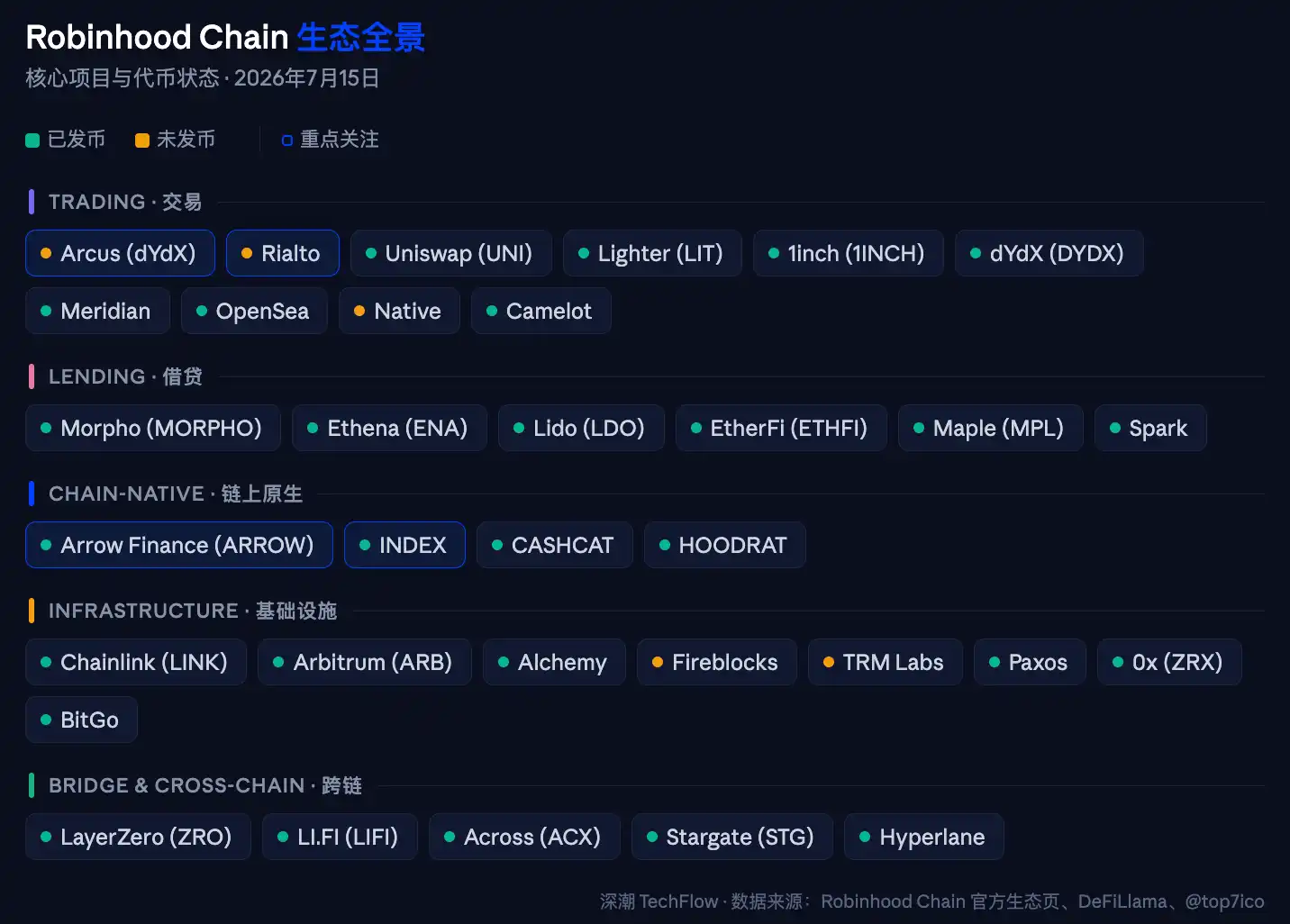
On July 1st, Robinhood launched the public mainnet of Robinhood Chain at the "The World is Flat" event in London. Two weeks later, this Arbitrum tech stack-based Ethereum L2 has gone through a standard cycle of "meme ignition, data peaking, and hype cooling down," and is now entering a critical window for ecosystem development.

According to DeFiLlama data, as of July 15th, Robinhood Chain TVL is approximately $161 million, stablecoin market cap around $327 million (USDG accounts for 68.2%), cumulative DEX trading volume about $3.9 billion, and RWA active market cap roughly $12.4 million. For a two-week-old L2, these figures are not bad, but the structure requires closer examination.

CASHCAT Ignites the First Week, Stories of $85 Turning into $2 Million Drive Daily Active Users to 193,000

The first week's activity on Robinhood Chain was almost entirely driven by a single token: CASHCAT.

The name CASHCAT originates from the alternative name founders Vlad Tenev and Baiju Bhatt once considered for their company. This token was deployed before the mainnet launch. On July 8th, it contributed approximately $98 million in daily DEX volume, with its market cap once surging to $150-170 million. That day, Robinhood Chain's total 24-hour DEX volume reached $560-570 million, briefly surpassing Hyperliquid.

Typical early wealth-creation stories emerged on-chain: one wallet bought CASHCAT for about $85 (0.05 ETH), with its holdings' value peaking at over $2 million; another wallet started with $838, achieving a return exceeding 1180x. These on-chain data, tracked by Lookonchain and Bubblemaps, quickly spread and became the main narrative driving new wallet inflows. On July 8th, there were 141,000 new active wallets, with total daily actives nearing 193,000.

Tenev himself joined the hype. He posted on X platform that Robinhood Chain was "built for RWA, but memes work too."

However, as of July 15th, according to GMGN market data, CASHCAT's market cap has fallen back to around $138 million, down 12% in 24 hours. Other meme coins like HOODRAT and JUGGERNAUT have fallen over 25%. The meme retreat has begun.

Utility-Based Projects Rise Against the Trend: ARROW and INDEX Become New Focal Points

While memes recede, some on-chain native projects with practical product logic are beginning to attract capital.

Arrow Finance (ARROW) is a native CDP (Collateralized Debt Position) protocol on Robinhood Chain. Users can deposit collateral to mint the aUSD stablecoin. Its core difference from typical CDP protocols lies in its collateral scope: besides mainstream crypto assets and stablecoins, Arrow Finance is the first CDP protocol to accept tokenized public stocks and ETFs as collateral. Holders of tokenized stocks can borrow liquidity without selling their stock positions, avoiding taxable events and the need to leave Robinhood Chain.

According to CoinGecko data, ARROW's current market cap is approximately $16 million, with a price of around $1.79, marking an over 10x increase from its starting price of about $0.15 on July 7th. CoinMarketCap shows a higher price of around $2.26. ARROW has launched staking functionality (LP Staking), with trading mainly concentrated on Uniswap V2/V3/V4 (Robinhood Chain).

INDEX is another utility token gaining attention. Public data shows that INDEX surged 160% on the evening of July 14th after gaining attention from Robinhood team members. At the time of writing, its market cap is around $7.36 million. The project's core mechanism involves using trading fees to purchase on-chain stock tokens and distributing them to INDEX holding addresses. This "trading fees → buy stock tokens → distribute" flywheel structure essentially builds a revenue distribution layer on top of Robinhood Chain's stock token ecosystem.

It's important to emphasize that both INDEX and ARROW are extremely early-stage on-chain native projects, with thin liquidity, highly volatile prices, and project information primarily from on-chain data and community dissemination, lacking institutional-level due diligence verification.

Ecosystem Projects with Tokens Issued: Fundamentals vs. On-Chain Performance

Robinhood Chain's initial partner list covers 16 projects. Most already have tokens. For these projects, investor focus lies in their fundamentals and the token's actual utility on Robinhood Chain.

Lighter (LIT): A ZK-powered perpetuals and spot DEX, directly integrated into the Robinhood Wallet. Eligible users can trade perpetual contracts within the wallet. Lighter has committed $11 million worth of LIT tokens to the Robinhood community. Trading earns points (double points for trading via Robinhood Wallet), which can later be converted to LIT. This is currently the most direct points farming channel on Robinhood Chain.

Morpho (MORPHO): A lending protocol hosting the majority of the chain's TVL. In its first week, around $90 million TVL concentrated in Morpho, serving as the underlying infrastructure for the Robinhood Earn product (estimated 7% APY USDG lending). It has insurance coverage from Lloyd's of London and RELM. High TVL concentration in a single protocol is a risk, but also indicates lending demand is not purely speculative.

Chainlink (LINK): As Robinhood Chain's official oracle and cross-chain infrastructure, it provides price data for all Stock Tokens. CCIP, Data Streams, and Data Feeds were deployed on the mainnet from day one.

Arbitrum (ARB): The underlying tech stack for Robinhood Chain. Offchain Labs simultaneously launched a revenue-sharing model: 10% of Robinhood Chain's net protocol fees flow back to the Arbitrum ecosystem (8% to the DAO Treasury, 2% to the Developer Guild). ARB rose about 7.6% after the mainnet launch.

Other partners with existing tokens include Uniswap (UNI), LayerZero (ZRO), 1inch (1INCH), etc. These projects have real deployments on Robinhood Chain, but their token price drivers are not primarily from Robinhood Chain.

Projects Without Tokens: Interaction Paths and Airdrop Expectations

Four projects on the partner list have not yet conducted a TGE. Among them, TRM Labs (compliance & risk control) and Fireblocks (MPC infrastructure) are more B2B-focused, offering little participation entry for retail users. The real interaction opportunities lie with Arcus and Rialto.

Arcus: Incubated by dYdX Labs and co-built with Robinhood Crypto, which has also invested an undisclosed amount. CEO is Eddie Zhang, previously founder of social trading app Pocket Protector (acquired by dYdX Labs in July 2025). dYdX founder Antonio Juliano has joined Arcus's board.

Arcus currently offers zero-fee spot trading for 95 Stock Tokens, operating 24/7 across 120+ countries (excluding the US, Canada, UK). 35 RWA perpetual contracts are still in a waitlist stage, with plans to open a Pre-IPO market.

Regarding tokens, dYdX explicitly stated in its announcement: future Arcus tokens will be prioritized for distribution to users who trade, stake, or validate on dYdX. In other words, there are two potential interaction paths for an Arcus airdrop. One is accumulating trading, staking, and validation history on dYdX Chain; the other is directly trading Stock Tokens on Arcus (currently zero fees, making interaction cost extremely low). The issuance timeline is undetermined.

Market reaction to the Arcus launch was mixed: DYDX token fell about 23% in 24 hours (traders concerned about resource diversion), while Robinhood stock (HOOD) rose over 10% during the same period.

Rialto: A stealth-mode launched, all-asset-class on-chain spot exchange supporting 24/7 trading of cryptocurrencies, Stock Tokens, ETFs, commodities, and Pre-IPO assets. The team has backgrounds in hedge funds, HFT, and market making.

Rialto's core differentiation is its PropAMM (Proactive Automated Market Maker) engine "Rivo Altus." Unlike passive AMMs, PropAMM is powered by the team's own inventory and proprietary pricing logic for on-chain market making. Using Arbitrum's Stylus infrastructure, it deploys the market-making logic directly on-chain, aiming for execution quality close to centralized exchanges.

Rialto has no token plans announced yet, but has launched a referral program: unlock a referral code after reaching $10,000 in cumulative trading volume; referrers earn 10% of the referee's fees. New exchanges on fresh chains using referral programs and volume accumulation to filter early users before a potential token launch is a common pre-airdrop signal. Initial listing covers 90+ Robinhood Stock Tokens and mainstream crypto assets.

Structural Issues with Robinhood Chain

Two weeks of data reveal a hard-to-ignore fact: on-chain TVL is highly concentrated in Morpho, DEX volume heavily relies on meme speculation, and RWA active market cap is only about $12.4 million. Robinhood Chain's narrative is "financial infrastructure," but so far, the most actively traded asset on-chain is a cat meme coin.

The actual on-chain activity of Stock Tokens also falls far below expectations. According to SQD's on-chain data analysis, during the mainnet's early stages, only 24 Stock Tokens and ETF tokens had any on-chain transfers, totaling 313 transactions, accounting for a mere 0.27% of all ERC-20 transfers on the chain. The real trading demand for tokenized stocks on-chain has yet to be validated.

The 90-day gas fee waiver period is another variable. The current trading activity on Robinhood Chain benefits from gas subsidies. The retention rate after the subsidy ends will be a key window to judge the ecosystem's true stickiness.


Kripto yang Sedang Tren

Pertanyaan Terkait

QWhat is the current focus of activity on Robinhood Chain after the initial meme coin frenzy subsided?

AAfter the meme coin (e.g., CASHCAT) frenzy subsided, activity on Robinhood Chain is shifting towards utility-focused projects. Examples include Arrow Finance (ARROW), a CDP protocol that accepts tokenized stocks as collateral, and INDEX, a token that allocates trading fees to purchase and distribute stock tokens to holders.

QWhich two key projects in the Robinhood Chain ecosystem have not yet launched a token, presenting potential early interaction and airdrop opportunities?

ATwo key projects in the Robinhood Chain ecosystem that have not yet launched a token are Arcus (a stock/RWA trading platform incubated by dYdX Labs) and Rialto (a multi-asset spot DEX with a proprietary PropAMM engine). These represent potential early interaction and airdrop opportunities for users.

QWhat are the structural issues highlighted for Robinhood Chain after its first two weeks of operation?

AKey structural issues highlighted for Robinhood Chain include: highly concentrated TVL in the Morpho lending protocol, DEX trading volume heavily dependent on meme coin speculation, and low actual on-chain activity for its flagship Stock Tokens (only 0.27% of ERC-20 transfers). The chain's real-world asset (RWA) narrative is not yet matched by significant on-chain trading demand for tokenized stocks.

QHow did the launch of Arcus affect the prices of DYDX and HOOD (Robinhood stock)?

AThe market reaction to the Arcus launch was divergent. The DYDX token price dropped approximately 23% within 24 hours, likely due to trader concerns about resource diversion from the dYdX chain. Conversely, Robinhood's stock (HOOD) rose over 10% in the same period.

QWhat is the unique mechanism of the INDEX token on Robinhood Chain?

AThe INDEX token's core mechanism involves using trading fees generated from its associated platform to purchase on-chain stock tokens. These purchased stock tokens are then distributed to INDEX token holders. This creates a 'flywheel' effect where trading activity funds the acquisition and distribution of real-world asset (RWA) exposure.

Bacaan Terkait

Trading

Spot

Artikel Populer

Apa Itu MEME 2.0

Memecoin 2.0: Kebangkitan $MEME 2.0 di Dunia Cryptocurrency Pendahuluan Dalam lanskap cryptocurrency yang terus berkembang, sebuah pesaing baru telah muncul. Memecoin 2.0, yang disimbolkan sebagai $MEME 2.0, membawa konsep koin meme ke tingkat yang menarik. Sebagai produk sampingan dari Memecoin yang asli, proyek ini telah menarik perhatian komunitas kripto dengan mengalihkan fokus dari insentif finansial yang biasa ke pengalaman yang menarik dan menghibur. Beroperasi di blockchain Ethereum, Memecoin 2.0 dengan berani mendefinisikan kembali keterlibatan komunitas di ranah kripto. Apa itu Memecoin 2.0, $MEME 2.0? Pada intinya, Memecoin 2.0 adalah proyek cryptocurrency yang memprioritaskan semangat komunitas dan kesenangan yang terkait dengan budaya meme. Berbeda dengan cryptocurrency konvensional, yang berkonsentrasi pada kasus penggunaan praktis dan manfaat yang nyata, Memecoin 2.0 membedakan dirinya dengan menerima sisi yang lebih ringan dari mata uang digital. Proyek ini ada tanpa janji utilitas, peta jalan yang terstruktur, atau pengembalian finansial, tetapi lebih fokus pada pengembangan komunitas yang dinamis yang berpusat pada meme dan kesenangan yang dibagikan. Dengan melakukan hal ini, proyek ini memanfaatkan tren budaya meme yang berkembang di ruang online, menjadikannya pemain yang unik di dunia aset digital. Pencipta Memecoin 2.0, $MEME 2.0 Meskipun telah dilakukan penelitian mendalam tentang asal-usul Memecoin 2.0, identitas eksplisit penciptanya tetap tidak diketahui. Anonimitas ini tidak jarang terjadi di komunitas kripto, di mana banyak proyek dipimpin oleh individu atau kelompok yang lebih memilih untuk tetap berada di belakang layar. Kurangnya informasi yang tersedia untuk umum mengenai pencipta proyek ini dapat dipandang sebagai langkah strategis, menyoroti keterlibatan komunitas daripada ketenaran individu dalam ruang ini. Investor Memecoin 2.0, $MEME 2.0 Informasi mengenai para investor atau dukungan finansial untuk Memecoin 2.0 jarang ditemui. Ketidakadaan detail ini mungkin menunjukkan bahwa proyek ini didanai sendiri atau bahwa fokusnya pada komunitas daripada struktur investasi tradisional telah menarik jenis pendukung yang berbeda. Karena dunia koin meme biasanya melibatkan lebih banyak keterlibatan akar rumput daripada investasi institusional, pendekatan ini sejalan dengan etos proyek yang digerakkan oleh komunitas. Bagaimana Memecoin 2.0, $MEME 2.0 Bekerja? Memecoin 2.0 beroperasi sepenuhnya di blockchain Ethereum, memanfaatkan fitur keamanan dan skalabilitas yang kuat. Dengan memanfaatkan kekuatan Ethereum, Memecoin 2.0 dapat menawarkan lingkungan yang aman untuk interaksi pengguna sambil memastikan bahwa transaksi efisien dan hemat biaya. Salah satu atribut unik dari Memecoin 2.0 terletak pada strukturnya yang digerakkan oleh komunitas. Nilai dan popularitas token $MEME 2.0 berasal dari partisipasi aktif penggunanya, bukan dari utilitas yang melekat. Desain ini memperkuat fokus proyek pada aspek hiburan dari cryptocurrency, menunjukkan bahwa tawa dan keterlibatan komunitas adalah mata uang sejati yang mendorong kesuksesannya. Selain itu, proyek ini cocok dalam ekosistem yang lebih luas dari koin meme, di mana nilai setiap koin meme berfluktuasi berdasarkan budaya, tren, dan keterlibatan komunitas daripada prinsip ekonomi tradisional. Garis Waktu Memecoin 2.0, $MEME 2.0 Untuk lebih memahami evolusi dan tonggak sejarah Memecoin 2.0, berikut adalah garis waktu yang menyoroti peristiwa signifikan dalam sejarahnya: 2024: Proses penciptaan Memecoin 2.0 diakui sebagai cabang dari Memecoin yang asli, menetapkan dirinya di dalam konteks koin meme yang berkembang pesat sambil beroperasi di blockchain Ethereum. 13 Juli 2024: Memecoin 2.0 secara resmi memposisikan dirinya sebagai koin meme yang berfokus pada komunitas di jaringan Ethereum, menekankan pendekatan yang berfokus pada hiburan yang mengundang pengguna untuk terlibat dan berpartisipasi dalam pertumbuhannya. Poin Kunci Tentang Memecoin 2.0, $MEME 2.0 Beberapa karakteristik penting yang mendefinisikan Memecoin 2.0: Pendekatan Berfokus pada Komunitas: Misi utama Memecoin 2.0 adalah menciptakan pengalaman komunitas yang menyenangkan dan menarik, memanfaatkan kesenangan kolektif yang bersumber dari budaya memetik. Dibangun di atas Ethereum: Beroperasi di blockchain Ethereum memberikan proyek ini infrastruktur penting yang memastikan keamanan dan skalabilitas. Kurangnya Utilitas atau Peta Jalan: Dalam suatu perubahan yang mencolok dari cryptocurrency tradisional, Memecoin 2.0 tidak menjanjikan fitur utilitarian atau pengembalian finansial, menegaskan kembali komitmennya terhadap keterlibatan komunitas dan interaksi sosial. Fokus pada Budaya Memetik: Dengan menerima aspek humor dan budaya dari fenomena meme, Memecoin 2.0 menyediakan platform bagi pengguna untuk terlibat dengan kripto secara offline dan online. Konteks Tambahan: Signifikansi Koin Meme Koin meme telah muncul sebagai kelas cryptocurrency yang berbeda, sering kali didorong oleh humor dan pendekatan ringan terhadap perdagangan. Koin-koin ini umumnya tidak memiliki utilitas signifikan atau peta jalan pengembangan, menarik pengguna dengan janji kesenangan, interaksi komunitas, dan relevansi budaya. Dalam lanskap ekosistem kripto yang lebih luas, koin meme menghidupkan kembali pentingnya keterlibatan komunitas, menolak pendekatan yang hanya berorientasi keuntungan. Proyek-proyek seperti Memecoin 2.0 membuka era di mana hiburan dapat harmonis dengan aspirasi finansial, menjadikan blockchain sebagai taman bermain untuk kreativitas dan interaksi sosial. Kesimpulan Memecoin 2.0, atau $MEME 2.0, mewujudkan gelombang baru cryptocurrency yang memprioritaskan keterlibatan komunitas di atas struktur finansial yang kaku. Dengan fokus pada humor dan interaksi sosial, proyek ini memanfaatkan daya tarik yang mengelilingi budaya meme. Dengan beroperasi di blockchain Ethereum, Memecoin 2.0 memanfaatkan kemampuan teknologi sambil tetap teguh dalam komitmennya terhadap nilai hiburan dari mata uang digital. Seiring ruang seputar cryptocurrency terus berkembang, Memecoin 2.0 menjadi sebuah bukti bahwa masa depan aset digital mungkin sangat bergantung pada pengalaman bersama, tawa, dan hubungan komunitas yang kuat. Di dunia kripto yang tidak dapat diprediksi, mungkin kebahagiaan dapat sama berharganya dengan keuntungan finansial tradisional.

177 Total TayanganDipublikasikan pada 2024.04.04Diperbarui pada 2024.12.03

Apa Itu MEME 2.0

Cara Membeli MEME

Selamat datang di HTX.com! Kami telah membuat pembelian Memeland (MEME) menjadi mudah dan nyaman. Ikuti panduan langkah demi langkah kami untuk memulai perjalanan kripto Anda.Langkah 1: Buat Akun HTX AndaGunakan alamat email atau nomor ponsel Anda untuk mendaftar akun gratis di HTX. Rasakan perjalanan pendaftaran yang mudah dan buka semua fitur.Dapatkan Akun SayaLangkah 2: Buka Beli Kripto, lalu Pilih Metode Pembayaran AndaKartu Kredit/Debit: Gunakan Visa atau Mastercard Anda untuk membeli Memeland (MEME) secara instan.Saldo: Gunakan dana dari saldo akun HTX Anda untuk melakukan trading dengan lancar.Pihak Ketiga: Kami telah menambahkan metode pembayaran populer seperti Google Pay dan Apple Pay untuk meningkatkan kenyamanan.P2P: Lakukan trading langsung dengan pengguna lain di HTX.Over-the-Counter (OTC): Kami menawarkan layanan yang dibuat khusus dan kurs yang kompetitif bagi para trader.Langkah 3: Simpan Memeland (MEME) AndaSetelah melakukan pembelian, simpan Memeland (MEME) di akun HTX Anda. Selain itu, Anda dapat mengirimkannya ke tempat lain melalui transfer blockchain atau menggunakannya untuk memperdagangkan mata uang kripto lainnya.Langkah 4: Lakukan trading Memeland (MEME)Lakukan trading Memeland (MEME) dengan mudah di pasar spot HTX. Cukup akses akun Anda, pilih pasangan perdagangan, jalankan trading, lalu pantau secara real-time. Kami menawarkan pengalaman yang ramah pengguna baik untuk pemula maupun trader berpengalaman.

542 Total TayanganDipublikasikan pada 2024.12.12Diperbarui pada 2026.06.02

Cara Membeli MEME

Diskusi

Selamat datang di Komunitas HTX. Di sini, Anda bisa terus mendapatkan informasi terbaru tentang perkembangan platform terkini dan mendapatkan akses ke wawasan pasar profesional. Pendapat pengguna mengenai harga MEME (MEME) disajikan di bawah ini.

活动图片