Strategy's Accounting Gimmick: The Cap on BTC Sales Far Exceeds $1.25 Billion

Odaily星球日报Dipublikasikan tanggal 2026-07-10Terakhir diperbarui pada 2026-07-10

Abstrak

The article, originally from Bankless, discusses how MicroStrategy's (MSTR) recent Bitcoin (BTC) sales reveal a much larger potential selling capacity than the widely reported $1.25 billion "reserve-building" cap. On July 7, MicroStrategy disclosed a sale of 3,588 BTC (~$216M) to pay dividends for its STRAT (STRC) preferred shares and replenish its USD Reserve. Crucially, the company stated this sale did not count against its stated $1.25 billion "reserve-building capacity." The analysis explains that MicroStrategy's "BTC Monetization Plan," part of its broader "Digital Credit Capital Framework," actually outlines three main purposes for selling BTC, only one of which has the $1.25B cap: 1. **Building the USD Reserve** (capped at $1.25B). 2. **Covering preferred share/ debt costs** (replenishing the reserve after payments). 3. **Funding buybacks** (up to $10B for preferred shares and $10B for MSTR common stock). The key nuance is the accounting distinction between "building" the reserve (selling BTC before making payments) and "replenishing" it (selling BTC after using reserve funds for payments). While functionally the same—converting BTC to cash for obligations—only "building" counts against the publicized $1.25B limit. This means sales for "replenishing" and the $20B+ buyback pool allow for total potential sales exceeding $30B. The article frames this as part of MicroStrategy's shift from a simple "buy and hold" Bitcoin narrative to an "active capital management" mo...

This article is from:Bankless

Compiled by|Odaily Planet Daily (@OdailyChina); Translator|Azuma (@azuma_eth)

On July 7th, Strategy disclosed that the company sold 3,588 BTC between June 29th and July 5th, worth approximately $216 million.

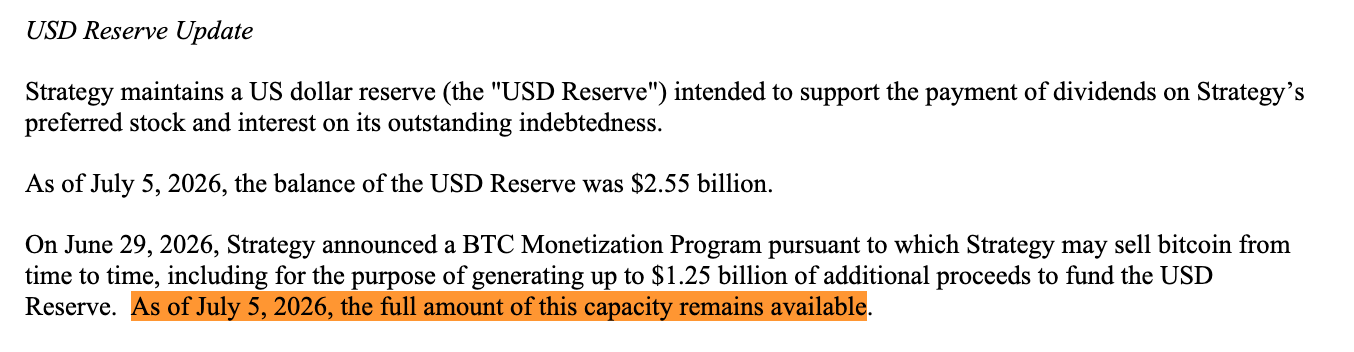
These funds were used to pay STR C dividends and replenish the USD Reserve previously used for dividend payments. Despite completing this sale, Strategy stated that its full $1.25 billion reserve-building capacity remains intact.

  • Odaily Note: In the "self-help plan" announced last week, Strategy had indicated it authorized the company to sell BTC to build a USD reserve of up to $1.25 billion.

In other words, the $216 million worth of BTC sold to replenish the reserve is not counted against the previously disclosed reserve-building capacity.

Strictly speaking, there is a technical distinction: one is "replenishing," and the other is "building." However, in practice, both types of sales ultimately flow into the same reserve pool for the same purpose, just categorized for different uses.

From another perspective, the previously disclosed "BTC Monetization Program" never limited Strategy to selling only $1.25 billion worth of Bitcoin in total; it only capped one specific funding pool — the sale of BTC to "build" the USD reserve.

The plan also permits Strategy to sell BTC for other purposes, which is exactly what we are seeing now.
Three Funding Pools

On June 29th, after weeks of pressure on MSTR and STR C, Strategy launched the aforementioned BTC "Monetization Program" as part of its broader "Digital Credit Capital Framework."

This plan allows Strategy to sell Bitcoin and actually mentions three primary uses:

  • First, to Build the reserve: Sell up to $1.25 billion worth of BTC to establish a USD Reserve.
  • Second, to Cover the preferreds: Sell BTC to cover Strategy's fixed dividend and interest obligations on its preferred shares and debt. If management deems it "more advantageous to sell BTC than issue common stock," they may also sell BTC to replenish reserve funds previously used to cover these obligations.
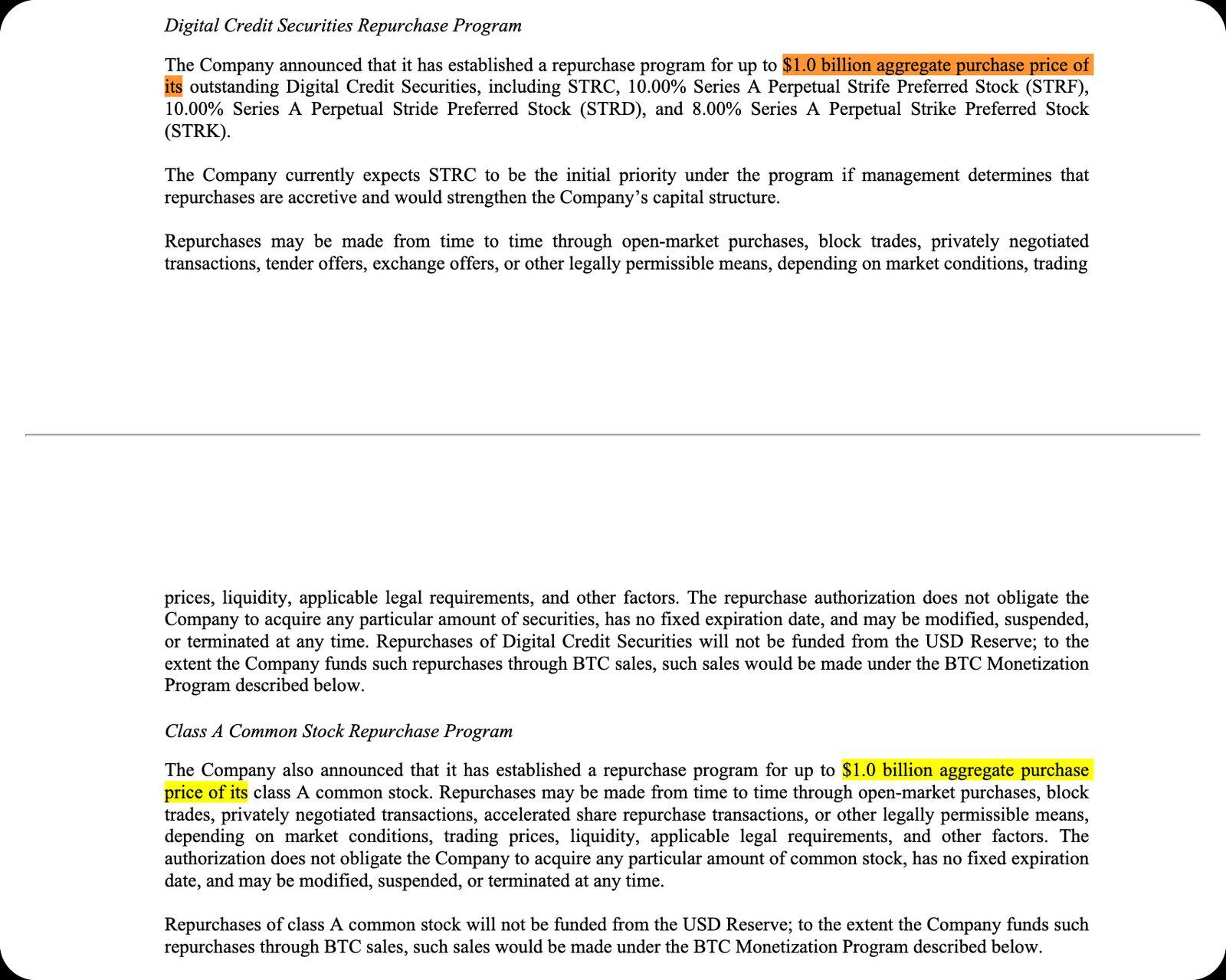
  • Third, to Fund buybacks: Sell BTC to repurchase up to $1 billion worth of preferred shares and up to $1 billion worth of MSTR common stock. Additionally, proceeds from BTC sales may also cover related taxes, fees, and other expenses.

At the time, the entire market discussion focused on the $1.25 billion cap for the first funding pool, but the reality is far more complex.

Looking solely at the third pool, it adds an additional $2 billion in potential sales. Therefore, even calculating only the parts with explicit caps, Strategy's currently designed BTC sale plan already exceeds $3 billion. This does not include the funding pool for paying dividends, interest, and replenishing the reserve — for which there is no disclosed cap.
Building vs. Replenishing

This is where it gets truly subtle.

The purpose of the USD Reserve is to pay these preferred share dividends and debt interest obligations. Under the current policy framework, it cannot be used for stock buybacks.

As of June 28th, Strategy's USD Reserve stood at $2.55 billion, sufficient to cover the company's annual obligations of approximately $1.76 billion for debt and preferred shares, providing about 17 months of coverage. The board has set a minimum requirement to maintain 12 months of coverage unless board-approved reductions occur.

This is why the distinction between "building" and "replenishing" the reserve is noteworthy.

  • Selling BTC before paying dividends to add cash to the reserve: This is defined as "building."
  • Using the reserve to pay dividends, then selling BTC to refill the reserve: This is defined as "replenishing."

The plan treats these as different categories, but they essentially accomplish the same thing — converting BTC into cash to cover preferred share dividends and interest payments.

These details were already disclosed in the documents, but the recent sale made this categorical distinction more apparent. Strategy sold $216 million worth of BTC, using the funds to pay dividends and replenish the reserve, while simultaneously announcing that its $1.25 billion reserve-building capacity remains intact.

Now, the market needs to start understanding Strategy's "proprietary language": "Building" and "replenishing" are essentially accounting classifications, but they determine whether Strategy's BTC sales count against the "public cap" the market sees.

From Hoarding to Active Capital Management

In the June 29th announcement, Michael Saylor stated that this framework reflects Strategy's need for "liquidity, discipline, and active capital management."

Strategy CEO Phong Le was more direct: "Strategy is shifting from a one-way capital issuance model to an active capital management model."

As Matt Walsh and Jeff Dorman from Castle Island explained in a podcast last week, Strategy has essentially evolved into an actively managed hedge fund.

The past Strategy narrative was simple: sell MSTR stock → buy Bitcoin → provide investors with leveraged BTC exposure. But the logic has now changed.

Today, Strategy is buying and selling different components within its own capital structure to manage the pressures between common stock (MSTR), preferred shares, the USD Reserve, and Bitcoin assets (BTC).

This dynamic also introduces new conflicts of interest. Walsh and Dorman pointed out:

  • Selling common stock can support preferred share dividends but depress MSTR's premium relative to its underlying BTC holdings.
  • Selling Bitcoin can extend the cash runway but further erode the core "never sell" narrative.
  • Supporting the preferred share system can maintain market confidence but depletes cash reserves.
  • Cutting preferred share dividends can protect liquidity but may cause preferred share prices to crash.

The so-called "reserve loophole" is an embodiment of this shift. Bitcoin is no longer just an asset for Strategy to accumulate; it is becoming a balance-sheet lever used to keep the preferred share system operational.

What We Will Ultimately See

Now, investors must assess Saylor's ability to operate this "machine" — each adjustment to one lever in the capital structure helps one part while potentially threatening another.

This is the most significant takeaway following the July 6th filing disclosure. Strategy is not out of options. It likely has more room to maneuver than what is apparent on the surface.

Don't continue to mistakenly believe that the $1.25 billion cap represents the total ceiling for Strategy's Bitcoin sales.

Today, Strategy has become an institution that the market must relearn to understand. Now, every proprietary term matters more:

  • Build
  • Replenish
  • Issue
  • Repurchase
  • Defend

Just as Fed watchers parse every punctuation mark in policy statements, the market must also deconstruct every term Strategy uses to gauge what it implies for future BTC sales.

By rolling out this plan, Strategy has secured greater flexibility for itself, but the underlying contradictions persist. This is no longer a simple "leveraged Bitcoin play." It has now become a bet on active capital management prowess.

Can Strategy consistently manage to "sell BTC," "replenish reserves," "issue securities," "repurchase stock," and "maintain the capital structure" without any one action undermining the others?

Personally, I wouldn't want to bet on it.

Kripto yang Sedang Tren

Pertanyaan Terkait

QWhat are the three main purposes for which MicroStrategy's BTC Monetization Program allows the company to sell Bitcoin, according to the article?

AAccording to the article, MicroStrategy's BTC Monetization Program allows the company to sell Bitcoin for three main purposes: 1) To build a USD reserve (up to $1.25 billion). 2) To cover the costs of preferred shares and debt (covering fixed dividend and interest obligations). 3) To fund buyback programs (up to $1 billion for preferred shares and up to $1 billion for MSTR common stock).

QWhat is the key difference between 'building' and 'replenishing' the USD reserve, and why is this distinction important in understanding MicroStrategy's potential Bitcoin sales?

AThe key difference is an accounting classification. 'Building' refers to selling BTC and adding cash to the USD reserve *before* using it to pay obligations. 'Replenishing' refers to using the reserve cash to pay obligations (like dividends) first and *then* selling BTC to refill the reserve. This distinction is crucial because the publicly announced $1.25 billion cap applies only to 'building' the reserve. Sales for 'replenishing' do not count against this public limit, meaning the total potential BTC sales for reserve purposes is effectively uncapped.

QAccording to the article, what is the new narrative for MicroStrategy, shifting away from its previous simple model?

AThe article states that MicroStrategy's narrative has shifted from a simple model of 'selling MSTR stock → buying Bitcoin → providing leveraged BTC exposure' to becoming an 'actively managed hedge fund.' It is now actively buying and selling different components of its capital structure (common stock, preferred shares, USD reserve, Bitcoin assets) to manage the pressure and conflicts between them.

QWhat core conflict or dilemma does the article highlight regarding MicroStrategy's use of Bitcoin as a 'balance-sheet lever'?

AThe article highlights that Bitcoin is no longer just an asset for perpetual accumulation but has become a 'balance-sheet lever' used to maintain the preferred share system. This creates a core conflict: selling Bitcoin can extend cash flow and support the preferred share system, but it simultaneously weakens the foundational 'never sell' narrative that was central to the company's original investment thesis.

QWhat is the main conclusion or warning the article provides to investors regarding the $1.25 billion reserve-building capacity?

AThe main conclusion and warning is that investors should not mistake the $1.25 billion reserve-building capacity as the total upper limit for MicroStrategy's Bitcoin sales. When including the other authorized purposes (like funding buybacks and covering obligations without a stated cap), the designed potential sales exceed $3 billion, and sales for 'replenishing' the reserve are effectively unlimited within the framework. The company has given itself far more flexibility to sell BTC than the headline $1.25 billion figure suggests.

Bacaan Terkait

Kes Perceraian Chey Tae-won Selesai: Mengungkap Garis Suksesi Tersembunyi di Balik Kerajaan Triliunan SK Hynix

Kasus perceraian Ketua SK Group, Choi Tae-won, akhirnya diputuskan, mengungkap garis suksesi tersembunyi di balik kerajaan triliunan won SK Hynix. Artikel ini menjelaskan perjalanan ketiga anaknya sebagai generasi penerus ketiga dalam keluarga Chaebol Korea Selatan yang tidak mengikuti skenario tradisional. Anak tertua, **Choi Yun-jung**, dianggap sebagai kandidat penerus yang paling jelas. Berpendidikan tinggi di bidang biologi dan informatika biomedis, dia memegang posisi eksekutif di SK Inc., mengelola perencanaan jangka panjang dan ekspansi global. Pernikahannya dengan pendiri startup infrastruktur AI mencerminkan pergeseran dari pernikahan dinasti tradisional. Anak kedua, **Choi Min-jung**, memiliki koneksi mendalam dengan SK Hynix, Washington, dan jaringan militer. Sebagai veteran Angkatan Laut Korea yang pernah bertugas di Teluk Aden, dia bekerja di divisi kebijakan internasional SK Hynix sebelum mendirikan startup perawatan kesehatan berbasis AI di AS. Dia menikahi mantan perwira Korps Marinir AS, menguatkan hubungannya dengan lingkungan geopolitik tempat perusahaan semikonduktor beroperasi. Putra satu-satunya, **Choi In-geun**, adalah yang paling sesuai dengan profil penerus tradisional namun justru paling diam. Setelah bekerja di SK E&S, dia kini berkarier di McKinsey Seoul, sebuah langkah yang dianggap sebagai pelatihan eksternal standar, bukan pernyataan suksesi. Kasus perceraian orang tua mereka, dengan tuntutan pembagian aset mencapai triliunan won, juga membawa ketiganya ke dalam narasi publik melalui berkas hukum. Sementara SK Hynix melonjak menjadi aset geopolitik global di era AI, ketiga anak ini tidak mewarisi jawaban sederhana, melainkan serangkaian tantangan kompleks industri AI global. Pewarisan bagi mereka bukan lagi sekadar masalah keluarga, melainkan uji kelayakan publik di panggung dunia baru.

marsbit2 hari yang lalu 09:11

Kes Perceraian Chey Tae-won Selesai: Mengungkap Garis Suksesi Tersembunyi di Balik Kerajaan Triliunan SK Hynix

marsbit2 hari yang lalu 09:11

2 Bulan, Valuasi Melonjak dari 88 Miliar Jadi 680 Miliar! OpenRouter, 'Stasiun Transit' AI Terbesar, Akan Diakuisisi

Stripe, pemroses pembayaran terbesar di dunia, dilaporkan sedang dalam negosiasi untuk mengakuisisi OpenRouter, pasar yang menghubungkan lebih dari 400 model AI besar, dengan harga sekitar 100 miliar USD. Harga ini mencerminkan lonjakan valuasi hampir 7 kali lipat dari 13 miliar USD dua bulan lalu. OpenRouter berfungsi sebagai lapisan perantara atau "mesin perbandingan harga" yang memungkinkan pengembang mengakses berbagai model AI (seperti GPT, Claude, atau model open-source) melalui satu API. Platform ini secara otomatis mencocokkan permintaan pengguna dengan model terbaik berdasarkan kompleksitas tugas, biaya, dan kecepatan, membantu aplikasi AI mengoptimalkan biaya tanpa mengubah pengalaman pengguna. Didirikan pada 2023 oleh Alex Atallah (salah satu pendiri OpenSea) dan Louis Vichy, OpenRouter telah mencatat pertumbuhan pesat dengan pendapatan tahunan mencapai 50 juta USD per April 2025. Akuisisi ini merupakan bagian dari strategi Stripe untuk memperluas infrastruktur ekonomi AI. Pada akhir 2025, mereka mengakuisisi Metronome, platform penagihan berbasis penggunaan. Dengan menggabungkan OpenRouter (pemilihan dan perutean model) dan Metronome (penagihan), Stripe bertujuan menawarkan solusi terpadu—dari pemilihan model, penagihan sesuai pemakaian, hingga pembayaran—bagi bisnis yang menggunakan AI. Langkah ini memperkuat posisi Stripe sebagai "pusat kendali" dalam alur kerja AI. Meski transaksi berpotensi diumumkan dalam sebulan, negosiasi masih bisa gagal.

链捕手2 hari yang lalu 09:03

2 Bulan, Valuasi Melonjak dari 88 Miliar Jadi 680 Miliar! OpenRouter, 'Stasiun Transit' AI Terbesar, Akan Diakuisisi

链捕手2 hari yang lalu 09:03

Trading

Spot

Artikel Populer

Cara Membeli CAP

Selamat datang di HTX.com! Kami telah membuat pembelian Cap (CAP) menjadi mudah dan nyaman. Ikuti panduan langkah demi langkah kami untuk memulai perjalanan kripto Anda.Langkah 1: Buat Akun HTX AndaGunakan alamat email atau nomor ponsel Anda untuk mendaftar akun gratis di HTX. Rasakan perjalanan pendaftaran yang mudah dan buka semua fitur.Dapatkan Akun SayaLangkah 2: Buka Beli Kripto, lalu Pilih Metode Pembayaran AndaKartu Kredit/Debit: Gunakan Visa atau Mastercard Anda untuk membeli Cap (CAP) secara instan.Saldo: Gunakan dana dari saldo akun HTX Anda untuk melakukan trading dengan lancar.Pihak Ketiga: Kami telah menambahkan metode pembayaran populer seperti Google Pay dan Apple Pay untuk meningkatkan kenyamanan.P2P: Lakukan trading langsung dengan pengguna lain di HTX.Over-the-Counter (OTC): Kami menawarkan layanan yang dibuat khusus dan kurs yang kompetitif bagi para trader.Langkah 3: Simpan Cap (CAP) AndaSetelah melakukan pembelian, simpan Cap (CAP) di akun HTX Anda. Selain itu, Anda dapat mengirimkannya ke tempat lain melalui transfer blockchain atau menggunakannya untuk memperdagangkan mata uang kripto lainnya.Langkah 4: Lakukan trading Cap (CAP)Lakukan trading Cap (CAP) dengan mudah di pasar spot HTX. Cukup akses akun Anda, pilih pasangan perdagangan, jalankan trading, lalu pantau secara real-time. Kami menawarkan pengalaman yang ramah pengguna baik untuk pemula maupun trader berpengalaman.

91 Total TayanganDipublikasikan pada 2026.06.26Diperbarui pada 2026.06.26

Cara Membeli CAP

Diskusi

Selamat datang di Komunitas HTX. Di sini, Anda bisa terus mendapatkan informasi terbaru tentang perkembangan platform terkini dan mendapatkan akses ke wawasan pasar profesional. Pendapat pengguna mengenai harga CAP (CAP) disajikan di bawah ini.

活动图片