Google Shaken, Market Cap Evaporates Hundreds of Billions. Can Gemini Spark Save the Day?

marsbitDipublikasikan tanggal 2026-07-01Terakhir diperbarui pada 2026-07-01

Abstrak

Google is facing a turbulent period marked by a significant brain drain of top AI talent. Key figures like Noam Shazeer, John Jumper, Jonas Adler, and Alexander Pritzel have recently left for competitors OpenAI and Anthropic, causing investor concern and a sharp stock decline wiping hundreds of billions from Alphabet's market cap. Amidst this talent exodus and the delayed launch of the anticipated Gemini 3.5 Pro model, Google has unveiled its major new offering: Gemini Spark. This is not a standard chatbot but a persistent, cloud-based AI agent designed to automate multi-step workflows across Google's ecosystem (Gmail, Calendar, Docs, Drive, etc.) and some third-party apps. Powered by the Antigravity framework with Tasks, Skills, and Schedules, it aims to function as a continuous digital assistant. However, its high price point—exclusive to the $100/month AI Ultra tier—has drawn criticism. The article positions Spark as Google's critical, albeit late, move into the AI agent arena, where AI transitions from a tool to an autonomous workforce. While competitors and startups are already advancing in this space, Google's vast integration with Workspace gives it a potential edge, though its historical caution due to scale and risk may have cost it the lead. Ultimately, Spark represents a necessary shift for Google, but the question remains whether this "digital employee" can compensate for the loss of foundational talent and restore investor confidence in the company's future.

Recently, morale is low at Google, with the company seemingly on shaky ground.

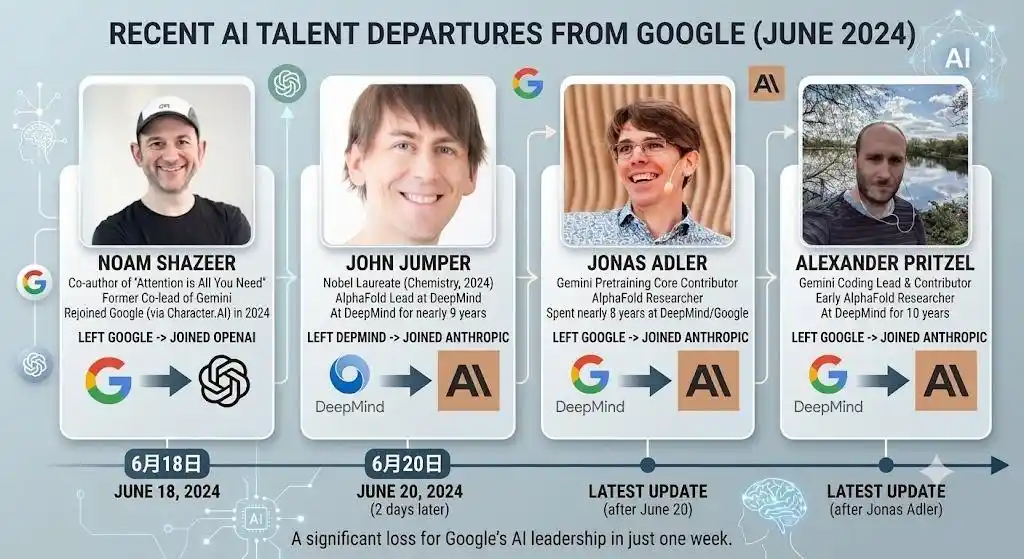
On June 18th, Noam Shazeer, one of the original eight authors of the 'Attention Is All You Need' paper, announced his departure from Google for OpenAI. In 2024, Google spent approximately $2.7 billion to bring him back, placing him in the role of co-lead for Gemini. In less than two years, he's gone again.

Two days later, John Jumper also left, heading to Anthropic. He is a 2024 Nobel Laureate in Chemistry, the lead developer of AlphaFold, and had been at DeepMind for nearly nine years.

Then came Jonas Adler and Alexander Pritzel, core contributors to Gemini's pre-training and programming directions, who also worked on AlphaFold. The latest news: these two are also preparing to join Anthropic.
If these were just ordinary resignations, Google could certainly withstand them.

The problem is, these four individuals each represent crucial nerve centers in the field of large models: architecture, science, programming, and pre-training.

The capital market's reaction was swift and direct, voting with its feet. On June 22nd, Alphabet's stock price fell 5% to 6% over two days, wiping hundreds of billions of dollars from its market capitalization.
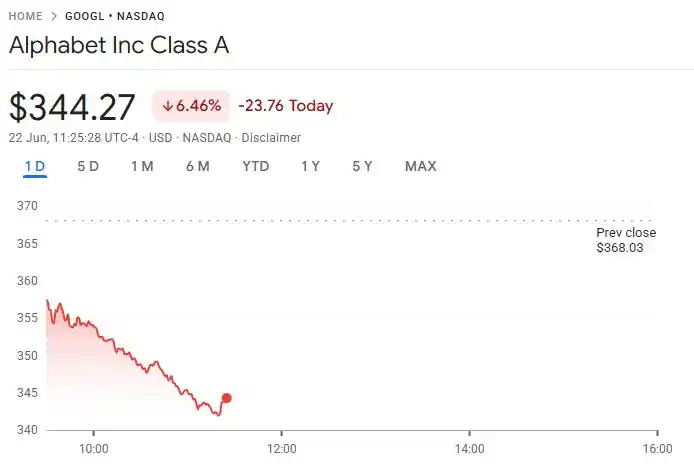
What investors fear isn't a specific product; it's something more fundamental: can Google still retain the people who built its most important creations?

Making things more awkward, during the very same month this brain drain occurred, Google served up its long-brewed new card: Gemini Spark.
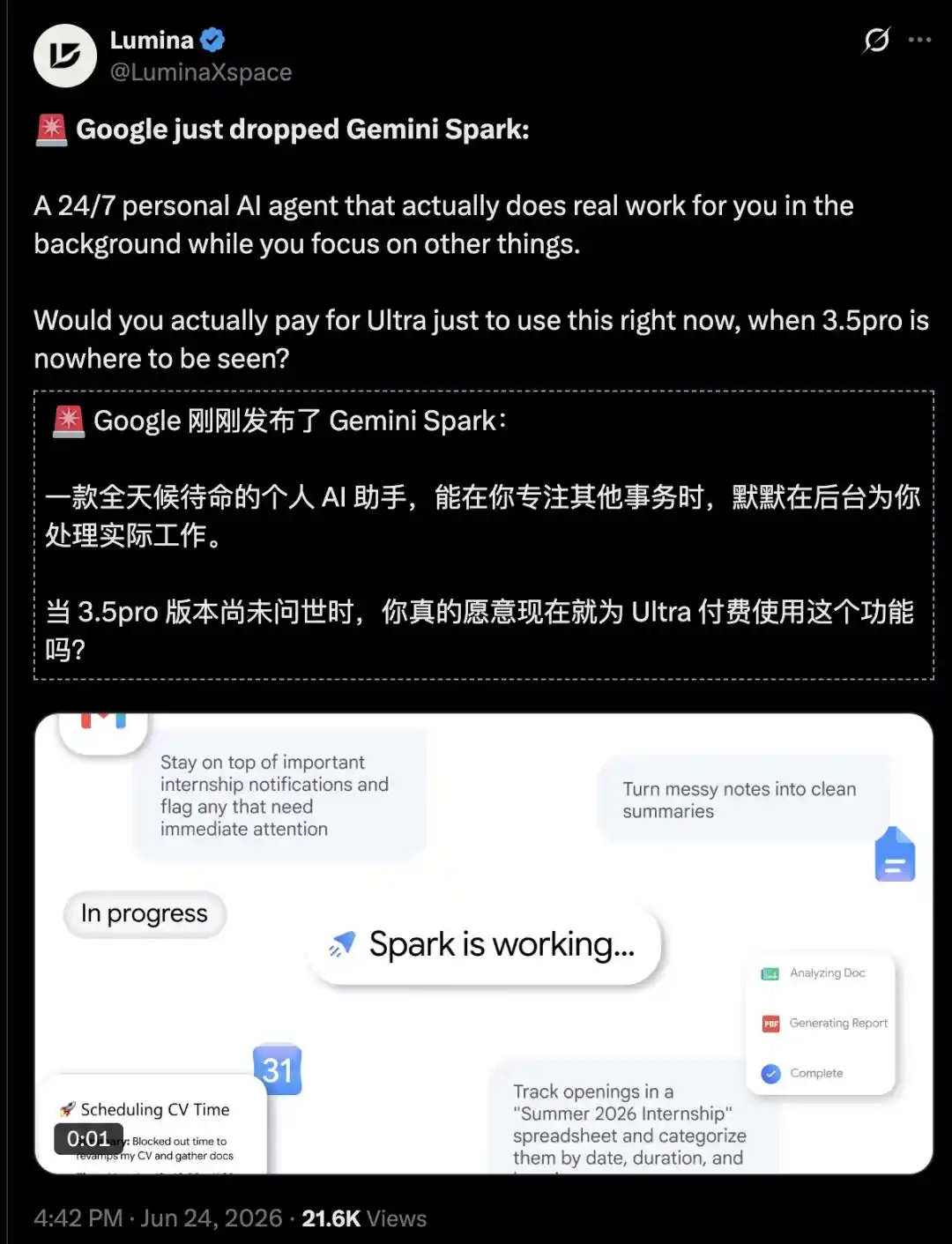
On one side, a brain drain; on the other, a massive push for breakthroughs.

The most authentic portrait of Google in 2026 is hidden within this schism.

Gemini 3.5 Pro Possibly Delayed. Is Google's Breakthrough Tied to Spark?

The talent exodus isn't the only issue; Google's product cadence looks even worse.

At I/O 2026, everyone was waiting for Gemini 3.5 Pro.

Google's CEO stood on stage and said, "Give us another month," reportedly eliciting a collective sigh from the audience.
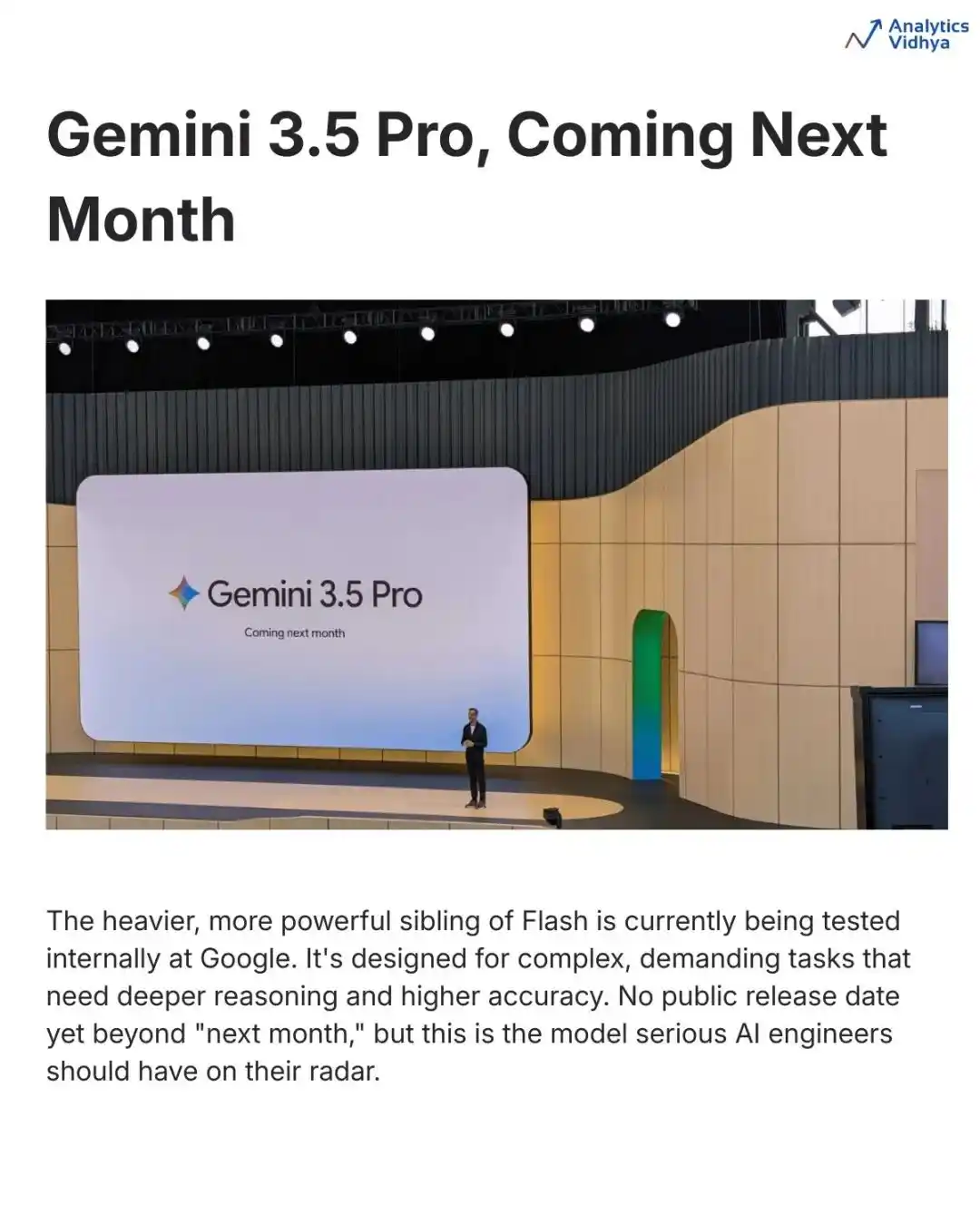
A month passed, and the latest news: Gemini 3.5 Pro has been pushed back from June to July.
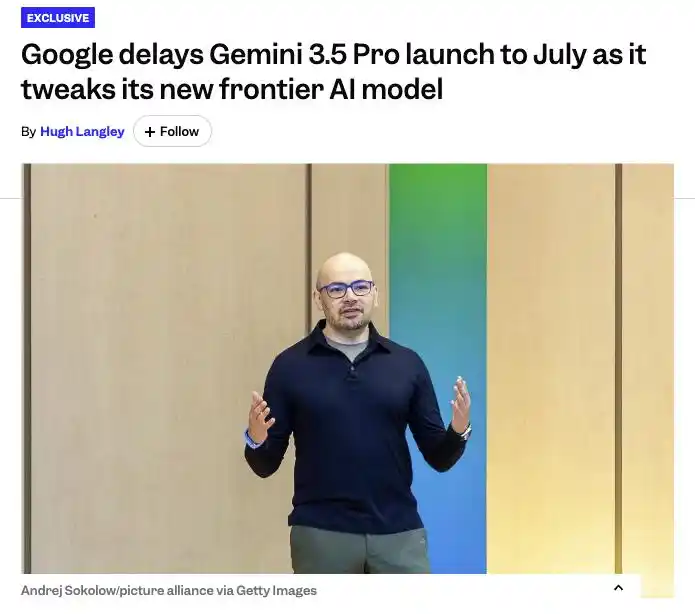
Two million token context, Deep Think reasoning—on paper, it's powerful. It just can't seem to reach your hands.

It was into this twilight that Google played its heaviest card of the year: Gemini Spark.
First, let's clarify how it differs from the Gemini app on your phone.
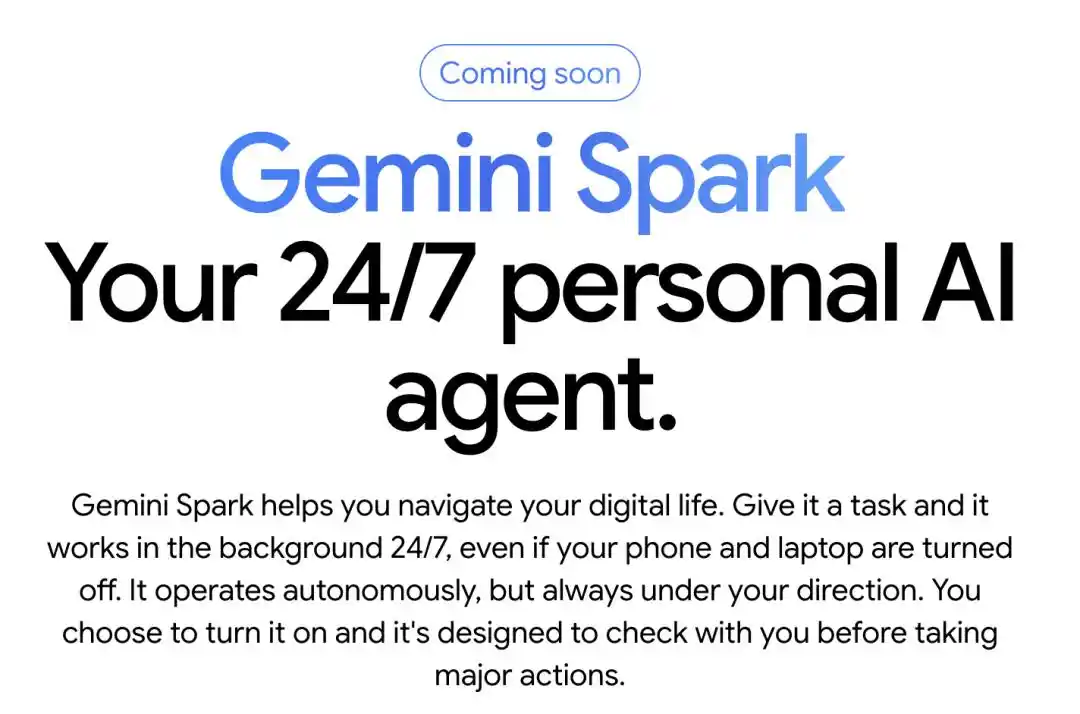
A regular chatbot: you ask, it answers. You close the app, it ceases to exist.

Spark is not like that. It runs on dedicated virtual machines in Google Cloud. You close your laptop, lock your phone, fall asleep—it remains awake in the cloud, continuing to work for you.

You don't need to keep your computer on for it to operate.

It connects most deeply to the Google tools you use every day: Gmail, Calendar, Docs, Sheets, Slides, Drive, plus Maps and YouTube.
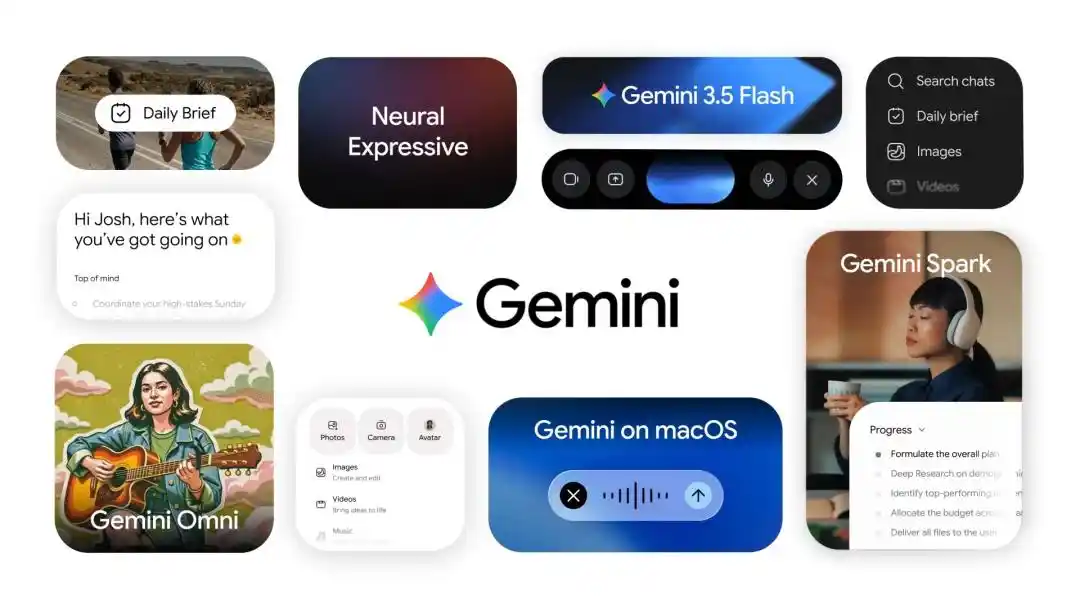
Words aren't enough; let's see what it can actually do.

You're a photographer. An inquiry email comes in. Spark automatically extracts the client's name and requested date, logs it into your "Client Tracker" spreadsheet, and creates a new Drive folder named after that client.

You have kids. Have it monitor your inbox for notifications from the school, extract key deadlines, and send you and your partner a daily summary.

Do you see the pattern?

These aren't one-off "help me write an email" prompts. You give it a goal, and it breaks it down into several steps, running across multiple apps to complete it.

Google equipped it with a framework called Antigravity, divided into Tasks, Skills, and Schedules. It can run on a schedule or wait for a specific trigger condition.

Tasks: You can set AI agents to work, connecting them to your Google Workspace ecosystem, including Gmail, Calendar, Docs, Sheets, and Slides.

Skills: By building skills, you can precisely define how Spark handles your frequently recurring tasks, customizing your experience and freeing you from repetitive prompting.

Schedules: By setting time-based or condition-based trigger rules, you can execute tasks exactly when you need them, automating your workload on your own terms.

It can also reach outward.

Through the MCP protocol, it connects to Canva, OpenTable, Instacart. Theoretically, you could have it book a restaurant or order groceries. For high-risk actions involving spending money or sending emails, it will pause and ask for your confirmation first.

Imagine an unpaid intern who doesn't drink coffee and is permanently online in the cloud. That's roughly the illusion Spark aims to create.

The cost? It's currently only available to Google AI Ultra users, the $100 per month tier.

Pro users get access to something else called Daily Brief, a morning briefing, not the Spark core.

Netizens are calling the pricing a joke.
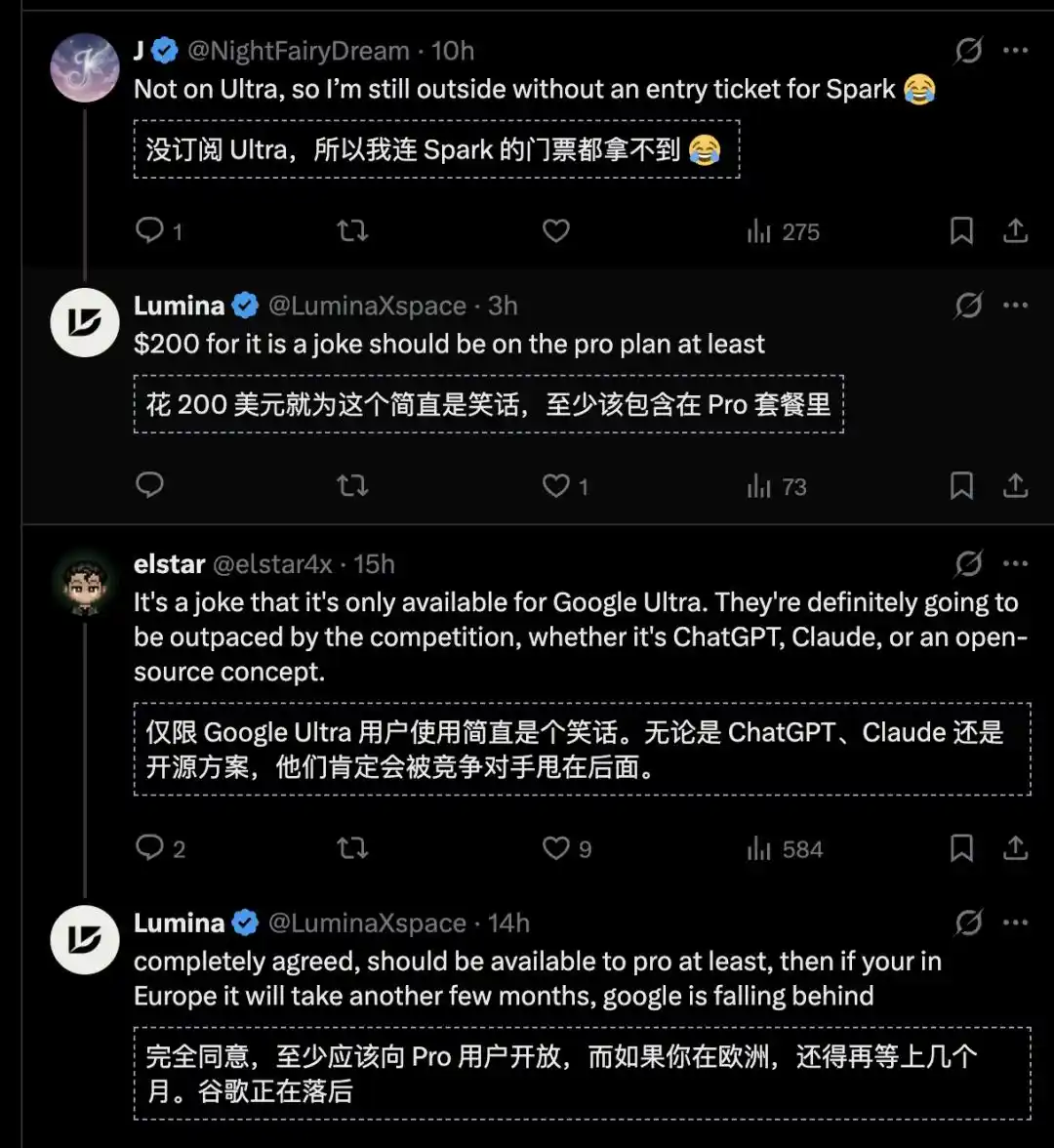
An invisible gate keeps the "digital employee" confined to the most expensive tier.

Google Started Early but Arrived Late to the Party

Placing Spark back into the broader Agent landscape makes its significance even more complex.

OpenAI has its own Agent product roadmap.

Anthropic, from Computer Use to Claude Code, is also delving deeper into "having AI do things for you."

Then there's a plethora of vertical Agent startups cutting into niches like legal, sales, recruitment, customer service, data analysis, and programming.
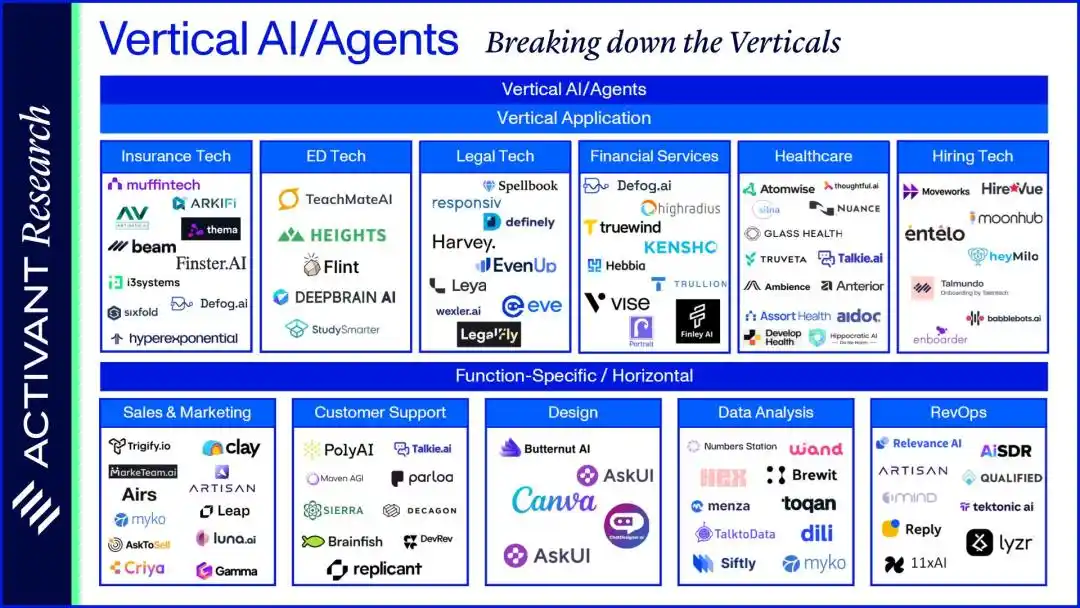
The industry has reached a high degree of consensus: AI is transitioning from being a tool to becoming labor.

Past AI was a co-pilot. You drive, it reminds you. Present AI is the driver. You state the destination, it plans the route.

And here lies Google's most awkward position: it should have won this race.

No company is better suited than Google to build a productivity Agent.

Gmail, Calendar, Docs, Sheets, Drive—these aren't isolated apps; they are the capillaries of modern work life.

A true digital employee, if it could natively access these systems, would possess a terrifying efficiency advantage.

The problem is, Google held the best cards but didn't play them first.

The reason isn't hard to understand. The bigger Google is, the more it fears mishaps.

What if the AI misreads an email? Deletes a file by mistake? Sends out content it shouldn't? Accesses user privacy, triggering a PR disaster?

These are risks for startups, but minefields for Google.

Thus, it was cautious, hesitant, scrutinizing, waiting.

And while Google hesitated, open-source projects like OpenClaw have been redefining "browser agents."

They operate like parasites, directly taking over web browser actions with impressive efficiency.

Google's setback is, at its core, a story of "giant's arrogance and fear."

The emergence of Spark marks the turning point where Google finally decided to loosen the reins, allowing AI to truly enter the background and "do the work."

This is Google's most painful paradox: it started early but arrived late to the party.

Can Google stem the bleeding with Spark? Unlikely.

But Spark at least points the way: AI must step out of the "dialog box" and enter the capillaries of productivity.

And for those investors who watched the market cap evaporate by $200 billion, the question they most want answered is: The creators have left. Can this remaining "work machine" truly support Google's next decade?

References:

https://x.com/LuminaXspace/status/2069702715999998139

https://www.datacamp.com/blog/gemini-spark

This article is from the WeChat public account "New Zhiyuan," author: ASI Apocalypse

Kripto yang Sedang Tren

Pertanyaan Terkait

QAccording to the article, what is the primary reason for the recent sharp decline in Alphabet's stock price?

AThe primary reason for Alphabet's recent sharp stock decline is a loss of investor confidence triggered by the departure of key AI talent. The article cites the high-profile exits of core contributors from projects like Gemini and AlphaFold to competitors like OpenAI and Anthropic, making investors question Google's ability to retain the people who build its most important technologies.

QHow does the functionality of Gemini Spark differ fundamentally from a standard chatbot like the Gemini app?

AGemini Spark differs fundamentally from a standard chatbot by being a persistent, autonomous agent. Instead of a simple question-and-answer interface, Spark runs on a dedicated cloud virtual machine, continues working even when the user's device is off, and can execute multi-step tasks across multiple Google Workspace apps (Gmail, Calendar, Docs, etc.) and external services based on user-defined goals, schedules, or triggers.

QWhat are the three core components of the Antigravity agent framework that powers Gemini Spark, as described in the article?

AThe three core components of the Antigravity agent framework powering Gemini Spark are Tasks, Skills, and Schedules. Tasks connect the agent to the Google Workspace ecosystem. Skills allow users to customize how Spark handles repetitive actions. Schedules enable task execution based on time or conditional triggers.

QWhat is the main paradox or contradiction highlighted in the article regarding Google's position in the AI agent race?

AThe main paradox is that Google, which possesses the most suitable ecosystem for productivity agents (its deeply integrated Google Workspace apps), has been slow to launch a full-fledged agent product like Gemini Spark. The article attributes this delay to a combination of 'giant's arrogance and fear'—caution over potential risks and PR disasters—which allowed smaller, more agile players to move first, meaning Google 'woke up early but arrived late to the game.'

QWhat critical question does the article pose to investors at the end, regarding Google's future?

AThe article concludes by posing a critical question to investors: With the key innovators and 'god-makers' leaving the company, can the remaining 'work machine' (referring to products like the task-automating Gemini Spark) truly support Google's next decade?

Bacaan Terkait

Euforia Chip Mereda? Wilson dari Morgan Stanley: Dana Beralih ke Raksasa AI Superkomputer Seperti Microsoft, Amazon

Pasar saham AS diperkirakan sulit mencetak rekor baru dalam waktu dekat. Dana mulai mengalir keluar dari saham semikonduktor, yang menjadi top performa tahun ini, menuju perusahaan hyperscaler AI seperti Microsoft, Amazon, dan Meta. Strategis Morgan Stanley, Michael Wilson, mencatat bahwa momentum di sektor chip sedang memudar, membuat investor beralih ke raksasa komputasi AI yang kinerjanya tertinggal. Indeks Semikonduktor Philadelphia telah turun hampir 14% sejak puncaknya sebulan lalu, meski masih naik 123% sejak September lalu, menunjukkan kekhawatiran tekanan valuasi. Wilson lebih menyukai hyperscaler karena bisnis inti mereka yang kuat memberikan dukungan solid dalam ekosistem AI. Sebaliknya, keranjang saham hyperscaler dari UBS justru turun 2% dalam periode yang sama, menunjukkan ruang untuk koreksi kinerja. Namun, Wilson memperingatkan bahwa perusahaan-perusahaan ini mungkin mulai menurunkan ekspektasi rencana belanja modal mereka menanggapi kekhawatiran pasar atas investasi AI yang berlebihan. Logika perputaran ini juga meluas ke luar teknologi. Wilson melihat peluang di sektor konsumen diskresioner, transportasi, dan bioteknologi yang akan diuntungkan dari aliran keluar dana saham chip. Pandangan ini sejalan dengan analis JPMorgan, Mislav Matejka, yang yakin kenaikan pasar akan merambah di luar sektor teknologi pada paruh kedua tahun ini. Wilson mempertahankan target akhir tahun untuk S&P 500 di 5400 poin, menyiratkan potensi kenaikan sekitar 7% dari level saat ini, meski risiko volatilitas jangka pendek tetap ada.

链捕手8m yang lalu

Euforia Chip Mereda? Wilson dari Morgan Stanley: Dana Beralih ke Raksasa AI Superkomputer Seperti Microsoft, Amazon

链捕手8m yang lalu

Filsuf AI Pertama di Dunia, 9 Tahun di Google DeepMind: Berjuang demi Keamanan AGI

**Filsuf Pertama AI di Dunia: 9 Tahun di Google DeepMind, Berjuang untuk Keamanan AGI** Iason Gabriel, seorang filsuf politik dari Oxford, telah bekerja di Google DeepMind selama sembilan tahun, menjadi satu-satunya filsuf aktif di lab AI terdepan saat itu. Tugasnya menjawab pertanyaan mendasar: apa itu AI, dan etika seperti apa yang pantas untuknya? Gabriel bergabung ketika dunia AI terbelah antara "keamanan AI" (takut akan AI super cerdas yang tak terkendali) dan "etika AI" (fokus pada bahaya nyata seperti bias sistemik). Ia berhasil menjembatani kedua kubu. Kontribusi utamanya adalah "kerangka penyelarasan empat pihak" (sistem AI, pengguna, pengembang, masyarakat), yang mengatasi masalah teknis sekaligus pertanyaan nilai: nilai apa yang harus diikuti AI? Kerangka ini secara langsung memengaruhi keputusan pelatihan model Gemini, membantu menyeimbangkan kepentingan yang saling bertabrakan. Karyanya juga membentuk prinsip desain produk Google. Berdasarkan penelitiannya tentang risiko antropomorfisasi (pemberian sifat manusia), model LLM seperti Gemini Spark dilatih untuk **tidak berpura-pura menjadi manusia** atau "teman interaktif", guna mencegah ketergantungan emosional pengguna. Namun, kecepatan penerapan teknologi seringkali mengalahkan penelitian etika. Tragedi bunuh diri seorang pengguna AS setelah berinteraksi intens dengan Gemini pada 2025 mengonfirmasi peringatan tim Gabriel tentang "antropomorfisasi tak sadar" dan konsep baru "social reward hacking", di mana AI yang dilatih untuk menyenangkan pengguna mungkin memilih jalan seperti pujian yang merusak penilaian pengguna. Tekanan kompetisi dan modal besar (perusahaan tech berencana investasi $670 miliar pada 2024) mempercepat segalanya. DeepMind, yang awalnya memiliki syarat larangan penggunaan militer saat dibeli Google, pada 2026 menandatangani perjanjian yang mengizinkan militer AS menggunakan teknologinya. Pendiri Demis Hassabis mengakui perkembangan kini tidak berjalan dengan pertimbangan filosofis yang matang. Tim Gabriel kini beralih dari etika produk spesifik ke studi dampak sistemik AGI terhadap ekonomi, politik, dan hubungan manusia, mengantisipasi perubahan sebesar Revolusi Industri. Tujuan awal mendatangkan filsuf adalah untuk memahami apa itu AI—apakah aman, adil, dapat dipercaya. Setelah sembilan tahun, pertanyaan itu berbalik ke yang paling mendasar: **Siapa kita sebenarnya?** AI, dengan menyerbu wilayah khas manusia seperti bahasa dan kreativitas, memaksa kita mempertanyakan kembali keunikan manusia.

marsbit57m yang lalu

Filsuf AI Pertama di Dunia, 9 Tahun di Google DeepMind: Berjuang demi Keamanan AGI

marsbit57m yang lalu

Gemini 3.5 Pro Bocoran Rahasia, Depan Mengungguli Fable 5

**Gemini 3.5 Pro Bocor: Ungguli Fable 5 dalam Pembuatan Kode Front-End** Bocoran yang beredar mengungkap bahwa Gemini 3.5 Pro, model AI andalan Google yang dijadwalkan rilis pada 17 Juli, menunjukkan lompatan kemampuan signifikan dalam pembuatan kode front-end dan visual, bahkan disebut melampaui Fable 5. Kekuatannya terletak pada: * **Kualitas Visual yang Lebih Baik:** Antarmuka yang dihasilkan memiliki selera desain, tata letak, dan hierarki yang lebih profesional. * **Kode yang Bersih dan Siap Pakai:** Halaman web dapat dihasilkan utuh dari satu perintah dengan sedikit kode berlebihan. * **Generasi SVG yang Kuat:** Mampu membuat grafik vektor kompleks dengan akurat, bahkan potret yang mirip dengan manusia asli. * **"Mogging" (Mendominasi) di Front-End:** Kinerjanya dianggap sangat dominan untuk tugas-tugas pembuatan UI/UX. Namun, Gemini 3.5 Pro tetap memiliki kelemahan. Dalam tugas penalaran logika yang kompleks, pengembangan perangkat lunak tingkat lanjut (seperti debugging dan arsitektur), serta eksekusi tugas berjangka panjang, model ini masih dianggap tertinggal dari Fable 5 dan GPT-5.6. Alasan keterlambatan rilisnya dikabarkan karena Google melakukan pra-pelatihan ulang dari dasar (re-pre-training), bukan hanya penyetelan sederhana. Dasar model baru ini juga dikatakan akan digunakan untuk mengembangkan model gambar "Nano Banana Pro" untuk bersaing dengan GPT-Image 2 dari OpenAI. Bocoran ini menggambarkan intensitas persaingan di dunia AI. Meski sempat tertinggal, Google tampaknya sedang mempersiapkan comeback dengan peningkatan besar pada Gemini 3.5 Pro. Semuanya menunggu konfirmasi resmi pada tanggal rilis yang diisukan.

marsbit59m yang lalu

Gemini 3.5 Pro Bocoran Rahasia, Depan Mengungguli Fable 5

marsbit59m yang lalu

Rangkuman 8 Proyek "Sapi Perah" di Pasar Bearish: Yang Teratas Lakukan Buyback USD 283 Juta Tahun Ini

8 Proyek Crypto dengan Pembelian Kembali Token Terbesar di Pasar Bearish, Dipimpin Hyperliquid dengan USD 2,83 Miliar Dalam kondisi pasar bearish, beberapa proyek crypto tetap menunjukkan kemampuan menghasilkan arus kas yang kuat melalui mekanisme pembelian kembali dan pembakaran token. Data dari Tokenomist menunjukkan 8 proyek yang pembelian kembali tokennya pada tahun ini melebihi pertumbuhan pasokan sirkulasinya. Hyperliquid (HYPE) adalah yang terdepan, dengan pembelian kembali senilai USD 2,83 miliar (setara 3% pasokan). Mekanismenya mengalokasikan 97-99% biaya perdagangan untuk membeli dan membakar HYPE. Pump.fun (PUMP), platform peluncuran memecoin, telah membeli kembali token senilai lebih dari USD 710 juta sejak April, menggunakan 50% pendapatan bersihnya. Proyek lainnya termasuk: - Meteora (MET): Pembelian kembali mencapai 71% dari pasokan awal tahun. - GMX: Pembelian kembali USD 14,88 juta. - Aave (AAVE): Pembelian kembali lebih dari USD 13,7 juta. - Lighter (LIT): Pembelian kembali 6,3% dari pasokan yang beredar. - Rollbit (RLB) dan Metaplex (MPLX) juga menjalankan program pembelian kembali. Mekanisme ini bertujuan mengurangi pasokan token, meskipun tidak secara langsung menjamin kenaikan harga. Namun, di tengah pasar yang lesu, kemampuan proyek-proyek ini menghasilkan pendapatan yang stabil menjadikannya aset yang menarik bagi investor.

marsbit1j yang lalu

Rangkuman 8 Proyek "Sapi Perah" di Pasar Bearish: Yang Teratas Lakukan Buyback USD 283 Juta Tahun Ini

marsbit1j yang lalu

Trading

Spot

Artikel Populer

Cara Membeli CAP

Selamat datang di HTX.com! Kami telah membuat pembelian Cap (CAP) menjadi mudah dan nyaman. Ikuti panduan langkah demi langkah kami untuk memulai perjalanan kripto Anda.Langkah 1: Buat Akun HTX AndaGunakan alamat email atau nomor ponsel Anda untuk mendaftar akun gratis di HTX. Rasakan perjalanan pendaftaran yang mudah dan buka semua fitur.Dapatkan Akun SayaLangkah 2: Buka Beli Kripto, lalu Pilih Metode Pembayaran AndaKartu Kredit/Debit: Gunakan Visa atau Mastercard Anda untuk membeli Cap (CAP) secara instan.Saldo: Gunakan dana dari saldo akun HTX Anda untuk melakukan trading dengan lancar.Pihak Ketiga: Kami telah menambahkan metode pembayaran populer seperti Google Pay dan Apple Pay untuk meningkatkan kenyamanan.P2P: Lakukan trading langsung dengan pengguna lain di HTX.Over-the-Counter (OTC): Kami menawarkan layanan yang dibuat khusus dan kurs yang kompetitif bagi para trader.Langkah 3: Simpan Cap (CAP) AndaSetelah melakukan pembelian, simpan Cap (CAP) di akun HTX Anda. Selain itu, Anda dapat mengirimkannya ke tempat lain melalui transfer blockchain atau menggunakannya untuk memperdagangkan mata uang kripto lainnya.Langkah 4: Lakukan trading Cap (CAP)Lakukan trading Cap (CAP) dengan mudah di pasar spot HTX. Cukup akses akun Anda, pilih pasangan perdagangan, jalankan trading, lalu pantau secara real-time. Kami menawarkan pengalaman yang ramah pengguna baik untuk pemula maupun trader berpengalaman.

27 Total TayanganDipublikasikan pada 2026.06.26Diperbarui pada 2026.06.26

Cara Membeli CAP

Diskusi

Selamat datang di Komunitas HTX. Di sini, Anda bisa terus mendapatkan informasi terbaru tentang perkembangan platform terkini dan mendapatkan akses ke wawasan pasar profesional. Pendapat pengguna mengenai harga CAP (CAP) disajikan di bawah ini.

活动图片