Chips, Open-Source Models, and $50 Trillion: Joe Tsai Reassesses Alibaba Once Again

marsbitDipublikasikan tanggal 2026-06-22Terakhir diperbarui pada 2026-06-22

Abstrak

Alibaba Executive Chairman Joe Tsai recently outlined the company's comprehensive AI strategy in a public discussion. He believes AI represents a massive opportunity, estimating its potential economic impact at up to $50 trillion, stemming from the automation of human intelligence and productivity. Tsai detailed Alibaba's four-layer investment approach across the AI stack: starting from the chip level, moving to cloud infrastructure (Alibaba Cloud), then the model layer with its open-source Qwen model, and finally applications within its vast digital ecosystem (e-commerce, logistics, etc.). The company avoids the energy layer due to China's efficient infrastructure. This broad strategy is designed to ensure Alibaba captures value regardless of where it ultimately concentrates in the AI value chain. He dismissed concerns about an AI investment bubble, pointing to the enormous $50 trillion opportunity. While acknowledging U.S. cloud giants' higher capital expenditure, he argued Chinese firms, including Alibaba (funded by its cash-generative e-commerce core), need to invest more in AI infrastructure. A key theme was technological sovereignty. Tsai positioned open-source models like Qwen as a solution for companies, especially in Europe, seeking independence from proprietary U.S. models and greater data privacy control. He contrasted this with the trend of U.S. giants keeping their models closed-source. Tsai highlighted Alibaba's collaborations with European manufacturers lik...

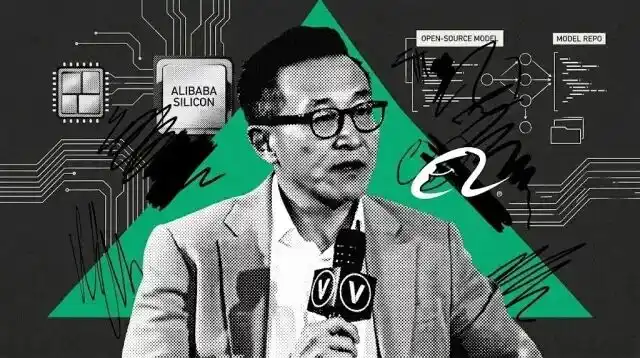
Alibaba Group Chairman Joe Tsai. Image processed via AI.

At this year's VivaTech conference, Alibaba Chairman Joe Tsai systematically outlined the company's long-term AI vision during a "fireside chat." This marks his second public reassessment of Alibaba following a summit at Yale University in late May.

"From a macro perspective, we are going all-in on AI. The logic is simple."

Tsai stated that global GDP exceeds $100 trillion, with at least half coming from human intelligence and productivity contributions. "This $50 trillion is the total addressable market for AI, far larger than any company's IT budget or the software market."

Everyone is talking about going all-in on AI, and Tsai is no exception. He summarized Alibaba's strategic approach as covering almost all layers except the energy layer, encompassing chips, cloud infrastructure, models, and applications.

"We are primarily investing in four layers, but we are not touching the bottommost energy layer because China's energy efficiency is high and costs are relatively low."

In Tsai's view, this near-full-stack strategy stems from future uncertainty, as no one can accurately predict where the ultimate value will settle—whether in chips, cloud infrastructure, or the model layer. "We choose to participate comprehensively, so no matter where the value ultimately lands, we are present."

Compared to Alibaba, U.S. cloud giants are even more aggressive, investing across the entire infrastructure stack, with a combined capital expenditure of $800 billion by 2027, which short-sellers have criticized as a "bubble." Tsai not only disagrees with the bubble theory but also emphasizes that Chinese companies need to increase their infrastructure investments.

"The investment numbers are indeed staggering," Tsai said. "But we need to go back to that $50 trillion total market. That's the reason for optimism."

Discussing open source, Tsai first mentioned the recent suspension of Anthropic's most advanced model by the Trump administration, bluntly stating this is the consequence of "putting all your eggs in one basket." In his view, models from Google, OpenAI, and Anthropic are now all closed-source, while the open-source path is currently being pursued by Chinese companies.

"You truly cannot base trust on the assumption that a third-party government will never act against your interests."

Below is an edited version of Joe Tsai's interview:

01. The $50 Trillion "Market"

Q: Alibaba has changed significantly over the years, with achievements like its open-source large model. But many still see you primarily as a B2B/B2C platform. Can you talk about the group's evolution?

Joe Tsai: When Alibaba started in 1999, it was indeed a B2B platform. The idea was simple: to bring small Chinese manufacturers and trading companies online, helping them wholesale products globally. Later, we entered the B2C space with Taobao, now China's largest consumer e-commerce platform.

Q: How many consumers does this serve?

Joe Tsai: 820 million Chinese consumers. Moreover, this platform helps European companies and brands sell approximately €30 billion worth of goods to Chinese consumers annually. But the story doesn't end there. We are heavily investing in AI and cloud.

We started investing in cloud technology 17 years ago, but out of necessity. Our e-commerce business was generating massive amounts of data daily. If we kept relying on others' database and storage technologies, eventually all our profits would go to the tech vendors. So we decided to build our own proprietary technology to manage this data, and that's how our cloud business began.

From a macro perspective, we are now going all-in on AI, and the logic is simple.

If you ask me how big the AI market is, I'd say it's far larger than any company's IT budget or the software market. Because AI is essentially about producing human intelligence and productivity. Global GDP today is over $100 trillion, with at least half ($50 trillion) related to human productivity and intelligence. That's the total AI market. So we must go all-in.

Q: Do you really believe AI can boost productivity? Many have invested heavily without seeing results yet.

Joe Tsai: Many CEOs will tell you that engineers are consuming a huge number of tokens, and costs are rising. But I'd say we are on the cusp of a real productivity explosion.

Take our company. Some engineers are super-users of AI. They not only use programming tools for their core work but also explore new uses. Give engineers a toy, and they'll find more ways to play with it, sometimes without realizing the company is paying for these usage costs. That's the current reality.

But I am deeply convinced—it's more like a belief, a conviction that artificially produced intelligence units can add value to human intelligence. It's close to a kind of faith. I don't want to try to convince you this will definitely happen, but we ourselves firmly believe it.

02. The Logic of Going All-In on AI

Q: Returning to Alibaba's layout, which AI layer do you invest the most in? Infrastructure, models, or cloud services?

Joe Tsai: We primarily invest in four layers, but we skip the bottommost energy layer because China's energy efficiency is high and costs are low.

We really started at the chip layer—that's the first layer. The second is the infrastructure layer, corresponding to our cloud business. The third is the model layer, like Qwen, which is now one of the world's hottest open-source models. The fourth is the application layer, where we have a complete digital life ecosystem—e-commerce, food delivery, local services, travel, maps, etc. These are all scenarios where AI capabilities can be directly embedded to serve users.

The advantage of this approach is that we are not betting on a single track.

Today, pure model companies have high valuations, making it seem like all the value is in the model layer. But looking five or ten years ahead, no one can say for sure whether the value will settle in chips, cloud infrastructure, models, or applications. We choose comprehensive participation so that, no matter where the value ultimately lands, we are there.

Q: Speaking of AI infrastructure, when you see such massive investments, do you think there's a bubble? Do we really need this much computing power? Some models are more efficient and don't require as many resources.

Joe Tsai: I don't think it's a bubble. The investment numbers are indeed staggering. Just looking at the U.S. hyperscale cloud providers, the combined capital expenditure of the top four or five companies next year exceeds $800 billion, potentially over a trillion the year after. Investments at this scale naturally raise concerns about overcapacity.

But we must return to that $50 trillion total market. That's the reason for optimism.

Moreover, in China, our investment in AI infrastructure and the supply chain is actually insufficient. Theoretically, all Chinese companies should increase their investments. Of course, we won't reach the investment level of the U.S. hyperscale players, but our investment intensity is already quite substantial.

Q: Why can't you reach U.S. levels?

Joe Tsai: Sometimes there are funding constraints, depending on how much free cash flow you can generate. Fortunately, Alibaba is one of the few companies with a core e-commerce business that generates about $25 billion in annual free cash flow, which can support our AI investments. So we are in a relatively good position.

Q: Currently, does the e-commerce platform business still account for 80% to 85% of Alibaba's total revenue?

Joe Tsai: Yes, e-commerce platform revenue still accounts for over 80%. This generates stable cash flow, allowing us to invest in the future, primarily in AI and cloud.

03. Open Source and the Second Basket

Q: Qwen is an open-source model. Who are your main customers, and how do you help them?

Joe Tsai: In recent weeks in Europe, I've spoken with many company executives, CEOs, and scientists. One word that came up most frequently was "sovereignty."

But what is sovereignty?

Ask ten Europeans, and you might get twelve different answers. For me, the core is two things.

First, technological independence. Everyone is worried about the risk of a "one-click shutdown," the fear of relying too heavily on technology from a single country that could flip a switch at any time. We just saw a vivid example of this in recent days.

Second is data privacy. People want to use AI technology but want their data to belong entirely to them, used within their own environment, with a firewall to protect it.

I believe open source addresses both these issues. It is essentially free software; you can download it to your own data center, even onto a laptop. At that point, it has little to do with the original manufacturer—we can't even figure out how to charge for it. That achieves independence.

More importantly, with an open-source model, you can use your own data for further training, fine-tuning, or post-training. The entire process and all data remain entirely confidential within your firewall. This point is crucial for European companies.

But I want to emphasize that open source is not a panacea or the only path, but it is a practical route to achieving a certain degree of sovereignty.

Interestingly, the open-source movement today is largely being driven by Chinese companies, while the major U.S. players have closed their models. They want you to call them via APIs; you have no idea where the data goes. When you converse with a chatbot, your most private questions and thoughts enter their data pool to further train the model. The data flow is completely opaque to you.

Q: Honestly, European sovereignty is a huge concern right now. We've just realized we were too dependent on U.S. technology. I acknowledge the benefits of open source, but I still worry about the risk of future access being cut off to models. That's a significant risk for Europe.

Joe Tsai: You're right; that concern cannot be completely eliminated. Simply put, you truly cannot base trust on the assumption that a third-party government will never act against your interests. But the problem is, right now, all your eggs are in one basket.

Why not choose a second basket and put some eggs there? Even if Europe might develop its own basket in the long term, at least for now, you have two baskets.

04. AI in the Factory

Q: That's true. How do you cooperate with German companies and what do you help them do?

Joe Tsai: These German manufacturing companies are very interesting. In the Chinese market, they are all Alibaba Cloud customers. We collaborate with them in manufacturing, covering areas like design, testing, and quality control.

I believe this will be a very important field in the future. Because most AI applications today are either consumer products like ChatGPT or tools for programmers and knowledge workers like Copilot. But in the future, these manufacturing companies will be extremely valuable because they accumulate their own unique, high-quality data from the production process, which can be used to train proprietary models to improve manufacturing processes.

We have collaborations with companies like BMW, Siemens, and Bosch. Last week, I attended the Bosch ConnectedWorld conference. They are using AI to develop driver assistance and autonomous driving technologies, requiring massive computing power.

A lot of interesting things are happening in manufacturing.

Q: Can I understand it this way: The U.S. export controls on high-end chips have actually created an opportunity for you?

Joe Tsai: You could put it that way. There are two paths here:

First, they directly adopt our open-source model and deploy it on their own infrastructure, like a data center. But our infrastructure is developed in tight integration with our models, achieving high efficiency and helping customers train models. If they use our open-source model, they can also procure computing power from us. The model and infrastructure have a symbiotic relationship. That's one path.

The other path is the emergence of inference platform companies that can offer users multiple model choices. You don't necessarily have to use Qwen. As long as there is an agreement between the model provider and the platform to open the weights in a private environment, customers can use models on these platforms.

05. AI, Agents, and Humanity

Q: A more philosophical question. What's your view on the balance between AI, large language models, and humanity, even the future of human nature? What state will humanity be in ten years from now?

Joe Tsai: Earlier today, I was chatting with colleagues at our Paris office. We just moved into a new office on the upper floors of a beautiful building. I looked out the window; there was a café outside. The weather was nice, people were sitting outdoors drinking coffee, enjoying life.

I pointed to the scene and told my colleagues, "This is the future of AI."

You might think they're just drinking coffee, having fun, seemingly not working. But in reality, they have already deployed agents to work for them. While you sleep, agents are working for you. Think about that productivity boost—having "someone" working for you 24/7.

Q: This sounds similar to some ideas in Silicon Valley, where many people might not need to work, as agents and robots will do it for them.

Joe Tsai: I believe this will definitely free up human time to enjoy life, spend time with family, and engage in more entertainment. That's also why I place great importance on live entertainment. When people spend less time in the office, where will they go? They won't just stay at home; they'll want to go to concerts, watch football, watch basketball games.

Q: The Chinese are known for their diligence. Chinese engineers, even with agents and AI, still work very long hours.

Joe Tsai: There will always be people who work harder than others. But I believe most people, deep down, wish to enjoy life a bit more and spend more time with their families.

This article is from WeChat public account "Tencent Technology," author: Su Yang.

Kripto yang Sedang Tren

Pertanyaan Terkait

QAccording to Joseph Tsai, what is the total market opportunity he sees for AI, and why?

AJoseph Tsai sees a total market opportunity of 50 trillion dollars for AI. He argues that global GDP exceeds 100 trillion dollars, and at least half of it comes from human intelligence and productivity contributions. Since AI essentially produces human-like intelligence and productivity, its total addressable market is this 50 trillion dollar share of global GDP.

QWhat are the four layers of AI that Alibaba is investing in, according to Joseph Tsai?

AAccording to Joseph Tsai, Alibaba is investing in four layers of AI: 1) The chip layer, 2) The infrastructure/cloud layer, 3) The model layer (e.g., the Qwen open-source model), and 4) The application layer (integrating AI into Alibaba's digital ecosystem like e-commerce, food delivery, and travel). He stated they do not invest in the foundational energy layer due to China's high energy efficiency and low costs.

QWhy does Joseph Tsai argue that open-source models, like Alibaba's Qwen, are crucial for technological sovereignty, particularly in Europe?

AJoseph Tsai argues open-source models address two core aspects of technological sovereignty: 1) Independence from a single-point-of-failure or 'kill switch' risk, as companies can download and run the model independently, and 2) Data privacy, as companies can train, fine-tune, and use the model entirely within their own secure firewalls. He contrasts this with closed-source models from US companies, where data flows opaquely to the provider's servers.

QHow does Joseph Tsai respond to concerns about a potential bubble in massive AI infrastructure investments by cloud giants?

AJoseph Tsai does not believe it is a bubble. While acknowledging the staggering scale of investment (e.g., US hyperscalers planning $800 billion+ in capex), he argues it must be viewed in the context of the massive 50 trillion dollar AI opportunity. He further states that Chinese companies, including Alibaba, actually need to invest more in AI infrastructure and supply chains, though likely not reaching US levels due to different free cash flow realities.

QWhat is Joseph Tsai's vision for how AI will change human life and work in the future?

AJoseph Tsai envisions AI, particularly intelligent agents, will liberate human time. He believes agents will work continuously, even while people sleep, dramatically boosting productivity. This will free people to enjoy life more, spend time with family, and engage in entertainment and leisure activities like attending live sports or concerts, shifting the balance from work to life enjoyment.

Bacaan Terkait

Dana Kembali, Ethlabs Maju: Ethereum Menghadapi Restrukturisasi Terbesar dalam Sejarah

Pada 23 Juni, ekosistem Ethereum mengalami dua perkembangan penting. Ethlabs, organisasi nirlaba independen baru yang didirikan oleh mantan peneliti Ethereum Foundation, diluncurkan dengan dukungan dana utama dari pemegang ETH besar seperti Bitmine dan SharpLink. Fokus awal Ethlabs adalah memenuhi kebutuhan adopsi institusional, seperti kecepatan penyelesaian lebih cepat, penerbitan aset asli, dan perluasan kapasitas jaringan utama. Secara bersamaan, Ethereum Foundation mengumumkan restrukturisasi besar-besaran, mengurangi 54 karyawan (sekitar 20% dari total) dan memposisikan ulang dirinya sebagai penjaga dan pengatur protokol yang lebih ringan, bukan sebagai pengembang inti utama. Perubahan ini menandakan pergeseran tata kelola: yayasan mengambil langkah mundur, sementara organisasi seperti Ethlabs mengambil peran eksekusi yang lebih besar untuk menjawab kritik mengenai kecepatan dan adopsi pasar. Ethlabs, didukung banyak tokoh berpengaruh ekosistem (kecuali Vitalik Buterin), bertujuan menjadi lapisan eksekusi yang lebih terindustrialisasi, mengatasi kecemasan Ethereum tentang adopsi institusional dan skalabilitas. Sementara Ethereum Foundation berfokus menjaga "kebenaran" dan netralitas protokol, Ethlabs diharapkan membuktikan "keefektifan" Ethereum dalam menarik modal dan aplikasi dunia nyata. Langkah ini dipandang sebagai koreksi tata kelola penting untuk membuat Ethereum lebih tanggap terhadap pasar, meski berpotensi menimbulkan ketegangan baru antara kepentingan institusional dan semangat asli crypto.

链捕手4j yang lalu

Dana Kembali, Ethlabs Maju: Ethereum Menghadapi Restrukturisasi Terbesar dalam Sejarah

链捕手4j yang lalu

Paruh Kedua Kebijakan Kripto AS: UU CLARITY Perjuangkan 60 Suara, Komite "Satu Orang" CFTC Jadi Variabel Terbesar

Penulis: Cleve Mesidor, Direktur Eksekutif National Blockchain Foundation di Washington DC Industri kripto di AS tengah menantikan momen pentingnya dengan kemajuan RUU CLARITY di Senat, yang membutuhkan 60 suara untuk disahkan. Untuk mencapainya, Partai Republik mungkin perlu berkompromi dengan Gedung Putih dan menarik beberapa senator yang masih ragu-ragu. Waktu yang tersisa sangat terbatas, hanya sekitar 40 hari kerja legislatif. Selain prospek RUU CLARITY, beberapa proposal perpajakan kripto yang dipisahkan dari RUU PARITY baru berpeluang disahkan tahun ini dengan menumpang pada undang-undang yang lebih besar. Undang-Undang Kepastian Regulasi Blockchain juga berusaha memasukkan perlindungan bagi pengembang ke dalam hukum. Situasi di Commodity Futures Trading Commission (CFTC) memprihatinkan karena kekurangan empat komisioner, menambah ketidakpastian. Perdebatan mengenai yurisdiksi atas pasar prediksi—apakah jatuh ke negara bagian, CFTC, Securities and Exchange Commission (SEC), atau Mahkamah Agung—juga masih berlangsung. Industri akan kehilangan dua pendukung kunci: Komisioner SEC Hester M. Peirce dan Senator Cynthia Lummis, yang keduanya memainkan peran sentral dalam kebijakan kripto. Para ahli berpendapat: - **Sara K. Weed**: Peluang RUU CLARITY lolos tahun ini kecil karena kendala waktu dan pemilu, sehingga SEC dan CFTC harus lebih aktif memberikan kepastian. - **Sulolit 'Raj' Mukherjee**: Reformasi pajak kripto yang berarti kemungkinan akan disahkan dengan menempel pada paket undang-undang yang lebih besar, bukan sebagai RUU mandiri. - **Rashan Colbert**: CFTC sedang berupaya membangun kerangka regulasi yang lebih kokoh untuk pasar prediksi yang tengah berkembang, meski perdebatan klasifikasinya sebagai infrastruktur keuangan atau perjudian masih berlanjut. Babak kedua pertarungan kebijakan kripto telah dimulai. Meski waktu sempit, peluang masih ada, tetapi diperlukan komunikasi dan dorongan pragmatis lintas partai untuk mencapai hasil substansial pada 2026.

marsbit7j yang lalu

Paruh Kedua Kebijakan Kripto AS: UU CLARITY Perjuangkan 60 Suara, Komite "Satu Orang" CFTC Jadi Variabel Terbesar

marsbit7j yang lalu

Artikel Baru Dan Koe: Melarikan Diri dari Nasib Pekerja Kantoran, Bagaimana Bertahan di Tengah Gelombang Penggantian AI?

**Rangkuman Artikel: Lolos dari Nasib Karyawan dan Bertahan di Era Penggantian AI** Banyak yang khawatir pekerjaan mereka akan sepenuhnya digantikan oleh AI, tetapi ancaman sebenarnya bukanlah teknologi, melainkan ketergantungan pada orang lain untuk masa depan dan kesejahteraan kita. Artikel ini membahas cara keluar dari "perbudakan gaji" (hidup hanya untuk bekerja pada hal yang tidak bermakna) dan menemukan cara kerja yang lebih bermakna. Kunci untuk bertahan dan berkembang di era AI adalah **memulai usaha sendiri**. Untuk melakukan ini, Anda perlu menguasai lima elemen inti kesuksesan: 1. **Agen (Agency):** Kemampuan untuk bertindak tanpa menunggu perintah. 2. **Selera (Taste):** Intuisi untuk membedakan yang baik dan bernilai. 3. **Persuasif:** Kemampuan meyakinkan orang lain. 4. **Ketekunan (Persistence):** Memahami bahwa kegagalan adalah bagian dari proses. 5. **Iterasi (Iteration):** Kemampuan untuk terus memperbaiki berdasarkan umpan balik. Lima elemen ini mengerucut pada dua keterampilan utama: **memecahkan masalah dan akumulasi pengalaman** untuk mengetahui apa yang harus dilakukan. **Langkah praktis untuk memulai:** 1. **Ubah Lingkungan Anda:** Untuk mengubah identitas dan kebiasaan, ubah total lingkungan dan rangsangan di sekitar Anda—mulai dari konten yang dikonsumsi hingga rutinitas harian. 2. **Pilih Media Konten sebagai Wahana Utama:** Dibandingkan coding, keterampilan membuat konten (tulisan, video, podcast) lebih berharga karena nilainya subjektif dan membutuhkan selera yang tidak bisa sepenuhnya digantikan AI. Ini adalah "jagoan" masa depan. 3. **Temukan "Panggilan Hidup" Anda, Bukan Hanya Membangun Merek Pribadi:** Jawab pertanyaan-pertanyaan mendalam untuk menggali bahan baku unik Anda: * Topik apa yang paling Anda kuasai atau ingin pelajari tanpa dibayar? * Masalah apa yang mudah Anda selesaikan tetapi orang lain kesulitan? * Pendapat "anti-konsensus" apa yang Anda pegang teguh di bidang Anda? 4. **Langkah Aksi: Terbitkan Gagasan Pertama Anda.** Gabungkan jawaban dari pencarian panggilan hidup Anda menjadi satu potong konten dan PUBLIKASIKAN. Umpan balik nyata dari dunia adalah guru terbaik untuk belajar, beriterasi, dan mengembangkan keterampilan persuasif serta selera Anda. Mulailah dengan meluangkan 15 menit untuk menjawab pertanyaan-pertanyaan inti dan mempublikasikan satu ide. Proses inilah yang akan membebaskan Anda dari ketergantungan finansial pada orang lain.

marsbit8j yang lalu

Artikel Baru Dan Koe: Melarikan Diri dari Nasib Pekerja Kantoran, Bagaimana Bertahan di Tengah Gelombang Penggantian AI?

marsbit8j yang lalu

Interpretasi Riset: Morgan Stanley Memperjelas SanDisk (SNDK), Kebenaran Kekuatan Penetapan Harga di Pusat Data Cloud dan Dividen Inferensi AI

**Ringkasan Laporan: Morgan Stanley Menganalisis SNDK, Kekuatan Penetapan Harga di Pusat Data Awan & Realitas Manfaat AI Inference** Morgan Stanley (MS) pada 22 Juni meningkatkan target harga SNDK dari $1100 menjadi $1750, dengan rating "Overweight". Alasan utamanya: permintaan untuk **AI inference** mengubah aturan pasar NAND. Pelanggan pusat data awan (cloud) yang membayar premium untuk penyimpanan **KV Cache** dan konteks AI menjadi kurang sensitif terhadap harga, memberikan SNDK **kekuatan penetapan harga**. SNDK mengunci profitabilitas masa depan melalui **NBM (New Business Model)**, kontrak jangka panjang (3-5 tahun) yang telah mencakup lebih dari sepertiga volume bit FY27. Kontrak ini memiliki harga tetap atau struktur floor/ceiling, dan bahkan pada harga terendah (floor) dapat mempertahankan margin kotor sekitar **80%**. MS memproyeksikan margin kotor SNDK akan melonjak dari 30.3% (FY25) menjadi 86.7% (FY27e). Dengan pasokan NAND yang diperkirakan tetap ketat hingga setidaknya pertengahan 2027, SNDK berfokus pada pertumbuhan melalui peningkatan kepadatan (density), bukan ekspansi kapasitas besar-besaran. Pertumbuhan pendapatan yang diproyeksikan (6.6x dari FY25 ke FY27) berasal dari segmen cloud ber-margin tinggi. **Katalis:** Adopsi eSSD di pusat data yang melampaui ekspektasi, pertumbuhan AI di edge, dan teknologi baru seperti HBM. **Risiko:** Pertumbuhan industri melambat, kompetisi meningkat (termasuk dari produsen China seperti YMTC), dan kehilangan pangsa pasar di segmen pusat data. Logika utama MS: **1)** Perubahan struktural permintaan AI inference, **2)** Perlindungan margin oleh kontrak NBM, dan **3)** Pasokan NAND yang ketat. Target harga $1750 didasarkan pada 28x PER FY27e.

marsbit8j yang lalu

Interpretasi Riset: Morgan Stanley Memperjelas SanDisk (SNDK), Kebenaran Kekuatan Penetapan Harga di Pusat Data Cloud dan Dividen Inferensi AI

marsbit8j yang lalu

Trading

Spot
Futures

Artikel Populer

Cara Membeli JOE

Selamat datang di HTX.com! Kami telah membuat pembelian TraderJoe (JOE) menjadi mudah dan nyaman. Ikuti panduan langkah demi langkah kami untuk memulai perjalanan kripto Anda.Langkah 1: Buat Akun HTX AndaGunakan alamat email atau nomor ponsel Anda untuk mendaftar akun gratis di HTX. Rasakan perjalanan pendaftaran yang mudah dan buka semua fitur.Dapatkan Akun SayaLangkah 2: Buka Beli Kripto, lalu Pilih Metode Pembayaran AndaKartu Kredit/Debit: Gunakan Visa atau Mastercard Anda untuk membeli TraderJoe (JOE) secara instan.Saldo: Gunakan dana dari saldo akun HTX Anda untuk melakukan trading dengan lancar.Pihak Ketiga: Kami telah menambahkan metode pembayaran populer seperti Google Pay dan Apple Pay untuk meningkatkan kenyamanan.P2P: Lakukan trading langsung dengan pengguna lain di HTX.Over-the-Counter (OTC): Kami menawarkan layanan yang dibuat khusus dan kurs yang kompetitif bagi para trader.Langkah 3: Simpan TraderJoe (JOE) AndaSetelah melakukan pembelian, simpan TraderJoe (JOE) di akun HTX Anda. Selain itu, Anda dapat mengirimkannya ke tempat lain melalui transfer blockchain atau menggunakannya untuk memperdagangkan mata uang kripto lainnya.Langkah 4: Lakukan trading TraderJoe (JOE)Lakukan trading TraderJoe (JOE) dengan mudah di pasar spot HTX. Cukup akses akun Anda, pilih pasangan perdagangan, jalankan trading, lalu pantau secara real-time. Kami menawarkan pengalaman yang ramah pengguna baik untuk pemula maupun trader berpengalaman.

156 Total TayanganDipublikasikan pada 2024.12.11Diperbarui pada 2026.06.02

Cara Membeli JOE

Diskusi

Selamat datang di Komunitas HTX. Di sini, Anda bisa terus mendapatkan informasi terbaru tentang perkembangan platform terkini dan mendapatkan akses ke wawasan pasar profesional. Pendapat pengguna mengenai harga JOE (JOE) disajikan di bawah ini.

活动图片